Quick Verdict: A Pragmatic PHEV From the Pre-NACS Era
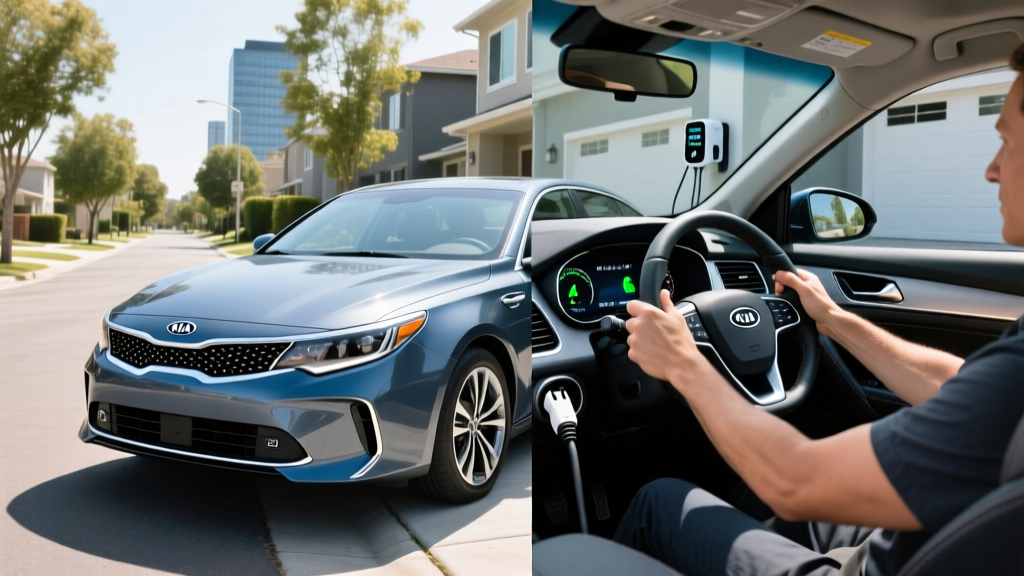
The 2017 Kia Optima Plug-In Hybrid EX was Kia's first serious entry into the plug-in midsize sedan segment, pairing a 2.0-liter four-cylinder engine with an electric motor and a 9.8 kWh lithium-ion polymer battery. For used-car shoppers in 2026 evaluating this model, the Optima PHEV delivers 27 miles of EPA-rated electric-only range and 99 MPGe when running on combined electric and gasoline power. It's a practical choice for commuters who can charge at home but still need gas-engine flexibility for road trips — though its age and discontinued status mean buyers need to pay close attention to battery health and warranty transferability.
| Spec | 2017 Kia Optima PHEV EX |
|---|---|
| Powertrain | 2.0L I4 + electric motor |
| Combined Horsepower | 202 hp |
| Battery Capacity | 9.8 kWh (lithium-ion polymer) |
| EPA Electric Range | 27 miles |
| EPA MPGe (combined) | 99 MPGe |
| EPA MPG (gas only, combined) | 40 MPG |
| Total Range (gas + electric) | ~430 miles |
| Level 1 Charge Time (120V) | ~9 hours |
| Level 2 Charge Time (240V, 3.3 kW) | ~3 hours |
| DC Fast Charging | Not supported |
| 0-60 mph | ~7.6 seconds |
| Original MSRP (EX) | $36,790 |
| Used Price Range (2026) | $9,000–$14,000 |
| Battery Warranty (original) | 10 years / 100,000 miles |
HEV vs. PHEV: What's the Difference on the Optima?
Before diving deeper, it's worth clarifying the distinction between the two hybrid variants Kia sold for the 2017 Optima, because confusion here is common on the used market:
| Feature | Optima Hybrid (HEV) | Optima Plug-In Hybrid (PHEV) |
|---|---|---|
| Plugs in to charge? | No — charges via regen & engine | Yes — J1772 port, Level 1 or 2 |
| Battery Size | 1.62 kWh | 9.8 kWh |
| Electric-Only Range | None (motor assists only) | 27 miles EPA |
| Combined MPG / MPGe | 42 MPG | 99 MPGe / 40 MPG (gas) |
| Combined HP | 192 hp | 202 hp |
| Original MSRP | $26,890 (base) | $36,790 (EX) |
The conventional hybrid never plugs in. Its small battery captures energy from regenerative braking and the gasoline engine to assist acceleration and enable brief low-speed electric driving. The PHEV, by contrast, has a battery roughly six times larger, a charging port, and enough stored energy to handle most daily commutes entirely on electricity before the gas engine kicks in.
Fuel Economy: EPA Numbers vs. Real-World MPG
According to fueleconomy.gov, the 2017 Kia Optima PHEV EX carries the following ratings:
| Driving Mode | City | Highway | Combined |
|---|---|---|---|
| Electric + Gas (MPGe) | — | — | 99 MPGe |
| Gasoline Only (MPG) | 38 MPG | 43 MPG | 40 MPG |
Real-World Expectations
In practice, PHEVs reward city and stop-and-go driving more than highway cruising. Owners who charge nightly and commute under 25 miles round-trip may go weeks without burning gasoline. On the other hand, once the battery depletes, you're driving a 3,600-pound sedan with a 2.0L engine and a smaller hybrid battery — expect 36–40 MPG in mixed real-world driving, which is still strong for a midsize sedan.
Cold weather (below 40°F) reduces the electric-only range by roughly 15–25%, meaning that 27-mile EPA figure can shrink to 20–22 miles in winter. The gasoline engine will also activate sooner in cold conditions to provide cabin heat, since this model lacks a heat pump.
Electric Range, Charging, and Battery Specs
The 9.8 kWh lithium-ion polymer battery pack is the heart of the Optima PHEV's electric capability. Here's what that means in practical terms:
- Usable capacity: Approximately 7.8–8.0 kWh (Kia buffers the top and bottom of the pack to protect longevity)
- Electric-only range: 27 miles EPA — expect 22–25 miles in warm weather at city speeds, 18–22 miles in cold or at highway speeds
- On-board charger: 3.3 kW maximum — this is the rate at which the car can accept AC power
- Charging port: J1772 (standard for all non-Tesla AC charging in North America)
- DC fast charging: Not supported — this vehicle cannot use CCS or CHAdeMO DC fast chargers
Charging is straightforward but slow by modern standards. On a standard 120V household outlet (Level 1), a full charge takes approximately 9 hours. On a 240V Level 2 home charger or public station, expect a full charge in about 3 hours. Because the battery is small, even a basic Level 2 charger is more than adequate — there's no need to invest in a 48-amp hardwired unit for this car.
Battery Warranty & Replacement Cost
Kia originally backed the Optima PHEV's high-voltage battery with a 10-year / 100,000-mile warranty (10 years from original in-service date). For a 2017 model, that factory coverage expires in 2027 at the latest — and only if the vehicle has under 100,000 miles. Critically, Kia's 10-year powertrain warranty is not fully transferable to second owners; it typically converts to a 5-year/60,000-mile warranty upon resale. Used buyers should verify remaining coverage with a Kia dealer using the VIN.
If the battery pack requires replacement out of warranty, expect a cost in the $3,000–$5,500 range for a refurbished or new pack plus labor at an independent hybrid specialist. Kia dealership replacement can exceed $7,000. Battery degradation on the Optima PHEV has been moderate in owner reports — most 2017 examples retain 80–88% of original capacity at 80,000–100,000 miles, which still yields 20+ miles of electric range.
Powertrain Deep Dive: Engine, Motor, and Combined Output
The 2017 Optima PHEV pairs a 2.0-liter GDI four-cylinder engine (154 hp, 140 lb-ft) with a 50 kW (67 hp) electric motor integrated into the transmission housing. Combined system output is 202 horsepower, routed through a 6-speed automatic transmission — not a CVT, which gives the Optima PHEV a more conventional and engaging driving feel than many competitors.
The electric motor provides instant torque from a stop, making the car feel peppier than the 0-60 time of roughly 7.6 seconds suggests in city driving. At highway speeds, the gasoline engine does most of the work, and the transition between electric and hybrid modes is generally smooth, though you'll notice the engine engage under hard acceleration or when battery charge is low.
Regenerative braking captures energy during deceleration, and the car offers a "Charge" mode that uses the engine to recharge the battery while driving — useful if you want to save electric range for an upcoming city segment, though this sacrifices fuel economy in the moment.
Pricing, Tax Credits, and Used Market Value in 2026
When new, the 2017 Optima PHEV EX carried an MSRP of $36,790 (before destination). It originally qualified for a $4,902 federal tax credit under the pre-2023 IRS §30D rules, which were based on battery capacity rather than sourcing requirements.
Tax Credit Eligibility Today (Used Purchase)
Under current IRS §25E rules for used clean vehicles, buyers may be eligible for a credit of up to $4,000 or 30% of the sale price (whichever is lower) if:
- The vehicle is purchased from a licensed dealer (not a private party)
- The sale price is $25,000 or less (easily met at current used prices)
- The buyer's adjusted gross income falls below $75,000 (single), $112,500 (head of household), or $150,000 (joint)
- The vehicle is at least two model years old (the 2017 qualifies)
- The buyer has not claimed a used clean vehicle credit in the prior three years
At typical 2026 used prices of $9,000–$14,000, the maximum credit would be 30% of the sale price — so a $12,000 purchase could yield a $3,600 credit, bringing effective cost down to $8,400. Consult a tax professional to confirm your eligibility, as individual circumstances vary.
Reliability, Safety, and Ownership Costs
The 2017 Optima PHEV earned strong safety marks, receiving a 5-star overall rating from NHTSA and a Top Safety Pick designation from IIHS when equipped with optional forward-collision warning and automatic emergency braking. Standard safety features include blind-spot monitoring, rear cross-traffic alert, and lane-departure warning on the EX trim.
Mechanically, the Optima PHEV shares its core architecture with the conventional Optima, which has a solid reliability track record. The hybrid-specific components (battery, electric motor, power electronics) have proven durable in Kia and Hyundai PHEV models of this generation. Common complaints from owners are minor: infotainment glitches, occasional 12V battery drain if the car sits unplugged for extended periods, and brake-by-wire feel that takes adjustment.
Insurance costs for the used Optima PHEV are moderate — typically 5–10% higher than a comparable gas-only Optima due to the hybrid powertrain, but significantly cheaper to insure than a full EV.
Pros
- 27 miles of electric range covers most commutes
- 40 MPG on gas after battery depletes
- Conventional 6-speed automatic (no CVT drone)
- Strong original safety ratings (5-star NHTSA)
- Low used prices + potential $4,000 used-EV tax credit
- Comfortable ride and spacious rear seat
Cons
- No DC fast charging capability
- 3.3 kW on-board charger is slow for public Level 2
- Battery warranty nearing expiration on most examples
- Outdated infotainment (no wireless CarPlay/Android Auto)
- Trunk space reduced by battery pack (~1 cu ft loss)
- Kia's 10-yr warranty partially voids on resale
Who Should Buy the 2017 Optima PHEV vs. a Full EV or Gas Car?
Decision Framework
Choose the 2017 Optima PHEV if:
- Your daily round-trip commute is under 25 miles and you can charge at home (Level 1 overnight is sufficient)
- You take 3+ road trips per year where charging infrastructure is uncertain
- You want to reduce gas consumption without committing to full electric
- Your budget is $8,000–$14,000 and you want a midsize sedan with low running costs
- You live in an area with extreme cold where EV range loss is a concern
Choose a full EV instead if:
- You have reliable home Level 2 charging and your daily driving is under 150 miles
- You want to eliminate oil changes, spark plugs, and transmission fluid entirely
- You're eligible for the full $7,500 new-EV credit or up to $4,000 used-EV credit on a newer model
- You want modern ADAS features (adaptive cruise, lane centering) unavailable on the 2017 Optima
Choose a conventional gas car if:
- You cannot charge at home or at work
- Your budget is under $8,000
- You want the simplest possible ownership experience with no battery degradation concerns
Frequently Asked Questions
How many MPG does the 2017 Kia Optima Plug-In Hybrid get?
The EPA rates it at 99 MPGe when using both electric and gasoline power. Once the battery is depleted, it operates as a conventional hybrid and achieves 38 city / 43 highway / 40 combined MPG. Real-world owners report 36–42 MPG in gas-only mode depending on driving style and conditions.
How far can the 2017 Optima PHEV go on electric only?
The EPA rates it at 27 miles of all-electric range. In warm weather at city speeds, expect 22–25 miles. In cold weather or at sustained highway speeds, expect 18–22 miles. After the battery depletes, the gasoline engine takes over seamlessly.
Does the 2017 Kia Optima PHEV qualify for a tax credit?
It no longer qualifies for the new-vehicle §30D credit (which ended for this model years ago and has since been restructured). However, under the current IRS §25E used clean vehicle credit, you may qualify for up to $4,000 (30% of sale price) if you meet income requirements and purchase from a dealer. Always verify eligibility with a tax professional.
Is the 2017 Optima PHEV reliable, and what does a battery replacement cost?
Overall reliability is good. The hybrid powertrain has proven durable, with most examples retaining 80–88% battery capacity at 80,000–100,000 miles. Out-of-warranty battery replacement runs $3,000–$5,500 at an independent hybrid shop and $7,000+ at a Kia dealer. Verify remaining warranty coverage via a Kia dealer using the VIN.
Can the 2017 Optima PHEV use DC fast chargers?
No. The Optima PHEV only supports Level 1 (120V) and Level 2 (240V) AC charging via a J1772 connector. It cannot use CCS, CHAdeMO, NACS, or Tesla Supercharger stations. Full charges take about 9 hours on Level 1 and 3 hours on Level 2.
Hybrid vs. PHEV vs. EV — which is right for me?
A conventional hybrid (HEV) like the Optima Hybrid never plugs in and simply improves MPG. A PHEV like the Optima Plug-In Hybrid adds a plug and 20–27 miles of electric range for daily commuting on electricity, with a gas engine for longer trips. A full battery EV (BEV) eliminates gasoline entirely but requires reliable charging access. If you can charge at home and commute under 25 miles but still need road-trip flexibility, the PHEV is the sweet spot.
What is the total driving range of the 2017 Optima PHEV?
Combining the 27 miles of electric range with the 15.3-gallon fuel tank and 40 MPG gas-only rating, total range is approximately 430 miles — more than enough for any road trip without range anxiety.
Sources: EPA Fuel Economy, IRS §25E Used Clean Vehicle Credit, IIHS Safety Ratings