The 2015 Toyota Prius remains one of the most recognizable nameplates in the hybrid segment, even well past its original model year. As a used-car proposition in 2026, this third-generation Prius (model code ZVW30, final year of its generation) offers proven fuel economy, low running costs, and a reputation for longevity that few vehicles can match. But with newer hybrids and full EVs flooding the market, does a decade-old conventional hybrid still make financial sense? This guide breaks down the real-world numbers.
2015 Toyota Prius: Conventional Hybrid (HEV), Not a Plug-In
Before diving into specs, it's critical to understand what the 2015 Prius is — and isn't. The standard 2015 Prius is a conventional hybrid electric vehicle (HEV). It has no plug, no electric-only driving range to speak of, and no external charging capability. The gasoline engine and regenerative braking keep a small traction battery charged automatically.
This is distinct from the Prius Plug-in Hybrid (later renamed Prius Prime), which was sold alongside the standard Prius in 2015. The Plug-in variant offered approximately 11 miles of electric-only range and a 4.4 kWh battery that could be charged from a wall outlet. If you're shopping for a 2015 Prius, verify which version you're looking at — the badging and charge port location (driver-side rear quarter panel on the Plug-in) are the quickest tells.
| Feature | 2015 Prius (HEV) | 2015 Prius Plug-in (PHEV) |
|---|---|---|
| Powertrain Type | Conventional Hybrid | Plug-in Hybrid |
| Battery Capacity | 1.3 kWh (NiMH) | 4.4 kWh (Li-ion) |
| Electric-Only Range | ~1 mi at low speed | 11 mi (EPA) |
| Plug-In Charging | No | Yes (Level 1/2) |
| EPA Combined MPG | 50 MPG | 95 MPGe (EV mode) / 50 MPG (hybrid) |
| DC Fast Charging | No | No |
Fuel Economy: EPA Ratings vs Real-World MPG
The 2015 Toyota Prius HEV carries an EPA rating of 51 MPG city / 48 MPG highway / 50 MPG combined for the standard Two, Three, Four, and Five trims. The lighter Prius Two Eco variant (with low-rolling-resistance tires and weight reductions) bumps that to 53 MPG combined.
| Trim | City MPG | Highway MPG | Combined MPG |
|---|---|---|---|
| Two / Three / Four / Five | 51 | 48 | 50 |
| Two Eco | 53 | 46 | 50 |
| Prius c (subcompact) | 51 | 48 | 50 |
| Prius v (wagon) | 44 | 40 | 42 |
Real-world note: Hybrids typically exceed their EPA city rating in stop-and-go traffic, where regenerative braking and electric-motor assist do the most work. Many 2015 Prius owners report 52-56 MPG in urban driving. Highway fuel economy, however, often falls slightly below the EPA sticker — expect 44-47 MPG at sustained 70-75 mph speeds, where the gasoline engine carries most of the load. In cold weather (below 30°F), expect a 5-10% drop across the board as the engine runs more frequently for cabin heat and battery warmup.
According to fueleconomy.gov, the 2015 Prius's annual fuel cost is approximately $1,100 based on 15,000 miles/year and current average gas prices — roughly $600-$800 less per year than a comparable non-hybrid compact sedan.
Powertrain and Performance Specs
The 2015 Prius uses Toyota's Hybrid Synergy Drive, pairing a 1.8-liter Atkinson-cycle four-cylinder gasoline engine with two motor-generators and a planetary gearset that functions as a continuously variable transmission (eCVT).
| Specification | Value |
|---|---|
| Engine | 1.8L 4-cylinder Atkinson cycle (98 hp) |
| Electric Motor | 60 kW (80 hp) permanent-magnet AC synchronous |
| Net Combined Horsepower | 134 hp |
| Transmission | eCVT (planetary gearset) |
| 0-60 mph | ~10.0 seconds |
| Drivetrain | Front-wheel drive |
| Traction Battery | 1.3 kWh NiMH (sealed) |
| Curb Weight | 3,042 lbs (Two trim) |
| Cargo Volume | 21.6 cu ft (rear seats up) |
The 134 net horsepower figure is modest, and the 10-second 0-60 time reflects the Prius's efficiency-first engineering. This is not a performance car. It's a commuter appliance that excels in urban and suburban environments where its torque-fill from the electric motor makes it feel more responsive than the horsepower number suggests.
Battery Health, Warranty, and Replacement Costs
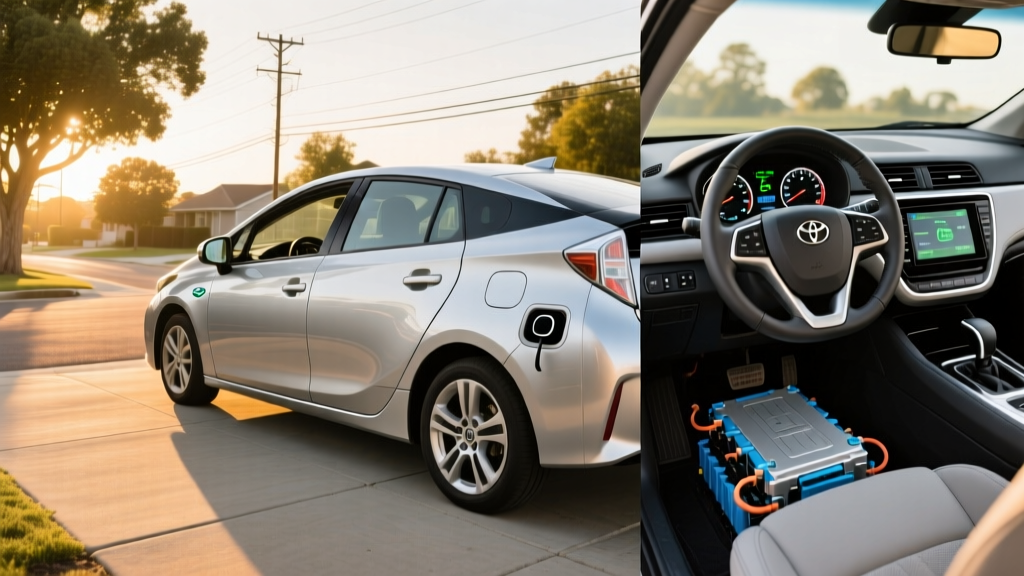
Battery longevity is the single biggest concern for any used hybrid buyer. The 2015 Prius uses a nickel-metal hydride (NiMH) traction battery — a chemistry that has proven extremely durable in Toyota's application, with many units lasting 150,000-200,000+ miles before significant degradation.
Original coverage: 8 years / 100,000 miles (10 years / 150,000 miles in CARB states including CA, CT, ME, MA, NJ, NY, OR, RI, VT, WA). For a 2015 model, original factory warranty has expired in most cases by 2026 unless the vehicle has exceptionally low mileage and is registered in a CARB state.
Battery replacement cost (2026 estimates):
- New OEM Toyota battery: $2,500-$3,500 installed at a dealership
- Remanufactured/refurbished battery: $1,200-$2,000 installed at an independent hybrid specialist
- Individual module replacement: $300-$600 if only a few cells have failed (common on higher-mileage units; a hybrid-savvy shop can test and replace individual modules)
What to check before buying: Use an OBD-II scanner with hybrid-specific software (such as the Dr. Prius app or Torque Pro with hybrid PID add-ons) to read individual battery block voltages. A healthy pack shows block voltages within 0.2V of each other at rest. Blocks that deviate by 0.3V or more indicate cell imbalance — a precursor to a check-engine light and reduced fuel economy. A Toyota dealership or hybrid specialist can also run a full battery health report.
2015 Prius Pricing and Tax Credit Eligibility in 2026
As a used vehicle in 2026, the 2015 Toyota Prius is no longer eligible for the federal §30D New Clean Vehicle Credit, which applies only to new vehicles. However, buyers may qualify for the Used Clean Vehicle Credit (up to $4,000 or 30% of the sale price, whichever is less) under IRC §25E — but with critical caveats:
- The vehicle must be purchased from a licensed dealer (private-party sales do not qualify)
- The sale price must be $25,000 or less (easily met by a 2015 Prius)
- Buyer income caps apply: $75,000 single / $112,500 head of household / $150,000 married filing jointly (modified AGI)
- The vehicle must be at least two model years old (met)
- The buyer must not have claimed the used-EV credit in the prior three years
- Important: The vehicle must be a qualifying model — confirm eligibility on the IRS clean vehicle list, as the standard Prius HEV may not qualify under the used credit rules (which target plug-in vehicles with at least 4 kWh battery capacity)
Current used market pricing (early 2026):
| Condition / Mileage | Typical Price Range |
|---|---|
| 80,000-100,000 miles, clean | $9,500-$12,000 |
| 100,000-140,000 miles, clean | $7,500-$10,000 |
| 140,000-180,000 miles, fair | $5,500-$8,000 |
| 180,000+ miles, high-mileage | $4,000-$6,000 |
Reliability and Long-Term Ownership Costs
The third-generation Prius (2010-2015) is widely regarded as one of the most reliable vehicles Toyota has produced. The hybrid powertrain has fewer wear items than a conventional gasoline car — no traditional starter motor, no alternator, no accessory drive belts, and regenerative braking extends brake pad life significantly (60,000-100,000 miles on original pads is common).
Known issues specific to the 2010-2015 generation:
- Head gasket failure: The 1.8L 2ZR-FXE engine has a documented head gasket weakness, typically appearing between 120,000-180,000 miles. EGR (exhaust gas recirculation) system clogging is a contributing factor. Proactive EGR cleaning every 80,000-100,000 miles is widely recommended by hybrid specialists.
- Oil consumption: Some 2010-2014 1.8L engines consume oil at higher rates. Check oil levels every 3,000-5,000 miles. Toyota issued a warranty enhancement for certain model years; verify if a specific VIN was covered and whether the repair was performed.
- Inverter coolant pump: Can fail around 100,000-150,000 miles. Replacement is roughly $400-$600. Watch for the red triangle warning light.
- 12V auxiliary battery: Located in the rear cargo area, the AGM 12V battery typically lasts 4-6 years. A failing 12V battery can cause a cascade of warning lights that mimic hybrid system failure. Replace with the correct AGM-spec battery (not a standard flooded cell).
According to NHTSA records, the 2015 Prius has relatively few recalls and technical service bulletins compared to its segment peers. Always pull a vehicle history report and verify recall completion before purchase.
Who Should Buy the 2015 Prius — and Who Shouldn't
- You want maximum MPG without plugging in
- Your commute is city/suburban stop-and-go
- You need a low-cost, low-risk used car under $12,000
- You lack access to home or workplace charging
- You prioritize low maintenance costs and parts availability
- You want a proven platform with 200,000+ mile potential
- You want electric-only driving or plug-in capability
- You need strong highway passing power (134 hp is modest)
- You want modern ADAS features (lane-keep, adaptive cruise)
- You need AWD (not available on 2015 Prius)
- You want the latest infotainment (no Apple CarPlay/Android Auto)
- You drive mostly highway miles at 75+ mph (MPG advantage narrows)
2015 Prius vs Full EV vs Modern PHEV: Which Fits Your Situation?
The 2015 Prius occupies a specific niche. Here's how it compares to the alternatives a 2026 buyer might consider:
| Factor | 2015 Prius (Used HEV) | New PHEV (e.g., Prius Prime) | Used Full EV (e.g., 2020 Bolt) |
|---|---|---|---|
| Purchase Price | $6,000-$12,000 | $33,000-$40,000 | $14,000-$20,000 |
| Fuel/Energy Cost per Mile | ~$0.07 | ~$0.03-$0.06 | ~$0.03-$0.05 |
| Home Charging Needed? | No | Recommended | Essential |
| Federal Tax Credit | Possibly $4,000 (used) | Up to $7,500 (new) | Possibly $4,000 (used) |
| Maintenance Complexity | Low (gas + hybrid) | Moderate (gas + plug-in) | Very Low (no engine) |
| Best For | Budget buyers, no charger | Home chargers, short commutes | Home chargers, daily driving |
Frequently Asked Questions
How many MPG does the 2015 Toyota Prius actually get?
The EPA rates the standard 2015 Prius at 51 city / 48 highway / 50 combined MPG. In real-world driving, most owners see 48-55 MPG depending on driving style, terrain, and temperature. City driving tends to yield higher numbers than the EPA estimate thanks to regenerative braking; sustained highway speeds above 70 mph typically produce 44-47 MPG.
Is the 2015 Prius hybrid reliable, and what does battery replacement cost?
Yes — the 2015 Prius is among the most reliable vehicles in its class. The NiMH hybrid battery commonly lasts 150,000-200,000+ miles. If replacement is needed, expect $2,500-$3,500 for a new OEM battery or $1,200-$2,000 for a remanufactured unit. The primary mechanical concern is the EGR system, which should be cleaned proactively to prevent head gasket issues.
Does the 2015 Prius qualify for any tax credit?
Not the new-vehicle §30D credit. The standard 2015 Prius HEV may qualify for the Used Clean Vehicle Credit (IRC §25E) worth up to $4,000, but only if purchased from a dealer, buyer income is within limits, and the vehicle meets the battery capacity threshold (at least 4 kWh). The standard Prius's 1.3 kWh battery likely disqualifies it — the Prius Plug-in (4.4 kWh) would have a stronger case. Consult a tax professional and verify on the IRS used vehicle credit page.
How does the 2015 Prius compare to a full EV like a used Tesla Model 3 or Chevy Bolt?
The 2015 Prius costs significantly less upfront ($6,000-$12,000 vs $14,000-$22,000 for a used EV) and requires no home charging infrastructure. However, a used EV offers far lower per-mile energy costs, zero tailpipe emissions, stronger acceleration, and less routine maintenance (no oil changes, no spark plugs). If you have reliable home charging, a used EV often delivers a lower total cost of ownership over five years despite the higher purchase price.
Can the 2015 Prius battery be repaired instead of replaced?
Yes. Individual battery modules can be tested and replaced by hybrid-specialist shops for $300-$600, extending the pack's life at a fraction of full replacement cost. Some owners also opt for aftermarket reconditioning services. This is a viable option for high-mileage examples where a full $3,000 battery investment doesn't make financial sense relative to the car's value.