Quick Verdict: The Efficiency King That Still Holds Up
When Hyundai launched the Ioniq lineup for the 2017 model year, it did something Toyota hadn't done in two decades: it beat the Prius at its own game. The 2017 Hyundai Ioniq Hybrid Blue trim achieved a 58 MPG combined EPA rating, edging past the Prius Eco's 56 MPG. Nearly a decade later, this compact hatchback remains one of the most fuel-efficient conventional hybrids ever sold in the United States — and on the used market in 2026, it's become a compelling budget electrified option.
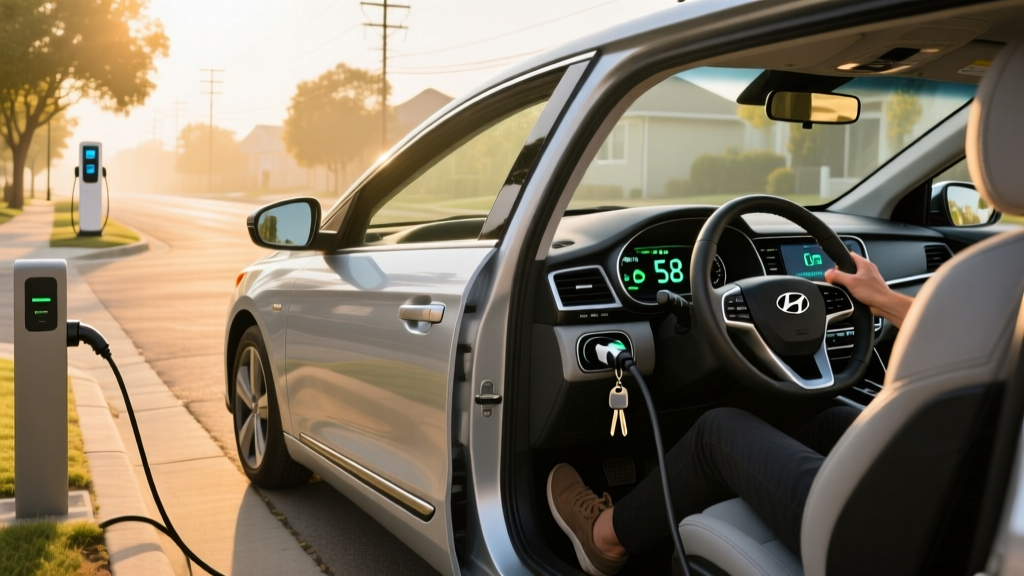
Hyundai offered the Ioniq in three electrified variants for 2017: a conventional hybrid (HEV), a plug-in hybrid (PHEV), and a full battery-electric vehicle (EV). This guide focuses on the conventional Ioniq Hybrid — the version that requires no plug, no charging routine, and no lifestyle adjustment beyond filling up less often. We'll cover the PHEV variant where relevant so you can compare.
HEV vs PHEV vs EV: Which 2017 Ioniq Is Right for You?
Before we dig into the numbers, here's a clear breakdown of the three Ioniq variants Hyundai sold in 2017. Confusing them is common — and costly if you buy the wrong one for your needs.
| Attribute | Ioniq Hybrid (HEV) | Ioniq Plug-In Hybrid (PHEV) | Ioniq Electric (EV) |
|---|---|---|---|
| Plug-in required? | No — self-charging | Yes — plug in for EV miles | Yes — must charge to drive |
| EPA combined | 55–58 MPG | 52 MPG (gas) / 119 MPGe (EV) | 136 MPGe |
| Electric-only range | N/A (EV assist only) | 29 miles | 124 miles |
| Battery capacity | 1.56 kWh | 8.9 kWh | 28 kWh |
| Total range | ~690 miles | ~630 miles (gas + EV) | 124 miles |
| DC fast charge? | No | No (Level 2 only) | Yes (CCS, ~50 kW) |
The HEV is for drivers who want maximum simplicity — no plug, no charging anxiety, just exceptional fuel economy. The PHEV suits those with home charging access and a short commute who want some electric miles without range limitations. The EV works for urban drivers with reliable charging and a second car for longer trips. In 2026, most Ioniq Hybrids on the used market are HEVs, as they were the volume seller.
Fuel Economy: EPA Ratings and Real-World MPG
The 2017 Ioniq Hybrid came in three trims — Blue, SEL, and Limited — and the EPA ratings vary slightly by trim due to weight and wheel-size differences.
| Trim | City MPG | Highway MPG | Combined MPG |
|---|---|---|---|
| Blue | 57 | 59 | 58 |
| SEL | 55 | 57 | 55 |
| Limited | 55 | 54 | 55 |
Source: U.S. EPA / fueleconomy.gov
Real-World MPG: What Owners Actually Report
Hybrids tend to outperform their EPA city ratings in stop-and-go driving because regenerative braking recaptures energy that gas-only cars waste as heat. The Ioniq Hybrid's city-biased rating (57 city vs. 59 highway on the Blue trim) already reflects this advantage.
In real-world driving, most owners report averaging between 52 and 60 MPG combined depending on climate and driving style. Key factors:
- City-heavy commuting: 56–62 MPG is common. Short trips with frequent stops maximize regen benefit.
- Highway cruising (70+ mph): Expect 48–54 MPG. Aerodynamic drag rises steeply above 65 mph, and the engine works harder without regen assist.
- Cold weather (below 35°F): Fuel economy drops 10–15% as the engine runs more frequently to generate cabin heat and the battery's charge/discharge efficiency declines.
- Summer with A/C: Minimal impact — the electric compressor draws modest power compared to winter heating demands.
Powertrain: How the Hybrid System Works
The 2017 Ioniq Hybrid pairs a 1.6-liter Atkinson-cycle four-cylinder gasoline engine with a permanent-magnet synchronous electric motor, routed through a six-speed dual-clutch automatic transmission (DCT). This is a notable engineering choice — most competitors, including the Prius, use a continuously variable transmission (CVT).
| Specification | Detail |
|---|---|
| Gas engine | 1.6L GDI 4-cylinder, 104 hp / 109 lb-ft |
| Electric motor | 32 kW (43 hp) / 125 lb-ft |
| Combined system output | 139 hp / 195 lb-ft |
| Transmission | 6-speed dual-clutch automatic (DCT) |
| Hybrid battery | 1.56 kWh lithium-ion polymer |
| 0–60 mph | ~9.4 seconds |
| Curb weight | 3,131–3,250 lbs (varies by trim) |
| Drag coefficient | 0.24 Cd |
The DCT gives the Ioniq Hybrid a more traditional, connected driving feel than the rubber-band sensation common in CVT-equipped hybrids. Acceleration is adequate for merging and city driving but not quick — 9.4 seconds to 60 mph puts it squarely in economy-car territory. The tradeoff for that 0.24 drag coefficient is excellent highway efficiency but a slightly swoopy exterior design that not everyone loves.
Battery Longevity, Warranty, and Replacement Cost
Hybrid battery degradation is the top concern for used-hybrid buyers, and it's a legitimate one to investigate. Here's what the data shows for the 2017 Ioniq Hybrid.
10 years / 100,000 miles (whichever comes first) for the original owner in most states. In California Air Resources Board (CARB) states, emissions-related hybrid components carry a 10-year/150,000-mile warranty. For second owners, the hybrid battery warranty typically transfers as 10 years / 100,000 miles from the original in-service date, though you should verify with a Hyundai dealer using your VIN.
Real-World Battery Degradation
The 1.56 kWh battery pack in the Ioniq HEV is small — it's designed for frequent shallow charge/discharge cycles, not deep cycling like a PHEV or EV. This actually works in its favor for longevity. Hybrid batteries that never see extreme states of charge (the system keeps the pack between roughly 40% and 80% state of charge) tend to degrade slowly.
Based on owner reports and fleet data from 2017–2025 Ioniq Hybrids:
- At 100,000 miles: Most owners report no noticeable fuel-economy decline, suggesting battery capacity retention above 90%.
- At 150,000+ miles: Some owners report a 2–5 MPG drop, consistent with modest battery degradation. The system compensates by running the gas engine slightly more often.
- Outright failure: Rare. Hyundai's lithium-ion polymer chemistry and conservative state-of-charge management have yielded strong reliability.
Battery Replacement Cost
If the hybrid battery does fail outside warranty, replacement costs in 2026 typically range from $2,000 to $3,500 including parts and labor at an independent hybrid specialist. A Hyundai dealer may quote $3,500–$4,500. Third-party refurbished battery packs are available for $1,200–$1,800 (parts only). Given the Ioniq's used-market value of roughly $9,000–$15,000 depending on mileage and condition, a battery replacement is a significant but not total-loss expense.
Pricing, Used Market Value, and Tax Credit Eligibility
Original MSRP (2017)
- Blue: $22,200
- SEL: $24,800
- Limited: $28,300
2026 Used Market Pricing
In early 2026, the 2017 Ioniq Hybrid typically sells for $9,000–$15,000 depending on mileage, trim, condition, and region. Blue trims command a small premium for their superior fuel economy ratings. Well-maintained examples under 80,000 miles with clean Carfax reports cluster around $12,000–$14,000.
Does the 2017 Ioniq Hybrid Qualify for a Tax Credit?
No. The conventional Ioniq Hybrid (HEV) did not qualify for the federal §30D new clean vehicle credit when it was sold new, and it does not qualify for the used clean vehicle credit (§25E) in 2026. Here's why:
- The §30D credit applies only to new plug-in vehicles (PHEVs and BEVs) with sufficient battery capacity. The conventional HEV has no plug and a 1.56 kWh battery — far below the threshold.
- The §25E used EV credit (up to $4,000 or 30% of sale price, whichever is less) applies only to used PHEVs and BEVs sold for $25,000 or less by a licensed dealer. Conventional hybrids are excluded.
- The 2017 Ioniq Plug-In Hybrid originally qualified for a partial §30D credit (~$2,917 based on battery capacity) when new. On the used market in 2026, the PHEV variant may qualify for the §25E used credit if sold by a dealer for under $25,000, subject to buyer income caps ($75,000 single / $150,000 joint) and other IRS requirements.
Some states offer their own incentives for used hybrid purchases, but these vary widely. Check your state's energy or environmental agency for current programs.
Reliability, Safety, and Common Issues
The 2017 Ioniq Hybrid earned strong marks for reliability and safety during its production run and in long-term ownership surveys.
Safety Ratings
- IIHS: Good ratings in all crashworthiness tests. Available automatic emergency braking earned a Superior rating for front crash prevention. (IIHS)
- NHTSA: 5-star overall safety rating.
Common Owner-Reported Issues
- DCT hesitation at low speeds: The dual-clutch transmission can feel jerky in stop-and-go traffic at very low speeds. This is a characteristic of DCTs, not a defect, but it surprises drivers accustomed to CVTs or traditional automatics.
- Infotainment lag: The 7-inch or 8-inch touchscreen (depending on trim) runs dated software by 2026 standards. Apple CarPlay and Android Auto are supported on SEL and Limited trims, which largely solves the problem.
- 12V battery drain: Some owners report the 12-volt auxiliary battery dying if the car sits for extended periods (2+ weeks). This is common in hybrids with small 12V batteries and is not a traction-battery issue.
- Road noise: The lightweight construction and low-rolling-resistance tires transmit more road noise than competitors. Cabin insulation is adequate but not luxurious.
Who Should Buy the 2017 Ioniq Hybrid in 2026?
Choose the 2017 Ioniq Hybrid if:
- You want 55+ MPG without changing your fueling habits (no plug needed)
- Your budget is under $15,000 and you want a proven, efficient daily driver
- You commute in stop-and-go city traffic where hybrids shine brightest
- You want a hatchback with usable cargo space (26.5 cu ft behind rear seats)
- You're not ready for EV charging logistics or don't have home charging access
Consider a full EV or newer PHEV instead if:
- You have home Level 2 charging and want zero tailpipe emissions for daily driving
- You want modern ADAS features (the 2017 Ioniq has basic AEB but lacks adaptive cruise on lower trims)
- You prioritize acceleration — 139 hp and a 9.4-second 0–60 is functional, not fun
- You want to qualify for a federal tax credit (look at new PHEVs/EVs or used EVs under §25E)
- Best-in-class 58 MPG combined (Blue trim)
- Low cost of ownership — minimal maintenance, no plug-in hassle
- Strong hybrid battery reliability record
- Hatchback practicality with 26.5 cu ft cargo
- Available Apple CarPlay/Android Auto (SEL/Limited)
- IIHS Top Safety Pick
- Modest 139 hp — slow acceleration
- DCT can be jerky at low speeds
- Dated infotainment and interior materials
- No federal tax credit eligibility
- Road noise above average for the class
- Limited ADAS on Blue and SEL trims
Frequently Asked Questions
How many MPG does the 2017 Hyundai Ioniq Hybrid actually get?
The EPA rates the Blue trim at 57 city / 59 highway / 58 combined MPG. The SEL and Limited trims are rated at 55 combined. In real-world driving, most owners average 52–60 MPG combined, with city-heavy driving yielding the best results and sustained highway speeds above 70 mph reducing efficiency to 48–54 MPG.
How far can the 2017 Ioniq Hybrid go on electric only?
The conventional Ioniq Hybrid (HEV) cannot drive on electric power alone for any meaningful distance. The 1.56 kWh battery provides brief electric-only assist at very low speeds (typically under 25 mph for a few hundred yards), but the gas engine engages almost immediately under normal driving. If you want electric-only driving, you need the Ioniq Plug-In Hybrid (29 miles EV range) or the Ioniq Electric (124 miles EV range).
Is the 2017 Ioniq Hybrid reliable, and what does a battery replacement cost?
Yes — the 2017 Ioniq Hybrid has a strong reliability record. Hyundai's hybrid battery warranty covers 10 years/100,000 miles, and real-world degradation has been minimal for most owners. If replacement is needed outside warranty, expect $2,000–$3,500 at an independent hybrid shop or $3,500–$4,500 at a dealer. Refurbished packs are available for $1,200–$1,800 (parts only).
Does the 2017 Ioniq Hybrid qualify for any tax credit in 2026?
No. The conventional Ioniq Hybrid is not eligible for the federal §30D new vehicle credit or the §25E used clean vehicle credit — both programs require plug-in vehicles (PHEVs or BEVs). Some states may offer separate incentives for used hybrid purchases; check your state energy office. The Ioniq Plug-In Hybrid variant may qualify for the §25E used credit if purchased from a dealer for under $25,000, subject to IRS income and eligibility requirements.
How does the 2017 Ioniq Hybrid compare to the 2017 Prius?
The Ioniq Hybrid Blue (58 MPG combined) slightly beats the Prius Eco (56 MPG combined) on fuel economy. The Ioniq also offers a more conventional driving feel thanks to its 6-speed DCT versus the Prius's CVT. The Prius counters with a more spacious rear seat, slightly more cargo room, and a longer track record of hybrid reliability. Both are excellent used hybrid choices — the Ioniq typically sells for $1,000–$2,000 less than a comparable Prius.
Should I be worried about buying a 2017 hybrid with high mileage?
The hybrid system itself is not the primary risk at high mileage — the 1.56 kWh battery and electric motor have proven durable well past 150,000 miles. The bigger concerns are typical wear items: suspension components, brake hardware (though regen extends pad life significantly), and the DCT clutch packs. A pre-purchase inspection by a hybrid-experienced mechanic and a review of maintenance records are essential for any used Ioniq Hybrid with over 100,000 miles.