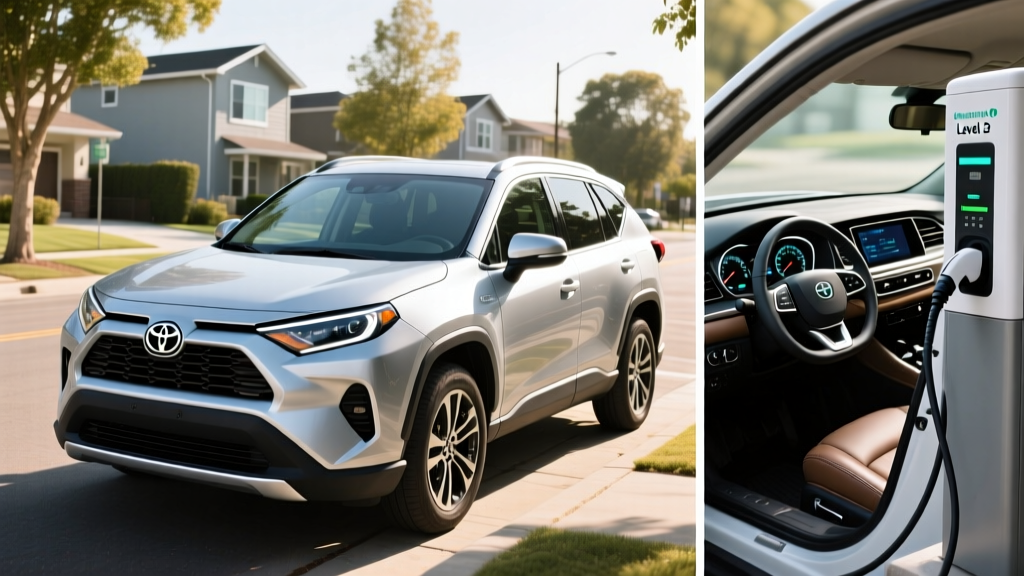
Quick Verdict: The 2017 Hybrid RAV4 in 2026
If you're shopping the used compact SUV market for maximum fuel efficiency without plugging in, the 2017 Toyota RAV4 Hybrid remains one of the smartest buys available. With an EPA-rated 33 MPG combined, standard all-wheel drive, and Toyota's proven hybrid synergy drive system, this HEV (conventional hybrid — no plug required) delivers real-world fuel savings that still rival newer competitors. As a used vehicle in 2026, it avoids the steep depreciation of new cars while offering a powertrain built to outlast 200,000 miles with basic maintenance.
| Spec | Value |
|---|---|
| Powertrain Type | Conventional Hybrid (HEV) — no plug |
| Engine | 2.5L 4-cylinder Atkinson-cycle + electric motor |
| Combined Horsepower | 194 hp (net system) |
| EPA MPG (City / Hwy / Combined) | 34 / 30 / 33 |
| Drivetrain | Electronic On-Demand AWD (AWD-i) |
| Hybrid Battery | 1.6 kWh Nickel-Metal Hydride (NiMH) |
| 0-60 mph | ~7.8 seconds |
| Cargo Volume | 35.6 cu ft (rear seats up) |
| Original MSRP (2017) | $29,710 – $34,510 |
| Typical Used Price (2026) | $14,000 – $20,500 |
| Hybrid Battery Warranty (original) | 8 years / 100,000 miles (10 yr/150k in CARB states) |
HEV vs. PHEV vs. EV: Where the 2017 RAV4 Hybrid Fits
Before diving into fuel economy, it's critical to understand what this vehicle is — and what it is not. The 2017 RAV4 Hybrid is a conventional hybrid (HEV). It has a small battery that charges exclusively through regenerative braking and the gasoline engine. There is no plug, no charging cable, and no electric-only driving range to speak of (the EV mode creeps up to roughly 1 mile at very low speeds, which is functionally negligible).
| Factor | HEV (2017 RAV4 Hybrid) | PHEV (e.g., RAV4 Prime) | BEV (e.g., bZ4X) |
|---|---|---|---|
| Plugs in? | No | Yes (Level 1/2) | Yes (Level 1/2/DC) |
| Electric-only range | ~0 miles | 42 miles (RAV4 Prime) | 222–252 miles (bZ4X) |
| Needs home charging? | No | Recommended | Essential |
| Federal tax credit (new) | $0 | Up to $7,500 (§30D) | Up to $7,500 (§30D) |
| Used EV credit (§25E) | $0 | Up to $4,000 | Up to $4,000 |
| Best for | No plug access, simple ownership | Short commutes + road trips | Home charging, low running cost |
Choose the 2017 RAV4 Hybrid (HEV) if: You have no access to plug-in charging at home or work, you want lower fuel costs with zero behavioral change, and you prefer the lowest-complexity electrified powertrain available.
Look at a PHEV instead if: You can install a Level 2 charger, your daily commute is under 40 miles, and you want electric-only driving for most trips with gas backup for road trips. The current-generation RAV4 Prime (42 miles electric-only, 38 MPG hybrid mode) is the natural upgrade path — though it commands a significant price premium on the used market.
Go full BEV if: You have reliable home charging, your daily driving is under 250 miles, and you want to eliminate gasoline entirely.
Fuel Economy: EPA Ratings vs. Real-World MPG
The 2017 RAV4 Hybrid carries an EPA rating of 34 MPG city, 30 MPG highway, and 33 MPG combined, according to fueleconomy.gov. This was class-leading for a compact AWD SUV in 2017, and it remains highly competitive against 2026 models.
| Driving Condition | EPA Rating | Real-World Expectation |
|---|---|---|
| City | 34 MPG | 33–37 MPG (hybrids excel in stop-and-go) |
| Highway | 30 MPG | 28–31 MPG (aero drag limits regen benefit) |
| Combined | 33 MPG | 30–34 MPG |
| Cold weather (below 30°F) | — | 27–30 MPG (engine runs more for cabin heat) |
Why Hybrids Often Beat EPA in the City
Unlike gas-only vehicles, which suffer their worst efficiency in stop-and-go traffic, hybrids thrive there. Every braking event captures kinetic energy through regenerative braking, recharging the battery and reducing the load on the gasoline engine. In heavy urban traffic, many RAV4 Hybrid owners report 35–37 MPG — exceeding the EPA city estimate. Highway driving flips the script: at 70+ mph, aerodynamic drag dominates, and the hybrid system's low-speed advantages diminish. Expect 28–31 MPG on sustained highway trips.
Cold-Weather MPG Impact
In sub-freezing temperatures, the Atkinson-cycle engine must run more frequently to provide cabin heat (the 2017 model lacks a heat pump, which is found only on newer BEVs and PHEVs). Expect a 10–15% fuel economy reduction in winter — dropping combined MPG to roughly 27–30. This is typical for all hybrids and still significantly better than a comparable gas-only RAV4's winter performance (~22–24 MPG combined in cold weather).
Cost Savings vs. Gas-Only RAV4
At $3.40/gallon (2026 national average for regular unleaded) and 12,000 miles/year:
- 2017 RAV4 Hybrid (33 MPG combined): ~$1,236/year in fuel
- 2017 RAV4 AWD gas (25 MPG combined): ~$1,632/year in fuel
- Annual savings: ~$396/year, or ~$1,980 over 5 years
The hybrid's fuel savings are meaningful but not transformative. The real value proposition is the combination of AWD, efficiency, and long-term reliability — not dramatic monthly savings.
Powertrain and Performance Details
The 2017 RAV4 Hybrid pairs a 2.5-liter four-cylinder Atkinson-cycle gasoline engine (150 hp, 138 lb-ft torque) with a front electric motor integrated into the transaxle and a separate rear electric motor that powers the rear axle. Combined net system output is 194 horsepower.
The AWD-i system is fully electronic — there is no mechanical driveshaft connecting the front and rear axles. Instead, the rear motor engages automatically when slip is detected or during hard acceleration. This design eliminates drivetrain losses and keeps weight down, but it's tuned for traction in rain and light snow, not off-road use or heavy towing (towing capacity is just 1,750 lbs).
Acceleration to 60 mph takes approximately 7.8 seconds — competitive with the gas-only RAV4 and adequate for merging and passing. The CVT (continuously variable transmission) delivers smooth, linear acceleration without gear-shift shock. Under hard throttle, the engine drone is noticeable (a characteristic of CVT-equipped hybrids), but around-town driving is quiet and refined.
Hybrid Battery: Lifespan, Warranty, and Replacement Cost
The 2017 RAV4 Hybrid uses a 1.6 kWh Nickel-Metal Hydride (NiMH) battery pack. Unlike the lithium-ion packs in modern BEVs and PHEVs, NiMH chemistry is less energy-dense but extremely durable. Toyota's hybrid battery management system is conservative — it never fully charges or fully depletes the pack, keeping it in a narrow state-of-charge window (roughly 40–80%) that dramatically extends cycle life.
Hybrid Battery Warranty
Original warranty: 8 years / 100,000 miles nationwide; 10 years / 150,000 miles in CARB states (CA, CT, ME, MD, MA, NJ, NY, OR, RI, VT, WA, plus states that adopted CARB standards).
For a 2017 model in 2026: The 8-year/100k federal warranty has expired. However, the 10-year/150k CARB-state warranty may still apply depending on your state and the vehicle's mileage. Check your specific VIN and state regulations.
Real-World Battery Longevity
Toyota's hybrid battery track record is exceptional. Data from fleet operators, taxi services, and long-term owner surveys consistently show NiMH hybrid packs lasting 180,000–250,000+ miles before significant degradation. The 2017 RAV4 Hybrid benefits from Toyota's fourth-generation hybrid system (shared with the contemporary Prius), which refined thermal management and charge algorithms further.
That said, a 2017 model is now 9 years old. Battery degradation is a function of both age and mileage. If the vehicle you're considering has 120,000+ miles, the battery has likely lost some capacity — but because the pack is small (1.6 kWh) and its role is supplemental (not primary propulsion), even moderate degradation doesn't dramatically affect fuel economy. You may notice the engine kicking on slightly more often, but the vehicle remains fully functional.
Battery Replacement Cost
If the hybrid battery does fail, replacement options include:
- New OEM battery (Toyota dealer): $2,500–$3,500 including installation
- Remanufactured battery: $1,200–$2,000 including installation
- Individual cell replacement (specialist shops): $500–$1,000 (only the degraded cells are swapped)
Many independent hybrid specialists now offer cell-level repairs, replacing only the weak modules within the pack rather than the entire assembly. This has made battery repair far more affordable than the dealer-only replacement scenario that worried early hybrid buyers.
Pricing, Tax Credits, and Ownership Economics
As a used vehicle in 2026, the 2017 RAV4 Hybrid typically sells for $14,000–$20,500 depending on mileage, condition, and trim (XLE or Limited). This represents a significant discount from its original MSRP of $29,710–$34,510.
Tax Credit Eligibility
The 2017 RAV4 Hybrid does not qualify for any federal tax credit — new or used. Here's why:
- §30D New Clean Vehicle Credit: Applies only to new PHEVs and BEVs with qualifying battery sourcing. Conventional hybrids (HEVs) are excluded by statute.
- §25E Used Clean Vehicle Credit: Up to $4,000 (30% of sale price, capped at $4,000) for used PHEVs and BEVs sold by a licensed dealer for under $25,000. Conventional hybrids are excluded. See IRS §25E guidelines for full eligibility rules.
- State incentives: A handful of states offer rebates or HOV-lane access for hybrids, but most have shifted incentive programs toward PHEVs and BEVs. Check your state's energy or environmental agency for current programs.
5-Year Ownership Cost Estimate
| Category | Estimated Cost |
|---|---|
| Purchase price | $17,000 |
| Fuel (12,000 mi/yr, 33 MPG, $3.40/gal) | $6,180 |
| Insurance (national avg.) | $6,500 |
| Maintenance (Toyota hybrid = low) | $2,800 |
| Estimated repairs (out of warranty) | $1,500 |
| Depreciation (5 yr, used-to-used) | $4,500 |
| Total 5-year cost | ~$38,480 |
This is among the lowest 5-year ownership costs in the compact AWD SUV segment, driven by Toyota's reliability, low maintenance needs, and strong resale retention.
Reliability, Safety, and Common Issues
Toyota's hybrid powertrain is widely regarded as one of the most reliable in the industry. The planetary gearset in the eCVT transmission has no clutch packs, bands, or friction components that wear out — it's essentially bulletproof with normal fluid maintenance. The 2017 RAV4 Hybrid carries above-average reliability ratings from owner surveys and has no widespread systemic failures.
Common Issues to Watch (Used Purchase Inspection)
- 12V auxiliary battery: Like all hybrids, the RAV4 has a standard 12V battery for electronics. If the vehicle sat unused for extended periods, this battery may need replacement ($150–$250).
- Brake actuator recall: Some 2017 RAV4 Hybrid models were included in a brake booster assembly recall. Verify recall completion via NHTSA's VIN lookup.
- Inverter coolant pump: Rare failures reported at high mileage. Check for coolant level and any warning lights.
- Rear motor bearing noise: Uncommon but reported at 150k+ miles. Listen for whining from the rear axle during test drive.
Safety Ratings
The 2017 RAV4 earned the IIHS Top Safety Pick+ designation (with optional front crash prevention) and a 5-star overall NHTSA rating. Toyota Safety Sense-P (TSS-P) was standard on all 2017 RAV4 Hybrid trims, including pre-collision braking, lane departure alert with steering assist, automatic high beams, and full-speed-range adaptive cruise control. This was exceptional equipment for a 2017 compact SUV and remains competitive with 2026 active-safety suites.
Who Should Buy the 2017 RAV4 Hybrid in 2026?
Pros
- 33 MPG combined — still class-competitive for AWD SUVs
- Standard AWD-i with no fuel-economy penalty vs. FWD
- Toyota Safety Sense-P standard (rare for 2017)
- Proven hybrid powertrain — 200k+ mile lifespan typical
- No plug required — zero infrastructure dependency
- Low maintenance costs (no timing belt, regen saves brake pads)
- Strong parts availability and independent repair network
Cons
- No electric-only driving range
- No federal tax credit eligibility (new or used)
- CVT drone under hard acceleration
- Dated infotainment (no Apple CarPlay/Android Auto on 2017)
- Hybrid battery warranty likely expired (8 yr/100k)
- 1,750 lb towing capacity (below segment average)
- Higher used prices than gas-only RAV4 (hybrid premium holds)
Hybrid vs. PHEV vs. EV: Decision Framework for 2026 Buyers
Which Electrified SUV Is Right for You?
Buy the 2017 RAV4 Hybrid (HEV) if:
- You cannot install a home charger (apartment, street parking, landlord restrictions)
- Your budget is $14,000–$20,000 for a used AWD SUV
- You want the simplest possible ownership experience — just add gas
- You drive 10,000–15,000 miles/year and value reliability over novelty
Consider a used RAV4 Prime (PHEV) if:
- You can charge at home (even a standard 120V outlet adds ~4 miles/hour)
- Your daily commute is under 40 miles (electric-only covers it)
- You qualify for the §25E used clean vehicle credit (up to $4,000 on dealer-sold PHEVs under $25,000)
- Your budget stretches to $28,000–$38,000 used
Consider a used BEV (e.g., Tesla Model Y, Hyundai Ioniq 5) if:
- You have Level 2 home charging access
- Your daily driving is under 200 miles
- You want the lowest per-mile energy cost (~$0.04–$0.06/mile on home electricity vs. ~$0.10/mile for the RAV4 Hybrid)
- You're comfortable with public charging for road trips
Frequently Asked Questions
How many MPG does the 2017 RAV4 Hybrid get?
The EPA rates the 2017 RAV4 Hybrid at 34 MPG city, 30 MPG highway, and 33 MPG combined. In real-world driving, city-heavy commutes often yield 35–37 MPG thanks to regenerative braking, while sustained highway driving at 70+ mph typically returns 28–31 MPG. Cold weather (below 30°F) reduces combined economy to roughly 27–30 MPG.
Does the 2017 RAV4 Hybrid need to be plugged in?
No. The 2017 RAV4 Hybrid is a conventional hybrid (HEV). Its small 1.6 kWh battery charges entirely through regenerative braking and the gasoline engine. There is no plug, no charging cable, and no electric-only range of practical significance. You fuel it exactly like a gas car.
Is the 2017 RAV4 Hybrid reliable?
Yes. Toyota's fourth-generation hybrid system is among the most proven powertrains in the automotive industry. The eCVT transmission uses a planetary gearset with no wear components. NiMH hybrid batteries routinely last 180,000–250,000 miles. The main reliability concerns for a used 2017 model are standard wear items (suspension bushings, 12V battery) rather than hybrid-specific failures.
How much does a hybrid battery replacement cost?
A new OEM replacement battery from a Toyota dealer runs $2,500–$3,500 installed. Remanufactured packs cost $1,200–$2,000 installed, and cell-level repairs at a hybrid specialist can be as low as $500–$1,000. Given the proven longevity of Toyota NiMH packs, most 2017 RAV4 Hybrids will never need a full battery replacement under normal ownership.
Does the 2017 RAV4 Hybrid qualify for any tax credit?
No. Conventional hybrids (HEVs) do not qualify for the federal §30D new vehicle credit or the §25E used vehicle credit. These programs are limited to plug-in vehicles (PHEVs and BEVs) with qualifying battery capacity and sourcing. Some states may offer minor incentives for hybrids, but most state programs have shifted focus to plug-in vehicles. Check your state's energy office for current programs.
How does the 2017 RAV4 Hybrid compare to the current RAV4 Hybrid?
The 2026 RAV4 Hybrid (fifth generation) is rated at 39–41 MPG combined — a meaningful 6–8 MPG improvement. It also offers a more powerful 219 hp powertrain, updated infotainment with wireless Apple CarPlay/Android Auto, and a more refined ride. However, a new 2026 RAV4 Hybrid starts around $33,000–$38,000, roughly double the cost of a used 2017 model. If budget is the priority, the 2017 remains a strong value; if you want the latest efficiency and tech, the newer generation justifies its premium.
What should I check when buying a used 2017 RAV4 Hybrid?
Focus on: (1) hybrid battery health — ask for a Toyota Hybrid Battery Health Check report from a dealer; (2) recall completion — verify the brake actuator recall via NHTSA VIN lookup; (3) maintenance records — confirm regular oil changes and inverter coolant service; (4) a thorough test drive including highway merging and regenerative braking feel. A pre-purchase inspection by a Toyota-certified technician or hybrid specialist is strongly recommended.