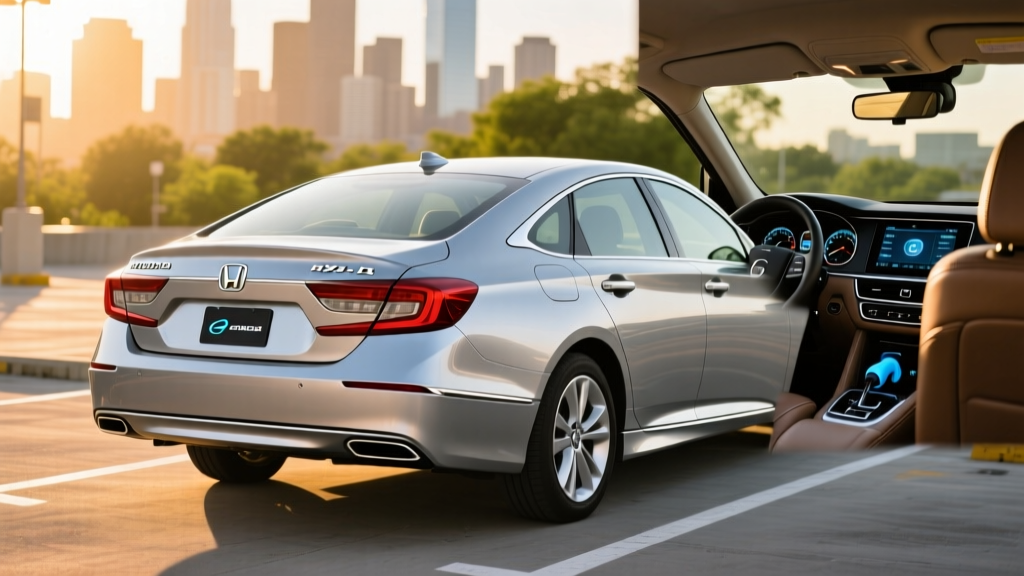
The 2017 Honda Accord Hybrid EX-L sedan occupies a specific niche in the used-car market: a midsize hybrid that delivers genuine fuel savings without asking you to change how you drive. You never plug it in. You just fill it with gas and go — except you'll be visiting the pump far less often. With an EPA-estimated 48 MPG combined, this generation Accord Hybrid remains one of the most efficient non-plug-in sedans ever sold in the US, and in 2026 it's aging into a compelling budget-conscious commuter.
But buying a nine-year-old hybrid raises legitimate questions: How long does the battery last? What does replacement cost? And does the real-world fuel economy actually match the sticker? This guide breaks down every number that matters.
HEV vs PHEV vs EV: Where the Accord Hybrid Fits
Conventional Hybrid (HEV) — like this Accord Hybrid: A small battery (1.3 kWh) is charged entirely by the gasoline engine and regenerative braking. You never plug it in. The electric motor assists the gas engine and enables brief electric-only driving at low speeds. The result is dramatically improved MPG without any charging infrastructure.
Plug-in Hybrid (PHEV): A larger battery (typically 10–20 kWh) that you plug in to charge, offering 25–45 miles of electric-only range before the gas engine kicks in. Examples: Toyota RAV4 Prime, Jeep Wrangler 4xe. Requires access to a plug to realize full benefits.
Battery Electric Vehicle (BEV): No gasoline engine at all. Runs entirely on a large battery pack (60–100+ kWh). Requires reliable home or public charging. Examples: Tesla Model 3, Hyundai Ioniq 5.
The 2017 Accord Hybrid is strictly an HEV. Honda did not offer a plug-in Accord in the US market for this generation (the Accord Plug-In was limited to 2014 and only sold in California and Oregon). If you want electric-only commuting range, you'll need to look at a PHEV or BEV instead.
Fuel Economy: EPA Numbers and Real-World MPG
The EPA rates the 2017 Honda Accord Hybrid at the following fuel economy figures across all trims (LX, EX-L, Touring):
| Driving Cycle | EPA Estimate |
|---|---|
| City | 49 MPG |
| Highway | 47 MPG |
| Combined | 48 MPG |
Real-world expectations: Honda's two-motor hybrid system excels in stop-and-go city driving, where regenerative braking recaptures energy constantly. Many owners report exceeding the EPA city estimate — 50–53 MPG in urban commuting is common based on Fuelly-tracked data. Highway driving at sustained 70+ MPH tends to return 42–45 MPG, slightly below the EPA highway figure, because aerodynamic drag dominates and the electric motor provides less benefit at constant speed.
In cold weather (below 35°F), expect a 5–10% fuel economy drop as the engine runs more frequently to provide cabin heat and warm up the hybrid system. This is normal for all hybrids and far less severe than the 20–30% range loss a BEV experiences in winter.
Over a 15,000-mile annual driving schedule at $3.50/gallon, the 48 MPG combined figure translates to roughly $1,094 per year in fuel — compared to approximately $1,875 for a comparable gas-only midsize sedan averaging 28 MPG combined. That's about $780 in annual fuel savings.
Powertrain: Two-Motor Hybrid System Specs
| Specification | 2017 Accord Hybrid EX-L |
|---|---|
| Engine | 2.0L Atkinson-cycle 4-cylinder |
| Engine Output | 143 hp / 129 lb-ft torque |
| Electric Motor Output | 184 hp / 232 lb-ft torque |
| Combined System Output | 212 hp |
| Hybrid Battery | 1.3 kWh lithium-ion |
| Transmission | Electronic CVT (e-CVT, no belt) |
| 0–60 MPH | ~7.2 seconds |
| Drivetrain | Front-wheel drive |
| Curb Weight | ~3,536 lbs |
Honda's Sport Hybrid Intelligent Multi-Mode Drive (i-MMD) system is fundamentally different from Toyota's planetary-gear hybrid setup. At low speeds, the Accord Hybrid operates primarily as a series hybrid: the gas engine generates electricity, and the electric motor drives the wheels. At highway cruising speeds, a lock-up clutch connects the engine directly to the wheels for efficiency. During hard acceleration, both the engine and motor contribute.
The result is smooth, responsive acceleration with none of the "rubber band" feel that older CVTs produce. The e-CVT here has no physical belt or pulley — it's an electrical coupling, which improves long-term reliability. The 212 combined horsepower gives the Accord Hybrid confident passing power, and it feels noticeably quicker than the contemporary Toyota Camry Hybrid (200 hp).
EX-L Trim: What You Get
The EX-L sits in the middle of the 2017 Accord Hybrid lineup (LX → EX-L → Touring) and adds meaningful comfort and technology over the base LX:
- Leather-trimmed seats with heated front seats
- Leather-wrapped steering wheel
- Power-adjustable front seats (driver 10-way, passenger 4-way)
- HomeLink universal garage door opener
- Auto-dimming rearview mirror
- HondaLaneWatch (passenger-side camera for lane-change visibility)
- 7-inch Display Audio touchscreen with Apple CarPlay and Android Auto
- Honda Sensing suite (adaptive cruise control, lane-keeping assist, forward collision warning, collision mitigation braking, road departure mitigation)
- 17-inch alloy wheels
- Smart Entry with push-button start
The Honda Sensing suite is particularly significant. In 2026, having adaptive cruise control and automatic emergency braking on a sub-$20,000 used car represents strong value. The IIHS rated the 2017 Accord a Top Safety Pick+ when equipped with Honda Sensing, with "Good" ratings across all crashworthiness tests and a "Superior" front crash prevention rating.
Battery Longevity, Warranty, and Replacement Cost
Original Hybrid Battery Warranty: 8 years / 100,000 miles (10 years / 150,000 miles in CARB states including California, New York, Massachusetts, and others adopting California emissions standards).
2026 Status: The original 8-year/100,000-mile warranty has expired for most 2017 Accord Hybrids unless the vehicle was registered in a CARB state and has fewer than 150,000 miles. Verify warranty status with a Honda dealer using the VIN before purchase.
Real-world battery longevity: Honda's 1.3 kWh lithium-ion hybrid battery is relatively small and is managed conservatively — the system never uses the full capacity, maintaining a buffer to reduce stress on the cells. Based on fleet data and owner reports, the IMA/lithium-ion batteries in Honda hybrids typically last 150,000–200,000 miles before significant degradation. Some units exceed 250,000 miles.
Unlike a BEV's large traction battery, a hybrid battery doesn't need to hold a large charge — it cycles frequently but in shallow depth-of-discharge patterns. Degradation manifests as slightly reduced fuel economy and more frequent engine engagement, not as a dramatic range loss.
Battery replacement cost (2026 estimates):
- New OEM Honda battery pack: $2,000–$3,500 (parts + labor at a dealer)
- Refurbished/remanufactured battery: $1,200–$2,000 installed
- Individual cell/module replacement (if only some cells are weak): $500–$1,200 at a hybrid specialist shop
Compared to a BEV battery replacement ($5,000–$20,000+), the Accord Hybrid's battery replacement cost is manageable. It's also a job any competent hybrid shop can perform — it doesn't require Honda-specific high-voltage certification the way some BEV packs do.
Who Should Buy This Hybrid (and Who Shouldn't)
Choose the Accord Hybrid EX-L If:
- You commute in stop-and-go traffic and want 50+ MPG in the city
- You have no access to home or workplace charging (no plug needed)
- You want a proven, low-risk hybrid with strong safety ratings
- You need a spacious midsize sedan with a usable 13.5 cu-ft trunk
- Your budget is $13,000–$19,000 for a well-equipped used car
- You drive 15,000+ miles/year and want to minimize fuel cost without going electric
Look Elsewhere If:
- You want electric-only driving range (consider a PHEV like the Toyota Prius Prime or a BEV)
- You prioritize the latest infotainment tech (the 2017 system is dated)
- You need all-wheel drive (the Accord Hybrid is FWD only; consider a RAV4 Hybrid)
- You want the lowest possible emissions (a BEV with clean-energy charging is cleaner)
- You primarily drive highway miles at 75+ MPH (the hybrid advantage shrinks at high sustained speed)
Used Pricing and Tax Credit Eligibility in 2026
As of early 2026, the 2017 Honda Accord Hybrid EX-L sedan trades in the used market at approximately:
- 60,000–80,000 miles: $16,000–$19,000
- 80,000–120,000 miles: $13,500–$16,000
- 120,000+ miles: $10,500–$13,500
Prices vary by region, condition, color, and accident history. Hybrid variants typically command a $1,000–$2,000 premium over equivalent gas-only Accord EX-L models due to their fuel-economy advantage.
Federal tax credit status: The 2017 Accord Hybrid does not qualify for the federal §30D new clean vehicle credit — that credit applies only to new vehicle purchases. However, under the previously owned clean vehicle credit (§25E), you may qualify for up to $4,000 or 30% of the sale price (whichever is less) when purchasing this vehicle from a dealer, provided:
- The sale price is $25,000 or less (most 2017 Accord Hybrids qualify)
- Your modified adjusted gross income does not exceed $75,000 (single), $112,500 (head of household), or $150,000 (joint)
- The vehicle is at least two model years old (a 2017 easily qualifies)
- You purchase from a licensed dealer (private-party sales do not qualify)
- You haven't claimed the used-EV credit in the prior three years
Important caveat: The §25E credit requires the vehicle to be a qualifying plug-in electric or fuel-cell vehicle. The 2017 Accord Hybrid is a conventional HEV — it has no plug-in capability. Under current IRS guidance, conventional hybrids (HEVs) do not qualify for §25E. Only PHEVs and BEVs are eligible. This means the Accord Hybrid, despite its efficiency, does not qualify for any federal purchase tax credit as a used vehicle. Consult a tax professional to confirm eligibility for your specific situation.
Decision Framework: Accord Hybrid vs. Alternatives
If you're cross-shopping the 2017 Accord Hybrid EX-L, here's how it stacks up against common alternatives in the $13,000–$19,000 used range:
| Vehicle | Type | EPA Combined | Plug-In? | AWD? |
|---|---|---|---|---|
| 2017 Accord Hybrid EX-L | HEV | 48 MPG | No | No |
| 2017 Toyota Camry Hybrid XLE | HEV | 42 MPG | No | No |
| 2017 Ford Fusion Hybrid Titanium | HEV | 42 MPG | No | No |
| 2017 Toyota Prius v Four | HEV | 42 MPG | No | No |
| 2018 Toyota Prius Prime (PHEV) | PHEV | 54 MPG + 25 mi EV | Yes | No |
The Accord Hybrid leads this group in combined MPG and horsepower. The Camry Hybrid and Fusion Hybrid are strong competitors but trail by 6 MPG combined. If you want plug-in electric range, the Prius Prime is the logical upgrade — but it's a smaller vehicle with less cargo space and power.
Pre-Purchase Checklist for a Used 2017 Accord Hybrid
Before committing to a specific vehicle, verify these items:
- Hybrid battery health: Ask a Honda dealer to pull the battery State of Health (SoH) reading via the OBD-II diagnostic system. A reading above 80% is healthy.
- Maintenance records: Confirm regular oil changes (the Atkinson-cycle engine still needs conventional maintenance) and transmission fluid service.
- Hybrid system warning lights: During a test drive, ensure no IMA (Integrated Motor Assist) or hybrid system warnings appear on the dash.
- 12V battery age: Like all hybrids, the Accord has a standard 12V auxiliary battery that powers electronics. If it's over 4 years old, budget $150–$250 for replacement.
- Brake pad condition: Regenerative braking reduces wear on the friction brakes, but at 80,000+ miles, pads and rotors may need attention. Budget $400–$700 per axle if needed.
- Tire wear pattern: Uneven wear can indicate alignment issues or suspension wear — common on any vehicle approaching 100,000 miles.
Frequently Asked Questions
How many MPG does the 2017 Honda Accord Hybrid actually get?
The EPA rates it at 49 city / 47 highway / 48 combined. In real-world city commuting, many owners achieve 50–53 MPG. Sustained highway driving at 70+ MPH typically returns 42–45 MPG. Cold weather reduces economy by 5–10%.
Does the 2017 Accord Hybrid need to be plugged in?
No. It is a conventional hybrid (HEV). The battery charges through regenerative braking and the gasoline engine. There is no plug, no charging cable, and no electric-only commuting range to manage.
How far can it drive on electric power alone?
Only about 1–2 miles at very low speeds (under 25 MPH) in stop-and-go traffic. This is not a plug-in hybrid — it cannot sustain electric-only driving at highway speeds or for meaningful distances. If you want 25+ miles of electric-only range, look at a PHEV.
Is the 2017 Accord Hybrid reliable?
Yes. Honda's i-MMD two-motor hybrid system has proven durable, and the e-CVT design (with no physical belt) eliminates a common failure point in older CVT designs. The hybrid battery typically lasts 150,000–200,000+ miles. NHTSA records show no significant hybrid-system-related recalls for this model year. Overall, it's one of the lower-risk used hybrids on the market.
What does a hybrid battery replacement cost?
A new OEM battery from Honda runs $2,000–$3,500 installed. Refurbished units cost $1,200–$2,000 installed. Individual cell replacement at a hybrid specialist can cost $500–$1,200. Given the battery's typical 150,000+ mile lifespan, most buyers of a well-maintained example won't face this expense for years.
Does the 2017 Accord Hybrid qualify for any tax credits?
No federal tax credits apply. The §30D new-vehicle credit doesn't apply to used purchases, and the §25E used clean-vehicle credit requires a plug-in electric vehicle (PHEV or BEV). Conventional hybrids like the Accord Hybrid are not eligible. Some states may offer separate incentives — check your state's energy office or DMV for current programs.
How does the Accord Hybrid compare to a full EV?
A BEV like a used Nissan Leaf or Chevrolet Bolt will have lower per-mile fueling costs (electricity vs. gasoline) and zero tailpipe emissions, but requires reliable charging access. If you can charge at home and your daily commute is under 200 miles round-trip, a BEV may save you more money long-term. If you lack charging access, drive long highway trips frequently, or want zero lifestyle adjustment, the Accord Hybrid is the lower-friction choice.