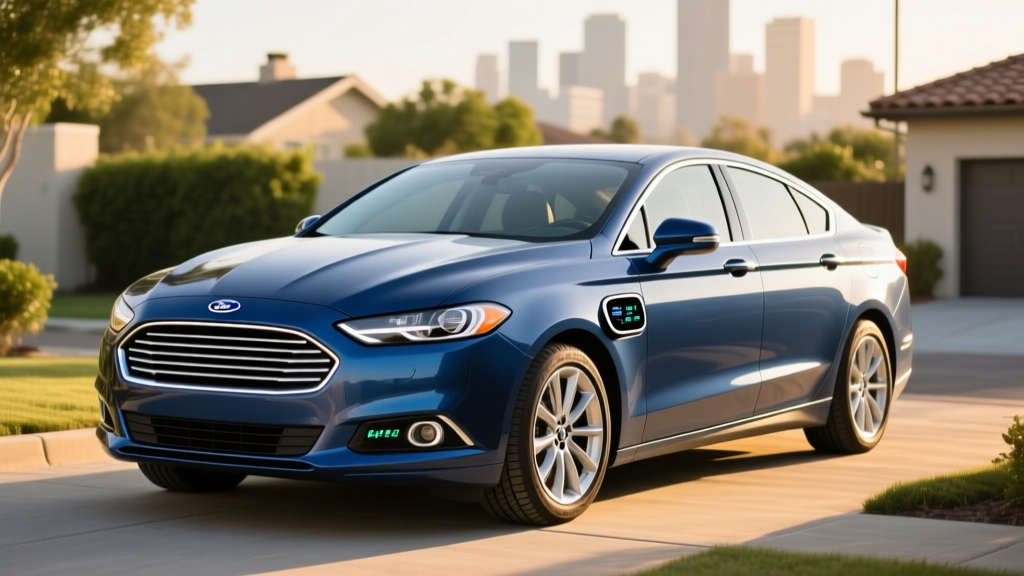
The 2017 Ford Fusion Hybrid SE occupies a specific niche in the used-car market: a midsize sedan that delivers genuine hybrid efficiency without the premium pricing of a Toyota Camry Hybrid or the complexity of a plug-in. For buyers in 2026 evaluating a used hybrid, the Fusion Hybrid SE remains a data point worth examining — not because it's cutting-edge, but because it proves that conventional hybrid (HEV) technology from the mid-2010s holds up well with proper maintenance.
This guide breaks down the 2017 Fusion Hybrid SE's real-world fuel economy, powertrain specs, battery longevity, ownership costs, and how it compares to both PHEV alternatives and modern full EVs.
Ford Fusion Hybrid SE: Core Specs at a Glance
| Attribute | Value |
|---|---|
| EPA Combined MPG | 42 MPG |
| EPA City / Highway | 43 city / 41 highway |
| Combined Horsepower | 188 hp |
| Gas Engine | 2.0L Atkinson-cycle I-4 (141 hp, 129 lb-ft) |
| Electric Motor | Permanent-magnet synchronous AC (120 hp / 88 kW) |
| Traction Battery | 1.4 kWh lithium-ion (usable ~1.0 kWh) |
| Transmission | eCVT (planetary gearset, not belt-driven) |
| 0-60 mph | ~7.8 seconds |
| Drivetrain | Front-wheel drive |
| EPA Emissions Rating | SULEV (Super Ultra-Low Emission Vehicle) |
| Original MSRP (SE trim) | $26,860 (2017 base, before destination) |
| Typical 2026 Used Price | $9,500 – $14,000 (depending on mileage/condition) |
Fuel Economy: EPA Numbers vs. Real-World MPG
The 2017 Fusion Hybrid SE carries an EPA rating of 43 city / 41 highway / 42 combined MPG according to fueleconomy.gov. Unlike conventional gas cars, hybrids often match or exceed their city rating in real-world urban driving thanks to regenerative braking and electric-motor assist at low speeds.
| Driving Scenario | Expected MPG | Notes |
|---|---|---|
| EPA City (sticker) | 43 MPG | Stop-and-go test cycle |
| EPA Highway (sticker) | 41 MPG | |
| EPA Combined (sticker) | 42 MPG | 55% city / 45% highway blend |
| Real-world city (owner reports) | 40 – 46 MPG | Regen braking boosts urban efficiency |
| Real-world highway (70-80 mph) | 36 – 40 MPG | Aero drag reduces hybrid advantage at speed |
| Cold-weather combined (below 35°F) | 34 – 38 MPG | Engine runs more for cabin heat; battery less efficient |
Owner-reported data on fueleconomy.gov shows the average real-world combined for this model sits around 40.7 MPG across hundreds of submissions. Drivers who stay under 65 mph and use the car primarily for commuting in moderate climates consistently report 42-45 MPG. Highway-heavy drivers at 75+ mph should expect the low-to-mid 30s — aerodynamic drag dominates at those speeds, and the hybrid system provides less benefit than in city driving.
Cold-weather caveat: In sub-freezing temperatures, the gasoline engine must run more frequently to generate cabin heat (the Fusion Hybrid SE uses engine coolant for warmth, not a heat pump). Expect a 10-15% MPG drop in winter months, which is typical for all conventional hybrids.
HEV vs. PHEV: Understanding What You're Buying
The 2017 Fusion Hybrid SE is a conventional hybrid electric vehicle (HEV). It cannot be plugged in. Ford also sold a Fusion Energi — a plug-in hybrid (PHEV) variant — in the same model year. These are fundamentally different vehicles, and confusing them is one of the most common mistakes used-car shoppers make.
| Feature | Fusion Hybrid SE (HEV) | Fusion Energi (PHEV) |
|---|---|---|
| Plugs in? | No — charges via regen + engine | Yes — Level 1 (120V) or Level 2 (240V) |
| Electric-only range | ~1 mile at low speed | 22 miles (EPA) |
| Traction battery | 1.4 kWh lithium-ion | 7.6 kWh lithium-ion |
| EPA combined (gas) | 42 MPG | 42 MPG (gas) / 97 MPGe (electric) |
| Total range | ~630 miles (14.5-gal tank) | ~610 miles (combined EV + gas) |
| Trunk space | 12.0 cu ft | 8.2 cu ft (battery intrusion) |
| Federal tax credit (new, 2017) | None | $4,007 (expired) |
| 2026 used tax credit | None | None — only new vehicles qualify under §30D |
Bottom line: If you see a Fusion Hybrid SE for sale, it does not have a charge port. You will never plug it in. The 1.4 kWh battery charges entirely through regenerative braking and the gasoline engine. This is the simpler, lighter, and more trunk-space-friendly option — but it offers no electric-only commuting capability beyond brief low-speed creep.
Powertrain Deep Dive: How the Hybrid System Works
The 2017 Fusion Hybrid SE uses Ford's second-generation hybrid powertrain, which pairs a 2.0-liter Atkinson-cycle inline-4 engine with a permanent-magnet electric motor through a planetary-gearset eCVT. This is not a traditional belt-and-pulley continuously variable transmission — it's a power-split device that blends engine and motor output seamlessly without fixed gear ratios.
Combined output: 188 horsepower. The gas engine produces 141 hp and 129 lb-ft of torque, while the electric motor contributes up to 120 hp (88 kW). Because peak output for each doesn't occur at the same RPM, combined system horsepower is 188 hp — not a simple sum of the two.
The 1.4 kWh lithium-ion traction battery sits behind the rear seats. It's small by EV standards (a Tesla Model 3 carries ~75 kWh), but in a conventional hybrid it only needs to buffer energy for acceleration assist and regenerative capture, not sustain electric-only driving. The battery's usable capacity is roughly 1.0 kWh — Ford maintains a substantial buffer to prevent deep discharge, which is a key factor in hybrid battery longevity.
The Atkinson-cycle engine sacrifices low-end torque for higher thermal efficiency by keeping the intake valve open longer during the compression stroke. The electric motor fills in the torque gap at low RPM, which is why hybrid acceleration feels smoother than the engine's standalone 141 hp would suggest.
Battery Reliability, Warranty & Replacement Cost
2017 Fusion Hybrid SE — Battery Warranty (Original)
Ford's original hybrid battery warranty: 8 years / 100,000 miles (whichever comes first) in most states. In California Air Resources Board (CARB) states — including CA, CT, ME, MA, NJ, NY, OR, RI, VT, and WA — the warranty extends to 10 years / 150,000 miles.
2026 status: A 2017 model is now 9 years old. In non-CARB states, the original battery warranty has expired. In CARB states, it may still have coverage through 2027 or 150,000 miles — check the vehicle's VIN and registration state with a Ford dealer.
Real-world battery longevity: The 1.4 kWh lithium-ion pack in the Fusion Hybrid is one of the more durable hybrid batteries on the market. Because it operates within a narrow state-of-charge window (roughly 40-60% SoC) and never experiences deep discharge cycles, degradation is minimal. Many Fusion Hybrid taxis and fleet vehicles have surpassed 200,000 miles on the original battery pack with negligible capacity loss.
That said, age degrades all lithium-ion cells. A 9-year-old pack will have lost some capacity, but because the hybrid system only uses ~1.0 kWh of the 1.4 kWh total, there is enough buffer that modest degradation doesn't noticeably affect fuel economy or drivability until the battery is significantly worn.
Battery replacement cost (2026 estimates):
- OEM Ford replacement pack: $2,500 – $3,500 (part only; labor adds $500-$900)
- Aftermarket/remanufactured pack: $1,200 – $2,000 (from suppliers like Green Bean Battery or Dorman)
- Individual cell/module repair: $400 – $800 at a hybrid-specialist shop (not all shops offer this)
For context, a Toyota Camry Hybrid battery replacement runs $2,000-$4,000, and a Prius pack is $1,500-$2,500. The Fusion Hybrid's battery cost is in line with the segment. Given the robust longevity record, most buyers of a well-maintained 2017 Fusion Hybrid SE will never need a battery replacement during typical ownership.
According to NHTSA records, the 2017 Fusion Hybrid has no open recalls specifically related to the hybrid battery system, though buyers should always check the VIN at nhtsa.gov/recalls before purchasing any used vehicle.
Tax Credit Eligibility for Used Hybrid Buyers in 2026
Here's where the math gets straightforward: the 2017 Ford Fusion Hybrid SE does not qualify for any federal tax credit in 2026.
The federal §30D new clean vehicle credit applies only to new vehicles, and conventional hybrids (HEVs) have never qualified — the credit requires a minimum battery capacity and plug-in capability. The Fusion Energi (PHEV) qualified for a $4,007 credit when new, but that credit was available only to the original purchaser.
The used clean vehicle credit (§25E) offers up to $4,000 (30% of sale price, capped at $4,000) for qualifying used EVs and PHEVs purchased from a dealer. However, the Fusion Hybrid SE, as a conventional HEV, does not qualify. The Fusion Energi PHEV could potentially qualify under §25E if all requirements are met — but income caps, dealer-sale requirements, and the $25,000 maximum sale price limit apply. Consult IRS guidance on the used clean vehicle credit for current eligibility rules.
State incentives: A handful of states offer rebates or HOV-lane access for used hybrids, but these programs are limited and change frequently. Check your state's energy office or DMV for current offerings.
Who Should Buy the 2017 Fusion Hybrid SE (And Who Shouldn't)
Pros
- 42 MPG combined — real fuel savings over gas-only midsize sedans (a 2017 Fusion 2.5L gas gets 25 MPG combined)
- No plug-in required — no home charging setup, no range anxiety, no public charger dependence
- Smooth, quiet eCVT with no fixed-gear shift shock
- Competitive trunk space (12.0 cu ft) vs. Fusion Energi's compromised 8.2 cu ft
- Strong reliability record on hybrid battery and eCVT powertrain
- Low 2026 used pricing ($9,500-$14,000 range)
- Sync 3 infotainment with Apple CarPlay/Android Auto (on most SE builds)
Cons
- No electric-only driving — you always burn gasoline
- Modest 188 hp — adequate for commuting but not sporty
- Rear-seat battery placement limits trunk pass-through flexibility
- Ford discontinued the Fusion after 2020 — no new parts pipeline for body/interior (powertrain parts remain available)
- Hybrid battery warranty likely expired (unless CARB-state registered)
- No DC fast charging (not applicable — HEVs don't charge externally)
- Not eligible for any federal tax credit as a used purchase
Choose the 2017 Fusion Hybrid SE if:
- You drive 12,000-18,000 miles per year, mostly city/suburban commuting
- You cannot install a home charger (apartment, no garage, rental property)
- You want to spend under $15,000 on a reliable, efficient sedan
- You want hybrid efficiency without the complexity of plug-in charging
- You prioritize low fuel costs over performance or technology features
Look at a PHEV or full EV instead if:
- You have home charging and a short commute (a PHEV like the Fusion Energi or a used Chevy Bolt EV could eliminate most gasoline use)
- You want electric-only driving for environmental or cost reasons
- You want access to HOV lanes (available in some states for EVs/PHEVs but not conventional HEVs)
- You want the latest ADAS features — the 2017 Fusion's available adaptive cruise and lane-keeping are basic compared to 2024+ models
2017 Fusion Hybrid SE vs. Alternatives in 2026
| Model (2017) | EPA Combined MPG | Combined HP | Typical Used Price | HEV or PHEV |
|---|---|---|---|---|
| Ford Fusion Hybrid SE | 42 MPG | 188 hp | $9,500 – $14,000 | HEV |
| Toyota Camry Hybrid XLE | 40 MPG | 200 hp | $14,000 – $18,000 | HEV |
| Honda Accord Hybrid EX-L | 48 MPG | 212 hp | $14,500 – $19,000 | HEV |
| Hyundai Sonata Hybrid Limited | 39 MPG | 193 hp | $11,000 – $15,000 | HEV |
| Ford Fusion Energi (PHEV) | 42 MPG / 97 MPGe | 188 hp | $10,000 – $15,000 | PHEV (22 mi EV) |
The Fusion Hybrid SE undercuts the Camry and Accord Hybrid on price while matching or nearly matching their efficiency. The Accord Hybrid's 48 MPG combined is notably better, but commands a higher used price. The Sonata Hybrid is a close competitor in both price and efficiency.
Buying Checklist for a Used 2017 Fusion Hybrid SE
- Check the VIN at nhtsa.gov/recalls — confirm no open recalls (hybrid-specific or otherwise).
- Pull a vehicle history report (Carfax/AutoCheck) — look for consistent maintenance, no salvage title, and fleet/rental history.
- Verify hybrid battery health — a Ford dealer can pull the battery state-of-health (SoH) via OBD-II. Look for SoH above 85%. Independent hybrid shops can also perform this check.
- Test-drive in EV mode — the Fusion Hybrid can operate in electric-only mode at low speeds (under ~25 mph). If the engine kicks in immediately or the transition feels rough, the battery or inverter may need attention.
- Check the brake feel — regenerative braking blends with friction brakes. The transition should be smooth; any grinding or pulsation suggests worn friction brakes or a regen system issue.
- Inspect the coolant system — the hybrid inverter has its own coolant loop separate from the engine. Confirm it has been serviced per Ford's schedule (typically every 100,000 miles).
- Verify CARB-state warranty status — if the car was originally sold and registered in a CARB state, the hybrid battery may still carry warranty coverage through 2027.
Frequently Asked Questions
How many MPG does the 2017 Ford Fusion Hybrid SE get?
The EPA rates it at 43 city / 41 highway / 42 combined MPG. Real-world owners average around 40-41 MPG combined, with city drivers often exceeding the EPA city rating and highway drivers seeing 36-40 MPG at sustained speeds above 70 mph.
Can I plug in the 2017 Fusion Hybrid SE to charge it?
No. The Fusion Hybrid SE is a conventional hybrid (HEV) with no charge port. Its 1.4 kWh battery charges exclusively through regenerative braking and the gasoline engine. If you want a plug-in Ford Fusion, look for the Fusion Energi (PHEV) model instead.
How far can the Fusion Hybrid drive on electric power alone?
Less than one mile, and only at very low speeds (under ~25 mph). The 1.4 kWh battery is not designed for sustained electric-only driving. It exists to assist the gasoline engine during acceleration and to capture braking energy. For meaningful electric-only range, you need the Fusion Energi PHEV (22 miles EPA) or a full battery-electric vehicle.
Is the 2017 Fusion Hybrid reliable?
Yes, with normal maintenance. The eCVT planetary gearset has no belts, clutches, or bands to wear out — it's one of the most durable transmission designs in the industry. The hybrid battery has a strong longevity record, with many examples exceeding 200,000 miles. The main reliability concerns are the same as any 9-year-old sedan: suspension components, engine mounts, and standard wear items.
What does a replacement hybrid battery cost?
An OEM Ford replacement battery runs $2,500-$3,500 plus $500-$900 in labor. Aftermarket/remanufactured packs are available for $1,200-$2,000. Individual cell replacement at a hybrid specialist can cost as little as $400-$800. Most 2017 Fusion Hybrids still on the road have not required battery replacement.
Does the 2017 Fusion Hybrid SE qualify for any tax credit?
No. Conventional hybrids (HEVs) have never qualified for the federal §30D clean vehicle tax credit, which requires plug-in capability and minimum battery capacity. The used-vehicle credit (§25E) also does not cover HEVs. No federal tax incentive is available for this model in 2026.
Hybrid vs. PHEV vs. full EV — which should I choose?
Choose a conventional hybrid (HEV) like this Fusion Hybrid SE if you can't charge at home, want zero behavior change from a gas car, and prioritize low purchase price. Choose a PHEV if you have home charging, a short commute (under 30 miles), and want to eliminate most gasoline use while keeping a gas engine for longer trips. Choose a full EV if you have reliable home charging, want zero tailpipe emissions, and are ready to plan around public charging for road trips.
How does the Fusion Hybrid compare to a used Tesla Model 3 or Chevy Bolt EV?
A 2017-2018 Chevy Bolt EV offers 238 miles of EPA range and typically sells for $11,000-$15,000 — similar money, but you need home charging. A used 2018-2019 Tesla Model 3 starts around $18,000-$22,000. Both offer dramatically lower per-mile fuel costs if you can charge at home (electricity at $0.13/kWh ≈ $4 per 100 miles vs. the Fusion Hybrid at $10-$12 per 100 miles on gasoline). The trade-off is charging infrastructure dependence and potentially higher insurance costs on the EVs.