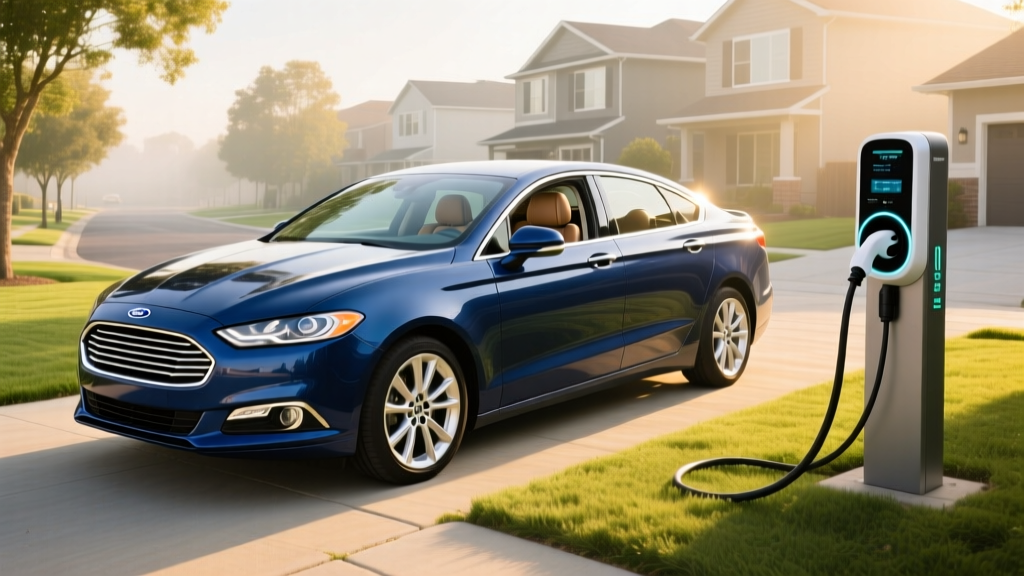
The Ford Fusion Hybrid was one of the most efficient midsize sedans of its era, and it remains a compelling option on the used market in 2026. If you're researching 2017 Ford Fusion Hybrid mileage, you're likely weighing a used purchase against newer hybrids or a full EV. This guide covers every number that matters — EPA ratings, real-world fuel economy, the Energi plug-in variant, battery longevity, and whether this platform still makes sense nearly a decade after it left the showroom.
EPA Fuel Economy: 2017 Ford Fusion Hybrid MPG Breakdown
The 2017 Fusion Hybrid carries an EPA rating that still holds up against many current midsize hybrids. Here is the official data from fueleconomy.gov:
| Model | City MPG | Highway MPG | Combined MPG | Fuel Tank | Total Range |
|---|---|---|---|---|---|
| 2017 Fusion Hybrid (HEV) | 43 | 41 | 42 | 13.5 gal | ~567 mi |
| 2017 Fusion Energi (PHEV) | 104 MPGe | 91 MPGe | 97 MPGe | 14.0 gal | 21 mi EV + ~340 mi gas |
The HEV's 43/41/42 split is notable. Most hybrids favor city driving where regenerative braking and electric-only low-speed operation dominate, and the Fusion Hybrid is no exception. The 2 MPG city advantage over highway reflects how the 1.4 kWh lithium-ion traction battery assists during stop-and-go traffic but provides less benefit at sustained 70+ MPH cruising.
Real-World MPG: What Owners Actually Report
EPA estimates are a baseline, not a guarantee. Based on aggregated owner data from Fuelly and forum reports, real-world 2017 Fusion Hybrid mileage typically falls into these ranges:
- City / suburban: 40–46 MPG (many owners exceed the EPA 43 city rating in warm weather)
- Highway (65–75 MPH): 37–41 MPG (aerodynamic drag and reduced regen opportunity lower efficiency)
- Cold weather (below 35°F): 34–38 MPG combined (engine runs more often for cabin heat; battery chemistry is less efficient)
- Overall owner average: ~39–41 MPG combined across mixed driving
The Fusion Hybrid's eCVT powertrain is well-suited to urban commuting. Drivers who prioritize smooth acceleration and use the brake coach feature to maximize regenerative braking routinely report mid-40s MPG in city driving during spring and fall. Winter is the penalty season: the gasoline engine runs more frequently to generate cabin heat and maintain battery temperature, dropping efficiency by 10–15%.
2017 Ford Fusion Energi: PHEV Electric Range and Specs
Ford offered the Fusion in two electrified variants for 2017. Understanding the difference is critical before buying used.
Hybrid (HEV): The 2017 Fusion Hybrid has a small 1.4 kWh battery charged entirely by regenerative braking and the gasoline engine. You never plug it in. It cannot drive on electric power alone beyond very low-speed, short-distance creep.
Plug-in Hybrid (PHEV): The 2017 Fusion Energi carries a larger 7.6 kWh battery (usable capacity) that you charge by plugging in. It can drive up to 21 miles on electricity alone before the gasoline engine engages, functioning as a conventional hybrid afterward.
| Specification | 2017 Fusion Hybrid (HEV) | 2017 Fusion Energi (PHEV) |
|---|---|---|
| Battery capacity | 1.4 kWh (Li-ion) | 7.6 kWh usable (Li-ion) |
| Electric-only range | N/A (motor assist only) | 21 miles (EPA) |
| Combined system HP | 188 hp | 188 hp |
| Engine | 2.0L Atkinson-cycle I-4 | 2.0L Atkinson-cycle I-4 |
| Transmission | eCVT | eCVT |
| Level 1 charge time (120V) | N/A | ~7 hours |
| Level 2 charge time (240V) | N/A | ~2.5 hours |
| DC fast charging | N/A | Not supported |
| Charge port | None | SAE J1772 |
| 0–60 MPH | ~8.4 sec | ~8.8 sec (heavier) |
The Energi's 21-mile electric-only range is modest by 2026 PHEV standards — the current Toyota RAV4 Prime delivers 42 miles, and the Hyundai Tucson PHEV offers 33. But for a short commute under 20 miles round-trip with home charging, the Energi can run almost entirely on electricity on weekdays, with the gas engine available for longer trips without range anxiety.
Neither variant supports DC fast charging. The Energi's Level 2 charge time of approximately 2.5 hours at 3.3 kW is adequate for overnight or workplace top-ups but means you won't quickly replenish the battery at a public fast charger during a road trip.
Powertrain Deep Dive: 188 HP Atkinson-Cycle System
Both the Hybrid and Energi pair a 2.0-liter Atkinson-cycle four-cylinder engine (141 hp, 129 lb-ft torque) with a permanent-magnet electric motor integrated into the eCVT transaxle. Combined system output is 188 horsepower.
The Atkinson cycle sacrifices low-end torque for thermal efficiency — the intake valve stays open longer during the compression stroke, reducing pumping losses. The electric motor fills in the torque gap off the line, which is why the Fusion Hybrid feels reasonably responsive in city driving despite its efficiency-first engine tuning.
The eCVT is not a belt-and-pulley CVT like those in some competitors. It uses a planetary gearset to blend engine and motor power, which contributes to the powertrain's durability — there is no belt to wear or fluid to degrade in the same way. This design is shared with Toyota's Hybrid Synergy Drive architecture and has proven robust over hundreds of thousands of miles in fleet and taxi service.
Battery Health, Warranty, and Replacement Cost
Battery longevity is the top concern for any used hybrid buyer. Here's what you need to know about the 2017 Fusion Hybrid battery:
Hybrid (HEV): 8 years / 100,000 miles (10 years / 150,000 miles in CARB states including CA, CT, MA, ME, MD, NJ, NY, OR, RI, VT, WA)
Energi (PHEV): 8 years / 100,000 miles (10 years / 150,000 miles in CARB states)
Warranty covers defects and capacity loss below approximately 70% of original capacity. For a 2017 model, the federal 8-year warranty has expired as of 2025 unless the vehicle was first registered late in the calendar year. CARB-state 10-year coverage may still apply through 2027 for qualifying vehicles.
Degradation reality: The Fusion Hybrid's 1.4 kWh battery is small and conservatively managed — Ford programmed a generous buffer (the car never uses the full top or bottom of the battery's charge window). Most owners report minimal noticeable degradation at 100,000+ miles. The Energi's 7.6 kWh pack shows more measurable loss; owners at 80,000+ miles sometimes report electric-only range dropping from 21 miles to 16–18 miles, which is within expected lithium-ion aging curves.
Replacement cost: A new OEM hybrid battery from Ford runs approximately $2,500–$3,500 for the HEV and $4,000–$6,000 for the Energi, plus $500–$1,000 in labor. Independent hybrid shops and refurbished battery options can reduce this to $1,500–$2,500 for the HEV. Given the conservative buffer management, complete battery failure before 150,000 miles is uncommon, but individual cell failures can occur and are sometimes repairable without a full pack replacement.
Used Pricing and Tax Credit Eligibility in 2026
The 2017 Fusion Hybrid is no longer in production — Ford discontinued the Fusion after the 2020 model year. Current used-market pricing (early 2026):
- 2017 Fusion Hybrid (SE/Luxury trims, 60k–100k miles): $11,000–$16,000
- 2017 Fusion Hybrid (Titanium, under 60k miles): $14,000–$18,000
- 2017 Fusion Energi (all trims, 60k–100k miles): $12,000–$17,000
Federal tax credit: Under current IRS §30D rules, the Used Clean Vehicle Credit offers up to $4,000 (or 30% of the sale price, whichever is lower) for qualifying used EVs and PHEVs purchased from a dealer. Key requirements:
- Sale price must be $25,000 or less (the Fusion Energi qualifies easily)
- Buyer income caps: $75,000 single / $112,500 head of household / $150,000 joint
- Vehicle must be at least two model years old (2017 qualifies)
- The Fusion Energi's 7.6 kWh battery meets the minimum 4 kWh threshold
- Must purchase from a licensed dealer (private-party sales do not qualify)
- Credit is non-refundable — you must have tax liability to use it
The conventional Fusion Hybrid (HEV) does not qualify for the used clean vehicle credit — only plug-in vehicles (BEVs and PHEVs) are eligible. Consult a tax professional to confirm your individual eligibility before relying on this credit.
Who Should Buy the 2017 Fusion Hybrid in 2026?
- You want maximum simplicity — no charging, no plug, just fill up with gas
- Your commute is city-heavy and you want 40+ MPG without behavior changes
- You're on a budget under $18,000 and want a comfortable, spacious midsize sedan
- You lack access to home or workplace charging
- Your daily round-trip commute is under 20 miles and you can charge at home
- You want electric-only weekday driving with gas-engine flexibility for road trips
- You qualify for the $4,000 used EV tax credit
- You want to reduce fuel costs without committing to a full EV
- You have reliable home Level 2 charging
- You want zero tailpipe emissions and minimal drivetrain maintenance
- Your daily driving is under 200 miles and you rarely take 400+ mile road trips
Reliability and Common Issues
The 2017 Fusion Hybrid benefits from one of the most proven hybrid powertrains in Ford's history. The planetary eCVT eliminates traditional transmission wear components, and the Atkinson-cycle engine operates under less thermal stress than a conventional Otto-cycle design. NHTSA gave the 2017 Fusion a 5-star overall safety rating.
Common issues reported by owners and mechanics include:
- 12V battery drain: Like many hybrids, the Fusion uses a conventional 12V battery for accessories. If the car sits for extended periods, the 12V can die, preventing the vehicle from starting even though the hybrid battery is charged.
- Brake actuator recalls: Some 2013–2018 Fusion Hybrid/Energi models were subject to recalls for the brake system. Check NHTSA for open recalls on any specific VIN.
- Infotainment quirks: The SYNC 3 system is generally reliable but can develop touchscreen responsiveness issues at higher mileage.
- Coolant leaks: The inverter coolant system should be inspected at purchase — leaks are uncommon but costly if neglected.
Frequently Asked Questions
How many MPG does the 2017 Ford Fusion Hybrid get?
The EPA rates the 2017 Fusion Hybrid at 43 city / 41 highway / 42 combined MPG. Real-world owners typically see 39–41 MPG combined, with city driving often exceeding 43 MPG in warm weather and cold-weather combined dropping to 34–38 MPG.
How far can the 2017 Fusion Energi go on electric only?
The EPA rates the 2017 Fusion Energi at 21 miles of electric-only range. Real-world range varies from about 17 miles in cold weather or at highway speeds to 24+ miles in mild conditions with gentle acceleration. After the battery is depleted, it operates as a conventional hybrid with an EPA rating of 42 MPG combined (gasoline-only operation is slightly lower than the HEV due to added weight).
Does the 2017 Fusion Hybrid need to be plugged in?
No. The conventional Fusion Hybrid (HEV) charges its battery entirely through regenerative braking and the gasoline engine. It has no charge port. Only the Fusion Energi (PHEV) requires plugging in to access its electric-only range — if you never plug in the Energi, it still functions as a hybrid but you lose the EV-range benefit.
Is the 2017 Fusion Hybrid battery expensive to replace?
A new OEM hybrid battery costs approximately $2,500–$3,500 for the HEV and $4,000–$6,000 for the Energi, plus labor. Refurbished and independent-shop options reduce this to $1,500–$2,500 for the HEV. Complete battery failure before 150,000 miles is uncommon due to Ford's conservative charge-buffer management.
Does the 2017 Fusion Energi qualify for a tax credit?
Under current IRS rules, the 2017 Fusion Energi may qualify for the Used Clean Vehicle Credit of up to $4,000 when purchased from a licensed dealer, subject to buyer income limits ($75k single / $150k joint) and a $25,000 maximum sale price. The conventional Hybrid (HEV) does not qualify for any federal tax credit. Verify eligibility with a tax professional and the IRS Used Clean Vehicle Credit page.
Hybrid vs. PHEV vs. EV — which should I choose?
Choose the HEV if you cannot charge at home and want effortless efficiency. Choose the PHEV (Energi) if you have home charging and a short commute but need gas-engine flexibility for longer trips. Choose a full EV if you have reliable home charging, mostly drive under 200 miles per day, and want the lowest operating cost and zero tailpipe emissions. The Fusion Hybrid excels as an HEV; its Energi PHEV variant is a budget entry to plug-in ownership but offers less electric range than newer PHEVs.
- Proven, durable planetary eCVT powertrain
- EPA 42 MPG combined still competitive in 2026
- Spacious midsize cabin with comfortable ride
- Strong used-market value under $18,000
- 5-star NHTSA safety rating
- Discontinued after 2020 — no new parts pipeline from Ford long-term
- Energi's 21-mile EV range is low by current PHEV standards
- No DC fast charging on Energi
- SYNC 3 infotainment feels dated vs. 2026 systems
- Original 8-year hybrid battery warranty has expired for most 2017 models