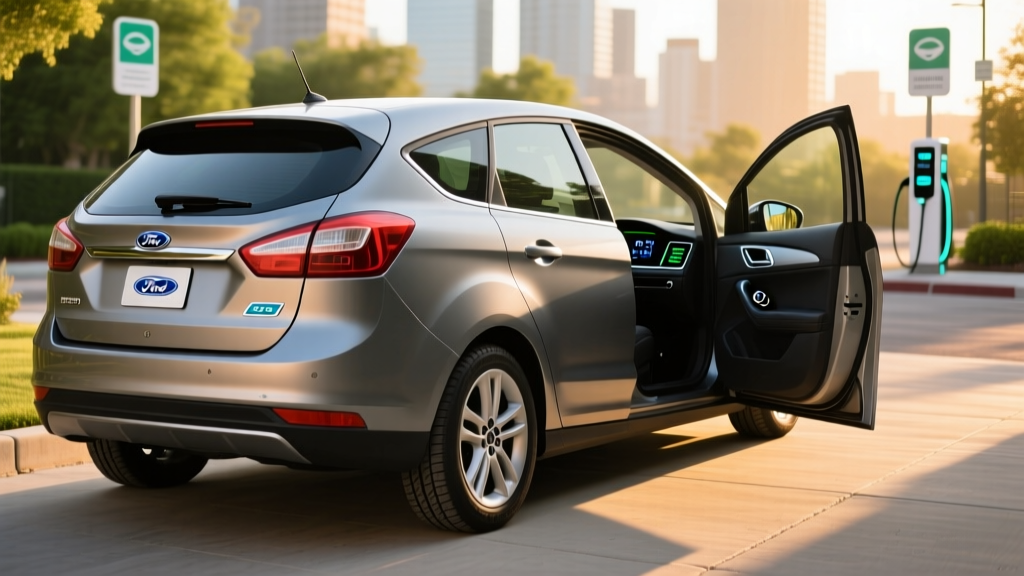
The 2017 Ford C-Max Hybrid occupies a specific niche in the used-hybrid market: a tall-hatchback HEV with competitive fuel economy, generous cargo space, and a comfortable ride. For shoppers searching for details on the cruise control 2017 Ford C-Max Hybrid setup—or evaluating this model as a budget-friendly hybrid in 2026—this guide covers the exact EPA numbers, powertrain specs, battery longevity, and real-world ownership data you need before buying.
Ford discontinued the C-Max Hybrid after the 2018 model year, so every example on the market today is used. That changes the calculus: there are no federal tax credits available, battery age matters more than battery size, and feature availability depends heavily on trim level. Here's the complete breakdown.
2017 Ford C-Max Hybrid: Key Specs at a Glance
| Specification | 2017 Ford C-Max Hybrid |
|---|---|
| Powertrain Type | Conventional Hybrid (HEV) — no plug |
| Engine | 2.0L Atkinson-cycle 4-cylinder |
| Electric Motor | Permanent-magnet AC synchronous |
| Combined Horsepower | 188 hp (net system) |
| Transmission | Electronic CVT (eCVT) |
| Hybrid Battery | 1.4 kWh lithium-ion (usable ~1.0 kWh) |
| EPA MPG (City / Hwy / Combined) | 42 / 38 / 40 MPG |
| Fuel Tank | 14.0 gallons |
| Total Range | ~560 miles |
| 0-60 mph | ~8.1 seconds |
| Cargo Volume (rear seats up / folded) | 24.5 / 52.6 cu ft |
| Original MSRP (SE / SEL) | $24,120 / $29,170 |
| Typical 2026 Used Price | $9,000 – $15,000 |
| Battery Warranty (original) | 8 years / 100,000 miles |
EPA Fuel Economy vs. Real-World MPG
The EPA rates the 2017 C-Max Hybrid at 42 city / 38 highway / 40 combined MPG. These numbers were revised upward for the 2017 model year after Ford settled a class-action lawsuit over earlier C-Max fuel economy claims (the 2013–2014 models were originally rated at 47 MPG combined, then corrected downward).
| Driving Scenario | Expected MPG | Notes |
|---|---|---|
| City (stop-and-go) | 40 – 46 MPG | Hybrids excel here; regenerative braking recovers energy |
| Highway (70 mph, flat) | 35 – 39 MPG | Aerodynamic drag and less regen opportunity reduce efficiency |
| Combined (mixed driving) | 38 – 42 MPG | Most owners report numbers close to the 40 MPG EPA sticker |
| Cold weather (below 30°F) | 32 – 37 MPG | Engine runs more to heat cabin; battery efficiency drops |
The C-Max Hybrid's real-world advantage is city driving, where the electric motor handles low-speed propulsion and regenerative braking recharges the small battery continuously. On long highway trips, expect a noticeable drop from the combined rating—this is typical of all conventional hybrids, not unique to Ford.
Cruise Control and Driver-Assist Features by Trim
This is where trim selection matters significantly. The 2017 C-Max Hybrid was offered in two trims: SE and SEL.
Important context: neither cruise control system on the 2017 C-Max is a Level 2 driver-assist system in the modern sense (like Ford's current BlueCruise). These are SAE Level 1 features—the driver must remain fully engaged, keep hands on the wheel, and manage steering at all times. The adaptive cruise control will not bring the car to a complete stop and resume in heavy traffic the way modern stop-and-go ACC systems do.
Buyer tip: If adaptive cruise control is a priority, confirm the SEL Premium Package is present before purchasing. Many used SEL models lack it, as it was an expensive add-on (~$2,395 at the time) and not every buyer selected it. Check for the radar sensor in the lower front grille and the ACC buttons on the steering wheel.
Hybrid Powertrain: How It Works
The C-Max Hybrid pairs a 2.0-liter Atkinson-cycle four-cylinder engine (producing 141 hp on its own) with a permanent-magnet electric motor integrated into the eCVT transaxle. Combined net system output is 188 horsepower.
The 1.4 kWh lithium-ion battery pack is small by modern standards—it stores roughly 1.0 kWh of usable energy. This is a conventional hybrid (HEV), meaning:
- No plug required. The battery charges exclusively through regenerative braking and the gasoline engine.
- No electric-only range to speak of. The C-Max can creep short distances (a few hundred yards) at low speed on electric power alone, but it cannot sustain EV-mode driving like a PHEV.
- No range anxiety. With a 14-gallon tank and 40 MPG combined, total range exceeds 560 miles.
The eCVT is not a belt-driven CVT like those in some Nissan or Subaru models. It uses a planetary gearset to blend engine and motor power, which is mechanically simpler and generally more durable. Toyota pioneered this architecture (called the Hybrid Synergy Drive), and Ford licensed a similar approach for its earlier hybrids before developing its own variant.
Battery Longevity, Warranty, and Replacement Cost
For a 2017 model, the original 8-year / 100,000-mile warranty has now expired for most vehicles (the 8-year mark passed in 2025). This is a critical consideration for 2026 buyers.
Real-world battery durability: Ford's lithium-ion hybrid battery packs have proven reasonably durable. Unlike the larger batteries in PHEVs and BEVs, the C-Max's 1.4 kWh pack undergoes shallow charge/discharge cycles—it rarely goes below 40% or above 80% state of charge. This shallow cycling dramatically reduces degradation. Many C-Max taxis and fleet vehicles have exceeded 200,000 miles on the original battery.
That said, a nine-year-old battery is entering the window where capacity loss becomes more noticeable. Signs of a weakening hybrid battery include:
- Reduced fuel economy (the engine runs more frequently to compensate)
- More frequent engine cycling on and off
- A dashboard warning light (check engine or hybrid system warning)
- Reduced regenerative braking feel
Battery replacement cost: A new OEM hybrid battery from Ford runs approximately $2,500 to $3,500 including labor at a dealership. Independent hybrid specialists may offer refurbished or reconditioned packs for $1,200 to $2,000. Third-party shops can sometimes replace individual failed cells for $500–$1,000, though this is a temporary fix if other cells are also aging.
Before purchasing, request a hybrid battery health report from a Ford dealer or qualified hybrid mechanic. The battery's state of health (SoH) can be read via OBD-II diagnostics and gives a percentage of remaining capacity relative to new.
HEV vs. PHEV vs. Full EV: Which Fits Your Driving?
| Factor | C-Max Hybrid (HEV) | Plug-In Hybrid (e.g., Prius Prime) | Full EV (e.g., Model 3, Bolt) |
|---|---|---|---|
| Plug-in Required? | No | Yes (for EV range) | Yes (always) |
| Electric-Only Range | Negligible | 25 – 44 miles | 250 – 360 miles |
| Total Range | ~560 miles | 400 – 600 miles | 250 – 360 miles |
| Fuel Cost (per mile) | ~$0.10 – $0.13 | ~$0.04 (EV mode) / $0.10 (gas) | ~$0.03 – $0.06 |
| Home Charging Needed? | No | Recommended | Essential |
| Used Price (2026) | $9,000 – $15,000 | $18,000 – $30,000 | $15,000 – $35,000 |
| Federal Tax Credit (used) | Not eligible | Up to $4,000 (§25E) | Up to $4,000 (§25E) |
| Best For | No plug access, budget buyers | Short commutes + road trips | Home charging, low running cost |
The C-Max Hybrid makes sense in 2026 if you:
- Cannot install a home charger (apartment, street parking, no garage)
- Want a low purchase price with no charging infrastructure dependency
- Drive mostly in the city where hybrid efficiency peaks
- Need hatchback cargo flexibility without paying SUV prices
Consider a PHEV or full EV instead if you have home charging access and want to reduce fuel costs further. A used Chevrolet Bolt EV (259-mile range) or a newer Toyota Prius Prime (44-mile EV range) may cost more upfront but deliver lower per-mile costs over time.
Tax Credit Eligibility for Used Hybrid Buyers
The 2017 Ford C-Max Hybrid does not qualify for the federal §30D new clean vehicle credit—it was never a plug-in vehicle, and it's no longer sold new.
Under the IRS §25E used clean vehicle credit, eligible used vehicles must be either a battery-electric vehicle (BEV), a plug-in hybrid (PHEV), or a fuel-cell vehicle. Conventional hybrids like the C-Max Hybrid are excluded from §25E.
Some states offer their own incentives for used hybrid purchases, but these vary widely by jurisdiction. Check your state's energy or environmental agency website for current programs. A tax professional can confirm eligibility for any local credits.
Reliability and Common Issues
The 2017 C-Max Hybrid rates as an average-to-above-average performer in reliability. The hybrid powertrain itself is robust—the eCVT has no belts or friction clutches to wear, and the Atkinson-cycle engine operates under less stress than a conventional engine. NHTSA records show no major pattern failures specific to the hybrid system.
Common issues reported by owners and mechanics include:
- 12V battery drain: Like many hybrids, the C-Max can experience 12V auxiliary battery issues if the vehicle sits unused for extended periods. The 12V battery powers electronics and boots the hybrid system; if it dies, the car won't start even if the hybrid battery is full.
- A/C compressor noise: Some units experience premature A/C compressor wear, which is an expensive repair ($800–$1,400).
- Transmission shudder: A small number of owners report a low-speed shudder from the eCVT, typically resolved with a software update or fluid change.
- Infotainment glitches: The SYNC 3 system is generally reliable but can freeze or lag; updates are available through Ford.
Overall, the C-Max Hybrid is a lower-risk used hybrid purchase compared to early-model-year vehicles from other manufacturers. The main financial risk is the aging hybrid battery, which should be evaluated pre-purchase.
- 40 MPG combined; 42+ in city driving
- Tall hatchback: 52.6 cu ft cargo with seats folded
- Comfortable ride quality, quiet cabin
- No charging infrastructure needed
- 188 hp provides adequate acceleration
- Affordable used pricing ($9K–$15K)
- Discontinued — no new models or updates
- Hybrid battery warranty likely expired
- Adaptive cruise only on SEL with premium package
- No plug-in option; cannot access EV carpool lanes
- Highway MPG drops below EPA sticker
- SYNC 3 infotainment feels dated in 2026
Frequently Asked Questions
How many MPG does the 2017 Ford C-Max Hybrid get?
The EPA rates it at 42 city / 38 highway / 40 combined MPG. Real-world city driving often matches or exceeds the EPA city number, while sustained highway driving at 70+ mph typically yields 35–39 MPG. Cold weather can reduce combined MPG to the low-to-mid 30s.
Does the 2017 C-Max Hybrid need to be plugged in?
No. The C-Max Hybrid is a conventional HEV. It charges its small 1.4 kWh battery through regenerative braking and the gasoline engine. You never plug it in. If you want plug-in capability, Ford offered the C-Max Energi (a PHEV) through 2017, which had a 7.6 kWh battery and 21 miles of electric-only range—but that's a separate model.
What cruise control does the 2017 C-Max Hybrid have?
The SE trim includes standard cruise control (set speed, maintain speed). The SEL trim, when equipped with the SEL Premium Package, adds adaptive cruise control with radar-based following distance. Neither system is a modern Level 2 driver-assist—steering remains the driver's responsibility at all times.
Is the 2017 C-Max Hybrid reliable?
Yes, with caveats. The hybrid powertrain is mechanically simple and proven durable. The main concern for 2026 buyers is hybrid battery age—at 9 years old, the battery may be entering the window where replacement becomes necessary within the next few years. A pre-purchase battery health check is strongly recommended.
How much does a hybrid battery replacement cost?
Expect $2,500–$3,500 for a new OEM battery at a Ford dealer, or $1,200–$2,000 for a refurbished pack from an independent hybrid specialist. Individual cell replacement is possible for $500–$1,000 but may not be a lasting fix.
Does the 2017 C-Max Hybrid qualify for any tax credit?
No. As a conventional hybrid, it is not eligible for the federal §30D new vehicle credit or the §25E used vehicle credit. Some states may offer separate incentives for hybrid purchases—check your state's energy office for current programs.
How does the C-Max Hybrid compare to a Toyota Prius?
The 2017 Prius is rated at 54 city / 50 highway / 52 combined MPG (Eco trim), significantly outperforming the C-Max on fuel economy. However, the C-Max offers more cargo volume (52.6 vs. 50.7 cu ft), a more car-like driving feel, and more horsepower (188 vs. 121). The Prius wins on efficiency; the C-Max wins on space and power.