The 2017 Chrysler Pacifica Plug-In Hybrid was the first plug-in hybrid minivan sold in the United States, and it remains one of the only PHEV minivans available on the used market in 2026. For families who want electric-only school runs and gas-powered road trips without range anxiety, this vehicle occupies a unique niche. But buying a nine-year-old PHEV requires careful evaluation of battery health, warranty status, and real-world efficiency. This guide covers every spec, cost, and ownership reality you need to know.
HEV vs PHEV: What the Pacifica Plug-In Hybrid Actually Is
Conventional Hybrid (HEV): A standard hybrid like the Toyota Sienna Hybrid uses a small battery (typically 1-2 kWh) that recharges through regenerative braking and the engine. You never plug it in. Electric-only driving is limited to brief low-speed bursts.
Plug-In Hybrid (PHEV): The 2017 Chrysler Pacifica Plug-In Hybrid carries a much larger 16 kWh lithium-ion battery pack that you charge by plugging in. This enables genuine electric-only driving — up to 33 miles per the EPA — before the gasoline engine engages. Once the battery is depleted, it operates as a conventional hybrid.
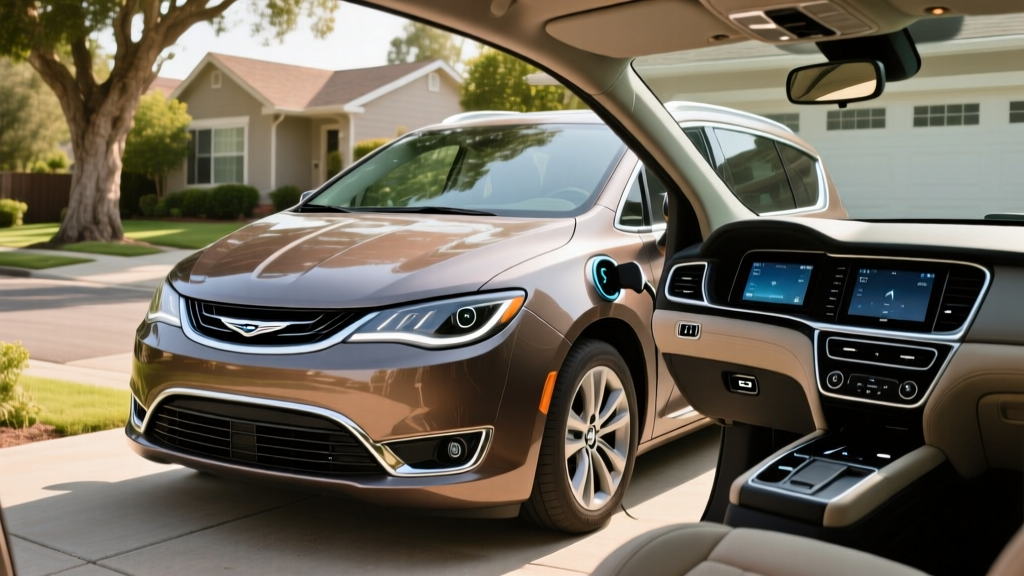
The distinction matters because the Pacifica was also sold as a gas-only model (and later a conventional HEV wasn't offered until the 2026 Chrysler Pacifica Hybrid refreshed lineup). When shopping used, confirm you're looking at the Plug-In Hybrid variant, identifiable by its charge port on the driver-side front fender and "eHybrid" badging.
Electric Range, MPGe, and Fuel Economy Breakdown
The EPA rated the 2017 Pacifica PHEV at 33 miles of electric-only range and 84 MPGe (miles per gallon equivalent) when running on battery power. Once the battery depletes, the combined gas-electric hybrid mode delivers 32 MPG combined.
| Metric | EPA Rating | Real-World Expectation |
|---|---|---|
| Electric-only range | 33 miles | 25-30 mi (highway/cold); 30-35 mi (city, mild weather) |
| MPGe (electric mode) | 84 MPGe | 70-85 MPGe depending on conditions |
| Combined MPG (hybrid mode) | 32 MPG | 28-34 MPG (hybrids often beat EPA in city) |
| City MPG (hybrid mode) | 33 MPG | 30-36 MPG |
| Highway MPG (hybrid mode) | 30 MPG | 27-31 MPG |
| Total combined range | 566 miles | ~500-560 miles |
Real-world context: The 33-mile electric range holds up well in city driving at moderate temperatures, where regenerative braking recovers energy and speeds stay low. On the highway at 70+ mph or in freezing weather, expect that range to drop to roughly 25 miles. The lithium-ion pack has no active thermal management (it uses passive air cooling), which means extreme heat or cold affects both range and charging speed more than in liquid-cooled EV batteries.
In hybrid mode, real-world owners frequently report exceeding the EPA's 32 MPG combined in stop-and-go city traffic — a common trait of PHEVs, where regenerative braking boosts urban efficiency. Highway-heavy commutes will trend closer to 28-30 MPG.
Powertrain, Battery, and Charging Specifications
| Specification | Detail |
|---|---|
| Engine | 3.6L Atkinson-cycle V6 |
| Electric motors | Two motor-generators (integrated in transmission) |
| Combined system horsepower | 262 hp |
| Transmission | Electrically variable transmission (eVT / planetary gearset) |
| Battery capacity (gross) | 16 kWh |
| Battery usable capacity | ~13 kWh |
| Battery chemistry | Lithium-ion (NMC) |
| Battery cooling | Passive air cooling |
| Level 1 charging (120V) | ~14 hours (full charge) |
| Level 2 charging (240V) | ~2 hours (full charge at 6.6 kW onboard charger) |
| DC fast charging | Not supported |
| Charge port | J1772 (driver-side front fender) |
| 0-60 mph | ~7.1 seconds |
| Drivetrain | Front-wheel drive |
The 16 kWh battery pack sits under the second-row floor, which means the Pacifica PHEV loses the Stow 'n Go second-row seats found on the gas model. The second-row captain's chairs are fixed and must be removed (not folded) if you need a flat cargo floor. This is a meaningful trade-off for families who prioritize flexible cargo space.
Charging is straightforward: a Level 2 home charger (240V, 32A circuit) will fully replenish the battery in about two hours thanks to the 6.6 kW onboard charger. Level 1 charging from a standard 120V outlet works but takes roughly 14 hours — feasible for overnight top-ups if your daily electric-only needs are modest. There is no DC fast charging capability; this is strictly a home-and-destination charging vehicle.
Battery Warranty, Degradation, and Replacement Cost
Original battery warranty: 8 years / 100,000 miles (10 years / 150,000 miles in CARB states including California, New York, Massachusetts, and others adopting California emissions standards).
Warranty coverage threshold: Chrysler warranted the battery to retain at least 70% of its original capacity during the warranty period.
2026 status: The original 8-year warranty for a 2017 model expired in 2025. In CARB states, the 10-year warranty expires in 2027 — so some 2017 Pacifica PHEVs may still have active battery coverage depending on mileage and state of registration.
Battery degradation on the Pacifica PHEV has been moderate in owner reports. The passive air-cooling system is less effective at managing heat stress than liquid-cooled systems in full EVs, and some owners have reported 15-25% capacity loss after 6-8 years, depending on climate and charging habits. A degraded battery means reduced electric-only range — a pack that started at 33 miles may deliver 25-28 miles after several years.
If the battery falls outside warranty and needs replacement, expect a cost between $5,500 and $8,000 for a new OEM pack, including labor. Third-party rebuilt or refurbished packs may be available for less, but availability for the Pacifica PHEV is limited compared to higher-volume models like the Toyota Prius. Before purchasing a used 2017 Pacifica PHEV, request a battery health report from a Chrysler dealer — they can pull the State of Health (SoH) reading from the vehicle's battery management system.
Reliability, Safety, and Known Issues
The 2017 Pacifica PHEV's first model year came with some teething issues. Early-production units had software-related complaints around the powertrain control module and occasional stalling events. Chrysler issued multiple recalls and technical service bulletins (TSBs) to address these. According to NHTSA recall records, the 2017 Pacifica PHEV had several recalls related to the high-voltage battery and powertrain — verify that all recall work has been completed on any used example you consider.
The National Highway Traffic Safety Administration gave the 2017 Pacifica (gas model) a 5-star overall safety rating. The Insurance Institute for Highway Safety (IIHS) tested the Pacifica and rated it well in most crashworthiness categories, though headlight ratings varied by trim.
Key reliability checkpoints for a used 2017 Pacifica PHEV:
- Verify all recall campaigns are completed (especially high-voltage battery and powertrain-related)
- Check for transmission shudder or hesitation during gas-to-electric transitions
- Inspect the charge port door mechanism (a known failure point on early models)
- Confirm the battery management system shows no active fault codes
- Review maintenance records — the 3.6L V6 still requires conventional oil changes, coolant flushes, and spark plug service
Pricing and Tax Credit Considerations for 2026 Buyers
The 2017 Chrysler Pacifica PHEV originally started at approximately $41,995 MSRP (before the then-available $7,500 federal tax credit and any state incentives). In the used market in 2026, expect pricing in the range of $16,000 to $26,000, depending on mileage, condition, trim level (Premium or Platinum), and region.
Tax credit eligibility: The federal §30D new clean vehicle credit does not apply to a used 2017 purchase. However, the Used Clean Vehicle Credit (§25E) may apply. This credit provides up to $4,000 or 30% of the sale price (whichever is less) for a qualifying used EV or PHEV purchased from a licensed dealer. Key requirements per the IRS:
- Sale price must be $25,000 or less
- Buyer income caps: $75,000 (single), $112,500 (head of household), $150,000 (joint)
- Vehicle must be at least two model years old (2017 qualifies)
- Must purchase from a licensed dealer (not private party)
- Credit can only be claimed once per vehicle (check if it was previously claimed)
- The vehicle must have a battery capacity of at least 7 kWh (the Pacifica PHEV's 16 kWh qualifies)
At a typical used price of $18,000-$22,000, the Pacifica PHEV can qualify for the full $4,000 used credit if the buyer meets income requirements and purchases through a dealer. This effectively brings the net cost down to the $14,000-$18,000 range — making it one of the most affordable PHEV family vehicles available.
Who Should Choose the 2017 Pacifica PHEV vs a Full EV or Gas Minivan
Choose the 2017 Pacifica PHEV if:
- You have home Level 2 charging and a daily commute under 30 miles
- You need minivan space (7 passengers, sliding doors) but want some electric driving
- You take regular road trips where EV charging infrastructure is sparse
- Your budget is under $25,000 and you want to minimize fuel costs
- You can verify battery health and recall completion before purchase
Choose a full EV (like a used Tesla Model X or upcoming electric minivans) if:
- You want zero gasoline maintenance and have reliable home + public charging
- Your daily driving rarely exceeds 200 miles
- You want a more modern infotainment and driver-assist suite
Choose a gas-only or conventional hybrid minivan (Toyota Sienna HEV) if:
- You cannot charge at home
- You need Stow 'n Go second-row seating flexibility
- You prefer lower mechanical complexity with no high-voltage battery concerns
Pros
- Only PHEV minivan available in the used market
- 33-mile electric range covers most school/activity runs
- Smooth, quiet electric driving in city conditions
- Eligible for up to $4,000 used EV tax credit (§25E)
- Strong safety ratings and family-friendly features
- 566-mile total range eliminates road-trip range anxiety
Cons
- No DC fast charging — home/destination charging only
- Second-row seats don't fold into the floor (no Stow 'n Go)
- Passive battery cooling leads to range loss in extreme temperatures
- First model year — more recalls and TSBs than later years
- 8-year battery warranty has expired for most examples
- Infotainment and ADAS tech is dated by 2026 standards
Frequently Asked Questions
How many MPG does the 2017 Chrysler Pacifica Plug-In Hybrid get?
The EPA rates it at 32 MPG combined (33 city / 30 highway) in hybrid mode after the battery is depleted. In electric mode, it achieves 84 MPGe. Real-world city driving often exceeds the EPA estimate, with some owners reporting 34-36 MPG in stop-and-go traffic. Highway driving at sustained speeds will trend toward 28-30 MPG.
How far can the 2017 Pacifica PHEV go on electric only?
The EPA rates the electric-only range at 33 miles. In real-world conditions, expect 25-30 miles on the highway or in cold weather, and 30-35 miles in mild-weather city driving. As the battery ages, this range will decrease — a used example with 15-20% degradation might deliver 26-28 miles of electric range when new-equivalent conditions are met.
Does the 2017 Pacifica Plug-In Hybrid qualify for any tax credit in 2026?
It does not qualify for the new vehicle §30D credit. However, it can qualify for the Used Clean Vehicle Credit (§25E) — up to $4,000 or 30% of the sale price (whichever is less) — if purchased from a licensed dealer for $25,000 or less and the buyer meets IRS income thresholds. Consult a tax professional to confirm your eligibility, as rules may shift.
Is the 2017 Pacifica PHEV reliable, and what does battery replacement cost?
As a first-year model, the 2017 Pacifica PHEV had more recalls and early-production issues than the refreshed 2019+ models. With all recalls addressed, the powertrain is generally durable. The high-voltage battery replacement costs $5,500-$8,000 out of warranty. The original 8-year/100,000-mile battery warranty has expired for most 2017 examples (though CARB-state vehicles may retain coverage through 2027). Always get a dealer battery health scan before purchasing.
Can I DC fast charge the 2017 Pacifica PHEV?
No. The 2017 Pacifica PHEV does not support DC fast charging. It charges at up to 6.6 kW on Level 2 (240V), taking about 2 hours for a full charge, or roughly 14 hours on a standard 120V Level 1 outlet. This vehicle is designed for overnight home charging and destination charging, not en-route fast charging.
How does the Pacifica PHEV compare to the Toyota Sienna Hybrid?
The Toyota Sienna Hybrid (introduced for the 2021 model year) is a conventional HEV — it cannot plug in and has no meaningful electric-only range, but it achieves 36 MPG combined and retains full Stow 'n Go-style flexible seating. The Pacifica PHEV offers genuine electric-only commuting capability but sacrifices second-row seat flexibility and has higher mechanical complexity. If you can charge at home and want electric miles, the Pacifica PHEV is the choice. If you want simplicity and slightly better hybrid MPG, the Sienna HEV wins.
What should I check before buying a used 2017 Pacifica PHEV?
Prioritize these items: (1) confirm all NHTSA recalls are completed, (2) get a battery State of Health reading from a Chrysler dealer, (3) inspect the charge port door mechanism, (4) review service records for regular engine maintenance, and (5) test-drive in both electric and hybrid modes to check for transition smoothness. A pre-purchase inspection by a technician familiar with PHEV systems is strongly recommended.
Sources: EPA fuel economy data via fueleconomy.gov, NHTSA recall database at nhtsa.gov/recalls, IRS Used Clean Vehicle Credit rules at irs.gov.