The 2017 Chevy Volt at a Glance: What You're Buying in 2026
The 2017 Chevrolet Volt is a plug-in hybrid electric vehicle (PHEV) — not a conventional hybrid like the Toyota Prius. That distinction matters enormously for used buyers in 2026. The Volt lets you drive up to 53 miles on battery power alone before its 1.5-liter gasoline range extender kicks in, effectively giving you an EV for daily commuting and a gas car for road trips. Nearly a decade after its debut, the second-generation Volt remains one of the most practical PHEVs on the used market, especially for drivers who lack reliable access to charging infrastructure but still want electric propulsion for most daily miles.
Before we get into the numbers, let's clear up the terminology that trips up many shoppers searching for a "2017 Chevy Volt hybrid." The Volt is technically a plug-in hybrid, meaning you charge it from an external power source to unlock its full electric range. A conventional hybrid (HEV) like the Prius generates all its electricity internally through regenerative braking and the gas engine — it never plugs in. The Volt can do both: run purely on grid electricity or operate as a hybrid once the battery depletes.
HEV vs. PHEV — Where the Volt Fits
| Feature | Conventional Hybrid (HEV) | Plug-in Hybrid (PHEV) — Volt |
|---|---|---|
| Plugs in? | No | Yes (Level 1 or Level 2) |
| Electric-only range | 0–2 miles (low-speed assist) | 53 miles (EPA) |
| Battery size | 1–2 kWh | 18.4 kWh (usable: ~14 kWh) |
| Gas-only MPG | 50–58 MPG combined | 42 MPG combined |
| Best for | No plug-in access | Home/work charging available |
2017 Chevy Volt: EPA Range, MPGe, and MPG Breakdown
The EPA rates the 2017 Volt at 53 miles of electric-only range and 106 MPGe (miles per gallon equivalent) when operating on battery power. Once the battery is depleted and the 1.5L range extender takes over, the EPA rates it at 42 MPG combined — 43 city / 42 highway.
| Mode | City | Highway | Combined |
|---|---|---|---|
| Electric-only (MPGe) | 113 | 99 | 106 |
| Gas-only (MPG) | 43 | 42 | 42 |
Source: fueleconomy.gov — 2017 Chevrolet Volt
⚡ Real-World Range vs. EPA Sticker
The 53-mile EPA electric range is achievable under moderate conditions (65–75°F, mixed city/highway, no heavy HVAC use). In real-world ownership, expect:
- Summer, city driving: 50–58 miles (regen braking helps in stop-and-go)
- Highway at 70+ mph: 38–45 miles (aerodynamic drag drains battery faster)
- Winter (below 35°F): 32–40 miles (cabin heating and reduced battery efficiency)
Total combined range (electric + full 8.9-gallon gas tank): approximately 420 miles in mixed use.
Powertrain and Battery Specifications
The 2017 Volt uses GM's Voltec powertrain, a sophisticated two-motor drive unit paired with a 1.5-liter four-cylinder range extender. The electric motors produce a combined 149 horsepower and 294 lb-ft of torque, which is available instantly from a stop — making the Volt feel surprisingly quick around town. The 0–60 mph time clocks in at approximately 7.5 seconds in electric mode, adequate for merging and passing.
| Battery capacity | 18.4 kWh total / ~14 kWh usable (NMC lithium-ion) |
| Electric motors | Two-motor Voltec drive unit, 149 hp / 294 lb-ft combined |
| Range extender | 1.5L DOHC 4-cylinder, 101 hp (generator only — does not drive wheels directly in most conditions) |
| EPA electric range | 53 miles |
| Total range | ~420 miles (electric + 8.9-gal gas tank) |
| 0–60 mph | ~7.5 seconds (EV mode) |
| DC fast charging | No — Level 1 (120V) and Level 2 (240V) only |
| Cargo volume | 10.6 cu ft (limited by T-shaped battery pack) |
Charging: Level 1 and Level 2 Times, No DC Fast Charge
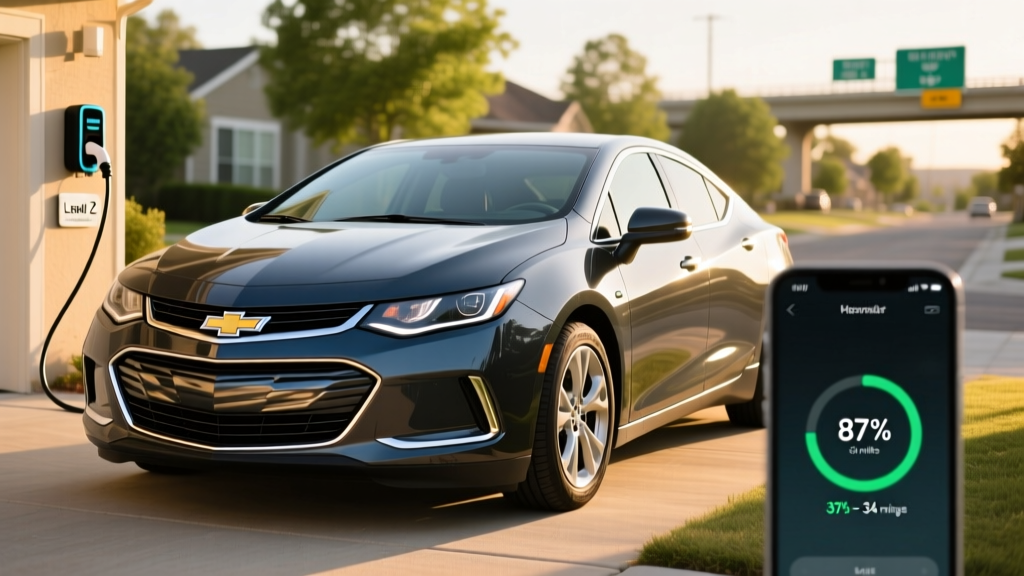
The 2017 Volt charges exclusively via AC power — there is no DC fast charging capability. This is typical for PHEVs with smaller batteries. For most owners, this isn't a limitation because the 18.4 kWh battery is small enough to refill overnight on a standard household outlet.
| Level | Voltage / Current | Power (kW) | 0–Full Time |
|---|---|---|---|
| Level 1 (included cord) | 120V / 12A | ~1.4 kW | ~13 hours |
| Level 1 (120V / 8A default) | 120V / 8A | ~0.96 kW | ~19 hours |
| Level 2 (240V / 16A) | 240V / 16A | 3.6 kW | ~4.5 hours |
Most Volt owners find that Level 1 charging at 12 amps is sufficient — plugging in overnight (8–10 hours) replenishes 11–14 kWh, which translates to roughly 40–50 miles of electric range. If your commute exceeds the electric range or you want a full charge in under five hours, a Level 2 home charger at 240V is the upgrade to make. A basic Level 2 unit (such as a ChargePoint Home Flex or Emporia Vue) costs $300–$600 for the equipment, with professional installation adding $400–$1,200 depending on your electrical panel and outlet proximity.
Critical note on kW vs. kWh: kW (kilowatts) measures the rate of charging power — how fast energy flows into the battery. kWh (kilowatt-hours) measures total energy capacity — how much the battery holds. The Volt's 18.4 kWh battery charging at 3.6 kW takes roughly 5 hours (18.4 ÷ 3.6 ≈ 5.1 hours, minus charging losses).
Real-World MPG: Does the Volt Beat or Miss Its EPA Numbers?
One of the Volt's strongest traits is that real-world fuel economy often exceeds EPA estimates when you charge regularly. Drivers who plug in nightly and commute under 40 miles round-trip may go months without visiting a gas station, effectively achieving infinite MPG for daily use. The onboard gasoline engine only fires when the battery depletes or when you explicitly select "Hold" mode to save battery for later.
When operating as a conventional hybrid (battery depleted), owner-reported data from fueleconomy.gov user logs clusters around 39–44 MPG combined — right in line with the 42 MPG EPA estimate. City driving tends to match or slightly exceed 43 MPG thanks to aggressive regenerative braking. Highway cruising at 75+ mph drops to roughly 38–40 MPG as aerodynamic drag increases and the range extender works harder.
For context, if you charge every night and drive 35 miles per day, you might use less than 15 gallons of gas per month. That's a dramatic reduction versus a conventional 25-MPG gas car, which would burn roughly 42 gallons for the same mileage.
💡 Ownership Insight: The "Charge Every Night" Sweet Spot
The Volt's economics work best when you treat it like an EV that happens to have a gas backup. If you can charge at home (even on Level 1) and your daily driving stays under 50 miles, you'll spend 70–90% of your miles on cheap electricity. At $0.14/kWh national average, a full charge costs roughly $2.00 — equivalent to about 50 cents per gallon of gasoline.
Reliability, Battery Health, and Replacement Costs
GM equipped the 2017 Volt with an 18.4 kWh NMC (nickel-manganese-cobalt) lithium-ion battery pack in a T-shaped configuration running down the center tunnel. The battery management system is conservative — GM limits usable capacity to roughly 14 kWh (about 76% of total), leaving substantial buffer at the top and bottom to slow degradation. This design choice has paid off: Volt battery packs have proven among the most durable in the PHEV segment.
🔋 Battery Warranty & Expected Lifespan
- Original warranty: 8 years / 100,000 miles (10 years / 150,000 miles in CARB states including CA, NY, MA, and others)
- Warranty threshold: GM covers the battery if capacity drops below 60% of original
- 2026 reality: Original 8-year warranty has expired for most 2017 Volts unless they were titled late or you're in a CARB state with 10-year coverage (check your state and in-service date)
- Real-world degradation: Most 2017 Volts with 80,000–120,000 miles retain 85–92% of original capacity — a loss of roughly 4–8 miles of electric range from the 53-mile EPA figure
- Replacement cost (out of warranty): $3,500–$5,500 for a refurbished pack, $6,000–$8,500 for new OEM from a dealer. Third-party shops and salvage packs from wrecked Volts can reduce this to $2,000–$3,500.
When evaluating a used 2017 Volt, ask the seller to fully charge the battery and check the "estimated range" display on the dash. A healthy pack should show 44–53 miles of estimated electric range at full charge (the display adjusts for recent driving style). You can also use an OBD-II scanner with the Torque Pro app to read the battery's State of Health (SoH) directly — look for SoH above 80%.
Beyond the battery, the Volt's powertrain has been generally reliable. The 1.5L range extender is a simple, low-stress engine that rarely runs hard (it mostly acts as a generator). Common maintenance items include standard coolant changes, tire rotation, and cabin air filter replacement. The Voltec drive unit has few wear components. NHTSA recall data shows minimal powertrain-related recalls for this model year.
Used Pricing and Tax Credit Eligibility in 2026
As a used vehicle in 2026, the 2017 Volt is no longer eligible for the new clean vehicle credit (§30D). However, it may qualify for the Used Clean Vehicle Credit (§25E), which provides up to $4,000 or 30% of the sale price (whichever is less) for eligible used EVs and PHEVs purchased from a licensed dealer.
§25E Used Clean Vehicle Credit — Key Requirements
- Credit amount: 30% of sale price, up to $4,000 maximum
- Vehicle price cap: Sale price must be $25,000 or less (the Volt easily qualifies — most sell for $9,000–$15,000)
- Buyer income limits (2026): AGI must not exceed $75,000 (single), $112,500 (head of household), or $150,000 (joint filers)
- Dealer requirement: Must be purchased from a licensed dealer, not a private party
- Model year rule: Vehicle must be at least two model years old (2017 qualifies)
- One-time use: You can only claim this credit once every three years
- Point-of-sale: The credit can be transferred to the dealer at purchase, reducing your out-of-pocket cost immediately
Consult a tax professional and verify current IRS §25E rules before purchase. Eligibility rules can change.
Typical used 2017 Volt pricing in the 2026 market ranges from $9,000 to $15,000 depending on mileage, condition, and trim (LT or Premier). At a $12,000 sale price, the 30% calculation yields $3,600 — meaning an income-eligible buyer purchasing from a dealer could reduce their effective cost to around $8,400 after the point-of-sale credit.
Who Should Buy the 2017 Volt — and Who Shouldn't
✅ Pros
- 53-mile EV range covers most commutes gas-free
- 42 MPG hybrid mode beats most gas cars
- No range anxiety — gas engine provides 420+ total miles
- Level 1 overnight charging is sufficient for most owners
- Strong regenerative braking enables one-pedal-like driving
- Conservative battery buffer = strong long-term SoH
- Eligible for up to $4,000 used EV credit (§25E)
- Quiet, smooth electric driving experience
❌ Cons
- Tight rear seats — only seats 4 comfortably
- Small 10.6 cu-ft cargo area (T-shaped battery intrudes)
- No DC fast charging
- Original battery warranty expired for most units in 2026
- Infotainment (MyLink) feels dated vs. modern systems
- 42 MPG gas-only trails the Prius (56 MPG combined)
- Premium recommended for best performance (not required)
Volt vs. Hybrid vs. Full EV — Which Fits You?
| Your Situation | Best Choice | Why |
|---|---|---|
| Home charging + commute under 50 mi + occasional road trips | 2017 Volt (PHEV) | Daily EV driving, gas backup for long trips, no range anxiety |
| No home charging + want max MPG | Toyota Prius (HEV) | 56 MPG combined, no plug needed, lower complexity |
| Home charging + commute under 250 mi + second car available | Full EV (Bolt, Model 3) | Zero gas, lower maintenance, 250+ mi range, DC fast charging |
| Apartment living, no charging access, long commute | Conventional HEV | Volt wastes its EV potential if you can't plug in regularly |
Frequently Asked Questions
How many MPG does the 2017 Chevy Volt get?
The EPA rates the 2017 Volt at 42 MPG combined (43 city / 42 highway) when running on gasoline after the battery is depleted. In electric-only mode, it achieves 106 MPGe combined. Real-world gas-only MPG typically falls between 39–44 depending on driving conditions, speed, and climate.
How far can the 2017 Volt go on electric only?
The EPA rates it at 53 miles of pure electric range. Real-world results vary from roughly 32 miles in freezing winter conditions to 58 miles in mild city driving with regenerative braking. For most owners in moderate climates, expect 45–50 miles of usable electric range per charge.
Is the 2017 Chevy Volt reliable, and what does battery replacement cost?
Yes — the Volt's Voltec powertrain has a strong reliability record. The battery management system's conservative buffer strategy (using only ~76% of total capacity) has kept degradation low. Most 2017 Volts retain 85–92% battery health at 100,000 miles. Out-of-warranty battery replacement runs $3,500–$8,500 depending on whether you use a refurbished pack, salvage unit, or new OEM battery. The 1.5L range extender engine and drive motors have proven durable with minimal reported failures.
Does the 2017 Volt qualify for any tax credit?
Not the new-vehicle §30D credit — that expired for the Volt years ago. However, it may qualify for the §25E Used Clean Vehicle Credit: up to $4,000 (or 30% of sale price) if purchased from a licensed dealer and your income falls below IRS thresholds ($75K single / $150K joint). At typical 2026 used prices of $9,000–$15,000, most buyers receive $2,700–$4,000 in credit. Verify current rules with a tax professional.
Can the 2017 Volt DC fast charge?
No. The Volt supports only Level 1 (120V AC) and Level 2 (240V AC) charging. The battery is small enough that a full Level 2 charge takes about 4.5 hours, and overnight Level 1 charging covers most daily needs. DC fast charging is not available on any Volt model year.
Is the Volt a hybrid or an electric car?
It's both — specifically, a plug-in hybrid (PHEV). It drives as a pure electric vehicle for the first 53 miles, then seamlessly switches to hybrid mode using its gasoline range extender to generate electricity. You never need to plug it in to drive it (it works as a hybrid), but plugging in unlocks the cheap, quiet electric miles that make the Volt compelling.