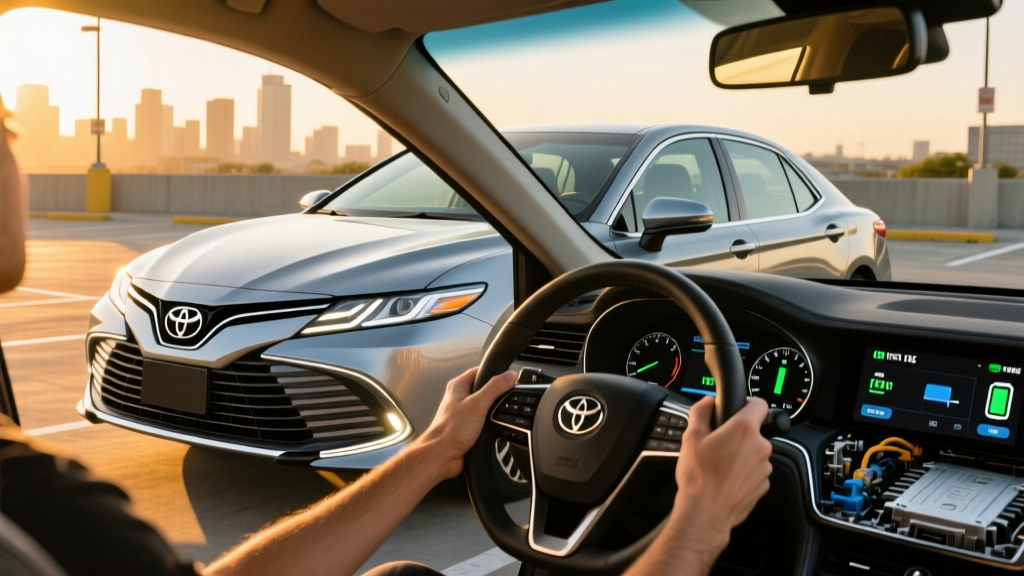
The 2017 Toyota Camry Hybrid XLE occupies a specific niche in the used-car market: a midsize sedan that delivers genuine hybrid efficiency without requiring a plug, a charging routine, or any behavioral change from its owner. For buyers in 2026 weighing a used hybrid against a newer EV or plug-in hybrid (PHEV), the XLE trim of Toyota's seventh-generation Camry Hybrid remains a compelling, data-backed option — provided you understand what you're getting, what the battery will cost when it eventually needs replacement, and where this car fits in today's electrified landscape.
This guide breaks down the 2017 Camry Hybrid XLE with the precision of an EV analyst: exact EPA figures, real-world MPG expectations, powertrain specs, battery chemistry and warranty, and a clear framework for whether this conventional hybrid (HEV) is the right choice versus a PHEV or full battery-electric vehicle (BEV).
HEV vs PHEV vs EV: Where the 2017 Camry Hybrid Fits
Before diving into specs, it's essential to clarify what the 2017 Camry Hybrid XLE is — and what it is not. This is a conventional hybrid electric vehicle (HEV), sometimes called a "self-charging hybrid." It cannot be plugged in. It has no electric-only driving mode of any meaningful distance. It recovers energy through regenerative braking and the gasoline engine to charge its small battery, then uses that stored energy to assist the engine and enable brief low-speed electric-only operation.
Quick Reference: HEV vs PHEV vs BEV
| Feature | HEV (This Camry) | PHEV (e.g., Prius Prime) | BEV (e.g., Model 3) |
|---|---|---|---|
| Plugs in? | No | Yes | Yes |
| Electric-only range | ~1 mi at low speed | 25–45 mi typical | 250–400 mi |
| Battery size | 1.6 kWh (NiMH) | 13–18 kWh (Li-ion) | 60–100 kWh (Li-ion) |
| Home charging needed? | No | Recommended (Level 2) | Required |
| Federal tax credit | None | Up to $7,500 (new, §30D) | Up to $7,500 (new, §30D) |
| Gas engine? | Yes (primary) | Yes (backup) | No |
The Camry Hybrid XLE makes sense if you want fuel savings without installing a home charger, changing your fueling routine, or worrying about public charging infrastructure. It does not qualify for any federal EV tax credit — a critical distinction buyers sometimes miss when comparing used hybrid prices to used EV prices that may have benefited from incentives when new.
EPA Fuel Economy and Real-World MPG
The 2017 Camry Hybrid XLE carries an EPA rating of 40 MPG city / 38 MPG highway / 40 MPG combined, according to fueleconomy.gov. The LE trim rates slightly higher at 42/38/41 due to lighter wheels and lower rolling-resistance tires, but the XLE's premium features — leather seats, upgraded audio, 17-inch alloy wheels — cost you just 1 MPG combined.
| Trim | City MPG | Highway MPG | Combined MPG |
|---|---|---|---|
| LE | 42 | 38 | 41 |
| XLE (This Review) | 40 | 38 | 40 |
| SE | 40 | 38 | 40 |
Real-World MPG: What Owners Actually See
Toyota's Hybrid Synergy Drive system excels in stop-and-go city driving, where regenerative braking and frequent engine shut-off maximize efficiency. In real-world ownership, the Camry Hybrid XLE commonly exceeds its EPA city rating in warm-weather urban commuting — owners report 42–45 MPG on city routes with moderate traffic. Highway driving is the relative weak spot: at sustained 70–75 MPH, expect 35–37 MPG, below the EPA highway sticker of 38.
- City (warm weather, stop-and-go): 42–45 MPG
- City (cold weather, short trips): 36–39 MPG
- Highway (65–70 MPH): 37–39 MPG
- Highway (75+ MPH): 34–36 MPG
- Annual average (mixed driving): 38–42 MPG
Cold weather reduces MPG in hybrids because the engine runs more often to maintain cabin heat and reach operating temperature. Short trips under 3 miles in winter can drop observed economy to the low 30s.
For context, the average 2017 gasoline-only Camry (2.5L four-cylinder) rates at 24/33/27 MPG. The hybrid's 40 MPG combined represents roughly a 48% improvement in fuel economy — translating to approximately $400–$600 in annual fuel savings depending on local gas prices and driving patterns.
Powertrain Specs: Engine, Motor, and Combined Output
The 2017 Camry Hybrid XLE pairs a 2.5-liter Atkinson-cycle four-cylinder gasoline engine with an electric motor-generator through Toyota's Hybrid Synergy Drive (HSD) eCVT transaxle. This is not a traditional continuously variable transmission with belts and pulleys — it's a planetary gearset that seamlessly blends power from both sources.
| Gas Engine | 2.5L Atkinson-cycle I4, 156 HP @ 5,700 RPM, 156 lb-ft torque |
| Electric Motor | Permanent-magnet synchronous, 105 kW (141 HP) |
| Net Combined Horsepower | 200 HP |
| Transmission | eCVT (planetary gearset, no belts) |
| Drivetrain | Front-wheel drive |
| 0–60 MPH | ~7.6 seconds |
| Hybrid Battery | 1.6 kWh, Nickel-Metal Hydride (NiMH), 34 modules |
| Fuel Tank | 17.2 gallons |
| Total Driving Range | ~688 miles (17.2 gal × 40 MPG) |
| Curb Weight | 3,545 lbs |
The net combined output of 200 HP is a key number: it's not simply the gas engine HP plus the electric motor HP. Because the two power sources peak at different RPMs, Toyota rates the combined system output conservatively. In practice, the Camry Hybrid XLE accelerates briskly for a midsize sedan, with the electric motor providing immediate torque from a stop before the gas engine spools up. The 0–60 MPH time of approximately 7.6 seconds is competitive with the gasoline Camry V6 of the same era.
Notably, the 2017 model year is the final year of the XV50-generation Camry Hybrid. The 2018 redesign moved to a more efficient platform with improved battery packaging. If generation matters to your purchase decision, know that 2017 represents mature, well-debugged powertrain technology — Toyota had been refining this HSD system since the 2001 Prius.
Hybrid Battery: Chemistry, Warranty, and Replacement Cost
The 2017 Camry Hybrid XLE uses a Nickel-Metal Hydride (NiMH) battery pack rated at 1.6 kWh (gross), positioned behind the rear seat. This is a small, purpose-built pack — it stores enough energy for brief electric-only assists at low speeds (typically under 25 MPH for less than a mile) and smooths the engine's stop-start transitions. It is not designed for sustained electric driving.
Hybrid Battery Warranty (Original)
Toyota warranted the 2017 Camry Hybrid battery for 8 years / 100,000 miles (10 years / 150,000 miles in California and states that follow CARB emissions standards: CT, ME, MA, NJ, NY, OR, RI, VT, WA).
2026 status: For a 2017 model, the standard 8-year/100,000-mile warranty has expired or is expiring this year. CARB-state 10-year coverage may still apply if your vehicle is under 150,000 miles. Check your warranty booklet and confirm with a Toyota dealer.
Battery Degradation and Lifespan
NiMH hybrid batteries degrade differently than the large lithium-ion packs in EVs. Rather than a steady capacity loss, NiMH packs typically exhibit gradual weakening of individual modules (the 2017 Camry Hybrid pack contains 34 modules). When one or more modules fall significantly out of balance, the pack triggers a hybrid system warning and may limit performance.
Real-world longevity data is encouraging: many 2017 Camry Hybrids have reached 150,000–200,000 miles on the original battery pack. Taxi fleets using Toyota HSD vehicles routinely report 250,000+ miles before battery service. The key factors affecting lifespan are:
- Heat exposure: Vehicles in hot climates (AZ, TX, FL) see faster NiMH degradation than those in moderate climates
- Usage patterns: Regular driving keeps modules balanced; vehicles that sit for weeks at a time may develop imbalances
- Age: Even with low miles, NiMH chemistry degrades with calendar age — a 9-year-old pack in 2026 is entering its risk window regardless of mileage
Battery Replacement Cost
This is the top concern for used hybrid buyers. Here are the realistic cost ranges as of 2026:
- New OEM Toyota pack: $2,500–$3,800 (parts) + $500–$800 (labor) = $3,000–$4,600 total
- Remanufactured pack: $1,500–$2,200 installed (third-party suppliers like Green Bean Battery, Dorman)
- Individual module replacement: $300–$800 if only 1–3 modules have failed (requires a shop experienced in module-level service)
The reconditioned/remanufactured route has become increasingly viable. Several companies offer refurbished NiMH packs with 1–3 year warranties at roughly half the cost of a new OEM unit. For a used 2017 Camry Hybrid valued at $14,000–$18,000 in 2026 (depending on mileage and condition), a $2,000 battery replacement is economically justifiable — especially compared to a major engine or transmission repair on a conventional car.
XLE Trim Features and What You Get
The XLE sits above the LE and SE in the 2017 Camry Hybrid lineup and was the top trim available for the Hybrid that year. Key XLE-specific equipment includes:
- SofTex (synthetic leather) heated front seats with 8-way power driver seat
- 17-inch alloy wheels (vs. 16-inch on LE)
- Keyless entry and push-button start
- Auto-dimming rearview mirror with HomeLink
- 7-inch touchscreen with Entune Audio Plus, navigation available
- Blind Spot Monitor with Rear Cross-Traffic Alert (standard on XLE)
- Dual-zone automatic climate control
- Leather-wrapped steering wheel and shift knob
- Chrome exterior accents and fog lights
The XLE's Blind Spot Monitor and Rear Cross-Traffic Alert were significant safety additions over the LE trim. The 2017 Camry earned a Top Safety Pick rating from the IIHS when equipped with optional front crash prevention, though it did not achieve Top Safety Pick+ due to headlight ratings.
Pricing, Tax Credits, and Total Cost of Ownership
As a conventional hybrid (HEV), the 2017 Camry Hybrid XLE does not qualify for the federal §30D EV tax credit — that credit applies only to plug-in vehicles (PHEVs and BEVs) with sufficient battery capacity. It also does not qualify for the used-EV credit (which requires a plug). No state-level hybrid incentives remain active for used purchases in most jurisdictions.
Used Market Pricing (2026 Estimates)
- 80,000–100,000 miles: $16,000–$19,000
- 100,000–130,000 miles: $14,000–$16,500
- 130,000–160,000 miles: $11,500–$14,000
These prices reflect the hybrid premium over a comparable gasoline 2017 Camry XLE, which typically sells for $2,000–$3,500 less at similar mileage. The fuel savings generally recoup that premium within 3–5 years of average driving (12,000 miles/year at $3.50/gallon), making the hybrid the better financial choice for owners who plan to keep the vehicle beyond the payback period.
Five-Year Ownership Cost Snapshot
| Category | Hybrid XLE (40 MPG) | Gas XLE (27 MPG) |
|---|---|---|
| Fuel (60,000 mi @ $3.50/gal) | $5,250 | $7,778 |
| Maintenance (oil, brakes, tires) | $2,800 | $3,200 |
| Insurance (avg) | $7,500 | $7,200 |
| Hybrid battery reserve | $1,500* | — |
| 5-Year Total | $17,050 | $18,178 |
*Hybrid battery reserve assumes prorated cost if replacement is needed. Hybrids often have lower brake wear due to regenerative braking, partially offsetting any hybrid-specific maintenance.
Pros and Cons of the 2017 Camry Hybrid XLE
Pros
- 40 MPG combined EPA; often exceeds in city driving
- Proven HSD powertrain with 200,000+ mile track record
- No plug or charging infrastructure needed
- 688-mile total range per tank
- XLE adds premium features over LE at modest price premium
- Strong resale value relative to gas-only Camry
- Regenerative braking extends brake pad life significantly
- Smooth, quiet powertrain with adequate 200 HP output
Cons
- No federal or state tax credit eligibility
- Hybrid battery out of warranty by 2026 ($2,000–$4,600 replacement risk)
- NiMH battery less energy-dense than modern Li-ion systems
- Trunk space reduced by battery pack (13.1 cu ft vs 15.4 gas Camry)
- Infotainment system dated by 2026 standards (no CarPlay on 2017)
- Highway MPG drops noticeably above 70 MPH
- No electric-only driving mode for emissions-free short trips
- Cold-weather fuel economy drops 10–15%
Who Should Choose This Hybrid vs a PHEV or Full EV?
Decision Framework: Is the 2017 Camry Hybrid XLE Right for You?
Choose this HEV if:
- You lack access to home or workplace charging (apartment, street parking, no garage)
- Your budget is $12,000–$18,000 and you want maximum fuel efficiency in that range
- You drive 10,000–15,000 miles/year in mixed city/highway conditions
- You want zero behavioral change — just fill up at any gas station
- You plan to keep the car 3–7 years and accept potential battery replacement cost
Consider a used PHEV (e.g., 2017–2020 Prius Prime) if:
- You have Level 2 home charging access and a commute under 25 miles
- You want some electric-only driving for daily errands while keeping gas for road trips
- You're willing to pay a $3,000–$5,000 premium over a conventional hybrid
Consider a used BEV (e.g., 2019–2021 Model 3, Bolt EV, Leaf) if:
- You have reliable home Level 2 charging
- Your daily driving is under 200 miles and you rarely take road trips over 300 miles
- You want zero tailpipe emissions and minimal maintenance (no oil, no spark plugs)
- You're comfortable with a larger battery replacement risk ($5,000–$15,000) in the long term
The fundamental advantage of the Camry Hybrid XLE as an HEV is its infrastructure independence. In 2026, public charging reliability remains inconsistent outside major metro areas. The NHTSA and J.D. Power data continue to show that charging-station downtime is a real friction point for EV owners. The Camry Hybrid sidesteps this entirely — it fuels at any of the 145,000+ gas stations in the U.S. and extracts maximum efficiency from every gallon through its hybrid system.
Frequently Asked Questions
How many MPG does the 2017 Camry Hybrid XLE get?
The EPA rates it at 40 MPG city / 38 MPG highway / 40 MPG combined. In real-world driving, owners typically see 38–42 MPG annually, with city driving often exceeding 42 MPG in warm weather and highway driving at 75+ MPH dropping to 34–36 MPG.
Does the 2017 Camry Hybrid need to be plugged in?
No. The 2017 Camry Hybrid is a conventional HEV — it charges its 1.6 kWh NiMH battery through regenerative braking and the gasoline engine. There is no plug, no charging port, and no electric-only range beyond brief low-speed assists under 1 mile.
Is the 2017 Camry Hybrid reliable?
Yes. Toyota's Hybrid Synergy Drive is one of the most proven hybrid powertrains in history, with millions of units on the road since 2001. The eCVT has no belts, clutches, or traditional wear components. The primary reliability concern is the NiMH battery pack, which typically lasts 150,000–200,000 miles but may require $2,000–$4,600 replacement if it fails out of warranty.
What does a hybrid battery replacement cost for the 2017 Camry?
A new OEM Toyota battery pack costs $3,000–$4,600 installed. Remanufactured packs from third-party suppliers cost $1,500–$2,200 installed. Individual module replacement (if only a few cells have failed) can cost $300–$800 at a hybrid-specialist shop.
Does the 2017 Camry Hybrid qualify for any tax credit?
No. Federal §30D clean vehicle credits apply only to plug-in vehicles (PHEVs and BEVs). Conventional hybrids like the Camry Hybrid are not eligible for federal or most state tax incentives, whether purchased new or used.
How does the 2017 Camry Hybrid compare to a 2017 Prius?
The Prius rates higher in fuel economy (54–58 MPG combined depending on trim) but offers less interior space, a firmer ride, and a more polarizing design. The Camry Hybrid trades ~15 MPG for a larger cabin, smoother ride, more trunk space, and a conventional sedan driving experience. If fuel economy is the absolute priority, the Prius wins. If comfort and space matter alongside efficiency, the Camry Hybrid is the stronger choice.
What should I check before buying a used 2017 Camry Hybrid?
Prioritize these inspections: (1) Hybrid battery health check via OBD-II scanner or Toyota dealer diagnostic — ask for the battery "block voltage delta" (under 0.20V is healthy); (2) full service history confirming regular oil changes (the Atkinson-cycle engine is sensitive to neglected maintenance); (3) brake pad thickness — regenerative braking usually extends pad life to 80,000+ miles, but worn pads at lower mileage suggest aggressive driving or system issues; (4) confirmation that the hybrid system warranty hasn't been voided by aftermarket modifications.
The 2017 Camry Hybrid XLE is not a headline-grabbing EV or a futuristic autonomous platform. It's something arguably more practical for millions of drivers: a thoroughly engineered, infrastructure-independent efficiency machine that delivers 40 MPG without asking you to change a single habit. In 2026, with charging infrastructure still maturing and used EV prices carrying battery-risk premiums, this proven hybrid remains a rational, data-supported choice for cost-conscious sedan buyers.