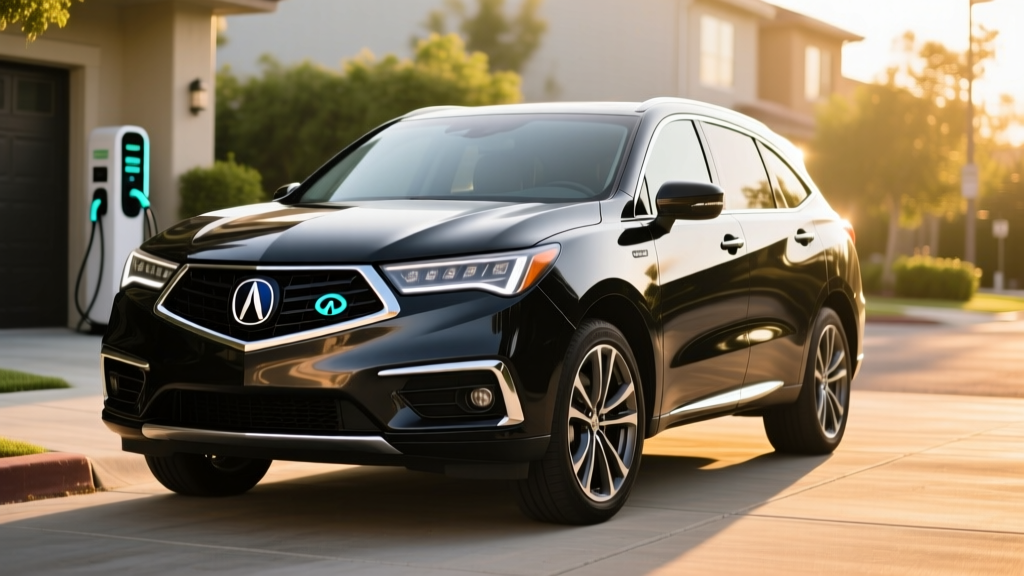
The 2017 Acura MDX Sport Hybrid arrived as Acura's first electrified SUV, pairing a 3.0-liter V6 with a three-motor system to deliver 321 combined horsepower and a meaningful bump in fuel economy over its gas-only sibling. Nearly a decade later, it remains one of the more compelling used luxury hybrid SUVs on the market — but its age raises legitimate questions about battery health, maintenance costs, and whether it still makes sense versus a newer hybrid or a modern plug-in alternative.
This guide covers everything a used-car buyer needs: exact EPA fuel economy, real-world MPG observations, the Sport Hybrid SH-AWD powertrain, battery warranty status in 2026, and how this conventional hybrid stacks up against today's PHEVs and full EVs.
HEV vs PHEV: What the 2017 MDX Hybrid Actually Is
Before diving into specs, it's essential to classify this vehicle correctly. The 2017 Acura MDX Sport Hybrid is a conventional hybrid electric vehicle (HEV) — not a plug-in hybrid (PHEV) and not a battery electric vehicle (BEV).
Quick Reference: Hybrid Types
| Feature | HEV (This MDX) | PHEV (e.g., RAV4 Prime) | BEV (e.g., Ioniq 5) |
|---|---|---|---|
| Plugs in? | No | Yes | Yes |
| Electric-only range | ~1-2 mi at low speed | 20-45 mi typical | 250-350+ mi |
| Battery size | 1.3 kWh | 13-20 kWh | 60-100+ kWh |
| Fueling | Gas only | Gas + plug-in electric | Electric only |
| Federal tax credit (new) | None | Up to $7,500 (§30D) | Up to $7,500 (§30D) |
| Regenerative braking | Yes | Yes | Yes |
The MDX Sport Hybrid's 1.3 kWh lithium-ion battery recharges exclusively through regenerative braking and the gasoline engine. You never plug it in. The electric motors assist during acceleration, enable brief low-speed EV mode, and power the rear axle for all-wheel drive — but the V6 remains the primary energy source.
Fuel Economy: EPA Ratings and Real-World MPG
The headline reason buyers chose the Sport Hybrid over the conventional MDX was fuel economy. Here's how the numbers break down per EPA data on fueleconomy.gov:
| Metric | 2017 MDX Sport Hybrid (SH-AWD) | 2017 MDX Gas (SH-AWD) |
|---|---|---|
| City MPG | 26 | 18 |
| Highway MPG | 27 | 26 |
| Combined MPG | 27 | 21 |
| Annual fuel cost (est.) | ~$2,450 | ~$3,150 |
That's a 6 MPG combined improvement — a 29% gain — over the gas-only SH-AWD model. The city driving improvement is even more dramatic: 26 vs 18 MPG, a 44% increase, because the hybrid system recovers energy during stop-and-go braking that the gas model wastes as heat.
Real-World MPG: What Owners Actually Report
The EPA's 27 MPG combined figure is a reliable baseline, but real-world results vary with driving style and conditions:
- City-heavy commuting: Many owners report 27-29 MPG in suburban and city driving, where regenerative braking keeps the battery charged and the electric motors do heavy lifting at low speeds.
- Highway cruising (70-80 mph): Expect 25-27 MPG. At sustained highway speeds, the V6 carries most of the load and the hybrid advantage narrows.
- Cold weather (below 30°F): Fuel economy drops to roughly 23-25 MPG. The engine runs more frequently to heat the cabin and maintain battery temperature.
- Mountainous terrain: Uphill segments consume more fuel, but aggressive downhill regen partially offsets the loss. Net effect: 24-26 MPG in hilly regions.
For a 3-row luxury SUV weighing over 4,400 lbs, hitting 27 MPG combined is genuinely efficient. The hybrid system's biggest advantage shows up in traffic-heavy commutes where the gas-only MDX would struggle to break 20 MPG.
Powertrain: 321 HP with Three Electric Motors
The 2017 MDX Sport Hybrid uses Acura's Sport Hybrid SH-AWD (Super Handling All-Wheel Drive) powertrain — a sophisticated system that's more than just a fuel-saving add-on. It fundamentally changes how the SUV delivers power and handles corners.
| Specification | Detail |
|---|---|
| Engine | 3.0L SOHC V6, 257 HP @ 6,300 rpm, 218 lb-ft @ 5,000 rpm |
| Front electric motor | 47 HP, integrated into 7-speed DCT |
| Rear electric motors (twin) | 36 HP each (72 HP combined rear) |
| Combined system output | 321 HP, 289 lb-ft torque |
| Transmission | 7-speed dual-clutch automatic (DCT) |
| Drivetrain | SH-AWD (torque-vectoring rear axle) |
| 0-60 mph | ~6.4 seconds |
| Curb weight | ~4,451 lbs |
| Towing capacity | 3,500 lbs |
The twin rear motors are the engineering highlight. They independently drive each rear wheel, enabling true torque vectoring — the outside rear wheel gets more torque in corners, pushing the SUV through turns with surprising agility for its size. This is the same system found in the NSX supercar, adapted for a family hauler.
The 1.3 kWh lithium-ion battery pack sits beneath the second-row seats. It's small by design: it doesn't need to store energy for long electric-only driving, just buffer enough charge for acceleration assist and regenerative capture.
Battery Health, Warranty Status & Replacement Costs in 2026
This is the critical concern for any used hybrid buyer. The 2017 MDX Sport Hybrid is now roughly 9 years old. Here's where things stand:
Hybrid Battery Warranty
- Original coverage: 8 years / 80,000 miles (10 years / 150,000 miles in CARB states including CA, NY, MA, and others)
- Status in 2026: Most 2017 MDX Hybrids have exceeded the 8-year warranty window. CARB-state vehicles with under 150,000 miles may still have coverage through 2027.
- What's covered: Hybrid battery pack and hybrid system components (inverter, electric motors, control modules)
How Long Do These Batteries Last?
Honda/Acura's hybrid battery packs have a strong longevity track record. The 1.3 kWh pack in the MDX is relatively small and conservatively managed — it never fully charges or fully discharges, which significantly extends cell life. Based on owner reports and Honda's history with similar systems (Accord Hybrid, RLX Sport Hybrid):
- Typical lifespan: 150,000-200,000+ miles before significant degradation
- Degradation pattern: Gradual capacity loss rather than sudden failure. A 10-15% capacity reduction at 120,000 miles is normal and barely noticeable in daily driving.
- Failure rate: Low. Complete hybrid battery failures on Honda/Acura systems are uncommon before 150,000 miles.
Battery Replacement Cost
If the hybrid battery does need replacement outside warranty:
- New OEM battery pack: $2,500-$4,000 (parts + labor at a dealership)
- Refurbished/reconditioned pack: $1,500-$2,500 from independent hybrid specialists
- Individual cell/module replacement: $500-$1,200 if only specific modules have degraded
For context, this is considerably less than a BEV battery replacement ($8,000-$20,000+). The small battery size keeps costs manageable. A pre-purchase inspection at a dealership or hybrid specialist can assess battery state of health (SoH) before you buy.
Used Pricing & Tax Credit Reality for 2026
The 2017 Acura MDX Sport Hybrid was originally priced from approximately $52,000 MSRP (base with SH-AWD) to over $60,000 with the Advance and Entertainment packages.
Current Used Market Pricing (2026)
Based on typical market listings, expect to pay:
- $18,000-$23,000 — Higher-mileage examples (100,000+ miles), base trim
- $23,000-$28,000 — Average mileage (60,000-100,000), Technology or Advance trims
- $28,000-$33,000 — Low-mileage, well-maintained examples with premium packages
Federal Tax Credit Eligibility
The IRS §30D used clean vehicle credit offers up to $4,000 or 30% of the sale price (whichever is lower) for qualifying used EVs and PHEVs purchased from a dealer. However, the 2017 MDX Sport Hybrid does not qualify because:
- It is a conventional hybrid (HEV), not a plug-in hybrid or battery electric vehicle
- The §30D used credit requires the vehicle to have at least 4 kWh of battery capacity and be capable of plug-in charging
- The MDX Sport Hybrid's 1.3 kWh battery does not meet the threshold
No federal tax credit is available for this vehicle. Some states may offer minor incentives for used hybrid purchases, but these vary by jurisdiction — check your state's energy or environmental agency for specifics.
Reliability, Maintenance & Common Issues
The 2017 MDX Sport Hybrid benefits from Honda's generally strong reliability reputation, but the added complexity of the hybrid system and the 7-speed dual-clutch transmission warrant attention.
Strengths
- The 3.0L V6 (J30Y1) is a proven Honda engine family with a timing chain (no belt replacement needed)
- Hybrid system components (motors, inverter) have proven durable across Honda's lineup
- SH-AWD rear motors are sealed units with minimal maintenance requirements
- Regenerative braking reduces wear on the friction brake pads — many owners report original pads at 80,000+ miles
Known Issues to Watch
- 7-speed DCT behavior: Some owners report hesitation or shuddering at low speeds, particularly in stop-and-go traffic. A transmission fluid change (recommended every 30,000-60,000 miles) often improves this. Check for software updates from Acura.
- Infotainment dual-screen system: The 2017 MDX uses Acura's dual-screen setup, which is slow by modern standards and occasionally unresponsive. Not a dealbreaker, but frustrating compared to current systems.
- 12V battery: Like many hybrids, the 12V auxiliary battery can drain if the vehicle sits unused for extended periods. A trickle charger or regular driving prevents this.
- AcuraWatch suite: The adaptive cruise control and lane-keeping assist work but are less refined than 2024+ systems — expect more conservative following distances and occasional lane-centering wander.
For NHTSA safety ratings and recall information, the 2017 MDX earned a 5-star overall safety rating. Check the VIN for any open recalls before purchasing.
Who Should Buy the 2017 MDX Hybrid vs. Alternatives
Pros
- 27 MPG combined in a 3-row luxury SUV
- 321 HP with torque-vectoring SH-AWD — genuinely engaging to drive
- Strong reliability track record for Honda hybrid components
- Comfortable, spacious cabin with premium materials
- Available Entertainment package with rear DVD screens
- Battery replacement costs are manageable ($2,500-$4,000)
Cons
- 7-speed DCT can be jerky at low speeds
- Dated infotainment system (dual-screen, no wireless CarPlay in most trims)
- Original hybrid battery warranty expiring or expired for most examples
- No electric-only driving range to speak of
- No federal tax credit eligibility (new or used)
- Higher insurance costs than gas-only MDX in some markets
Choose the 2017 MDX Sport Hybrid if:
- You want a used 3-row luxury SUV under $30,000 with strong fuel economy
- Your commute includes significant stop-and-go traffic where the hybrid advantage shines
- You value all-weather capability (SH-AWD is excellent in rain and light snow)
- You prefer not to deal with plug-in charging infrastructure
Look at a PHEV instead (e.g., Toyota RAV4 Prime, Hyundai Tucson PHEV) if:
- You have home charging access and want 25-40 miles of electric-only commuting
- You want to qualify for the used clean vehicle tax credit (up to $4,000)
- You prioritize the newest safety tech and infotainment
Look at a full EV (e.g., Kia EV9, Tesla Model Y) if:
- You have reliable home Level 2 charging
- Your daily driving is under 250 miles and you rarely tow
- You want to eliminate gasoline costs entirely and minimize maintenance
Frequently Asked Questions
How many MPG does the 2017 Acura MDX Hybrid get?
The EPA rates it at 26 city / 27 highway / 27 combined MPG. In real-world driving, most owners see 25-29 MPG depending on conditions. City-heavy commutes tend to yield higher numbers than highway-only driving — the opposite of a gas-only vehicle.
Does the 2017 MDX Hybrid need to be plugged in?
No. It is a conventional hybrid (HEV), not a plug-in. The battery charges through regenerative braking and the gasoline engine. You fuel it exactly like a regular car — with gasoline only.
How far can the 2017 MDX Hybrid drive on electric power alone?
Only about 1-2 miles at very low speeds (under 25 mph) in EV mode. The 1.3 kWh battery is not designed for meaningful electric-only range. Its purpose is acceleration assist and energy recapture, not plug-in-style electric commuting.
Is the hybrid battery reliable, and what does replacement cost?
Honda/Acura hybrid batteries have a strong longevity record, typically lasting 150,000-200,000+ miles. If replacement is needed, expect $2,500-$4,000 for a new OEM pack or $1,500-$2,500 for a refurbished unit. The original 8-year/80,000-mile warranty has likely expired on most 2017 examples, though CARB-state vehicles may retain coverage through 10 years/150,000 miles.
Does the 2017 MDX Hybrid qualify for any tax credit?
No. Federal tax credits under IRS §30D require plug-in capability and at least 4 kWh of battery capacity. The MDX Sport Hybrid has a 1.3 kWh battery and no plug-in port, so it qualifies for neither the new nor used clean vehicle credit.
How does the 2017 MDX Hybrid compare to the gas-only MDX?
The Sport Hybrid gains 6 MPG combined (27 vs 21), adds 31 HP (321 vs 290), and includes torque-vectoring SH-AWD for better handling. The trade-offs are roughly 150 lbs of added weight, a more complex drivetrain, and a higher original MSRP. On the used market, the hybrid often commands only a modest premium over the gas model.
Is the 7-speed dual-clutch transmission a concern?
It can exhibit low-speed hesitation or shuddering in some examples, especially if transmission fluid hasn't been changed regularly. A fluid service and any available software updates from Acura typically improve behavior. It's not a dealbreaker, but test-drive in stop-and-go conditions before buying.
What should I check before buying a used 2017 MDX Hybrid?
Prioritize a pre-purchase inspection that includes hybrid battery state-of-health assessment, transmission fluid condition, and a check for open recalls. Review maintenance records for regular oil changes, transmission fluid service, and brake inspections. Verify the vehicle's CARB-state status if you're in a state with extended hybrid warranty coverage.