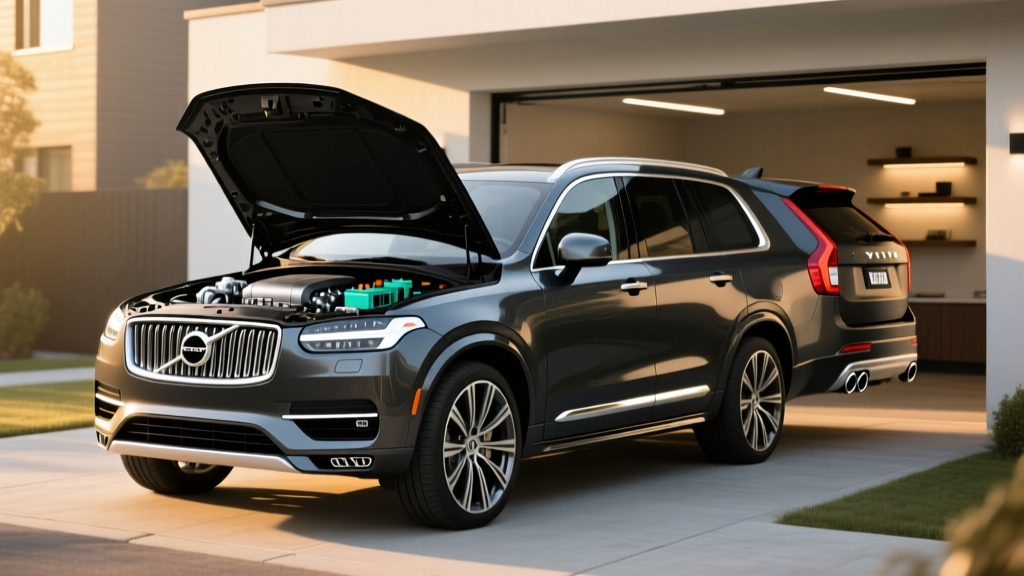
The 2016 Volvo XC90 plug-in hybrid (badged as the T8 Twin Engine AWD) was Volvo's first entry into the luxury plug-in SUV segment, pairing a turbocharged and supercharged 2.0-liter four-cylinder with a rear-axle electric motor for a combined 400 horsepower. Nearly a decade later, it remains a compelling option on the used luxury PHEV market — provided buyers understand the limitations of its modest 9.2 kWh battery and 13-mile EPA electric-only range.
This guide breaks down everything a prospective used buyer or current owner needs to know about the 2016 XC90 T8: real-world fuel economy, battery longevity, charging logistics, and whether this early-generation PHEV still makes sense against modern alternatives in 2026.
HEV vs. PHEV: Where the XC90 T8 Fits
Before diving into specs, it's essential to distinguish between the two hybrid architectures, because Volvo sold the 2016 XC90 in multiple powertrain configurations:
Conventional Hybrid (HEV)
The 2016 XC90 was not offered as a conventional hybrid in the U.S. market. Conventional hybrids (like the Toyota RAV4 Hybrid) use a small battery recharged solely by regenerative braking and the engine. They never plug in, offer no meaningful electric-only range, but deliver consistently improved MPG over gas-only models.
Plug-In Hybrid (PHEV)
The T8 Twin Engine is a plug-in hybrid. It carries a 9.2 kWh lithium-ion battery that can be recharged from a wall outlet or Level 2 charger, enabling short electric-only trips before the gasoline engine engages. This is the focus of this review.
If you encounter a 2016 XC90 labeled T5 or T6, those are conventional gasoline models with no hybrid system. Only the T8 designation indicates the plug-in powertrain.
Powertrain and Performance Specifications
The T8 powertrain is unusually complex for its era, combining forced induction with electrification across both axles:
| Specification | 2016 Volvo XC90 T8 AWD |
|---|---|
| Gas Engine | 2.0L I-4, turbocharged + supercharged |
| Engine Output | 316 HP / 295 lb-ft torque |
| Electric Motor (rear axle) | 87 HP / 177 lb-ft torque |
| Combined System Output | 400 HP / 472 lb-ft torque |
| Battery Capacity (gross / usable) | 9.2 kWh / ~7.0 kWh usable |
| Battery Chemistry | Lithium-ion (NMC) |
| Transmission | 8-speed automatic (AWF8G45) |
| Drivetrain | AWD (engine drives front, motor drives rear) |
| 0–60 mph | 5.3 seconds |
| DC Fast Charging | No — AC only |
| Onboard Charger | 3.7 kW (Level 2 AC) |
| Towing Capacity | 5,000 lbs |
The through-the-road AWD system is worth noting: there is no mechanical connection between the front engine and rear motor. Under heavy acceleration, both power sources engage simultaneously for that 400 HP combined figure. In EV-only mode, the XC90 T8 is rear-wheel drive only.
Fuel Economy: EPA Ratings and Real-World MPG
The EPA rates the 2016 XC90 T8 using two metrics: MPGe (miles-per-gallon-equivalent) when operating on combined electric and gasoline power, and conventional MPG once the battery is depleted.
| Metric | City | Highway | Combined |
|---|---|---|---|
| Charge-Depleting (MPGe) | — | — | 53 MPGe |
| Charge-Sustaining (MPG, gas only) | 26 MPG | 28 MPG | 27 MPG |
Source: fueleconomy.gov
Real-World MPG Expectations
The 27 MPG combined charge-sustaining figure is respectable for a 5,000-lb luxury SUV, but real-world results vary significantly:
- City driving with regular charging: Owners who plug in nightly and drive under 15 miles daily report effectively using zero gasoline for weeks at a time.
- Highway road trips (battery depleted): Expect 24–26 MPG at 70–75 mph. The boxy aerodynamics and 4,900-lb curb weight work against it.
- Cold weather (below 30°F): Charge-sustaining MPG drops to 22–24 as the engine runs more frequently for cabin heat and battery thermal management.
- Short trips without plugging in: If you never charge, you're hauling a heavy battery dead weight — expect 23–25 MPG in mixed driving.
The 53 MPGe figure is only achievable when you start with a full battery and drive within the electric range. It is not a sustained efficiency figure.
Electric-Only Range and Charging
The EPA rates the 2016 XC90 T8 at 13 miles of electric-only range. In real-world conditions:
- Mild weather, city driving (under 40 mph): 11–14 miles achievable
- Highway (65+ mph): 8–10 miles before the engine fires
- Cold weather (below freezing): 7–9 miles, as the gasoline engine activates to provide cabin heat
The 13-mile figure was modest even in 2016 and feels dated by 2026 standards, when new PHEVs like the Toyota RAV4 Prime deliver 42 miles electric-only. However, for owners with short commutes and reliable home charging, 13 miles still covers many daily errands engine-free.
Charging Times and Equipment
| Charging Level | Power | Time (0–100%) | Notes |
|---|---|---|---|
| Level 1 (120V household) | ~1.4 kW | ~7 hours | Trickle charge; adequate for overnight if parked 10+ hours |
| Level 2 (240V, 16A) | 3.7 kW | ~2.5 hours | Recommended for daily use; full charge during work hours or overnight |
| DC Fast Charge | N/A | N/A | The T8 does not support DC fast charging |
The 3.7 kW onboard charger is the bottleneck — even if you connect to a 7.2 kW or 11.5 kW Level 2 station, the car will only accept 3.7 kW. This is a common limitation of first-generation PHEVs. With only 9.2 kWh to fill, however, 2.5 hours on Level 2 is manageable for most routines.
The T8 uses a standard J1772 connector (the universal AC plug for non-Tesla EVs in North America). No adapter is needed for public Level 2 stations.
Battery Health, Warranty, and Replacement Cost
Original Battery Warranty
Volvo covered the 2016 XC90 T8's high-voltage battery for 8 years / 100,000 miles (whichever comes first), with a capacity retention threshold of approximately 70%. This warranty was transferable to subsequent owners.
As of 2026, all original 2016 XC90 T8 battery warranties have expired unless the vehicle had very low mileage and the battery was replaced under warranty with a new unit that restarted the clock.
Battery Degradation in Practice
The 9.2 kWh NMC battery in the T8 has shown moderate degradation patterns based on owner reports:
- Years 1–4 (0–60k miles): Minimal loss, typically 5–8% capacity reduction. Electric range drops from 13 to ~11–12 miles.
- Years 5–8 (60k–120k miles): 10–18% total degradation. Electric range may fall to 9–11 miles in mild weather.
- Years 9+ (120k+ miles): Degradation curve flattens. Most high-mileage T8s retain 78–85% of original capacity.
Volvo built in a buffer (roughly 2.2 kWh of the 9.2 kWh gross is reserved), which protects the cells from deep discharge and extends lifespan. The battery is also liquid-cooled, which helps mitigate heat-related degradation — a common failure point in early Nissan Leafs with passive air cooling.
Battery Replacement Cost
As of 2026, a replacement high-voltage battery for the 2016 XC90 T8 runs approximately $8,000–$12,000 including parts and labor at a Volvo dealer. Independent EV shops may offer refurbished packs for $5,000–$7,000. Given that a clean 2016 XC90 T8 trades for $18,000–$28,000 in the used market, a battery replacement represents a significant percentage of the vehicle's value.
Before purchasing a used example, request a battery health report from a Volvo dealer (they can read State of Health via VIDA diagnostics) or use an OBD-II tool compatible with Volvo's BMS to check capacity retention.
Reliability and Common Issues
The 2016 model year was the first year of the second-generation XC90, and first-year models historically carry more teething issues. The T8's complex powertrain — combining a twin-charged engine, rear electric motor, high-voltage battery, and 8-speed automatic — creates multiple potential failure points.
Documented trouble areas from owner forums and NHTSA data include:
- Engine software glitches: Early T8s experienced rough transitions between EV and gas modes, addressed via software updates.
- Electric motor inverter: Some units experienced rear motor inverter failures (covered under original 8-year hybrid component warranty, now expired).
- Brake feel: The regenerative-to-friction braking transition can feel inconsistent, particularly at low speeds. This is a characteristic, not necessarily a defect.
- Sensus infotainment: The 2016 Sensus system is slow by 2026 standards, with laggy responses and an interface that requires too many taps for basic functions. Apple CarPlay was not standard on early-build 2016 models.
- Air suspension (optional): If equipped, air struts typically require replacement at 80,000–110,000 miles at $1,500–$2,500 per corner.
The conventional gasoline components (engine, transmission) are generally robust if maintained on schedule. The 2.0L twin-charged engine is stressed (producing 316 HP from just 2.0 liters), so strict adherence to oil change intervals (every 5,000–7,500 miles with full synthetic) is critical.
Tax Credit and Incentive Status in 2026
When new, the 2016 XC90 T8 qualified for a $5,002 federal tax credit under the pre-2023 IRS §30D rules, based on its battery capacity. That credit structure no longer exists.
Current Incentive Eligibility (Used Purchase in 2026)
- Federal used-EV credit (§25E): Up to $4,000 or 30% of sale price (whichever is less) for qualifying used plug-in vehicles purchased from a dealer for $25,000 or less. The 2016 XC90 T8 qualifies as a PHEV with at least 4 kWh of battery. Income caps apply: $75,000 single / $112,500 head of household / $150,000 joint filers. Verify current rules at IRS.gov.
- Federal new-vehicle credit (§30D): Not applicable — this is a used vehicle purchase.
- State incentives: Vary widely. Check your state's energy office or afdc.energy.gov for local rebates, HOV lane access, or reduced registration fees.
Important caveat: The §25E used credit requires purchase from a licensed dealer (private-party sales don't qualify) and the sale price must be $25,000 or less. Many well-maintained 2016 XC90 T8s price above this threshold, so confirm the actual transaction price before counting on the credit.
Who Should Buy the 2016 XC90 T8 — And Who Shouldn't
Choose the 2016 XC90 T8 If:
- You want a 3-row luxury SUV with AWD for under $25,000 and can charge at home nightly.
- Your daily commute is under 15 miles round-trip, letting you run mostly on electricity.
- You value the Scandinavian interior design, excellent seats, and strong safety ratings (IIHS Top Safety Pick+).
- You occasionally need 5,000-lb towing capacity without going full-EV (which would sacrifice towing range).
Look Elsewhere If:
- You want meaningful electric-only range for highway commuting — the 13-mile EPA figure is a city errand range, not a commute solution.
- You cannot charge at home or work. Without plugging in, you're carrying 350+ lbs of dead battery weight for no efficiency benefit.
- You prioritize low maintenance costs — this is a complex European luxury vehicle with expensive parts and specialized service needs.
- You want modern PHEV range. The 2026 Toyota RAV4 Prime (42 miles EV), Chrysler Pacifica PHEV (32 miles EV), or even the 2024+ Volvo XC90 Recharge (35 miles EV) offer substantially more electric driving.
Pros
- 400 HP combined — genuinely quick for a family SUV (5.3s to 60)
- Premium interior with available Nappa leather, Bowers & Wilkins audio
- IIHS Top Safety Pick+ with standard City Safety auto-braking
- 5,000-lb towing capacity (rare for PHEVs)
- Depreciation makes it a luxury bargain on the used market
Cons
- 13-mile EV range is minimal by modern standards
- No DC fast charging capability
- First-year reliability concerns; complex powertrain
- Battery warranty has expired on all examples
- Sensus infotainment is dated and sluggish
- High out-of-warranty repair costs
Hybrid vs. PHEV vs. Full EV: Which Fits Your Needs?
The 2016 XC90 T8 occupies a specific niche. Here's how it compares to the broader options for buyers cross-shopping electrified SUVs in 2026:
| Factor | Conventional Hybrid (HEV) | Plug-In Hybrid (PHEV) like XC90 T8 | Battery Electric (BEV) |
|---|---|---|---|
| Plug in required? | No | Yes, to realize EV benefits | Yes, always |
| Electric-only range | 0–1 miles at low speed | 13 miles (XC90 T8) | 250–400+ miles |
| Gasoline backup | Yes (always blended) | Yes (full range) | No |
| Home charging needed | No | Recommended | Essential |
| Maintenance complexity | Low | High (dual systems) | Low (no engine) |
| Best for | No charging access; want better MPG | Short commute + home charge + road trips | Home charging + mostly under 300 mi trips |
For 2026 buyers, the XC90 T8 makes the most sense as a transitional vehicle: you get electric driving for short daily trips while retaining full gasoline flexibility for road trips and towing. If your lifestyle has already shifted to predictable routines within 250 miles, a full BEV like the Tesla Model X, Rivian R1S, or Kia EV9 will deliver lower operating costs and a smoother driving experience. If you can't charge at home at all, a conventional hybrid SUV will save you more money with zero behavioral change.
Frequently Asked Questions
How many MPG does the 2016 Volvo XC90 plug-in hybrid get?
The EPA rates it at 53 MPGe combined when starting with a full battery, and 27 MPG combined (26 city / 28 highway) once the battery is depleted and the gasoline engine runs exclusively. Real-world charge-sustaining MPG typically falls between 23–27 depending on driving style, temperature, and terrain.
How far can the 2016 XC90 T8 go on electric only?
The EPA rates it at 13 miles of electric-only range. In practice, expect 8–14 miles depending on speed, temperature, and terrain. Highway driving at 70 mph may yield only 8–10 miles; city driving under 40 mph in mild weather can stretch to 13–14 miles.
Is the 2016 XC90 T8 reliable, and what does a battery replacement cost?
As a first-year model with a complex twin-charged PHEV powertrain, reliability is mixed. The gasoline components are generally sound with proper maintenance, but the hybrid system (inverter, motor, battery) introduces expensive failure points now that the 8-year/100,000-mile warranty has expired. A replacement high-voltage battery costs $8,000–$12,000 at a dealer, or $5,000–$7,000 from independent shops using refurbished packs. Always check battery State of Health before purchasing.
Does the 2016 XC90 plug-in hybrid qualify for any tax credit?
It no longer qualifies for the new-vehicle federal credit. However, if you purchase one used from a dealer for $25,000 or less and meet income requirements ($75,000 single / $150,000 joint), you may qualify for the federal §25E used clean vehicle credit of up to $4,000. State incentives vary — check afdc.energy.gov for local programs.
Can the 2016 XC90 T8 use DC fast chargers?
No. The T8 only supports AC charging via a J1772 connector at a maximum rate of 3.7 kW. A full charge from empty takes approximately 2.5 hours on Level 2 (240V) or about 7 hours on a standard 120V household outlet. It cannot use CCS, CHAdeMO, or NACS DC fast-charging stations.
What is the total driving range combining electric and gasoline?
With a full battery and the 18.6-gallon fuel tank, the XC90 T8 can travel approximately 460–500 total miles in mixed driving before requiring both a fuel stop and a recharge. This is comparable to a conventional gas SUV and eliminates any range anxiety for long road trips.
How does the XC90 T8 compare to the newer XC90 Recharge?
Volvo updated the PHEV powertrain significantly for the 2023+ model year (rebadged as XC90 Recharge), increasing battery capacity to 18.8 kWh usable and electric-only range to 32–35 miles EPA. Combined output rose to 455 HP. If budget allows ($45,000+), a 2023+ Recharge is a substantially more capable PHEV. The 2016 T8 is the budget alternative for buyers who need 3 rows and AWD but can accept the range trade-off.