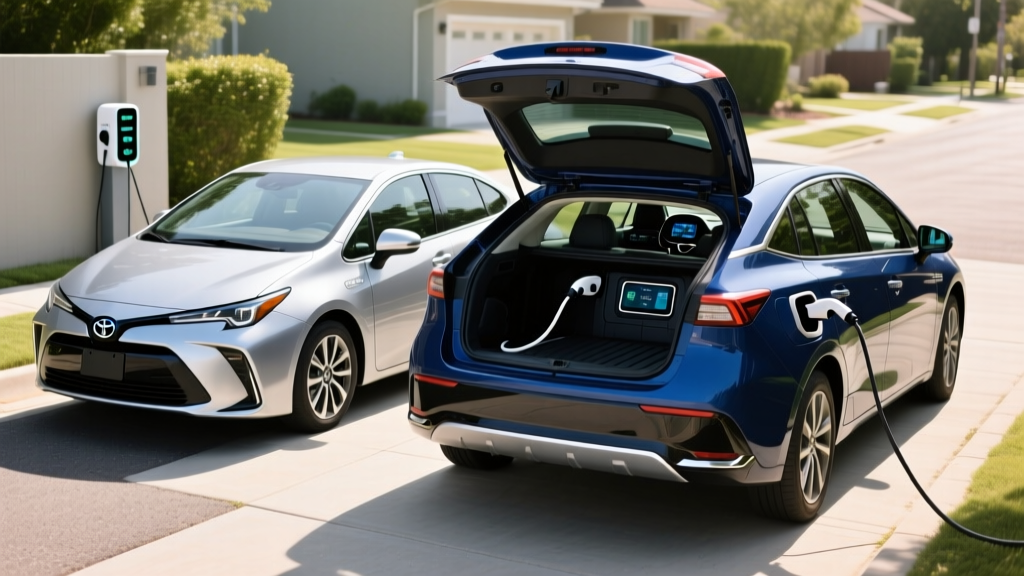
The Quick Answer: What Is a Plugin Hybrid?
A plug-in hybrid electric vehicle (PHEV) is a car that pairs a gasoline engine with a larger battery and electric motor than a conventional hybrid — and crucially, that battery can be recharged by plugging into an external power source. This lets you drive a meaningful distance on electricity alone (typically 25–45 miles in current 2026 models) before the gas engine takes over, giving you the combined range of a gasoline car for longer trips.
Think of it as a bridge between a conventional hybrid (which you never plug in) and a full battery-electric vehicle (which has no gas engine at all). For drivers who want electric commuting but aren't ready to commit to a full EV, the PHEV is the pragmatic middle ground.
HEV vs PHEV at a Glance
| Feature | Conventional Hybrid (HEV) | Plug-in Hybrid (PHEV) |
|---|---|---|
| Plug in to charge? | No — charges via regenerative braking and engine | Yes — plug in for full electric range |
| Battery size | 1.0–1.8 kWh | 13–25 kWh (usable) |
| Electric-only range | 0.5–1.5 miles at low speed | 25–45+ miles (EPA) |
| Typical combined MPG (gas mode) | 40–57 MPG | 35–50 MPG (after battery depletes) |
| Federal tax credit (new) | None | Up to $7,500 under §30D (eligibility varies) |
| Charging hardware needed | None | 120V outlet minimum; Level 2 recommended |
| Example (2026) | Toyota Prius (57 MPG combined) | Toyota RAV4 Prime (42 mi EV, 38 MPG gas) |
How a Plug-in Hybrid Actually Works
A PHEV powertrain combines three key components: a gasoline engine, an electric motor (or two), and a mid-size battery pack. The software orchestrates when each provides propulsion.
Charge-depleting mode (EV mode): When the battery is full, the car runs primarily on electricity. You get silent, zero-tailpipe-emission driving for your daily commute. Most 2026 PHEVs deliver 25–45 miles of EPA-rated electric range, enough for the average American's 37-mile daily round-trip commute according to Federal Highway Administration data.
Charge-sustaining mode (hybrid mode): Once the battery depletes to a buffer threshold (usually around 10–15% state of charge), the vehicle seamlessly switches to operating like a conventional hybrid. The gasoline engine and regenerative braking maintain the battery at that buffer level. This is where the MPG rating for "gas mode" applies.
Blended mode: Many PHEVs blend engine and motor power even while the battery still has charge, especially under hard acceleration or at highway speeds. This is normal — it preserves battery for low-speed city driving where electric propulsion is most efficient.
Real-World MPG and Electric Range: What the EPA Numbers Don't Tell You
EPA window stickers for PHEVs show two numbers: MPGe (miles per gallon equivalent) when running on electricity, and MPG when running on gasoline. Understanding both is essential.
| 2026 PHEV Model | EV Range (EPA) | MPGe (Electric) | MPG (Gas Only) | Combined Total Range |
|---|---|---|---|---|
| Toyota RAV4 Prime | 42 mi | 94 MPGe | 38 MPG | ~600 mi |
| Jeep Wrangler 4xe | 22 mi | 49 MPGe | 20 MPG | ~370 mi |
| Hyundai Tucson PHEV | 33 mi | 80 MPGe | 35 MPG | ~440 mi |
| Chrysler Pacifica PHEV | 32 mi | 82 MPGe | 30 MPG | ~460 mi |
| BMW X5 xDrive50e | 38 mi | 56 MPGe | 27 MPG | ~460 mi |
Real-world caveat: Electric-only range drops significantly in cold weather (expect 20–30% loss below freezing) and at sustained highway speeds above 70 mph. A RAV4 Prime rated at 42 miles EV range may deliver only 28–32 miles on a 25°F winter morning with the heater running. Gas-mode MPG, however, often exceeds EPA estimates in city driving for hybrids, since stop-and-go traffic maximizes regenerative braking.
For the best real-world fuel economy, a PHEV owner who charges nightly and commutes 30 miles might use gasoline only on weekend road trips — achieving an effective 100+ MPG over a month of mixed driving. An owner who never plugs in, by contrast, will see only the gas-mode MPG (which can be worse than a dedicated HEV due to the added battery weight).
Battery, Charging, and Powertrain Specs
The battery in a PHEV is substantially larger than a conventional hybrid's but far smaller than a full EV's. Here's what that means in practice:
| Spec | Typical 2026 PHEV | Example: RAV4 Prime |
|---|---|---|
| Battery capacity (usable) | 13–25 kWh | 14.9 kWh usable (18.1 kWh gross) |
| Chemistry | NMC (nickel manganese cobalt) most common | Lithium-ion NMC |
| Level 1 charging (120V / 12A) | 8–14 hours to full | ~12 hours |
| Level 2 charging (240V / 16–32A) | 2–4 hours to full | ~2.5 hours at 3.3 kW |
| DC fast charging | Rare — most PHEVs lack DC capability | Not available |
| Combined system horsepower | 200–380 HP | 302 HP (2.5L I4 + 2 electric motors) |
| 0–60 mph | 5.5–8.5 seconds | 5.7 seconds |
DC fast charging is the elephant in the room for PHEVs. The vast majority — including the RAV4 Prime, Tucson PHEV, and Pacifica — do not support DC fast charging. The smaller battery simply can't absorb high charge rates without excessive degradation, and manufacturers have opted for cost savings. This means public fast-charging networks (Electrify America, EVgo, Tesla Supercharger) are not useful for PHEV owners. You're limited to Level 1 (standard household outlet) or Level 2 (240V home or public AC charger).
kW vs kWh reminder: The battery stores energy measured in kWh (kilowatt-hours — think of it as the "gallon" equivalent). The charger delivers power measured in kW (kilowatts — the flow rate). A 3.3 kW Level 2 charger filling a 15 kWh battery takes roughly 15 ÷ 3.3 = 4.5 hours from empty.
Pricing, Tax Credits, and Total Cost of Ownership
PHEVs carry a price premium over their conventional hybrid siblings — typically $4,000–$8,000 more — due to the larger battery and more powerful electric motor. But federal tax incentives can narrow that gap substantially.
Federal Tax Credit Under IRS §30D
For 2026, qualifying new PHEVs can receive up to $7,500 in federal tax credits, but the rules are specific. The battery must meet critical-mineral sourcing and battery-component manufacturing requirements that tighten each year. As of 2026, very few PHEVs fully qualify for the maximum credit due to battery sourcing restrictions. Always verify current eligibility on the IRS §30D page before purchasing.
- MSRP caps: Vans, SUVs, and pickups ≤ $80,000; sedans ≤ $55,000
- Buyer income caps: AGI ≤ $300,000 (joint), $225,000 (head of household), $150,000 (single)
- Battery sourcing: Critical minerals and battery components must meet escalating domestic/free-trade sourcing percentages
- Point-of-sale transfer: You can transfer the credit to the dealer for an upfront price reduction starting 2024
- Battery capacity minimum: At least 7 kWh (all current PHEVs qualify)
State incentives vary widely. Some states (California, Colorado, New York) offer additional rebates of $1,000–$4,000 for PHEVs, while others offer nothing beyond the federal credit. Check your state's energy office or the Alternative Fuels Data Center for current local programs.
5-Year Ownership Cost Snapshot
For a driver who charges nightly and commutes 30 miles, a PHEV's fuel cost advantage over a gas-only car is substantial. At $3.50/gallon gas and $0.15/kWh electricity:
- PHEV (charged nightly, 15,000 mi/yr): ~$650/year fuel (mostly electricity)
- Gas car (30 MPG): ~$1,750/year fuel
- Savings: ~$1,100/year or $5,500 over 5 years
However, PHEV insurance premiums run 5–15% higher than equivalent gas models, and the purchase price premium may not be fully offset by fuel savings unless you drive primarily within your electric range.
Battery Longevity, Warranty, and Replacement Cost
PHEV Battery Warranty Standards
Federal law mandates that hybrid and PHEV batteries carry a minimum warranty of 8 years / 100,000 miles (10 years / 150,000 miles in CARB states like California, New York, and others adopting California emissions standards). Most manufacturers meet or exceed this:
- Toyota: 10 years / 150,000 miles on hybrid battery
- Hyundai/Kia: 10 years / 100,000 miles
- Chrysler/Jeep (Stellantis): 8 years / 100,000 miles (10/150k in CARB states)
- BMW: 8 years / 80,000 miles
The warranty typically covers battery capacity dropping below 60–70% of original capacity. Check your owner's manual for the exact retention threshold.
Real-world longevity data is encouraging. Toyota's hybrid battery packs (used across Prius, RAV4 Hybrid, and RAV4 Prime) have demonstrated 150,000–200,000+ mile lifespans with minimal degradation in fleet data. Because PHEV batteries are larger than HEV batteries and operate in a shallower state-of-charge window (the car never lets them fully deplete or fully charge to 100%), stress on the cells is reduced.
Out-of-warranty replacement cost for a PHEV battery in 2026 ranges from approximately $4,000–$9,000 depending on the model, plus $500–$1,500 in labor. The RAV4 Prime battery replacement runs roughly $6,000–$7,500 at a Toyota dealer. Third-party remanufactured batteries are becoming available at 30–40% lower cost for popular models. According to fueleconomy.gov, PHEV battery failures within the warranty period remain rare.
Who Should Buy a PHEV vs. a Full EV or Conventional Hybrid?
PHEV Advantages
- Electric commuting with no range anxiety on road trips
- Lower fuel cost than gas if you charge regularly
- Access to HOV lanes in many states
- Potential federal tax credit up to $7,500
- No dependence on public charging infrastructure
- Strong resale demand for popular models (RAV4 Prime waitlists persist)
PHEV Limitations
- Higher purchase price than equivalent HEV
- Two powertrains to maintain (engine + electric)
- No DC fast charging — limited to Level 1 or Level 2
- Heavier than HEV due to dual systems — worse gas MPG than a dedicated hybrid if you never plug in
- Tax credit eligibility is restrictive and model-dependent
- Electric range may not cover longer commutes without switching to gas
Choose Your Powertrain
Choose a PHEV if: You have home or workplace Level 2 charging access, your daily commute fits within 30–40 miles, you take regular road trips beyond 300 miles, and you want to reduce gasoline consumption without committing to full electric.
Choose a full EV if: You have reliable home charging, your daily driving rarely exceeds 200 miles, you want minimal maintenance (no oil changes, no engine), and you qualify for the full federal tax credit on a qualifying BEV.
Choose a conventional HEV if: You cannot charge at home or work, you want maximum MPG with zero behavior change, you prefer a lower purchase price, and you don't need electric-only driving.
Frequently Asked Questions
How many MPG does a plug-in hybrid get?
It depends on whether you charge. In electric mode, PHEVs achieve 50–100+ MPGe. After the battery depletes, gas-mode MPG ranges from 20 MPG (Jeep Wrangler 4xe) to 38 MPG (RAV4 Prime). If you charge nightly and stay within your EV range, your effective monthly fuel consumption can equate to 80–150+ MPG. If you never plug in, you'll get only the gas-mode MPG — which may be slightly worse than a conventional hybrid due to battery weight.
How far can a PHEV go on electric only?
Current 2026 PHEVs deliver 22–45 miles of EPA-rated electric-only range. The RAV4 Prime leads at 42 miles; the Wrangler 4xe trails at 22 miles. In real-world cold-weather or high-speed highway driving, expect 20–30% less than the EPA sticker.
Do I have to plug in a plug-in hybrid?
You don't have to — the car will run perfectly fine on gasoline alone, operating as a conventional hybrid. But if you never plug in, you're paying a premium for a battery you're not using and getting worse MPG than a lighter, dedicated HEV. Plugging in is what unlocks the economic and environmental benefit.
Can I use a regular household outlet to charge a PHEV?
Yes. Level 1 charging on a standard 120V outlet will fully recharge most PHEV batteries in 8–14 hours — sufficient for overnight charging. A 240V Level 2 home charger cuts that to 2–4 hours and typically costs $500–$2,000 installed (depending on your electrical panel). Given the smaller battery, most PHEV owners find Level 1 adequate for daily use.
Is a PHEV battery reliable, and what does replacement cost?
PHEV batteries are covered by a federally mandated minimum warranty of 8 years / 100,000 miles (10 years / 150,000 miles in CARB states). Real-world data shows most hybrid batteries lasting 150,000+ miles with gradual capacity loss. Out-of-warranty replacement costs $4,000–$9,000 depending on the model. Battery failures within the warranty period are uncommon.
Does a plug-in hybrid qualify for a tax credit?
Some do, under the federal §30D new clean vehicle credit. Eligibility depends on MSRP caps ($80K for SUVs/trucks, $55K for sedans), buyer income limits, and battery-component/critical-mineral sourcing requirements that tighten annually. As of 2026, many popular PHEVs qualify for a partial credit ($3,750) rather than the full $7,500 due to sourcing rules. Always verify on irs.gov before purchasing. Conventional hybrids (HEVs) do not qualify for any federal tax credit.
Is a PHEV better than a full EV?
Neither is universally better — it depends on your situation. A PHEV is better if you lack reliable charging access, frequently drive beyond 300 miles in a day, or live in an area with sparse public charging. A full EV is better if you want zero tailpipe emissions, minimal maintenance, lower per-mile fuel cost, and access to DC fast charging for road trips. For many households, a PHEV is the pragmatic stepping stone while charging infrastructure matures.