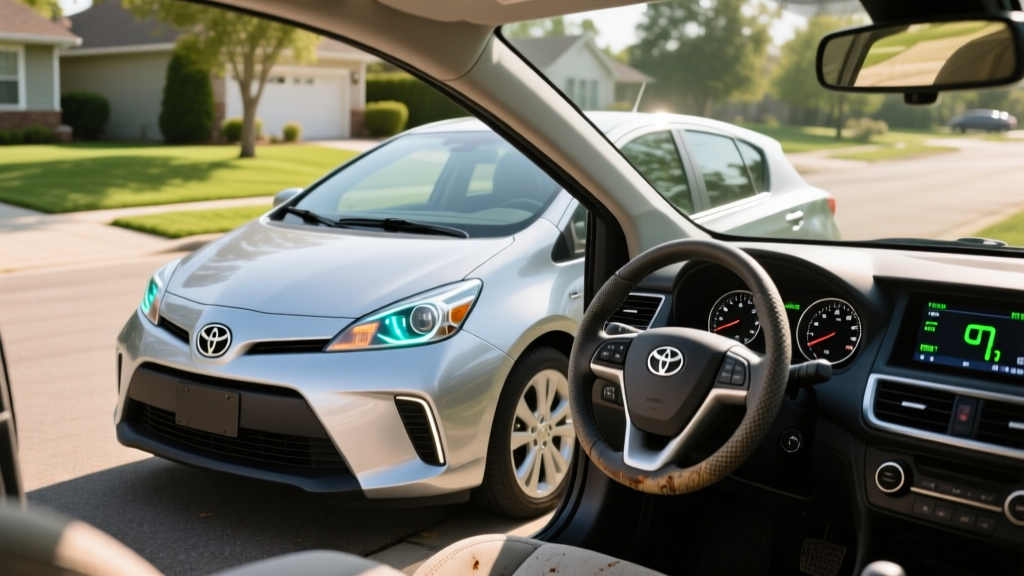
The 2016 Toyota Prius C at a Glance
If you are shopping the used hybrid market for a no-compromise fuel-sipper, the 2016 Toyota Prius C hybrid remains one of the most efficient non-plug-in vehicles Toyota ever sold. Built on a shortened Prius platform and powered by a 1.5-liter Atkinson-cycle four-cylinder paired with Toyota's Hybrid Synergy Drive, the Prius C delivers an EPA-rated 50 MPG combined without ever needing a plug. It was discontinued after the 2019 model year, but its reputation for bulletproof reliability and sub-$10,000 used pricing keeps it relevant for budget-conscious commuters in 2026.
This guide covers everything a prospective used buyer needs: exact fuel economy figures, powertrain specs, hybrid battery health expectations, replacement costs, and how the Prius C stacks up against modern PHEVs and full EVs.
HEV vs PHEV: Where the Prius C Fits
Before diving into specs, it is essential to understand what the 2016 Toyota Prius C hybrid is — and what it is not. The Prius C is a conventional hybrid electric vehicle (HEV). It has no plug, no external charging port, and no electric-only driving range beyond roughly one mile at very low speeds. Its small nickel-metal hydride (NiMH) traction battery recharges entirely through regenerative braking and the gasoline engine.
| Feature | HEV (Prius C) | PHEV (e.g., Prius Prime) | BEV (e.g., Bolt EV) |
|---|---|---|---|
| Plug-in charging | No | Yes | Yes |
| Electric-only range | ~1 mi (low speed) | 25–44 mi | 200–350+ mi |
| Gasoline engine | Yes (primary) | Yes (backup) | No |
| Fuel/energy source | Gasoline only | Gasoline + electricity | Electricity only |
| Tailpipe emissions | Low | Low (zero in EV mode) | Zero |
If you want electric-only commuting with a gas safety net, you would be looking at a plug-in hybrid like the Prius Prime. If you want pure electric driving, a BEV is the answer. The Prius C occupies a specific niche: maximum gasoline efficiency with zero lifestyle change — no charging routine, no range planning, just fill up and go.
Fuel Economy: EPA Ratings and Real-World MPG
The 2016 Toyota Prius C hybrid carries EPA ratings that still rank among the best of any non-plug-in car sold in the United States.
| Driving Cycle | EPA Rating | Real-World Expectation |
|---|---|---|
| City | 53 MPG | 50–58 MPG (hybrids excel in stop-and-go) |
| Highway | 46 MPG | 42–48 MPG (aerodynamic drag hurts at 70+ mph) |
| Combined | 50 MPG | 47–54 MPG depending on driving mix |
Source: EPA Fuel Economy Guide.
Why city MPG beats highway MPG: The Prius C's hybrid system recovers energy during braking and low-speed driving that a conventional car wastes as heat. In city traffic, the electric motor handles frequent acceleration while the engine shuts off at stops. On the highway, the 1.5L engine runs continuously, and the car's light weight (about 2,600 lbs) and tall profile create aerodynamic drag that reduces efficiency.
Cold-weather impact: Expect a 5–10% drop in fuel economy during winter months. The engine runs more frequently to maintain cabin heat and bring the catalytic converter to operating temperature. Owners in northern climates commonly report 44–47 MPG combined in January versus 52–55 MPG in July.
At the pump in 2026: With the national average for regular unleaded hovering around $3.20/gallon, a Prius C driver covering 12,000 miles annually spends roughly $768 on fuel. A comparable non-hybrid subcompact averaging 30 MPG combined would cost about $1,280 — a savings of over $500 per year with the Prius C.
Powertrain and Performance Specs
| Specification | 2016 Toyota Prius C |
|---|---|
| Engine | 1.5L Atkinson-cycle 4-cylinder (73 hp, 82 lb-ft) |
| Electric motor | AC synchronous permanent magnet (60 hp, 125 lb-ft) |
| Net combined horsepower | 99 hp |
| Transmission | eCVT (planetary gearset, no fixed gears) |
| Traction battery | 0.9 kWh NiMH (144V nominal) |
| 0–60 mph | ~10.8 seconds |
| Curb weight | ~2,600 lbs |
| Fuel tank capacity | 9.5 gallons |
| Total driving range | ~475 miles (9.5 gal × 50 MPG) |
| Drivetrain | Front-wheel drive |
The 99 combined horsepower figure is modest by any standard, and the 10.8-second 0–60 time reflects that. The Prius C was never designed for performance — it was engineered to minimize fuel consumption in urban environments. The eCVT provides seamless, gearless acceleration that feels adequate around town but strained during highway merging. Plan your lane changes accordingly.
The 0.9 kWh NiMH battery is tiny compared to modern PHEVs (which use 8–18 kWh packs) or BEVs (60–100 kWh). This battery is not user-chargeable and serves only as a buffer for regenerative energy capture and brief electric-assist bursts.
Hybrid Battery Lifespan, Warranty, and Replacement Cost
Original Battery Warranty
Toyota warranted the 2016 Prius C hybrid battery for 8 years/100,000 miles in most states, and 10 years/150,000 miles in California Air Resources Board (CARB) states (CA, CT, ME, MD, MA, NJ, NY, OR, RI, VT, WA). As of 2026, original factory coverage has expired for all 2016 models regardless of mileage.
How long do Prius C hybrid batteries actually last? The NiMH chemistry in the Prius C is among the most durable battery systems Toyota has ever deployed. Real-world data from high-mileage owners and taxi fleets consistently shows these packs lasting 150,000–200,000 miles before significant capacity loss. Unlike the larger lithium-ion packs in BEVs and PHEVs, the Prius C's NiMH battery operates within a narrow state-of-charge window (roughly 40–80%), which dramatically reduces degradation stress.
Signs of a failing hybrid battery:
- Noticeable drop in fuel economy (5–10 MPG below normal)
- The gasoline engine runs more frequently and at higher RPMs
- State-of-charge display shows rapid fluctuations
- Dashboard warning: "Check Hybrid System" or red triangle
- OBD-II codes P0A80 (replace hybrid battery pack) or individual module imbalance codes
Replacement cost in 2026:
- New OEM Toyota battery: $2,000–$2,500 installed at a dealership
- Remanufactured battery: $1,200–$1,800 installed (popular options include Green Bean Battery and Dorman)
- Individual module replacement: $300–$600 if only one or two cells have failed (a specialist can test and replace individual modules)
For a used 2016 Prius C with 120,000 miles, budgeting $1,500 for a potential battery replacement within the next few years is prudent. However, many original batteries continue functioning well past 180,000 miles with no intervention.
Used Pricing and Tax Credit Eligibility
The 2016 Toyota Prius C was originally sold in three trims — Two, Three, and Four — with MSRPs ranging from approximately $19,560 to $23,350 including destination. In the 2026 used market, expect the following price ranges depending on mileage and condition:
- 80,000–100,000 miles: $9,500–$12,000
- 100,000–130,000 miles: $7,500–$9,500
- 130,000–160,000 miles: $5,500–$7,500
Federal tax credits: The 2016 Prius C does not qualify for the IRS §30D New Clean Vehicle Credit, which applies only to new qualifying plug-in vehicles (BEVs and PHEVs with ≥7 kWh battery capacity). Conventional hybrids are excluded entirely from §30D.
However, if you purchase a used Prius C from a licensed dealer for $25,000 or less, you may qualify for the §25E Previously-Owned Clean Vehicle Credit — but only if the vehicle is a qualified plug-in EV or fuel cell vehicle. Since the Prius C is a conventional HEV with no plug, it does not qualify for §25E either. No federal tax credit applies to this vehicle.
Some states and municipalities offer rebates or HOV lane access for hybrids, but these programs vary widely and are subject to change. Check your state's energy office or department of motor vehicles for current offerings.
Reliability and Ownership Costs
The 2016 Prius C inherits Toyota's Hybrid Synergy Drive architecture, which has accumulated billions of real-world miles across the Prius family since 2000. The powertrain is widely regarded as one of the most reliable drivetrains in the automotive industry.
Key reliability factors:
- Engine: The 1NZ-FXE 1.5L is a low-stress Atkinson-cycle design with no turbocharger, no direct injection complexity, and proven longevity past 250,000 miles with basic maintenance.
- eCVT: Toyota's planetary gearset has no clutch packs, belts, or bands to wear out. Transmission failures are exceptionally rare.
- Brakes: Regenerative braking handles most deceleration, so the physical brake pads and rotors often last 80,000–120,000 miles.
- 12V auxiliary battery: Located in the rear cargo area, this standard lead-accent battery typically lasts 4–6 years and costs $150–$200 to replace. A dead 12V battery will prevent the car from starting even if the hybrid battery is fully charged.
Common issues to watch for on a used 2016 model:
- Head gasket concerns on high-mileage examples (rare but documented past 180k miles)
- Brake actuator assembly recall — verify recall status via NHTSA VIN lookup
- Water pump failure (the engine water pump, not the inverter coolant pump, which is more durable)
- Interior wear: the Prius C's budget-oriented interior materials show age more than premium vehicles
Estimated 5-year ownership cost for a 2016 Prius C purchased at $8,000 with 120,000 miles, driven 12,000 miles/year:
- Fuel: ~$3,840 (50 MPG at $3.20/gal)
- Insurance: ~$4,500 ($900/year average for a low-value subcompact)
- Maintenance: ~$2,000 (oil changes, tires, brake inspection, coolant)
- Hybrid battery reserve: ~$1,500
- Total 5-year operating cost: ~$11,840 (excluding purchase price)
Who Should Buy the 2016 Prius C — and Who Should Look Elsewhere
Pros
- 50 MPG combined — among the highest of any non-plug-in vehicle ever sold
- Proven Toyota hybrid reliability with low maintenance costs
- No plug required — works for apartment dwellers and street parkers
- Low used purchase price ($6k–$12k range)
- Excellent city fuel economy (53 MPG EPA)
- Tight turning radius (37.4 ft) ideal for urban parking
Cons
- Slow acceleration (10.8s 0–60) — merging requires planning
- Limited cargo space (17.1 cu ft behind rear seats)
- Budget interior with hard plastics and basic infotainment
- No DC fast charging or plug-in capability
- No modern ADAS features (no AEB, no lane-keeping assist)
- NiMH battery replacement adds $1,200–$2,500 to long-term costs
Choose the 2016 Prius C if:
- You drive 10,000–15,000 miles/year mostly in city or suburban traffic
- You cannot charge at home (apartment, street parking, no garage)
- Your used-car budget is under $12,000
- You want the lowest possible fuel cost without any charging routine
- You prioritize reliability and low maintenance over performance and tech
Look at a PHEV or BEV instead if:
- You have home charging access and want electric-only commuting (consider a used Prius Prime or Chevrolet Volt)
- You need modern safety features like automatic emergency braking (consider a 2020+ Corolla Hybrid)
- You drive primarily highway miles where the Prius C's 46 MPG highway rating is less impressive
- You want stronger acceleration and a more refined interior (consider a used Hyundai Ioniq Hybrid or Toyota Camry Hybrid)
Frequently Asked Questions
How many MPG does the 2016 Toyota Prius C hybrid get?
The EPA rates the 2016 Prius C at 53 MPG city, 46 MPG highway, and 50 MPG combined. In real-world driving, most owners report 47–54 MPG combined, with city-heavy routes yielding the highest numbers and sustained highway driving at 75+ mph dropping efficiency to the low-to-mid 40s.
Does the 2016 Prius C need to be plugged in?
No. The 2016 Toyota Prius C is a conventional hybrid (HEV), not a plug-in hybrid. It has no charging port. The hybrid battery charges exclusively through regenerative braking and the gasoline engine. You fuel it only with regular unleaded gasoline.
How far can the Prius C drive on electric power alone?
Less than one mile, and only at very low speeds (under 25 mph) on flat ground with a fully charged hybrid battery. This is not an electric vehicle — the gasoline engine is the primary power source at all times. If you want meaningful electric-only range, you need a PHEV like the Prius Prime (25–44 miles electric) or a full BEV.
Is the 2016 Prius C hybrid reliable?
Yes. Toyota's Hybrid Synergy Drive is among the most proven and durable hybrid systems in production. The 1.5L engine, eCVT, and NiMH battery have demonstrated longevity of 200,000+ miles with routine maintenance. The primary long-term cost concern is eventual hybrid battery replacement ($1,200–$2,500), which typically occurs past 150,000 miles.
What does it cost to replace the hybrid battery?
A new OEM Toyota replacement battery costs $2,000–$2,500 installed. Remanufactured options from reputable suppliers run $1,200–$1,800 installed. Individual module replacement by a hybrid specialist can cost as little as $300–$600 if only one or two cells have degraded. The original factory warranty (8yr/100k or 10yr/150k in CARB states) has expired for all 2016 models.
Does the 2016 Prius C qualify for any federal tax credit?
No. The IRS §30D credit applies only to new plug-in electric vehicles (BEVs and qualifying PHEVs). The §25E used-vehicle credit also requires the vehicle to be a plug-in EV or fuel cell vehicle. The Prius C, as a conventional hybrid with no plug, qualifies for neither. Some state or local programs may offer incentives for hybrids, but these vary by jurisdiction.
Hybrid vs PHEV vs EV — which should I choose?
If you lack home charging access and want maximum simplicity, a conventional hybrid like the Prius C is ideal. If you can charge at home and want electric-only commuting with a gas backup, a PHEV (Prius Prime, RAV4 Prime, or used Chevy Volt) offers the best of both worlds. If you have reliable charging access and want zero tailpipe emissions with the lowest per-mile energy cost, a BEV (Bolt EV, Model 3, Leaf) is the right choice — but requires a larger upfront investment and charging infrastructure.