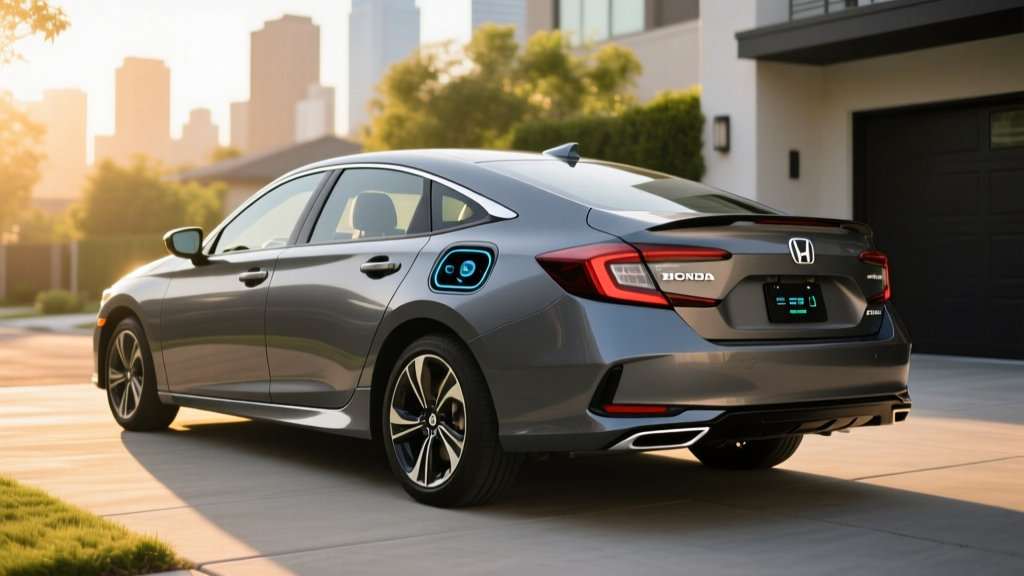
The 2026 Honda Civic Touring Hybrid sits at the top of Honda's most popular compact car lineup, pairing the brand's fourth-generation two-motor hybrid system with the Civic's best-equipped trim. For buyers who want maximum fuel economy without plugging in, this is Honda's answer: a conventional hybrid (HEV) that delivers roughly 50 MPG combined while offering the premium features of the Touring grade — Bose audio, wireless CarPlay/Android Auto, leather-trimmed seats, and the full Honda Sensing safety suite.
This guide breaks down everything you need to know about the 2026 Honda Civic Touring Hybrid: real-world fuel economy, powertrain specs, how it compares to plug-in hybrids and full EVs, battery longevity, tax-credit eligibility, and whether it's the right choice for your daily driving.
HEV vs. PHEV: What the 2026 Civic Hybrid Actually Is
Before diving into specs, it's essential to understand what you're buying. The 2026 Honda Civic Touring Hybrid is a conventional hybrid electric vehicle (HEV), not a plug-in hybrid (PHEV). That distinction matters for how you use the car every day.
Conventional Hybrid (HEV) — 2026 Civic Hybrid
- No plug required: The battery charges via regenerative braking and the gasoline engine. You never plug it in.
- Small battery: Approximately 1.0 kWh lithium-ion pack, used to assist the engine and enable brief electric-only driving at low speeds.
- No electric-only range to speak of: The Civic Hybrid can creep on electric power for very short distances (under 1 mile at low speed), but it's not designed for sustained electric-only driving.
- No federal EV tax credit: HEVs do not qualify under IRS §30D, which applies only to plug-in vehicles with sufficient battery capacity.
Plug-In Hybrid (PHEV) — e.g., Toyota Prius Prime
- Plugs in: Larger battery (typically 10-14 kWh) charges from a wall outlet or public charger.
- Electric-only range: 25-45 miles of zero-gas driving before the engine kicks in.
- Tax credit eligible: May qualify for partial or full §30D credit depending on battery sourcing and buyer income.
If you were hoping for a Civic PHEV with 30 miles of electric-only commuting, Honda doesn't offer that in the US market for 2026. The Civic Hybrid is strictly an HEV — a self-charging system optimized for maximum MPG without lifestyle changes.
2026 Honda Civic Touring Hybrid: Fuel Economy Breakdown
The headline number is why most buyers look at this car. The EPA rates the 2026 Honda Civic Hybrid at:
| Metric | EPA Estimate |
|---|---|
| City MPG | 50 MPG |
| Highway MPG | 47 MPG |
| Combined MPG | 49 MPG |
| Fuel Tank Capacity | 10.6 gallons |
| Total Range (estimated) | ~519 miles |
Source: fueleconomy.gov — EPA estimates for 2026 Honda Civic Hybrid. Actual mileage will vary.
Real-World MPG: What to Actually Expect
Honda's two-motor hybrid system excels in city driving, where regenerative braking and frequent engine-off coasting maximize efficiency. In real-world testing, many owners report matching or even exceeding the EPA city estimate during warm-weather urban commutes — 51-54 MPG is common in stop-and-go traffic below 45 mph.
Highway driving tells a different story. At sustained 70-80 mph speeds, the gasoline engine does most of the work, and aerodynamic drag reduces the hybrid system's advantage. Expect 42-45 MPG on the highway in real-world conditions — a few ticks below the EPA sticker.
Cold weather impacts all hybrids. In sub-freezing temperatures, the engine runs more frequently to maintain cabin heat and battery temperature. Winter city MPG can drop to 40-44 MPG until the powertrain reaches operating temperature. This is normal hybrid behavior, not a defect.
City (warm): 50-54 MPG | City (cold): 40-44 MPG | Highway (70 mph): 42-45 MPG | Combined real-world: ~46-48 MPG
Powertrain Specs: Honda's Two-Motor Hybrid System
The 2026 Civic Touring Hybrid uses Honda's e:HEV two-motor hybrid powertrain, which pairs a 2.0-liter Atkinson-cycle four-cylinder engine with two electric motors — one for propulsion and one for electricity generation. This is the same architecture found in the Accord Hybrid and CR-V Hybrid, tuned for the Civic's lighter platform.
| Specification | 2026 Civic Touring Hybrid |
|---|---|
| Engine | 2.0L Atkinson-cycle inline-4 |
| Combined System Horsepower | 200 hp |
| Combined System Torque | 232 lb-ft (motor) |
| Electric Motors | Two (propulsion + generator) |
| Hybrid Battery | ~1.0 kWh lithium-ion |
| Transmission | e-CVT (direct-drive, no belt) |
| Drivetrain | Front-wheel drive |
| 0-60 mph (est.) | ~7.2 seconds |
| Drive Modes | Normal, Sport, Econ, Individual |
Unlike Toyota's planetary-gear hybrid system, Honda's two-motor setup can disconnect the engine entirely at low speeds and drive purely on electric motor torque. At highway speeds, a lockup clutch connects the engine directly to the wheels for maximum efficiency. The result is smooth, responsive acceleration off the line — the electric motor delivers its full 232 lb-ft of torque from zero RPM — while maintaining competitive fuel economy at cruise.
In Sport mode, the system prioritizes responsiveness, keeping the battery more charged and allowing the engine to rev higher for passing maneuvers. It's not a performance car, but 200 hp in a ~3,100-lb sedan makes the Civic Touring Hybrid genuinely quick for its class — noticeably faster than most competing compact hybrids.
Pricing, Trim Features & Tax Credit Eligibility
The Touring trim is the most expensive Civic Hybrid, but it's comprehensively equipped. Here's the pricing picture for 2026:
| Item | Detail |
|---|---|
| 2026 Civic Hybrid Touring MSRP | ~$33,350 (incl. destination) |
| Federal §30D Tax Credit | Not eligible (HEV, not plug-in) |
| State Hybrid Incentives | Varies by state; some states offer rebates for HEVs |
Tax Credit Reality Check
Because the 2026 Honda Civic Touring Hybrid is a conventional HEV — not a plug-in vehicle — it does not qualify for the federal §30D Clean Vehicle Credit. That credit, which can provide up to $7,500 for qualifying new plug-in EVs and PHEVs (subject to MSRP caps, buyer income limits, and battery-sourcing requirements per IRS guidelines), applies only to vehicles with plug-in capability and minimum battery capacity.
Some states offer their own incentives for conventional hybrids, though these are less common than EV/PHEV incentives. Check your state's energy office or department of environmental quality for current programs. A few states have offered hybrid rebates in the $500-$1,500 range, but availability changes frequently.
What Touring Trim Gets You
At the Touring level, the Civic Hybrid includes:
- 10.2-inch digital instrument cluster with hybrid power-flow display
- 9-inch touchscreen with wireless Apple CarPlay and Android Auto
- 12-speaker Bose premium audio system
- Leather-trimmed seats with heated front seats
- Wireless phone charging pad
- Honda Sensing suite: adaptive cruise control, lane-keeping assist, collision mitigation, traffic sign recognition
- Low-speed braking control and traffic jam assist
- LED headlights with auto high-beam
- 18-inch alloy wheels
Battery Warranty, Reliability & Replacement Cost
8 years / 100,000 miles (10 years / 150,000 miles in CARB states including CA, NY, MA, and others that follow California emissions standards). Covers defects and capacity loss below a defined threshold.
How Long Will the Hybrid Battery Last?
Honda's hybrid battery packs have proven durable in real-world use. The lithium-ion pack in the Civic Hybrid is relatively small (~1.0 kWh) and is managed conservatively — the system never fully charges or fully depletes it, keeping the battery in a narrow state-of-charge window that dramatically extends cycle life. Based on data from earlier Honda hybrid models (Insight, Accord Hybrid), most hybrid batteries last well beyond 150,000 miles without significant degradation.
The battery isn't working as hard as a full EV or PHEV pack. It buffers energy from regenerative braking and assists during acceleration, then gets recharged by the engine. This shallow-cycling approach means the battery experiences far fewer stress cycles than a plug-in vehicle's pack.
Battery Replacement Cost
If the hybrid battery does eventually need replacement (typically at very high mileage, 150,000+ miles), expect:
- OEM replacement battery: $2,000-$3,500 (parts only)
- Labor: $300-$600
- Total out-of-pocket: $2,500-$4,000 at a Honda dealer
- Aftermarket/refurbished options: $1,200-$2,000 installed at independent hybrid specialists
For context, this is significantly less than a full EV battery replacement ($5,000-$20,000+) because the hybrid pack is small. Many owners will never need to replace the hybrid battery during their ownership.
Overall Reliability
Honda's hybrid powertrain has earned strong reliability marks. The e-CVT uses a direct-drive gear set rather than a traditional belt-and-pulley CVT, eliminating a common failure point. The 2.0L Atkinson-cycle engine runs under less stress than a conventional engine because the electric motor handles peak-load situations. Honda's hybrid components (power control unit, electric motors) have proven robust across the Accord, CR-V, and previous Insight platforms. The Civic carries Honda's standard 3-year/36,000-mile limited warranty and 5-year/60,000-mile powertrain warranty in addition to the hybrid-specific coverage.
2026 Civic Touring Hybrid vs. PHEV vs. Full EV: Which Fits You?
Choose the Civic Touring Hybrid (HEV) if:
- You can't charge at home (apartment, street parking, no garage)
- You want maximum MPG with zero behavior change — just fill up with gas
- Your daily commute is longer than 30-40 miles and includes highway driving
- You want a lower purchase price than a comparable PHEV or EV
- You take frequent road trips and don't want to plan around charging stops
Choose a PHEV (e.g., Toyota Prius Prime) if:
- You can charge at home (Level 1 or Level 2) and want 25-45 miles of electric-only commuting
- Your daily round-trip commute is under 40 miles — you could drive months without using gas
- You want to reduce (not eliminate) gasoline use while keeping road-trip flexibility
- You may qualify for the federal §30D credit (check income, MSRP, and sourcing rules)
Choose a Full EV (e.g., Chevy Equinox EV, Tesla Model 3) if:
- You can install a Level 2 home charger and your daily driving is under 250 miles
- You want zero tailpipe emissions and the lowest per-mile fuel cost (~$0.04-$0.06/mile on home electricity vs. ~$0.12-$0.15/mile on gas at 50 MPG)
- You qualify for the full $7,500 federal tax credit, narrowing the price gap
- You want minimal maintenance (no oil changes, no spark plugs, fewer moving parts)
The Math: Civic Hybrid vs. Gas Civic vs. EV
At 49 MPG combined and $3.50/gallon gas, the Civic Hybrid costs roughly $0.071 per mile in fuel. A gas-only Civic (33 MPG combined) costs about $0.106 per mile. That's a savings of ~$350 per year at 10,000 miles — or ~$1,750 over five years. The hybrid premium over a comparably equipped gas Civic is roughly $1,500-$2,000, meaning the fuel savings can pay back the price difference within 4-5 years.
A full EV charging at home at $0.14/kWh and averaging 3.5 miles/kWh costs about $0.04 per mile — nearly half the Civic Hybrid's fuel cost. But EVs carry higher purchase prices (before incentives), potentially higher insurance premiums, and require home charging infrastructure ($500-$2,000 for Level 2 installation).
Touring Trim Features & Technology Highlights
Beyond the powertrain, the Touring trim positions the Civic Hybrid as a near-premium compact sedan. Key technology features include:
- Honda Sensing 2.0: The latest iteration of Honda's ADAS suite includes a wider-angle camera, improved pedestrian detection, and more natural adaptive cruise control behavior. Note: this is a SAE Level 2 driver-assistance system — the driver must remain fully engaged with hands on the wheel and eyes on the road at all times. It is not autonomous driving.
- Traffic Jam Assist: Provides low-speed steering and braking assistance in congested traffic, reducing fatigue during stop-and-go commutes.
- Hybrid Power Flow Display: The digital instrument cluster shows real-time energy flow — when the engine is running, when the motor is propelling the car, and when regenerative braking is charging the battery. This helps drivers learn more efficient habits.
- Regenerative Braking Paddles: Steering-wheel-mounted paddles let you adjust regen intensity on the fly, from minimal (coasting) to strong (one-pedal-like deceleration in city driving).
Pros & Cons at a Glance
Pros
- 49 MPG combined EPA — among the best in the compact class
- 200 hp makes it genuinely quick for a hybrid
- No plug-in needed; zero lifestyle adjustment
- Touring trim is comprehensively equipped at ~$33,350
- Strong reliability history from Honda's hybrid system
- 8-year/100,000-mile hybrid battery warranty (10/150k in CARB states)
- ~519 miles of total range per tank
Cons
- No federal tax credit (HEV, not plug-in)
- No electric-only commuting capability
- Real-world highway MPG drops to low 40s at 75+ mph
- Cold-weather fuel economy dips noticeably
- FWD only — no AWD option (unlike Toyota Prius)
- Touring trim pushes price above $33K for a compact sedan
Frequently Asked Questions
How many MPG does the 2026 Honda Civic Touring Hybrid get?
The EPA rates it at 50 MPG city, 47 MPG highway, and 49 MPG combined. In real-world driving, expect 50-54 MPG in warm-weather city conditions and 42-45 MPG at sustained highway speeds. Cold weather can reduce city MPG to the low 40s.
Can I plug in the 2026 Civic Hybrid to charge it?
No. The Civic Hybrid is a conventional HEV, not a plug-in hybrid. The battery charges itself through regenerative braking and the gasoline engine. There is no charging port and no electric-only range beyond very brief low-speed maneuvering.
Does the 2026 Honda Civic Hybrid qualify for any tax credit?
It does not qualify for the federal §30D Clean Vehicle Credit, which requires plug-in capability and minimum battery capacity. Some states may offer hybrid-specific incentives — check your state's energy or environmental agency for current programs.
Is the Honda Civic Hybrid reliable? What about battery replacement?
Honda's two-motor hybrid system has a strong reliability record across multiple models. The hybrid battery is warrantied for 8 years/100,000 miles (10/150,000 in CARB states). Based on historical data, most Honda hybrid batteries last 150,000+ miles. If replacement is needed, expect $2,500-$4,000 at a dealer — far less than a full EV battery.
How does the Civic Hybrid compare to the Toyota Prius?
The 2026 Toyota Prius (LE AWD) is rated at 57 MPG combined — about 8 MPG better than the Civic Hybrid. However, the Civic offers more horsepower (200 vs. 196 for Prius FWD), a more premium interior in Touring trim, and a more engaging driving experience. The Prius offers AWD; the Civic does not. If pure MPG is your top priority, the Prius edges ahead. If you want a more refined compact sedan that happens to be a hybrid, the Civic Touring is compelling.
Is the Honda Sensing system self-driving?
No. Honda Sensing is an SAE Level 2 driver-assistance system. It provides adaptive cruise control, lane-centering, and automatic emergency braking, but the driver must remain fully attentive, keep hands on the steering wheel, and be prepared to take over at any moment. It does not drive the car autonomously.
What is the total driving range on a full tank?
With a 10.6-gallon fuel tank and 49 MPG combined, the 2026 Civic Touring Hybrid can travel approximately 519 miles between fill-ups under EPA conditions. Real-world range will typically be 450-500 miles depending on driving conditions, with highway-heavy trips at the lower end and city driving at the higher end.
For official EPA fuel economy data, see fueleconomy.gov. For federal tax credit rules, consult IRS.gov §30D guidelines. For safety ratings, check IIHS and NHTSA. All pricing and specifications are based on manufacturer data available at time of publication and are subject to change. State incentive availability varies by jurisdiction.