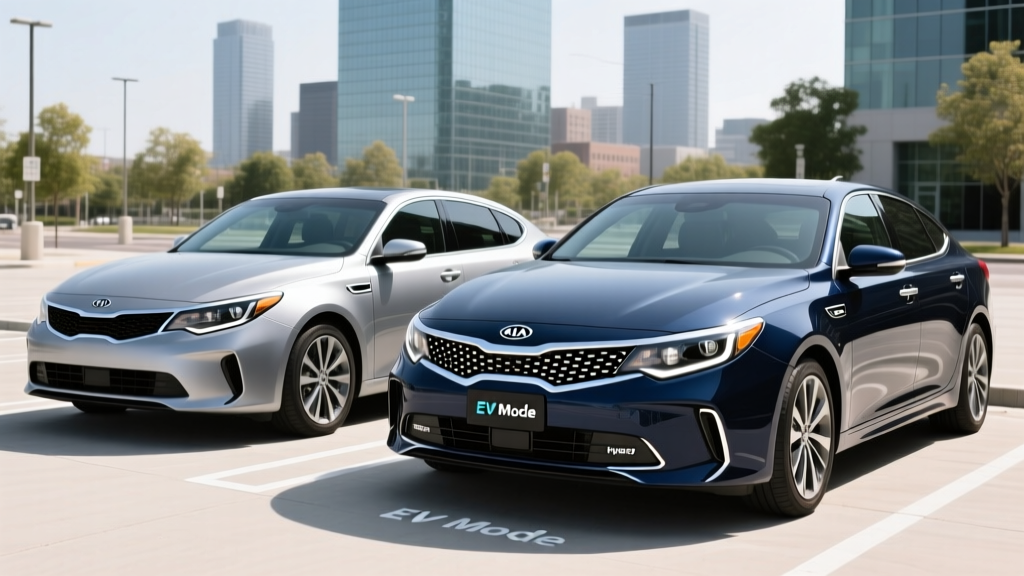
If you're shopping the used midsize sedan market for an electrified daily driver, the 2016 Optima Hybrid sits at a compelling intersection of value, efficiency, and Kia's lengthy hybrid battery warranty. For the 2016 model year, Kia offered the Optima in two electrified flavors: a conventional hybrid (HEV) that requires no plug, and a plug-in hybrid (PHEV) that delivers genuine electric-only commuting range. With used examples now well under $15,000, this generation represents one of the most accessible entry points into hybrid ownership — provided you know exactly what you're getting.
This guide breaks down the EPA fuel economy, real-world efficiency expectations, powertrain specs, battery longevity, and ownership economics for both the 2016 Kia Optima Hybrid and the 2016 Optima Plug-In Hybrid, so you can decide which version fits your commute.
HEV vs PHEV: Which 2016 Optima Electrified Model Is Right for You?
Before diving into specs, it's critical to understand the difference between the two 2016 Optima electrified models. This distinction determines how you fuel the car, what your commute looks like, and whether you'll ever see a charging station.
Conventional Hybrid (HEV) — 2016 Optima Hybrid
The HEV pairs a gasoline engine with a small electric motor and a compact battery (1.62 kWh). You never plug it in. The battery recharges through regenerative braking and engine power. It operates like a normal gas car — you fill up at the pump — but the hybrid system reduces fuel consumption significantly, especially in stop-and-go city driving.
Plug-In Hybrid (PHEV) — 2016 Optima Plug-In Hybrid
The PHEV uses a much larger battery (9.8 kWh) and a more powerful electric motor. You plug it in to a standard 120V outlet or a 240V Level 2 charger to fill the battery. It can drive 27 miles on electricity alone before the gasoline engine starts. After the battery depletes, it functions exactly like a conventional hybrid.
The short version: If you have access to a plug at home or work and your daily round-trip commute is under ~25 miles, the PHEV lets you drive most days without burning a drop of gas. If you don't have reliable charging access, the HEV delivers strong efficiency with zero lifestyle changes.
Fuel Economy: EPA Ratings and Real-World MPG
Fuel economy is the headline number for any hybrid buyer. Here's how the 2016 Optima Hybrid and PHEV stack up according to EPA estimates on fueleconomy.gov:
| Model | City MPG | Highway MPG | Combined MPG | MPGe (PHEV EV Mode) |
|---|---|---|---|---|
| 2016 Optima Hybrid (HEV) | 36 | 40 | 38 | N/A |
| 2016 Optima PHEV (charge-sustaining) | 38 | 43 | 40 | 103 MPGe |
MPGe explained: MPGe (miles per gallon equivalent) measures how far the PHEV travels on electricity alone, converting kWh consumption into a gasoline-equivalent figure. The 103 MPGe rating applies only while the battery has charge. Once depleted, the PHEV reverts to its 40 MPG combined gas-hybrid rating.
Real-World MPG: What to Actually Expect
Real-world range callout: The EPA's 38 MPG combined for the HEV is a realistic baseline, but hybrids shine in city driving where regenerative braking recaptures energy. Expect 38–42 MPG in mixed city/suburban driving and 34–37 MPG on sustained highway trips at 70+ mph. In cold weather (below 35°F), plan for a 5–10% efficiency drop as the engine runs more frequently for cabin heat. The PHEV's electric-only range of 27 EPA miles typically translates to 22–25 real-world miles in moderate temperatures and 18–20 miles in winter conditions.
Hybrid owners who do the majority of their driving in urban stop-and-go conditions often report exceeding EPA city estimates. Conversely, long highway commutes at high speeds reduce the hybrid advantage, since the electric motor assists less and aerodynamic drag dominates.
Powertrain and Performance Specs
Both 2016 Optima electrified models share a 2.0-liter four-cylinder gasoline engine, but the electric motor output and total system horsepower differ between the HEV and PHEV.
| Specification | 2016 Optima Hybrid (HEV) | 2016 Optima PHEV |
|---|---|---|
| Gas Engine | 2.0L I4, 154 hp | 2.0L I4, 154 hp |
| Electric Motor | 38 kW (51 hp) | 50 kW (67 hp) |
| Combined System Output | 199 hp | 202 hp |
| Transmission | 6-speed automatic | 6-speed automatic |
| 0–60 mph (est.) | ~8.5 sec | ~8.2 sec |
| Battery Capacity | 1.62 kWh (Li-polymer) | 9.8 kWh (Li-polymer) |
| Electric-Only Range (PHEV) | N/A | 27 mi (EPA) |
| Total Range (PHEV) | N/A | ~530 mi (EV + gas) |
| Drivetrain | FWD | FWD |
The PHEV's 50 kW electric motor provides noticeably stronger electric-only acceleration than the HEV's 38 kW unit. In EV mode, the PHEV can reach speeds up to 75 mph on electricity alone, making it viable for highway merging — not just parking-lot crawling. The combined 202 hp in the PHEV is adequate for daily driving, though neither model will be confused with a sport sedan.
PHEV Charging: How Long, What Plug, and Can It DC Fast Charge?
If you're considering the 2016 Optima PHEV, understanding the charging logistics is essential. Here's the breakdown:
| Charging Method | Power (kW) | Time (0–100%) | Connector |
|---|---|---|---|
| Level 1 (120V household outlet) | ~1.4 kW | ~9 hours | J1772 |
| Level 2 (240V home/public charger) | ~3.3 kW | ~3 hours | J1772 |
| DC Fast Charging | Not supported — the 2016 Optima PHEV has no DC fast-charge capability | ||
What this means practically: A nightly plug-in to a standard 120V outlet will fully replenish the 9.8 kWh battery by morning for most owners. If you install a Level 2 home charger (240V), you'll cut that time to about three hours — useful if you make multiple short trips per day and want to recharge between drives. The absence of DC fast charging is standard for PHEVs of this era; the battery is small enough that Level 2 charging is adequate.
The PHEV uses the J1772 connector, the universal North American AC charging standard. Any public Level 2 station with a J1772 plug (or a NACS-to-J1772 adapter for Tesla Destination Chargers) will work.
Battery Longevity, Warranty, and Replacement Cost
Battery degradation is the number-one concern for used hybrid buyers. Here's what you need to know about the 2016 Optima's hybrid battery.
Kia Hybrid Battery Warranty
- HEV battery: 10 years / 100,000 miles (whichever comes first)
- PHEV battery: 10 years / 100,000 miles
- Capacity threshold: Kia covers the battery if it falls below approximately 70% of original capacity within the warranty period
- Transferability: Kia's 10-year/100,000-mile powertrain and hybrid battery warranty is not transferable to second owners — it resets to 5 years / 60,000 miles upon resale. However, some states with California emissions requirements (CARB states) may enforce extended warranty transferability. Verify with your local Kia dealer.
Real-World Battery Degradation
The 2016 Optima uses lithium-polymer battery cells, which have proven durable in Kia/Hyundai hybrid applications. Based on owner reports and industry data, expect 8–12% capacity loss over 100,000 miles in normal use. The HEV's 1.62 kWh battery is so small that minor degradation is barely perceptible in daily driving. The PHEV's 9.8 kWh pack may lose 2–3 miles of electric-only range over a decade of use.
Battery replacement cost (out of warranty):
- HEV battery pack: $2,000–$3,500 (parts + labor at a Kia dealer)
- PHEV battery pack: $4,500–$7,000 (parts + labor at a Kia dealer)
Independent hybrid battery repair shops can often replace individual degraded cells for $800–$1,500, a significant savings over a full pack replacement. Given the 10-year original warranty, a 2016 model's factory coverage expired in 2026 by time (if not already by mileage), so budget accordingly if purchasing today.
Used Pricing and Tax Credit Eligibility
As of early 2026, the 2016 Kia Optima Hybrid and PHEV are available exclusively on the used market. Here's the pricing landscape:
| Model / Trim | Original MSRP | Used Price Range (2026) |
|---|---|---|
| 2016 Optima Hybrid LX | $26,795 | $10,000–$13,500 |
| 2016 Optima Hybrid EX | $30,895 | $12,000–$15,500 |
| 2016 Optima PHEV EX | $36,695 | $11,500–$15,000 |
| 2016 Optima PHEV Limited | $40,195 | $13,000–$16,500 |
Does the 2016 Optima Hybrid Qualify for Any Tax Credit?
As a new vehicle (originally): The 2016 Optima PHEV qualified for a federal tax credit of approximately $4,543 under the pre-2023 IRS §30D rules, based on its battery capacity. The conventional HEV did not qualify for any federal plug-in credit.
As a used vehicle purchased in 2026: The IRS Used Clean Vehicle Credit (§25E) offers up to $4,000 or 30% of the sale price (whichever is lower) for qualifying used EVs and PHEVs purchased from a dealer. Key requirements:
- Vehicle age: Must be at least 2 model years old (2016 qualifies)
- Sale price cap: Must be $25,000 or less (most 2016 Optima PHEV examples qualify)
- Buyer income cap: AGI must not exceed $75,000 (single), $112,500 (head of household), or $150,000 (joint)
- Battery requirement: The PHEV must have at least 7 kWh of battery capacity (the Optima PHEV's 9.8 kWh qualifies)
- Dealer requirement: Must be purchased from a licensed dealer, not a private party
- Conventional HEV: The Optima Hybrid (HEV) does NOT qualify — the used credit applies only to plug-in vehicles
Bottom line: If you buy a 2016 Optima PHEV from a dealer for $14,000 and meet the income requirements, you could claim $4,000 (30% of $14,000 = $4,200, capped at $4,000). This makes the effective purchase price as low as ~$10,000 — exceptional value for a plug-in midsize sedan. Consult a tax professional to confirm eligibility, as IRS rules are subject to change.
Reliability and Ownership Costs
The 2016 Optima Hybrid benefits from Kia's mature hybrid system, which debuted in the 2011 Optima and was refined across two generations. Here's the reliability picture:
- NHTSA safety rating: 5 stars overall — see NHTSA.gov
- Common issues: Some owners report hybrid system warning lights related to the hybrid control module or inverter cooling system. These are typically covered under the hybrid component warranty. Brake actuator recalls were issued for some Kia/Hyundai hybrid models of this era — verify recall completion via the VIN at nhtsa.gov/recalls.
- Maintenance advantage: Hybrids experience less brake wear (regenerative braking handles most deceleration) and the engine runs fewer hours, reducing oil degradation. Expect brake pad life of 80,000–120,000 miles.
- Insurance: Typically 5–10% higher than a gas-only 2016 Optima due to hybrid component repair costs.
5-Year Ownership Cost Estimate (Used Purchase, 15,000 mi/yr)
| Cost Category | Optima Hybrid (HEV) | Optima PHEV |
|---|---|---|
| Purchase Price (avg.) | $13,000 | $14,000 |
| Federal Tax Credit | $0 | −$4,000 |
| Fuel (5 yrs, $3.40/gal avg.) | $6,710 | $3,800* |
| Electricity (PHEV, $0.14/kWh) | — | $1,400 |
| Insurance (5 yrs est.) | $7,500 | $7,800 |
| Maintenance (5 yrs est.) | $2,500 | $2,500 |
| Net 5-Year Cost | ~$29,710 | ~$25,500 |
*PHEV fuel cost assumes 60% of driving is within electric-only range and charged at home. Your results depend heavily on commute length and charging habits.
Pros and Cons: 2016 Optima Hybrid and PHEV
Pros
- 38–40 MPG combined (HEV/PHEV gas mode) — excellent for a midsize sedan
- PHEV's 27-mile EV range covers most daily commutes gas-free
- Spacious cabin with 15.9 cu ft trunk (HEV) and 9.9 cu ft (PHEV — battery intrudes)
- Strong safety ratings (5-star NHTSA)
- Low used pricing; PHEV may qualify for $4,000 used-EV credit
- Smooth 6-speed automatic (no CVT drone)
Cons
- PHEV trunk reduced to 9.9 cu ft due to battery placement
- No DC fast charging (PHEV)
- 10-year hybrid battery warranty has expired by time for 2016 models
- Hybrid system adds ~200 lbs vs. gas Optima, slightly affecting handling
- Infotainment system feels dated by 2026 standards
- PHEV electric-only top speed limited to ~75 mph
Who Should Buy the 2016 Optima Hybrid vs. a Full EV or Gas Car?
Choose the 2016 Optima Hybrid (HEV) if:
- You don't have access to home or workplace charging
- Your daily driving exceeds 50+ miles with varied routes
- You want maximum simplicity — just fill up at the pump and go
- You prioritize trunk space (15.9 cu ft vs. 9.9 in the PHEV)
Choose the 2016 Optima PHEV if:
- You can charge at home (even a 120V outlet works overnight)
- Your daily round-trip commute is under 25 miles
- You qualify for the $4,000 used clean vehicle credit
- You want to minimize gasoline use without range-anxiety on road trips
Consider a full EV (BEV) instead if:
- You want zero gasoline engine maintenance (no oil changes, no spark plugs)
- You have reliable home Level 2 charging and your daily driving is under 200 miles
- You're willing to spend more upfront for a newer used EV (e.g., 2019+ Chevy Bolt, Nissan Leaf, or Tesla Model 3)
Stick with a gas-only car if:
- You drive fewer than 8,000 miles per year (the hybrid fuel savings won't offset any price premium)
- You're in a region with extremely low gasoline prices and high electricity rates
Frequently Asked Questions
How many MPG does the 2016 Kia Optima Hybrid get?
The 2016 Optima Hybrid (HEV) is EPA-rated at 36 city / 40 highway / 38 combined MPG. The Optima PHEV rates 38 city / 43 highway / 40 combined in hybrid (charge-sustaining) mode, plus 103 MPGe in electric-only mode. Real-world results vary: city-heavy driving often exceeds EPA estimates, while sustained highway driving at 75+ mph may yield 34–37 MPG.
How far can the 2016 Optima PHEV go on electric only?
The EPA rates the 2016 Optima PHEV at 27 miles of electric-only range. In real-world conditions, expect 22–25 miles in moderate weather and 18–20 miles in cold weather (below 35°F) when cabin heating draws additional power. Total combined range (electric + full gas tank) is approximately 530 miles.
Is the 2016 Optima Hybrid reliable, and what does battery replacement cost?
The 2016 Optima Hybrid has a solid reliability record with Kia's proven hybrid powertrain. The lithium-polymer battery typically degrades 8–12% over 100,000 miles. Out-of-warranty battery replacement costs $2,000–$3,500 for the HEV and $4,500–$7,000 for the PHEV at a Kia dealer; independent hybrid shops can often repair individual cells for $800–$1,500. The original 10-year/100,000-mile hybrid battery warranty has expired by time for 2016 models as of 2026.
Does the 2016 Optima Hybrid or PHEV qualify for a tax credit in 2026?
The conventional Optima Hybrid (HEV) does not qualify for any federal tax credit. The Optima PHEV may qualify for the IRS §25E Used Clean Vehicle Credit of up to $4,000 when purchased from a dealer for $25,000 or less, subject to buyer income limits ($75K single / $150K joint). Consult IRS.gov or a tax professional to verify eligibility.
Does the 2016 Optima Hybrid need to be plugged in?
No. The conventional 2016 Optima Hybrid (HEV) never needs to be plugged in — it charges its battery through regenerative braking and the gasoline engine. Only the Optima Plug-In Hybrid (PHEV) benefits from being plugged in to charge its larger 9.8 kWh battery for electric-only driving.
What's the difference between the HEV and PHEV trunks?
The HEV offers 15.9 cubic feet of trunk space, comparable to the gas-only Optima. The PHEV's larger battery reduces trunk volume to 9.9 cubic feet — a significant penalty if you regularly haul luggage or gear. This is a key trade-off for the PHEV's electric-only range.