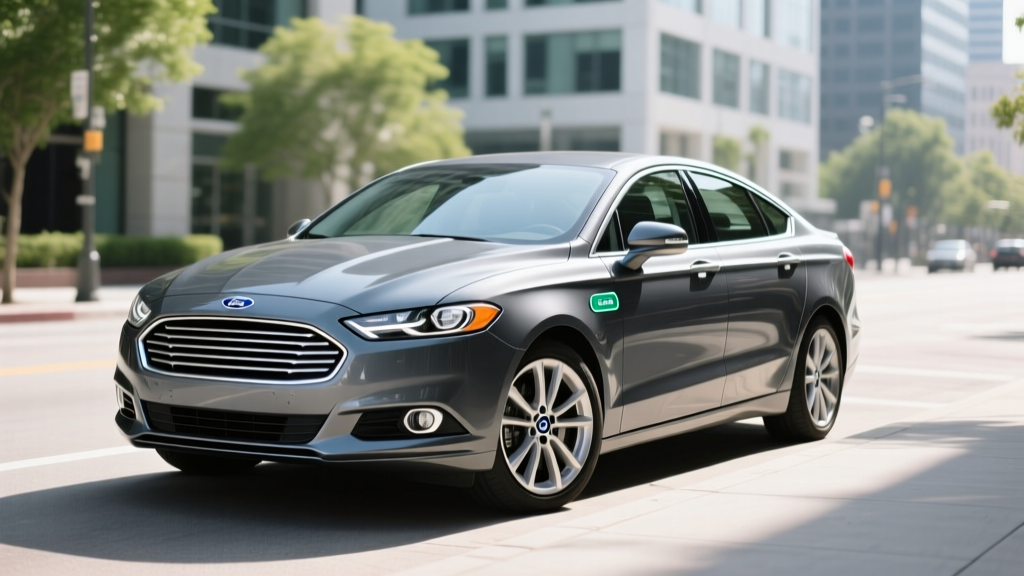
The 2016 Ford Fusion Hybrid remains one of the most fuel-efficient midsize sedans on the used market a decade after its debut. With an EPA-rated 42 MPG combined and no plug required, it appeals to buyers who want hybrid efficiency without charging infrastructure. But with these vehicles now approaching or exceeding 100,000 miles, the real questions shift from fuel economy to battery longevity, replacement costs, and whether a used Fusion Hybrid still makes financial sense against modern hybrids and EVs.
This guide covers the 2016 Fusion Hybrid's powertrain specs, real-world MPG, battery health expectations, and ownership economics — so you can decide if this discontinued sedan belongs on your shortlist.
2016 Ford Fusion Hybrid: Key Specifications
| Specification | Value |
|---|---|
| Powertrain Type | Conventional Hybrid (HEV) — no plug |
| Engine | 2.0L Atkinson-cycle inline-4 |
| Electric Motor | 88 kW (118 hp) permanent-magnet AC synchronous |
| Combined System Output | 188 hp |
| Transmission | eCVT (planetary gearset, not belt-driven) |
| Hybrid Battery | 1.4 kWh lithium-ion (usable ~1.0 kWh) |
| EPA MPG (City / Highway / Combined) | 44 / 41 / 42 |
| Fuel Tank | 13.5 gallons |
| Total Driving Range | ~567 miles (EPA estimate) |
| 0–60 mph | ~7.8 seconds |
| Drivetrain | Front-wheel drive |
| Original MSRP (Base S / SE / Titanium) | $26,305 / $27,305 / $32,190 |
| Current Used Price (2026 market) | ~$9,000–$15,500 depending on mileage and condition |
Fuel Economy: EPA Ratings vs. Real-World MPG
| Driving Scenario | MPG |
|---|---|
| EPA City | 44 MPG |
| EPA Highway | 41 MPG |
| EPA Combined | 42 MPG |
| Real-World City (owner-reported average) | 43–47 MPG |
| Real-World Highway (70–80 mph) | 36–40 MPG |
| Real-World Combined (mixed driving) | 39–43 MPG |
| Cold Weather (below 30°F, short trips) | 33–38 MPG |
The 2016 Fusion Hybrid's Atkinson-cycle engine and regenerative braking system shine in stop-and-go traffic, where the electric motor handles low-speed propulsion and recaptures energy during deceleration. Many owners report exceeding the 44 MPG city EPA estimate in warm-weather urban driving — a characteristic common to conventional hybrids where the gas engine shuts off frequently at low speeds.
Highway driving tells a different story. At sustained speeds above 70 mph, aerodynamic drag dominates and the gasoline engine carries the full load, dropping efficiency to the mid-to-high 30s. Cold weather compounds this: the engine must run more often to provide cabin heat (this generation lacks a heat pump), and battery internal resistance increases, reducing regenerative braking effectiveness. Expect a 10–15% MPG penalty in winter conditions, consistent with EPA cold-weather testing data.
According to fueleconomy.gov, the 2016 Fusion Hybrid's 42 MPG combined rating placed it among the top midsize sedans for efficiency, trailing only the Toyota Camry Hybrid (40–42 MPG depending on trim year) and matching or beating the Hyundai Sonata Hybrid of the same era.
HEV vs. PHEV vs. EV: Where Does the Fusion Hybrid Fit?
Ford offered the 2016 Fusion in three powertrain variants: a conventional gasoline model, the Fusion Hybrid (HEV), and the Fusion Energi (PHEV). Understanding the distinction matters because buyers sometimes confuse the two electrified versions.
| Feature | 2016 Fusion Hybrid (HEV) | 2016 Fusion Energi (PHEV) |
|---|---|---|
| Plugs in to charge? | No — refuels with gas only | Yes — Level 1 (120V) or Level 2 (240V) |
| Electric-only range | Less than 1 mile (low-speed only) | 22 miles (EPA) |
| Hybrid battery size | 1.4 kWh lithium-ion | 7.6 kWh lithium-ion |
| Combined MPG / MPGe | 42 MPG | 88 MPGe (electric+gas) / 38 MPG (gas only) |
| Total range | ~567 miles | ~550 miles (22 EV + 528 gas) |
| DC fast charging | Not applicable | No — Level 2 max (~3.3 kW) |
| Trunk space | 12.0 cu ft | 8.2 cu ft (battery intrudes) |
| Federal tax credit (original) | None | ~$3,750 (phased out for Ford) |
| 2026 used price range | $9,000–$15,500 | $10,500–$16,500 |
Conventional hybrid (HEV): The Fusion Hybrid generates all its electricity internally through regenerative braking and the gasoline engine. You never plug it in. The small 1.4 kWh battery enables brief electric-only assist at low speeds, but the gas engine does the majority of the work. Think of it as a highly efficient gas car that recaptures wasted energy.
Plug-in hybrid (PHEV): The Fusion Energi has a much larger 7.6 kWh battery that you charge by plugging in. It can drive up to 22 miles on electricity alone before the gas engine engages. This suits drivers with short commutes who can charge at home but still want gas-engine range for road trips.
Battery electric vehicle (BEV): A full EV like a used Tesla Model 3 or Chevrolet Bolt eliminates gasoline entirely but requires reliable charging access — either home Level 2 or dependable public DC fast-charging infrastructure. If you lack home charging, a BEV may not be practical.
Who Should Choose Which?
- Choose the Fusion Hybrid (HEV) if: You want maximum fuel savings with zero lifestyle change — no plug, no charging apps, no range planning. Ideal for apartment dwellers without charging access or drivers who frequently take long road trips.
- Choose the Fusion Energi (PHEV) if: You have a garage or driveway with a 120V outlet, your daily commute is under 20 miles, and you want to drive mostly electric on weekdays while keeping gas flexibility for weekends.
- Choose a full EV if: You can install a Level 2 home charger, your daily driving is predictable, and you want to eliminate gas and oil changes entirely.
Powertrain and Driving Experience
The 2016 Fusion Hybrid pairs a 2.0-liter Atkinson-cycle four-cylinder engine (141 hp, 129 lb-ft torque) with an 88 kW electric motor (118 hp, 117 lb-ft). Combined system output is 188 horsepower, routed through Ford's eCVT — a planetary gearset that blends power from both sources seamlessly, not a traditional belt-and-cone CVT.
The result is smooth, linear acceleration without the rubber-band drone associated with older CVTs. The 0–60 mph time of approximately 7.8 seconds is adequate for highway merging but not quick by modern standards. The transition between electric and gas power is among the smoothest in its class, with the engine starting and stopping almost imperceptibly at stops.
Ford's SmartGauge cluster with EcoGuide provides real-time coaching on braking and acceleration efficiency, and the Brake Coach shows how much energy you recaptured versus wasted on each stop. It's a useful tool for maximizing MPG without being intrusive.
Battery Lifespan, Warranty, and Replacement Cost
Original Hybrid Battery Warranty: 8 years / 100,000 miles (whichever comes first) in most states. In California Air Resources Board (CARB) states, the warranty extends to 10 years / 150,000 miles for emissions-related components including the hybrid battery.
Current Status (2026): A 2016 model is now 10 years old. The federal 8-year/100,000-mile warranty has expired for most original owners unless the vehicle has exceptionally low mileage. CARB-state 10-year warranties are also expiring or expired in 2026.
How Long Do Fusion Hybrid Batteries Last?
The 1.4 kWh lithium-ion pack in the Fusion Hybrid is modest in size and generally conservative in its charge/discharge cycles, which works in its favor for longevity. The battery management system maintains a buffer — it never fully charges or fully depletes the pack — reducing degradation stress.
Based on owner reports and fleet data, most 2016 Fusion Hybrid batteries retain sufficient capacity to deliver near-original fuel economy through 120,000–160,000 miles. Failures before 100,000 miles are uncommon but not unheard of. The more typical scenario for a 10-year-old vehicle is gradual capacity loss of 10–20%, which manifests as slightly more frequent engine engagement and a 1–3 MPG drop rather than a complete failure.
Battery Replacement Cost
If the hybrid battery does fail outside warranty, here's what to expect:
- New OEM battery (Ford dealer): $2,500–$3,800 including parts and labor
- Refurbished/remanufactured battery: $1,200–$2,200 from independent hybrid specialists
- Individual cell/module replacement: $400–$900 if only specific modules have degraded (available from hybrid repair shops)
- Junkyard/salvage battery: $500–$1,000, but with unknown remaining life — higher risk
For a vehicle worth $9,000–$15,500, a full OEM battery replacement represents a significant percentage of the car's value. Before purchasing a used 2016 Fusion Hybrid, request a hybrid battery health diagnostic from a Ford dealer or qualified hybrid technician. Some OBD-II scanners can read the battery's state of health (SoH) directly.
Tax Credits and Incentives (2026 Used Buyer Context)
The 2016 Ford Fusion Hybrid does not qualify for any federal tax credit — neither when new nor as a used purchase in 2026. Conventional hybrids (HEVs) have never been eligible for the IRS §30D Clean Vehicle Credit, which applies only to plug-in electric vehicles (PHEVs and BEVs) with sufficient battery capacity.
For reference, the plug-in Fusion Energi originally qualified for approximately $3,750 under the pre-2023 tax credit rules, but Ford's credit allocation was phased out years ago. Under current IRS §30D rules, used PHEVs and EVs may qualify for up to $4,000 or 30% of the sale price (whichever is lower) under the Used Clean Vehicle Credit, but this applies only to battery-electric and plug-in hybrid models — not conventional hybrids like the Fusion Hybrid.
Some states offer rebates or reduced registration fees for hybrid vehicles, but these vary widely by jurisdiction and many have expired or apply only to new purchases. Check your state's energy or environmental agency for current programs.
Reliability, Safety, and Ownership Costs
The 2016 Fusion Hybrid earned strong safety marks: a 5-star overall rating from NHTSA and a Top Safety Pick+ designation from IIHS when equipped with optional front crash prevention. Standard safety features include stability control, antilock brakes, and a full complement of airbags; adaptive cruise control and lane-keeping assist were available on SE and Titanium trims.
Reliability is generally good but not class-leading. Consumer surveys and long-term owner data place the Fusion Hybrid slightly below the Toyota Camry Hybrid in predicted reliability, primarily due to occasional issues with the SYNC infotainment system, power steering sensor faults, and coolant pump recalls. The hybrid powertrain itself — the eCVT, electric motor, and power electronics — has proven durable, with fewer reported failures than the conventional gasoline Fusion's 6-speed automatic transmission.
Estimated Annual Ownership Costs
- Fuel: At 42 MPG combined and $3.20/gallon gas (2026 national average), driving 12,000 miles/year costs approximately $914 annually — roughly $550 less per year than a comparable 26 MPG gas-only midsize sedan.
- Insurance: $1,100–$1,600/year depending on state, driver profile, and coverage level. Hybrid insurance premiums are generally comparable to gas equivalents for this model year.
- Maintenance: $400–$600/year. Oil changes every 7,500–10,000 miles, plus standard brake and tire service. Regenerative braking extends brake pad life significantly — many owners report original pads lasting 80,000+ miles.
- Depreciation: The Fusion Hybrid has already absorbed most of its depreciation. Expect 3–5% annual value loss for a well-maintained example, slower than average since the model is discontinued and demand for efficient used sedans remains steady.
Pros and Cons
Pros
- 42 MPG combined — top-tier efficiency for a midsize sedan with no plug required
- Smooth, refined hybrid powertrain with seamless gas-electric transitions
- Spacious cabin with comfortable ride quality and strong highway stability
- Excellent safety ratings (5-star NHTSA, IIHS Top Safety Pick+)
- No charging infrastructure needed — ideal for apartment dwellers
- Low used-market pricing ($9,000–$15,500) with strong value retention
- Regenerative braking extends brake pad life significantly
Cons
- Original hybrid battery warranty is expiring or expired on all 2016 models
- Battery replacement ($2,500+ OEM) is a meaningful percentage of vehicle value
- Highway MPG drops to 36–40 at sustained speeds above 70 mph
- No DC fast charging, no plug-in capability (HEV only)
- SYNC 2 infotainment system feels dated; no wireless CarPlay/Android Auto
- Discontinued model — Ford no longer produces the Fusion sedan
- Cold-weather MPG penalty of 10–15% without a heat pump
Should You Buy a Used 2016 Ford Fusion Hybrid in 2026?
Buy it if:
- You need a fuel-efficient daily driver without access to home or workplace charging
- Your budget is $10,000–$15,000 and you want a comfortable, safe midsize sedan
- You primarily drive in city or suburban conditions where the hybrid system maximizes MPG
- You're comfortable budgeting $1,500–$3,000 for a potential battery replacement within the next 2–4 years
- You can verify battery health before purchase via a dealer diagnostic
Look elsewhere if:
- You have home charging and could benefit from a used PHEV (Chevy Volt, Prius Prime) or BEV (Bolt, Model 3)
- Your driving is predominantly highway — a diesel or efficient turbo gas sedan may match the Fusion Hybrid's real-world highway MPG
- You want modern infotainment, wireless connectivity, or the latest ADAS features
- The vehicle you're considering has over 130,000 miles with no battery health documentation
The 2016 Fusion Hybrid occupies a specific niche: a proven, no-compromise fuel-sipper that asks nothing of your routine. For buyers who can't plug in but want hybrid efficiency, it remains a rational used-car choice — provided you factor in battery age and replacement risk as part of the total cost.
Frequently Asked Questions
How many MPG does the 2016 Ford Fusion Hybrid get?
The EPA rates the 2016 Fusion Hybrid at 44 MPG city, 41 MPG highway, and 42 MPG combined. Real-world results vary: expect 43–47 MPG in warm-weather city driving, 36–40 MPG on the highway at 70–80 mph, and 33–38 MPG in cold-weather conditions with short trips.
Does the 2016 Fusion Hybrid need to be plugged in?
No. The Fusion Hybrid is a conventional hybrid (HEV) that charges its small 1.4 kWh battery entirely through regenerative braking and the gasoline engine. You refuel it with gasoline at any gas station, just like a regular car. The Fusion Energi (PHEV) is the plug-in version — a different model.
How long does the 2016 Fusion Hybrid battery last?
Most Fusion Hybrid batteries maintain functional capacity through 120,000–160,000 miles. At 10 years old (in 2026), some degradation is expected — typically 10–20% capacity loss, which may reduce fuel economy by 1–3 MPG. Complete failures before 100,000 miles are uncommon but possible.
How much does it cost to replace the hybrid battery?
A new OEM battery from a Ford dealer costs $2,500–$3,800 installed. Refurbished or remanufactured batteries from independent hybrid specialists run $1,200–$2,200. Individual module repairs can cost $400–$900 if only specific cells have degraded.
Does the 2016 Ford Fusion Hybrid qualify for any tax credit?
No. Conventional hybrids (HEVs) do not qualify for the federal IRS §30D Clean Vehicle Credit, which applies only to plug-in vehicles (PHEVs and BEVs). The Fusion Hybrid was not eligible when new and is not eligible as a used purchase. Some states may offer minor incentives, but these vary by jurisdiction.
Is the 2016 Fusion Hybrid reliable?
The hybrid powertrain (eCVT, motor, power electronics) has proven durable with fewer issues than the conventional Fusion's automatic transmission. Common non-powertrain complaints include SYNC infotainment glitches and occasional power steering sensor faults. Overall reliability is good but slightly below the Toyota Camry Hybrid benchmark.
What's the difference between the Fusion Hybrid and Fusion Energi?
The Fusion Hybrid (HEV) cannot plug in and has a 1.4 kWh battery for hybrid assist. The Fusion Energi (PHEV) plugs into a standard outlet or Level 2 charger, has a 7.6 kWh battery, and can drive 22 miles on electricity alone before the gas engine takes over. The Energi sacrifices trunk space (8.2 vs 12.0 cu ft) to accommodate the larger battery.