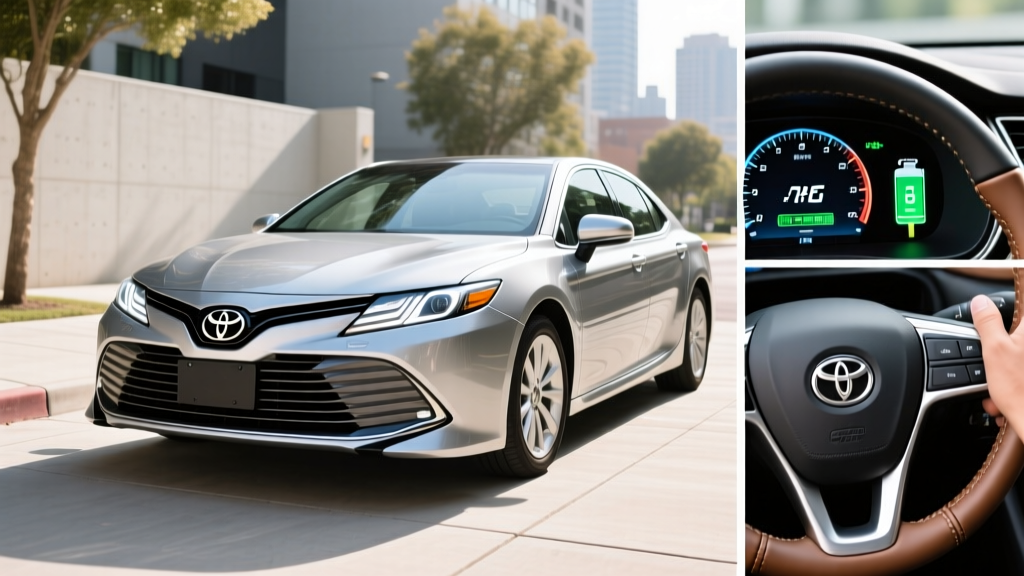
The 2016 Toyota Camry Hybrid occupies a specific niche in the used-car market: a midsize sedan that sips fuel without demanding any change in your daily routine. No plugs, no charging apps, no range calculations — just a gasoline-electric powertrain that Toyota has refined over two decades. For 2026 buyers evaluating used hybrids against newer PHEVs and full EVs, the 2016 Camry Hybrid remains a benchmark for simplicity and proven reliability.
This guide breaks down the exact fuel economy numbers, powertrain specs, battery longevity data, and ownership costs you need to decide whether a used 2016 Camry Hybrid fits your commute — or whether a plug-in hybrid or battery-electric vehicle serves you better.
HEV vs PHEV: Where the 2016 Camry Hybrid Fits
Before diving into specs, it is essential to distinguish the two hybrid architectures you will encounter while shopping:
Conventional Hybrid (HEV)
Example: 2016 Toyota Camry Hybrid
- No plug — the battery charges via regenerative braking and the gasoline engine
- Small battery (~1.6 kWh usable) that assists the engine and enables brief electric-only driving at low speeds
- Primary benefit: significantly reduced fuel consumption with zero behavior change
- No federal tax credit for new purchases; no electric-only highway range
Plug-In Hybrid (PHEV)
Example: Toyota Prius Prime, RAV4 Prime
- Plugs into a wall outlet or Level 2 charger to fill a larger battery (8–18 kWh typical)
- Delivers 25–45 miles of electric-only driving before the gas engine engages
- Primary benefit: EV-like daily commuting with gas-engine backup for long trips
- May qualify for federal §30D tax credit (up to $7,500) depending on battery sourcing, MSRP caps, and buyer income — check current IRS rules
The 2016 Camry Hybrid is strictly an HEV. You will never plug it in. It generates all its electrical energy onboard through regenerative braking and engine-driven generation. If you want electric-only commuting, you need a PHEV or a full BEV instead.
2016 Camry Hybrid Fuel Economy: EPA and Real-World MPG
The EPA rated the 2016 Camry Hybrid (LE trim) at 40 MPG combined, with a breakdown that reflects how hybrid systems exploit stop-and-go driving:
| Driving Cycle | EPA Rating | Real-World Expectation |
|---|---|---|
| City | 40 MPG | 41–45 MPG (hybrids excel in city regen) |
| Highway | 38 MPG | 35–38 MPG (less regen benefit at steady speed) |
| Combined | 40 MPG | 38–42 MPG depending on driving mix |
Source: fueleconomy.gov
Hybrids routinely match or exceed their EPA city ratings because regenerative braking recovers kinetic energy that a conventional car wastes as heat. Highway driving is where the 2016 Camry Hybrid's advantage narrows — at 70+ MPH, the gasoline engine does most of the work, and aerodynamic drag dominates.
Cold-weather impact: Expect a 5–10% fuel-economy drop in freezing temperatures. The engine runs longer to heat the cabin and bring the catalytic converter to operating temperature, reducing the time the hybrid system can shut the engine off. Owners in northern climates typically report 36–38 MPG combined in winter versus 40–43 MPG in mild weather.
Powertrain Specs: Engine, Motor, and Combined Output
| Specification | 2016 Camry Hybrid |
|---|---|
| Engine | 2.5L inline-4 Atkinson cycle |
| Engine Power | 156 HP @ 5,700 RPM |
| Electric Motor | Permanent-magnet synchronous, 105 kW (141 HP) |
| Combined Net Horsepower | 200 HP |
| Transmission | eCVT (planetary gearset, not a belt CVT) |
| Hybrid Battery | ~1.6 kWh nickel-metal hydride (NiMH) |
| 0–60 MPH | ~7.6 seconds |
| Drivetrain | Front-wheel drive |
| Curb Weight | ~3,545 lbs |
Toyota's Hybrid Synergy Drive uses a planetary gearset to blend engine and motor power seamlessly. The eCVT has no belts, no cones, and no fixed gear ratios — it is a power-split device that continuously varies the ratio between engine speed and wheel speed. This design eliminates shift shock and is mechanically simpler than a conventional automatic, contributing to the Camry Hybrid's strong reliability record.
The 200 HP combined output is adequate for highway merging and passing. The electric motor's instant torque (available from 0 RPM) gives the car a responsive feel from stoplights that the horsepower number alone does not convey.
Battery Longevity, Warranty, and Replacement Cost
2016 Camry Hybrid Battery Warranty (Original)
Hybrid Battery: 8 years / 100,000 miles (10 years / 150,000 miles in CARB states including CA, NY, MA, and others)
Hybrid System Components: 8 years / 100,000 miles
Capacity Retention Threshold: Toyota covers the battery if it fails to hold sufficient charge to operate the hybrid system — there is no published percentage threshold like the 70% used by some EV manufacturers.
For a 2016 model in 2026, the original 8-year/100,000-mile warranty has expired for most vehicles unless the car was sold late in the model year and remains under 100,000 miles. The 10-year/150,000-mile CARB-state warranty may still apply for vehicles registered in qualifying states.
Real-world battery lifespan: Toyota's NiMH hybrid batteries have demonstrated remarkable longevity. Data from fleet operators and owner surveys consistently show Camry Hybrid batteries lasting 150,000–200,000+ miles before requiring replacement. Unlike the lithium-ion packs in full EVs, the Camry Hybrid's small NiMH battery operates in a narrow state-of-charge window (roughly 40–80%) managed by the hybrid computer, which minimizes degradation.
Battery replacement cost:
- New OEM battery (Toyota dealer): $2,500–$4,000 including labor
- Refurbished/remanufactured battery: $1,500–$2,500 including labor
- Individual cell module replacement: $500–$1,200 if only a few cells have degraded (requires specialized diagnostics)
Given the vehicle's age, a refurbished battery or cell-level repair is the most cost-effective option. Several aftermarket suppliers offer reconditioned NiMH modules with 1–3 year warranties.
Used Pricing and Tax Credit Eligibility
As a used vehicle in 2026, the 2016 Camry Hybrid is no longer eligible for the federal §30D new clean vehicle credit. However, buyers should be aware of the Used Clean Vehicle Credit (§25E), which provides up to $4,000 (or 30% of the sale price, whichever is less) for qualifying pre-owned EVs and fuel-cell vehicles.
Critical distinction: The §25E used credit applies only to battery-electric vehicles (BEVs) and fuel-cell electric vehicles (FCEVs). Conventional hybrids like the 2016 Camry Hybrid do not qualify for any federal tax credit — neither the new-vehicle §30D credit nor the used-vehicle §25E credit. Only plug-in hybrids with sufficient battery capacity qualified under the older §30D rules, and the 2016 Camry Hybrid was never a PHEV.
2026 used market pricing (approximate):
- LE trim, 80,000–100,000 miles: $14,000–$17,000
- XLE trim, 80,000–100,000 miles: $16,000–$19,000
- LE trim, 100,000–130,000 miles: $11,000–$14,000
- XLE trim, 100,000–130,000 miles: $13,000–$16,000
Pricing varies significantly by region, condition, service history, and battery health. Always request a hybrid battery health check (many Toyota dealers can pull the battery's internal resistance data) before purchase.
Who Should Buy the 2016 Camry Hybrid vs a PHEV or EV
Pros
- Proven, 200 HP hybrid powertrain with 200k+ mile longevity potential
- No charging infrastructure needed — works anywhere gas is sold
- 40 MPG combined cuts fuel costs roughly in half vs a 4-cylinder gas Camry
- Low maintenance: no timing belt, eCVT is largely maintenance-free, regenerative braking extends pad life
- Comfortable midsize sedan with strong IIHS safety ratings
- Low entry price on the used market
Cons
- No electric-only highway range — the engine runs at all sustained speeds
- No federal or state tax credits available for this conventional hybrid
- Older infotainment and driver-assistance tech (no Apple CarPlay/Android Auto, basic Toyota Safety Sense on some trims)
- NiMH battery, while durable, is heavier and less energy-dense than modern lithium-ion
- Trunk space reduced by battery placement (~13.1 cu ft vs 15.4 cu ft in gas Camry)
- No DC fast charging capability (not applicable — this is an HEV)
2016 Camry Hybrid vs Alternatives: Decision Framework
Choose the 2016 Camry Hybrid if:
- You drive 10,000–15,000 miles per year in mixed city/highway conditions
- You cannot install a home charger (apartment, street parking, no garage outlet)
- You want a low purchase price under $18,000 with minimal ongoing complexity
- You regularly take road trips exceeding 300 miles and do not want to plan charging stops
- You live in an area with limited public charging infrastructure
Choose a Used PHEV (e.g., 2019–2021 Prius Prime, 2020+ RAV4 Prime) if:
- Your daily commute is under 25–40 miles round trip and you can charge at home
- You want to drive most weekdays on electricity but need gas-engine flexibility for weekend trips
- You want to reduce gasoline consumption by 60–80% without full EV commitment
Choose a Used BEV (e.g., 2020+ Tesla Model 3, Hyundai Kona Electric) if:
- You have reliable home Level 2 charging access
- Your daily driving is under 200 miles and you can plan occasional DC fast-charge stops on road trips
- You want the lowest per-mile energy cost (~$0.04–$0.06/mile on home electricity vs ~$0.10–$0.12/mile in the Camry Hybrid at 40 MPG and $3.50/gal)
- You want to qualify for the §25E used clean vehicle credit (up to $4,000)
Ownership Costs: 5-Year Projection
Here is a realistic 5-year / 60,000-mile cost comparison assuming 12,000 miles per year and national-average fuel/electricity prices:
| Cost Category | 2016 Camry Hybrid (Used) | 2016 Camry Gas 4-Cyl (Used) | 2020 Tesla Model 3 SR+ (Used BEV) |
|---|---|---|---|
| Purchase Price | $15,000 | $13,000 | $22,000 |
| Fuel/Energy (5 yr) | $5,250 (40 MPG, $3.50/gal) | $7,000 (30 MPG, $3.50/gal) | $2,400 ($0.13/kWh, 25 kWh/100mi) |
| Maintenance (5 yr) | $2,500 | $3,500 | $1,800 |
| Insurance (5 yr) | $6,500 | $6,000 | $8,500 |
| Tax Credit | $0 | $0 | −$4,000 (§25E, if eligible) |
| Estimated 5-Year Total | $29,250 | $29,500 | $30,700 |
The 2016 Camry Hybrid's total cost of ownership is remarkably close to the gas Camry despite the higher purchase price, because fuel savings offset the premium within 3–4 years. A used BEV costs more upfront but benefits from lower energy and maintenance costs — and the §25E credit can narrow the gap significantly if you qualify.
Frequently Asked Questions
How many MPG does the 2016 Camry Hybrid get?
The EPA rates the 2016 Camry Hybrid LE at 40 MPG city, 38 MPG highway, and 40 MPG combined. In real-world driving, owners typically see 38–42 MPG combined, with city driving often exceeding 40 MPG thanks to regenerative braking. Highway-only driving at 75+ MPH may drop to 35–37 MPG.
Does the 2016 Camry Hybrid need to be plugged in?
No. The 2016 Camry Hybrid is a conventional hybrid (HEV), not a plug-in hybrid (PHEV). Its small battery charges entirely through regenerative braking and the gasoline engine. You fuel it exactly like a conventional car — at a gas station.
How far can the 2016 Camry Hybrid drive on electric power alone?
Under 1 mile at very low speeds (typically under 25 MPH). The hybrid system uses the electric motor to assist the engine and enable brief engine-off coasting, but it is not designed for sustained electric-only driving. If electric-only commuting is your goal, consider a PHEV like the Prius Prime (25–40 miles electric) or a full BEV.
Is the 2016 Camry Hybrid reliable?
Yes. The Camry Hybrid's powertrain — the 2.5L Atkinson-cycle engine, eCVT, and NiMH battery — is among the most proven in the industry. The eCVT has no wear-prone belts or clutches. The NiMH battery operates in a conservative charge window that extends lifespan. Many examples exceed 200,000 miles with basic maintenance. The primary wear item unique to the hybrid is the battery pack, which typically lasts 150,000–200,000+ miles.
What does a hybrid battery replacement cost for the 2016 Camry?
A new OEM battery from a Toyota dealer costs $2,500–$4,000 installed. Refurbished batteries run $1,500–$2,500 installed. Individual cell-module replacement (if only a few cells have degraded) costs $500–$1,200. Given the vehicle's age, a refurbished unit or cell-level repair is the most common and cost-effective choice.
Does the 2016 Camry Hybrid qualify for any tax credit?
No. As a conventional hybrid (HEV), the 2016 Camry Hybrid does not qualify for the federal §30D new clean vehicle credit or the §25E used clean vehicle credit. Those credits are reserved for plug-in vehicles (PHEVs and BEVs) with sufficient battery capacity. Some states previously offered hybrid incentives, but most have expired or shifted to plug-in vehicles. Check your state's current programs at afdc.energy.gov.
How does the 2016 Camry Hybrid compare to a 2026 Toyota Camry Hybrid?
The current-generation Camry Hybrid (2025+ redesign) uses a more efficient lithium-ion battery, offers standard Toyota Safety Sense 3.0, and achieves up to 52 MPG combined in LE FWD trim. However, a new 2026 Camry Hybrid starts around $30,000+, making the 2016 model at $14,000–$18,000 a compelling value proposition for budget-conscious buyers who accept older tech and higher mileage.
Should I buy the 2016 Camry Hybrid or a full EV?
If you have home charging access, drive under 200 miles daily, and want the lowest operating cost, a used BEV (with the §25E credit) may save more over 5 years. If you lack home charging, regularly drive long distances, or want the lowest upfront cost with zero charging logistics, the 2016 Camry Hybrid remains an excellent choice.