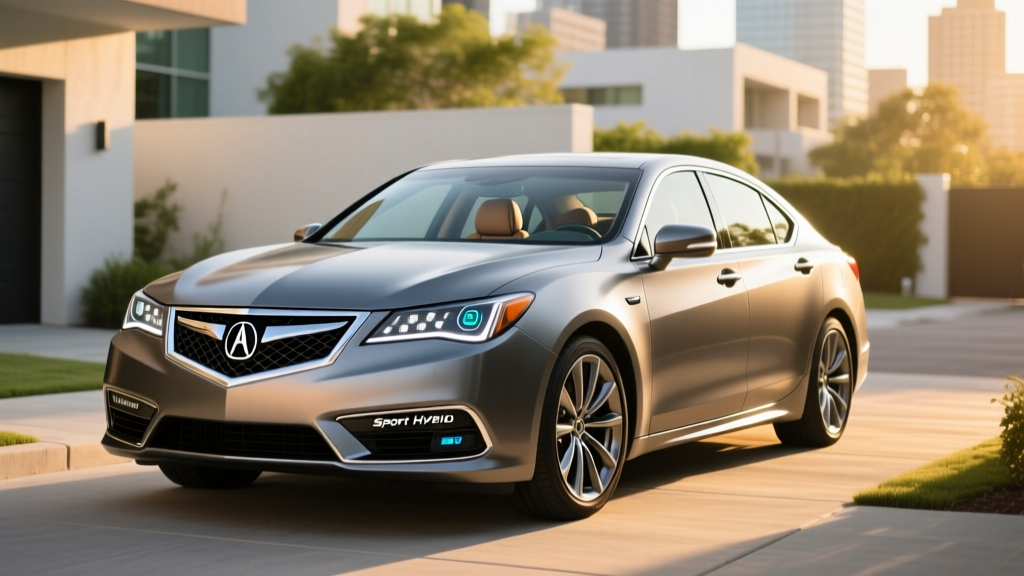
The 2016 Acura hybrid lineup was narrow but ambitious: a single model, the RLX Sport Hybrid SH-AWD, carried the brand's electrified torch. Built around Acura's three-motor Sport Hybrid Super Handling All-Wheel Drive system, it paired a 3.5-liter V6 with two rear-axle electric motors to produce a combined 377 horsepower while returning an EPA-estimated 30 MPG combined. In 2026, it remains one of the more interesting used luxury hybrid sedans on the market — if you know what you're buying.
This guide covers everything a prospective used buyer needs: exact EPA fuel economy, real-world MPG expectations, the hybrid battery's longevity and warranty, powertrain specs, and whether the 2016 RLX Sport Hybrid still makes financial sense against modern PHEVs and full EVs.
2016 Acura Hybrid: Which Model Actually Exists?
Acura's 2016 hybrid offering consisted of exactly one vehicle: the RLX Sport Hybrid SH-AWD. There was no Acura ILX hybrid, no MDX hybrid, and no RDX hybrid for the 2016 model year. The RLX Sport Hybrid sat at the top of the RLX sedan range, priced significantly above the front-wheel-drive V6 model, and competed with the Lexus GS 450h and BMW 5 Series hybrid offerings of the era.
Understanding what you're looking at matters because Acura's hybrid technology in 2016 was a conventional hybrid (HEV), not a plug-in hybrid (PHEV). The RLX Sport Hybrid charges its battery exclusively through regenerative braking and the gasoline engine — you never plug it in.
HEV vs PHEV: What the 2016 Acura Hybrid Is (and Isn't)
| Feature | 2016 Acura RLX Sport Hybrid (HEV) | Plug-In Hybrid (PHEV) Example |
|---|---|---|
| Plug-in charging? | No — self-charging via regen & engine | Yes — plugs into Level 1 or Level 2 |
| Electric-only range | ~1 mile at low speed (EV mode) | Typically 20–45 miles |
| Battery size | 1.3 kWh (lithium-ion) | 10–20+ kWh |
| Federal tax credit (§30D) | Not eligible | Up to $7,500 (if eligible) |
| Gas required? | Yes — always | Yes — when battery depleted |
Fuel Economy: EPA Ratings vs Real-World MPG
The 2016 Acura RLX Sport Hybrid's EPA fuel economy ratings are well documented by fueleconomy.gov:
| Cycle | EPA MPG | Real-World Expectation |
|---|---|---|
| City | 29 MPG | 28–32 MPG (hybrids often exceed EPA city) |
| Highway | 30 MPG | 27–30 MPG (heavy sedan, AWD drag) |
| Combined | 30 MPG | 28–31 MPG typical |
For a 4,300-pound all-wheel-drive luxury sedan with 377 horsepower, 30 MPG combined is genuinely impressive. The three-motor system shuts off the engine during low-speed cruising and stop-and-go traffic, letting the twin rear electric motors handle propulsion. In city driving, owners frequently report matching or slightly exceeding the EPA city rating because regenerative braking recaptures energy that a conventional sedan would waste as heat.
Highway efficiency is where the physics bite back. The RLX Sport Hybrid's SH-AWD system adds weight, and the V6 must work harder at sustained speeds. Expect 27–29 MPG on flat interstate driving at 70 mph, dropping to 25–27 MPG in mountainous terrain or cold weather below 35°F.
Total range on a full 14.3-gallon tank lands around 425–440 miles combined in mixed driving.
Powertrain Deep Dive: 377 HP From a Hybrid
The 2016 RLX Sport Hybrid's powertrain is the most complex system Acura had ever put in a production sedan at that time. Here's the exact breakdown:
| Specification | Detail |
|---|---|
| Gasoline engine | 3.5L V6, direct injection, i-VTEC — 310 hp / 272 lb-ft |
| Front electric motor | Integrated into 7-speed DCT — 47 hp / 109 lb-ft |
| Rear electric motors (twin) | One per rear wheel — 36 hp each / 54 lb-ft each |
| Combined system output | 377 hp |
| Transmission | 7-speed dual-clutch automatic (front) |
| Drivetrain | SH-AWD (torque-vectoring rear axle) |
| Hybrid battery | 1.3 kWh lithium-ion (located behind rear seat) |
| 0–60 mph | ~5.9 seconds (Car and Driver tested) |
| Curb weight | 4,310 lbs |
The SH-AWD system is the real engineering story. Unlike conventional AWD that uses a mechanical driveshaft to the rear axle, the RLX Sport Hybrid sends power to the rear wheels exclusively through the twin electric motors. This allows true torque vectoring — the system can over-torque the outside rear wheel in a corner, effectively rotating the car into turns. It's a performance hybrid system, not just an efficiency play.
Hybrid Battery Longevity, Warranty & Replacement Cost
The 1.3 kWh lithium-ion battery pack is the single biggest concern for any used hybrid buyer. Here's what you need to know:
Acura Hybrid Battery Warranty (Original)
- Duration: 8 years / 100,000 miles (10 years / 150,000 miles in CARB states — CA, NY, MA, and others adopting California emissions standards)
- Coverage: Battery capacity below a defined threshold or complete failure
- Transferable: Yes — warranty follows the vehicle, not the original owner
- 2026 status: Original 8-year warranty expired in 2024; 10-year CARB-state coverage may still apply through 2026 for low-mileage examples
Battery replacement cost: A new OEM replacement hybrid battery for the RLX Sport Hybrid runs approximately $2,500–$4,000 including labor at an Acura dealer. Third-party refurbished or reconditioned packs are available for $1,500–$2,500. Because the pack is relatively small (1.3 kWh), replacement is far less expensive than a full EV battery swap.
Real-world degradation: The RLX Sport Hybrid's battery is lightly stressed — it never deep-cycles like an EV battery. Most 2016 examples with 80,000–120,000 miles show minimal capacity loss. The battery management system keeps the state of charge in a narrow 40–80% window, which dramatically extends cycle life. Failure before 150,000 miles is uncommon based on owner reports, though individual cell degradation can trigger warning lights that require dealer diagnostics.
Is the 2016 Acura RLX Sport Hybrid Reliable?
The RLX Sport Hybrid carries some specific reliability considerations that separate it from the non-hybrid RLX:
The good: The 3.5L J-series V6 is one of Honda/Acura's most proven engines, widely used across the lineup with a track record exceeding 200,000 miles with basic maintenance. The hybrid battery system, as noted, is conservatively managed.
The concerns: The 7-speed dual-clutch transmission is the weak link. DCTs from this era — across all brands — are known for rough low-speed shifts, clutch wear, and expensive repairs. The RLX Sport Hybrid's DCT has been flagged in owner forums for shuddering during stop-and-go driving and occasional hesitation when the system transitions between electric-only and engine power. Acura issued software updates to address shift quality, so verify that all TSBs (Technical Service Bulletins) have been performed.
The twin rear electric motors and their associated power electronics add complexity. While failures are rare, any repair involving the rear drive unit requires specialized hybrid-system training, limiting your options to Acura dealers or experienced independent hybrid shops.
For overall reliability context, check the NHTSA recall and complaint database for the specific VIN you're considering.
Pricing, Tax Credits & Used Market Value in 2026
The 2016 Acura RLX Sport Hybrid originally carried an MSRP of approximately $65,950 (including destination). It was a low-volume model — Acura sold fewer than 1,000 units annually — which affects both availability and parts sourcing today.
2026 used market pricing: Expect to pay between $18,000 and $28,000 depending on mileage, condition, and service history. Examples under 60,000 miles with full dealer records command the top of that range.
Federal tax credit: The RLX Sport Hybrid does not qualify for the federal §30D new clean vehicle credit (it's a conventional HEV, not a PHEV or BEV). However, there is no current federal used-EV credit that applies to conventional hybrids either — the IRS used clean vehicle credit (up to $4,000) applies only to used BEVs and PHEVs meeting specific requirements.
State incentives: A handful of states offer rebates or HOV-lane access for hybrids, but most incentive programs have shifted to prioritize plug-in vehicles. Check your state's energy office or DMV for current hybrid-specific benefits.
Pros
- 377 hp with 30 MPG combined — rare combination
- SH-AWD torque vectoring is genuinely engaging
- Small hybrid battery = lower replacement cost
- No plug-in needed — works for apartment dwellers
- Proven 3.5L V6 engine longevity
- Luxury features: 14-speaker Krell audio, navigation, leather
Cons
- 7-speed DCT can be jerky at low speeds
- Heavy at 4,310 lbs — feels it in corners
- Low production volume = harder to find parts
- Infotainment is dated (dual-screen setup)
- No electric-only highway driving
- Trunk space reduced by battery placement
- No federal or most state tax credits
2016 Acura Hybrid vs Modern PHEVs and EVs: Which Fits You?
Choose the 2016 Acura RLX Sport Hybrid if:
- You cannot charge at home or work (no plug needed)
- You want luxury AWD sedan performance under $25,000
- Your daily commute involves mixed city/highway driving
- You drive 12,000–15,000 miles/year and want ~30 MPG without behavior change
- You prefer a proven V6 over turbocharged 4-cylinder alternatives
Consider a used PHEV (e.g., BMW 330e, Toyota RAV4 Prime) if:
- You have home Level 2 charging and a commute under 30 miles
- You want electric-only daily driving with gas backup for road trips
- You want to reduce fuel consumption by 50–70% on typical commutes
Consider a used full EV (e.g., Tesla Model 3, Hyundai Ioniq 5) if:
- You have reliable home charging
- Your daily driving is under 200 miles with occasional road trips
- You want near-zero maintenance (no oil, no transmission fluid, no spark plugs)
- You want to qualify for the used clean vehicle credit (up to $4,000)
The honest math: at 30 MPG combined and $3.50/gallon gas, the RLX Sport Hybrid costs roughly $1,750/year in fuel at 15,000 miles. A comparable non-hybrid luxury AWD sedan getting 22 MPG would cost about $2,386/year — a $636 annual savings for the hybrid. That's meaningful, but the purchase price and maintenance costs matter more in the total ownership equation.
Buying Checklist: What to Inspect on a Used 2016 RLX Sport Hybrid
- Hybrid battery health: Ask the dealer for a hybrid system diagnostic printout. Look for battery state-of-health (SoH) percentage and any stored fault codes.
- DCT behavior: Test-drive in stop-and-go traffic. Note any shudder, hesitation, or clunking during 1st-to-2nd gear transitions.
- TSB completion: Verify all Acura Technical Service Bulletins — especially DCT software updates — have been performed. Request service records.
- Rear motor function: During the test drive, accelerate hard from a stop. The SH-AWD system should seamlessly engage the rear motors. Any whining or vibration from the rear axle warrants inspection.
- Brake feel: Hybrid regenerative braking blends with friction brakes. The transition should be smooth. Grinding or pulsation may indicate worn rotors or a regen-system issue.
- 12V battery: Like all hybrids, the RLX has a conventional 12V battery that powers electronics. These fail every 3–5 years. Confirm it's been recently replaced or load-tested.
Frequently Asked Questions
How many MPG does the 2016 Acura hybrid get?
The 2016 Acura RLX Sport Hybrid is EPA-rated at 29 city / 30 highway / 30 combined MPG. Real-world owners typically see 28–32 MPG in mixed driving, with city driving sometimes exceeding the EPA estimate thanks to aggressive regenerative braking.
Can the 2016 Acura RLX Sport Hybrid drive on electric only?
Only briefly. The hybrid system can propel the car on electric power alone at very low speeds (under ~20 mph) for roughly one mile. It is not a plug-in hybrid and has no meaningful electric-only range for commuting. The engine is the primary power source at all normal driving speeds.
Is the 2016 Acura hybrid reliable?
The 3.5L V6 engine and hybrid battery are reliable, but the 7-speed dual-clutch transmission is a known weak point. Rough low-speed shifts and clutch wear have been reported. If the DCT has been serviced and all software TSBs applied, the car can be a solid long-term proposition. Always get a pre-purchase inspection from an Acura dealer or hybrid specialist.
What does it cost to replace the hybrid battery?
A new OEM replacement hybrid battery for the 2016 RLX Sport Hybrid costs approximately $2,500–$4,000 installed at a dealer. Refurbished packs are available for $1,500–$2,500. Given the conservative battery management, most original packs last well beyond 100,000 miles.
Does the 2016 Acura hybrid qualify for any tax credit?
No. The 2016 RLX Sport Hybrid is a conventional hybrid (HEV), not a plug-in hybrid or battery-electric vehicle. It does not qualify for the federal §30D clean vehicle credit, the used clean vehicle credit, or most state EV incentive programs. Check your state's energy office for any remaining hybrid-specific rebates, but most have been phased out.
How does the 2016 Acura hybrid compare to a Lexus GS 450h?
The Lexus GS 450h (2016) offers similar luxury and 31 MPG combined, but uses a CVT that delivers smoother — if less engaging — acceleration. The Lexus hybrid system is generally considered more proven and has wider dealer support. The Acura wins on driving dynamics via SH-AWD torque vectoring; the Lexus wins on transmission refinement and long-term parts availability.
Should I buy a 2016 Acura hybrid or a newer used EV?
If you have home charging and a predictable commute, a used EV like a 2020 Tesla Model 3 or Chevrolet Bolt will cost less per mile to operate and may qualify for the $4,000 used clean vehicle credit. If you lack charging access, drive long highway miles regularly, or want AWD without range anxiety, the RLX Sport Hybrid remains a compelling used luxury option at under $25,000.