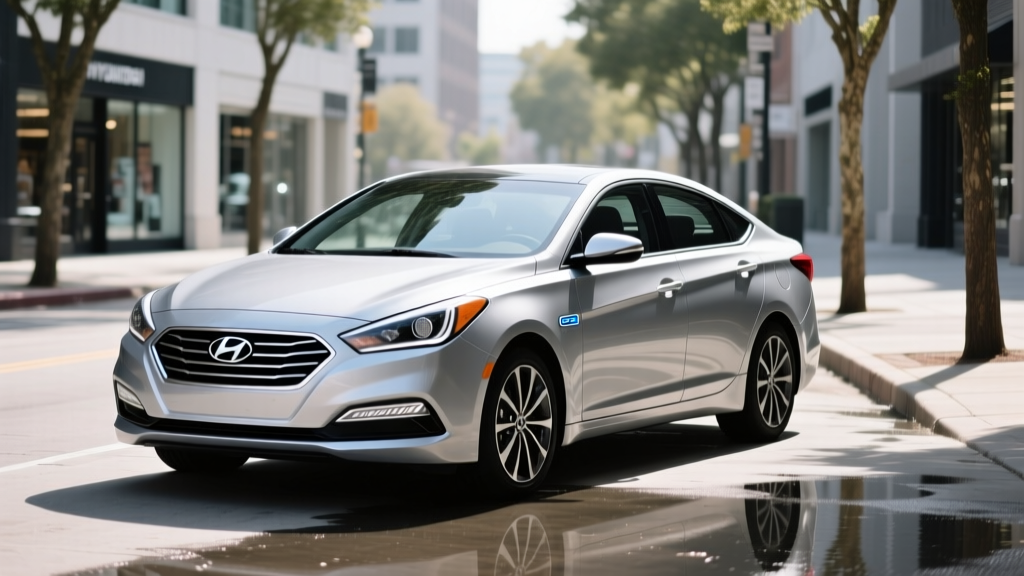
If you're searching the used-car market for a midsize hybrid sedan that won't break the bank, the 2015 Hyundai Sonata Hybrid deserves a close look. Positioned between the Toyota Camry Hybrid and Ford Fusion Hybrid in its day, this HEV (conventional hybrid) offers competitive fuel economy, a spacious cabin, and Hyundai's generous hybrid warranty — though buyers shopping in 2026 need to understand what they're getting with a decade-old hybrid system.
This guide covers the exact EPA fuel economy figures, real-world MPG expectations, powertrain specs, battery longevity, and whether the 2015 Sonata Hybrid still makes financial sense compared to newer hybrids or a full BEV. We'll also clarify a common point of confusion: this is a conventional hybrid, not a plug-in.
2015 Sonata Hybrid: HEV, Not PHEV — What That Means
Before diving into specs, it's critical to understand what you're buying. The 2015 Hyundai Sonata Hybrid is a conventional hybrid electric vehicle (HEV). It cannot be plugged in. It has no electric-only driving range to speak of. It recovers energy through regenerative braking and the gasoline engine to charge its small battery pack.
HEV vs PHEV: Key Differences
| Feature | HEV (2015 Sonata Hybrid) | PHEV (e.g., Sonata Plug-In Hybrid) |
|---|---|---|
| Plug-in charging | No — gas engine + regen only | Yes — Level 2 AC charging |
| Electric-only range | ~1 mile at low speed | 20-30+ miles (model dependent) |
| Battery size | 1.4 kWh (nominal) | 9.8 kWh (2016+ Sonata PHEV) |
| Federal tax credit | No (expired for this model year) | No (expired; was up to $4,583 when new) |
| Best for | No home charging access; want simplicity | Home charging available; short commutes |
Hyundai did offer a Sonata Plug-In Hybrid starting with the 2016 model year (not 2015). If you need electric-only commuting capability, you'd need to look at the 2016+ Sonata PHEV or a competing plug-in. For the 2015 model year, only the conventional HEV was available.
Fuel Economy: EPA MPG and Real-World Expectations
The 2015 Sonata Hybrid uses a 2.4-liter four-cylinder engine paired with an electric motor and a 6-speed automatic transmission (not a CVT, which sets it apart from most competitors). Here are the official EPA figures:
| Driving Cycle | EPA Estimate | Real-World Expectation |
|---|---|---|
| City | 36 MPG | 34-38 MPG (hybrids often beat EPA in city) |
| Highway | 40 MPG | 35-38 MPG (highway driving reduces regen benefit) |
| Combined | 37 MPG | 34-37 MPG (mixed driving typical) |
Real-world note: Hybrids typically outperform their EPA city estimates because stop-and-go traffic maximizes regenerative braking and electric-motor assist. Highway driving is where the 2015 Sonata Hybrid's efficiency drops relative to its sticker — at sustained 70-75 mph speeds, the gasoline engine does most of the work, and aerodynamic drag dominates. Expect roughly 35-38 MPG on long road trips.
For comparison, the 2015 Toyota Camry Hybrid LE achieves 41 MPG combined (42 city / 38 highway), and the 2015 Ford Fusion Hybrid posts 42 MPG combined (44 city / 41 highway). The Sonata Hybrid trails both by 4-5 MPG in EPA testing, a meaningful gap if fuel cost is your primary concern.
Powertrain Specs: Engine, Motor, and Combined Output
| Specification | 2015 Hyundai Sonata Hybrid |
|---|---|
| Engine | 2.4L GDI 4-cylinder |
| Engine horsepower | 169 HP @ 6,000 RPM |
| Electric motor output | 38 kW (51 HP) |
| Combined net horsepower | 199 HP |
| Transmission | 6-speed automatic (no CVT) |
| Hybrid battery | 1.4 kWh lithium-polymer (nominal) |
| 0-60 mph (est.) | ~8.5 seconds |
| Drivetrain | Front-wheel drive |
| Curb weight | ~3,496 lbs |
The 6-speed automatic is a deliberate engineering choice by Hyundai. Most competitors (Toyota, Ford) use a planetary-gear CVT-style e-CVT that's more efficient but can feel rubbery under hard acceleration. The Sonata Hybrid's conventional automatic delivers more natural shift feel, though it sacrifices a few MPG in the process.
With 199 combined horsepower, the 2015 Sonata Hybrid has adequate passing power for highway merging and is slightly more powerful than the Camry Hybrid (200 HP combined) but less refined in how the gas engine and electric motor hand off torque.
Battery Longevity, Warranty, and Replacement Cost
The lithium-polymer hybrid battery in the 2015 Sonata Hybrid is the single biggest concern for used buyers. Here's what you need to know:
Hyundai Hybrid Battery Warranty (Original)
- Hybrid battery: 10 years / 100,000 miles (original owner, non-transferable in most states)
- Hybrid battery (transferable): In states following California emissions warranty rules (CARB states), coverage extends to 10 years/150,000 miles and may transfer to second owners
- Hybrid system components: 10 years / 100,000 miles
- Lifetime Hybrid Battery Guarantee: Hyundai offered a lifetime replacement guarantee on the 2012-2015 Sonata Hybrid battery for the original owner — but this applies only to first registered owners and has specific claim requirements
Battery replacement cost in 2026: If the hybrid battery fails out of warranty, expect to pay $2,000-$3,500 for a replacement pack, including labor, at a dealership. Independent hybrid specialists and refurbished battery options can reduce this to $1,200-$2,000. The 1.4 kWh pack is relatively small and less expensive to replace than a full EV battery.
Real-world degradation: A 2015 Sonata Hybrid with 100,000-150,000 miles will have some battery capacity loss, but Hyundai's lithium-polymer chemistry has proven durable. Most owners report minimal MPG degradation over 100,000 miles — typically a loss of 1-2 MPG from new, not the dramatic range loss seen in early EVs. If a used example is getting 33+ MPG combined on a fresh tank, the battery is likely in acceptable health.
Pre-purchase tip: Ask for a hybrid battery state-of-health (SoH) readout from a Hyundai dealer or use an OBD-II scanner app that reads hybrid battery voltage and internal resistance. Cells showing significant voltage imbalance (more than 0.2V difference between modules) indicate a battery nearing end of life.
Used Pricing and Tax Credit Reality
As of early 2026, the 2015 Hyundai Sonata Hybrid trades in the used market at approximately:
- Base Hybrid (original MSRP ~$26,825): $8,000-$11,000 depending on mileage and condition
- Limited trim (original MSRP ~$31,225): $10,000-$14,000
Federal tax credit status: The 2015 Sonata Hybrid does not qualify for any current federal tax credit. The IRS §30D new clean vehicle credit applies only to new vehicle purchases, and the used clean vehicle credit (§25E) — which offers up to $4,000 — requires the vehicle to be a qualified plug-in EV or fuel cell vehicle with a battery capacity of at least 7 kWh. The Sonata Hybrid's 1.4 kWh battery and HEV powertrain disqualify it entirely.
No state-level hybrid incentives currently target conventional HEVs in most jurisdictions. Some states offer minimal emissions-related registration discounts, but these are not purchase incentives.
Reliability and Common Issues
The 2015 Sonata Hybrid carries a mixed reliability record. Key data points:
- NHTSA: The 2015 Sonata received a 5-star overall safety rating. The hybrid variant shares the same structural platform.
- IIHS: The 2015 Sonata sedan earned Good ratings in most crash tests (specific hybrid trim testing may vary).
- Common complaints: Transmission shudder during gas-to-electric handoff, hybrid battery cooling fan noise, and occasional 12V auxiliary battery drain if the vehicle sits unused for extended periods.
- Recall check: Always run the VIN through NHTSA's recall database before purchasing. Some 2015 Sonatas had recalls related to airbag deployment and brake light switches.
The 6-speed automatic, while more engaging than a CVT, has generated more shift-quality complaints than Toyota's e-CVT system. Test-drive any used example and pay attention to smoothness during light-throttle acceleration from a stop — that transition from electric motor to gasoline engine should be nearly imperceptible in a healthy unit.
Who Should Buy the 2015 Sonata Hybrid — and Who Shouldn't
Pros
- Affordable used entry point ($8K-$14K)
- Comfortable, spacious cabin with large trunk (14.0 cu ft)
- No plug-in required — works with any lifestyle
- 6-speed automatic feels more natural than CVTs
- Strong original hybrid battery warranty (check remaining coverage)
- 199 HP provides adequate highway passing power
Cons
- 4-5 MPG behind Camry and Fusion hybrids
- No electric-only range — pure HEV
- No federal or state tax credits available
- Battery replacement risk on high-mileage examples
- Hybrid system less proven than Toyota's track record
- Infotainment system dated by 2026 standards
Decision Framework: Is This the Right Hybrid for You?
Choose the 2015 Sonata Hybrid if: You want a budget-friendly used hybrid under $12K, you don't have access to plug-in charging, you value a comfortable ride and roomy trunk, and you drive a mix of city and highway miles where 35-37 MPG represents a meaningful fuel cost reduction.
Choose a Camry or Fusion Hybrid instead if: Maximum MPG is your top priority (both deliver 40+ combined), you want a more proven hybrid system (Toyota), or you prefer a larger dealer/service network.
Choose a used PHEV (e.g., 2017+ Prius Prime, 2016+ Sonata PHEV) if: You have Level 2 home charging access and your daily commute is under 25 miles — electric-only driving cuts fuel costs far more than any HEV can.
Choose a full EV (BEV) if: You have reliable home charging, want zero tailpipe emissions, and are ready to invest in a newer vehicle. A used 2020+ Chevy Bolt EV or Nissan LEAF offers 200+ miles of range with lower per-mile energy costs than any hybrid.
Frequently Asked Questions
How many MPG does the 2015 Hyundai Sonata Hybrid get?
The EPA rates the 2015 Sonata Hybrid at 36 MPG city, 40 MPG highway, and 37 MPG combined. In real-world mixed driving, expect 34-37 MPG. City-heavy routes may yield slightly above the EPA city estimate thanks to regenerative braking, while sustained highway driving at 70+ mph typically drops to 35-38 MPG.
Can I plug in the 2015 Sonata Hybrid?
No. The 2015 Sonata Hybrid is a conventional HEV — it charges its battery solely through the gasoline engine and regenerative braking. If you want plug-in capability, look at the 2016+ Sonata Plug-In Hybrid, which offers about 27 miles of electric-only range on a full charge.
Is the 2015 Sonata Hybrid reliable?
It's adequate but not class-leading. Hyundai's hybrid system has fewer long-term reliability data points than Toyota's, and the 6-speed automatic generates more shift-quality complaints than a Toyota e-CVT. The hybrid battery itself has proven durable, with most units lasting well past 100,000 miles. Check NHTSA for open recalls on any specific VIN.
What does a replacement hybrid battery cost?
A new OEM replacement battery pack runs $2,000-$3,500 installed at a dealership. Refurbished or aftermarket packs from independent hybrid specialists can cost $1,200-$2,000. Given the small 1.4 kWh capacity, this is significantly cheaper than an EV battery replacement.
Does the 2015 Sonata Hybrid qualify for any tax credit?
No. Federal tax credits under §30D (new vehicles) and §25E (used vehicles) require plug-in capability and minimum battery capacity thresholds that the 2015 Sonata Hybrid does not meet. You will not receive any federal purchase incentive for this vehicle.
How does it compare to a full EV in 2026?
A full EV like a used Chevy Bolt or Tesla Model 3 will cost significantly less per mile to operate (electricity vs. gasoline) and requires no oil changes or transmission service. However, a used EV in the $15K-$25K range is a larger upfront investment than an $8K-$12K Sonata Hybrid, and EVs require reliable home or workplace charging access. For buyers without charging infrastructure or with a tight budget, the Sonata Hybrid remains a practical bridge.