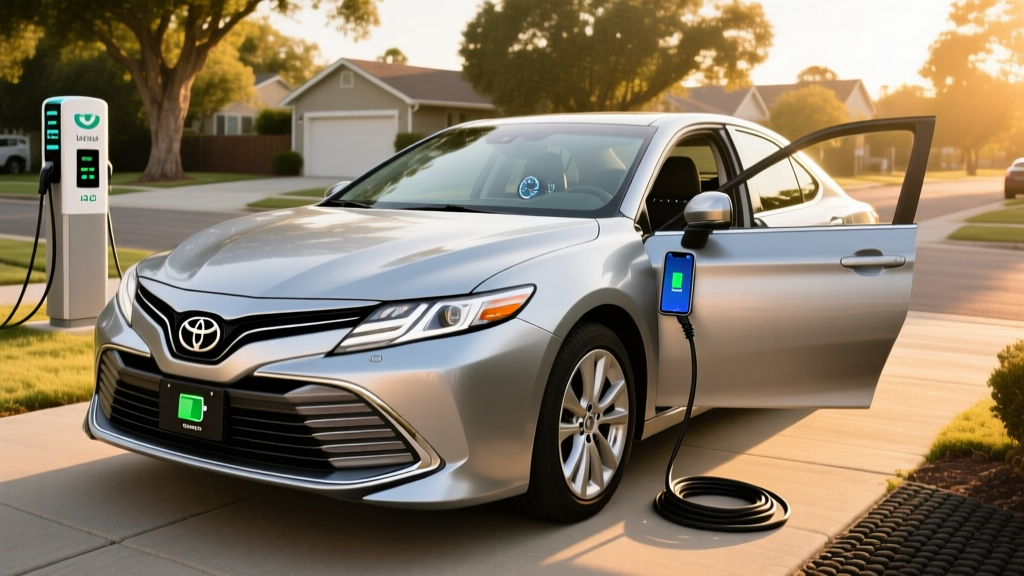
The 2015 Toyota Camry Hybrid LE occupies a specific niche in the used-car market: a midsize sedan that delivers genuine hybrid efficiency without requiring any change in driving habits. No plugs, no range anxiety, no charging apps — just a conventional hybrid (HEV) that sips fuel and keeps running. With over a decade of real-world data now available on Toyota's Hybrid Synergy Drive system, buyers in 2026 can evaluate this model with unusual confidence about long-term battery durability and ownership costs.
This guide covers everything a used-car shopper needs to know about the 2015 Camry Hybrid LE: EPA and real-world MPG, the hybrid powertrain, battery warranty and replacement economics, and how it stacks up against a PHEV or full EV for your daily commute.
2015 Camry Hybrid LE Fuel Economy: EPA vs. Real World
The EPA rates the 2015 Camry Hybrid LE at 40 MPG combined (42 city / 38 highway), according to fueleconomy.gov. That city-highway split is the hallmark of a conventional hybrid: regenerative braking and electric-motor assist shine in stop-and-go traffic, where a gas-only car wastes the most energy.
| Driving Condition | EPA Estimate | Real-World Expectation |
|---|---|---|
| City | 42 MPG | 40–45 MPG (often exceeds EPA) |
| Highway | 38 MPG | 35–39 MPG (less regen benefit) |
| Combined | 40 MPG | 38–42 MPG |
| Cold Weather (below 30°F) | — | 33–37 MPG (engine runs more for heat) |
In practice, many Camry Hybrid owners report exceeding the EPA city figure in warm-weather urban driving. The hybrid system recaptures kinetic energy during braking and uses the electric motor for low-speed propulsion, making traffic-heavy commutes its best-case scenario. Highway driving above 70 mph reduces the advantage — the 2.5-liter Atkinson-cycle engine does most of the work, and aerodynamic drag dominates.
Cold weather is the notable efficiency hit. Below freezing, the gasoline engine runs more frequently to provide cabin heat and maintain the hybrid battery's operating temperature. Expect a 10–15% MPG reduction in winter months, consistent across most hybrid vehicles.
Hybrid Powertrain: How the Camry HEV System Works
The 2015 Camry Hybrid LE pairs a 2.5-liter four-cylinder Atkinson-cycle engine (156 hp, 156 lb-ft torque) with a permanent-magnet electric motor (105 kW / 141 hp) integrated into the transaxle. Net system output is 200 horsepower. Energy is stored in a 1.6 kWh nickel-metal hydride (NiMH) battery pack located behind the rear seat.
| Specification | 2015 Camry Hybrid LE |
|---|---|
| Engine | 2.5L I4 Atkinson-cycle |
| Engine Power | 156 hp @ 5,700 rpm |
| Electric Motor | 105 kW (141 hp) |
| Net System Power | 200 hp |
| Battery Chemistry | NiMH (Nickel-Metal Hydride) |
| Battery Capacity | 1.6 kWh (gross) |
| Transmission | eCVT (planetary gearset) |
| 0-60 mph | ~7.6 seconds |
| Drivetrain | Front-wheel drive |
| Curb Weight | ~3,435 lbs |
Toyota's eCVT is not a belt-driven continuously variable transmission like those in some competitors. It uses a planetary gearset to blend engine and motor power with no belts or pulleys to wear — a key reason for the drivetrain's long-term reliability. The system seamlessly switches between electric-only, engine-only, and combined power modes without driver input.
The 1.6 kWh battery may seem tiny compared to a full EV's 60–100 kWh pack, but it only needs to buffer energy for short electric-only bursts (typically under 1 mile at low speeds) and capture regenerative braking energy. It's a power-density design, not an energy-density design.
HEV vs. PHEV vs. EV: Which Powertrain Fits You?
Conventional Hybrid (HEV) — like the 2015 Camry Hybrid: No plug. The battery charges through regenerative braking and the engine. You never think about charging. Best for drivers who want better fuel economy without any infrastructure change.
Plug-in Hybrid (PHEV) — like the Toyota Prius Prime or RAV4 Prime: Larger battery (typically 8–18 kWh), charges from a wall outlet or public charger. Offers 25–45 miles of electric-only range before the gas engine kicks in. Best for drivers with home charging who want daily electric commutes but gas-engine flexibility for road trips.
Battery Electric Vehicle (BEV) — like the Tesla Model 3 or Hyundai Ioniq 6: No gas engine. 250–350+ miles of range from a large battery (60–100 kWh). Lowest operating cost but requires access to home or workplace charging. Best for drivers with reliable charging access who want zero tailpipe emissions.
| Factor | HEV (Camry Hybrid) | PHEV | BEV |
|---|---|---|---|
| Plug Required? | No | Yes (for EV range) | Yes |
| Electric-Only Range | <1 mi at low speed | 25–45 mi | 250–350+ mi |
| Home Charging Needed? | No | Recommended | Essential |
| Fuel Cost (per mile) | ~$0.09 | ~$0.04 (EV) / ~$0.09 (gas) | ~$0.04 |
| Maintenance Complexity | Low (proven) | Moderate (two systems) | Lowest (fewest parts) |
The 2015 Camry Hybrid LE makes sense if you lack access to home or workplace charging, drive a mix of city and highway miles, and want a dependable sedan that costs less to fuel than its gas-only counterpart. If you have a garage with a 120V or 240V outlet and a short commute, a PHEV delivers more electric driving and lower fuel costs.
Battery Lifespan, Warranty & Replacement Cost
Toyota's hybrid battery warranty for the 2015 Camry Hybrid was originally 8 years / 100,000 miles (10 years / 150,000 miles in California and states adopting CARB emissions standards). By 2026, most examples have aged out of factory warranty coverage based on the 8-year clock, though some low-mileage cars in CARB states may still have residual coverage.
Original Warranty: 8 years / 100,000 miles (10 yr / 150,000 mi in CARB states)
Battery Chemistry: Nickel-Metal Hydride (NiMH)
Typical Lifespan: 150,000–200,000+ miles based on fleet and owner data
Replacement Cost (2026): $2,000–$4,000 (new OEM), $1,000–$2,000 (remanufactured)
Toyota's NiMH hybrid batteries have demonstrated exceptional longevity. The Camry Hybrid and Prius share similar battery architecture, and documented cases of original batteries exceeding 200,000 miles are common. NiMH chemistry is less energy-dense than modern lithium-ion but is highly tolerant of the shallow charge-discharge cycles that hybrid systems use — the battery management system keeps the pack between roughly 40% and 80% state of charge, avoiding the deep cycles that accelerate degradation.
If the hybrid battery does fail, replacement options in 2026 include:
- New OEM battery from Toyota: $2,500–$4,000 installed at a dealership
- Remanufactured battery: $1,000–$2,000 installed at an independent hybrid specialist
- Individual module replacement: $300–$800 if only specific cells have degraded (requires a knowledgeable technician)
The eCVT transaxle has no traditional transmission fluid to change on a short interval and no clutch packs or bands to wear. Toyota's maintenance schedule calls for transaxle fluid inspection, not mandatory replacement, though many owners opt for a drain-and-fill around 100,000 miles as preventive care.
Does the 2015 Camry Hybrid LE Qualify for Tax Credits?
No federal tax credit applies to the 2015 Camry Hybrid LE. The IRS §30D New Clean Vehicle Credit applies only to new plug-in vehicles (BEVs and PHEVs) meeting specific battery-sourcing, MSRP, and buyer-income requirements. Conventional hybrids like the Camry HEV do not have a plug and do not qualify.
The Used Clean Vehicle Credit (also under §25E) similarly applies only to used plug-in vehicles — BEVs and PHEVs — priced at or below $25,000, purchased from a dealer. A used 2015 Camry Hybrid LE does not meet the plug-in requirement.
Some states and local utilities have offered rebates for hybrid purchases in the past, but most current incentive programs (as of 2026) prioritize plug-in vehicles. Check your state's energy office or utility provider for any residual hybrid incentives, but plan your purchase budget assuming no credit.
What to Check Before Buying a Used 2015 Camry Hybrid LE
With a decade on the road, the 2015 Camry Hybrid LE is generally a low-risk used purchase, but a few model-specific items deserve attention:
- Hybrid battery health check: Ask a Toyota dealer or hybrid specialist to run a battery health diagnostic. The scan tool reports individual module voltages and internal resistance — a healthy pack shows balanced modules within ~0.2V of each other.
- Brake actuator recalls: Check the VIN on nhtsa.gov/recalls for any open recalls, particularly related to the brake booster assembly.
- Inverter coolant pump: Verify the inverter cooling system has been serviced. The inverter coolant pump should be circulating fluid (visible in the reservoir under the hood when the car is ON). A failed pump can overheat and damage the inverter — a $1,500+ repair.
- 12V auxiliary battery: Like all hybrids, the Camry has a standard 12V battery that powers electronics. If the car has sat for weeks, this battery may be depleted. Replacement is straightforward (~$150–$200 for an AGM-type group 12V battery).
- Maintenance records: Engine oil changes (0W-20 synthetic, every 10,000 miles), cabin air filter, and engine air filter are the primary recurring maintenance items. The hybrid system itself requires no scheduled maintenance.
Used Pricing & Value in 2026
The 2015 Camry Hybrid LE originally carried an MSRP of approximately $27,400 (including destination). In the 2026 used market, expect to pay:
- 80,000–120,000 miles: $11,000–$14,000
- 120,000–160,000 miles: $8,500–$11,000
- 160,000+ miles: $6,500–$8,500
These ranges vary by region, condition, and whether the hybrid battery has been replaced or tested. A documented battery replacement with a new OEM unit adds meaningful value. The Camry Hybrid LE's strong resale value relative to competing midsize sedans reflects its reputation for reliability — confirmed by years of IIHS safety ratings and owner surveys.
Pros
- 40 MPG combined — proven in real-world driving
- No plug required — zero infrastructure change
- Exceptional hybrid battery longevity (150K–200K+ mi)
- Smooth eCVT with no belt or clutch wear
- Low maintenance costs (no timing belt, minimal brake wear from regen)
- Spacious midsize sedan interior, large trunk
Cons
- No electric-only driving beyond parking-lot speeds
- No federal or state tax credit eligibility
- NiMH battery (older chemistry, heavy vs. lithium-ion)
- Modest acceleration (200 hp in a 3,435-lb car)
- Infotainment feels dated by 2026 standards
- Most examples are now out of hybrid battery warranty
Frequently Asked Questions
How many MPG does the 2015 Camry Hybrid LE get?
The EPA rates it at 42 city / 38 highway / 40 combined MPG. In real-world city driving, many owners report 40–45 MPG. Highway driving at 70+ mph typically yields 35–39 MPG. Cold weather reduces efficiency by roughly 10–15%.
Does the 2015 Camry Hybrid need to be plugged in?
No. The 2015 Camry Hybrid LE is a conventional hybrid (HEV), not a plug-in hybrid (PHEV). The 1.6 kWh NiMH battery charges entirely through regenerative braking and the gasoline engine. You fuel it like any other car — just less often.
How long does the Camry Hybrid battery last?
Toyota's NiMH hybrid batteries routinely last 150,000–200,000+ miles. The battery management system keeps the pack in a shallow state-of-charge window (~40–80%), which significantly reduces degradation. Many first-generation Prius batteries exceeded 200,000 miles with similar architecture.
What does it cost to replace the hybrid battery?
A new OEM battery from a Toyota dealer runs $2,500–$4,000 installed. Remanufactured batteries from hybrid specialists cost $1,000–$2,000 installed. In some cases, individual module replacement is possible for $300–$800. Given the battery's typical 150K+ mile lifespan, most owners never face this cost.
Is the 2015 Camry Hybrid LE better than a full EV?
It depends on your situation. The Camry Hybrid LE is better if you lack home charging access, drive long highway routes, or want minimal upfront cost. A full EV is better if you have reliable home charging, want the lowest per-mile fuel cost (~$0.04/mi vs. ~$0.09/mi), and prefer zero tailpipe emissions. For a used buyer on a budget in 2026, the Camry Hybrid LE offers strong value without charging infrastructure requirements.
Does it qualify for any tax credit?
No. Federal tax credits under IRS §30D and §25E apply only to plug-in vehicles (BEVs and PHEVs). The 2015 Camry Hybrid LE is a conventional hybrid with no plug. Some utilities have historically offered hybrid rebates, but most 2026 programs target plug-in vehicles. Budget accordingly.
What's the difference between the LE and XLE trims?
The LE is the base hybrid trim, equipped with fabric seats, a 6.1-inch touchscreen, and 16-inch steel wheels with covers. The XLE adds leather-trimmed seats, a 7-inch navigation display, dual-zone climate control, and 17-inch alloy wheels. Both share the identical hybrid powertrain and EPA fuel economy ratings.