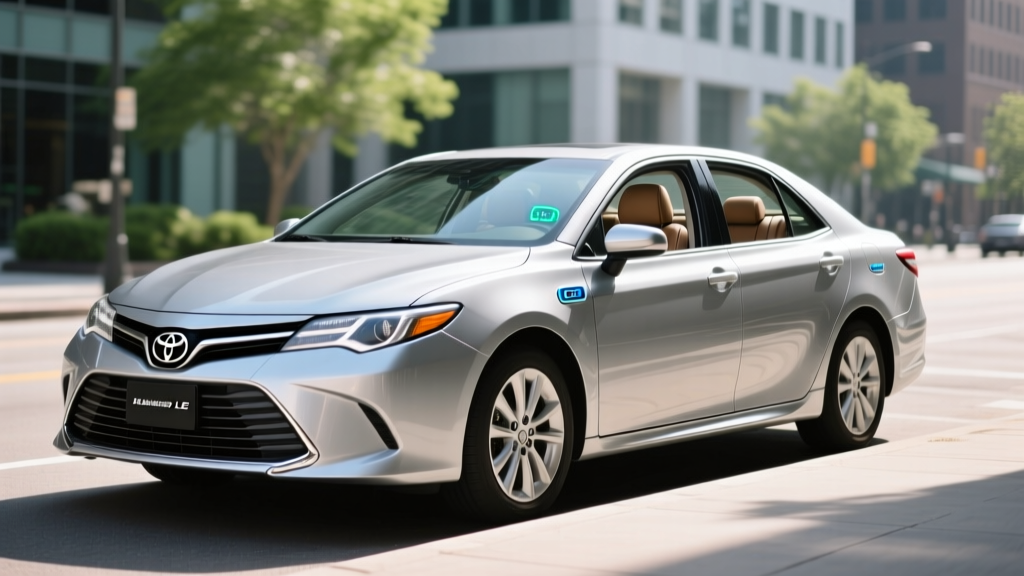
The 2014 Toyota Camry Hybrid LE sedan occupies a specific niche in today's used-car market: a midsize conventional hybrid (HEV) that delivers strong city fuel economy without requiring a plug, a charging routine, or any change in driving habits. More than a decade after its debut, this generation remains one of the most data-rich entries in the hybrid space, with well-documented reliability, known battery degradation curves, and a used-market price that makes it accessible to budget-conscious buyers in 2026.
This guide covers the 2014 Camry Hybrid LE specifically — the base hybrid trim — with exact EPA figures, real-world MPG reconciliation, powertrain specs, battery warranty and replacement economics, and a clear framework for deciding whether this HEV fits your needs versus a newer PHEV or full battery-electric vehicle (BEV).
HEV vs PHEV vs EV: Where the 2014 Camry Hybrid Fits
Before evaluating the numbers, it's essential to classify what this car is and is not. The 2014 Camry Hybrid LE is a conventional hybrid electric vehicle (HEV). It cannot be plugged in. Its small traction battery recharges exclusively through regenerative braking and the gasoline engine. This distinguishes it fundamentally from plug-in hybrids and full EVs.
| Feature | HEV (e.g., 2014 Camry Hybrid) | PHEV (e.g., RAV4 Prime) | BEV (e.g., Tesla Model 3) |
|---|---|---|---|
| Plug-in charging | No — self-charging | Yes — Level 1/2 AC | Yes — Level 1/2/DC |
| Battery size | ~1.6 kWh (NiMH) | 18–22 kWh (Li-ion) | 50–100 kWh (Li-ion) |
| Electric-only range | <1 mile at low speed | 25–42 miles | 250–350+ miles |
| Gasoline engine | Yes (primary) | Yes (backup + highway) | None |
| Federal tax credit (§30D) | No | Up to $7,500 (if eligible) | Up to $7,500 (if eligible) |
| Fueling cost per mile | ~$0.09 (gas) | ~$0.04 (electric) / $0.09 (gas) | ~$0.04 (electric) |
The 2014 Camry Hybrid LE makes sense for drivers who want better fuel economy than a gas-only sedan but lack access to home or workplace charging. If you can plug in nightly, a modern PHEV or BEV will deliver lower operating costs. If you park on the street or in a garage without a 120V/240V outlet, this HEV removes the infrastructure barrier entirely.
Fuel Economy: EPA Ratings and Real-World MPG
The EPA rated the 2014 Toyota Camry Hybrid LE sedan at 40 MPG combined, split as 43 MPG city and 39 MPG highway, according to fueleconomy.gov. These figures remain competitive more than a decade later against many current midsize hybrid sedans.
| Metric | Value |
|---|---|
| City MPG | 43 |
| Highway MPG | 39 |
| Combined MPG | 40 |
| Annual fuel cost (EPA est.) | ~$1,350 (at $3.20/gal, 15k mi/yr) |
| Fuel type | Regular unleaded (87 octane) |
Real-World MPG vs EPA Sticker
Toyota's Hybrid Synergy Drive system excels in stop-and-go traffic, where the electric motor handles low-speed propulsion and the Atkinson-cycle 2.5L engine shuts off at stops. In real-world use, many owners report exceeding the EPA city rating — 44–47 MPG is common in urban commuting with moderate acceleration. Highway driving at sustained 70–80 MPH tends to drop efficiency to 35–38 MPG, since the gasoline engine carries the full load and aerodynamic drag increases.
Cold-weather impact on this HEV is modest compared to a BEV. In sub-freezing temperatures, expect a 5–10% fuel economy reduction (roughly 36–38 MPG combined) as the engine runs more frequently to maintain cabin heat and battery temperature. This is far less severe than the 20–30% range loss a battery-electric vehicle experiences in the same conditions.
Powertrain and Performance Specs
The 2014 Camry Hybrid LE uses Toyota's second-generation Hybrid Synergy Drive pairing a 2.5-liter inline-4 Atkinson-cycle gasoline engine with a permanent-magnet AC synchronous motor, routed through an electronically controlled continuously variable transmission (eCVT).
| Specification | Value |
|---|---|
| Engine | 2.5L 4-cyl Atkinson-cycle (156 hp, 156 lb-ft) |
| Electric motor | Permanent-magnet AC synchronous (105 kW / 141 hp) |
| Combined net horsepower | 200 hp |
| Transmission | eCVT (planetary gearset) |
| 0–60 mph | ~7.6 seconds |
| Drivetrain | Front-wheel drive |
| Curb weight | ~3,435 lbs |
| Fuel tank | 17.0 gallons |
| Total driving range (est.) | ~680 miles (at 40 MPG combined) |
The 200 combined horsepower figure is a net system rating — not a simple addition of engine and motor peaks, since they reach maximum output at different RPM points. Acceleration is adequate for merging and highway passing, though the eCVT produces the characteristic drone under hard throttle. There are no gears to shift; the planetary gearset seamlessly blends power sources.
Hybrid Battery: Chemistry, Warranty, and Replacement Cost
This is the single most scrutinized component on any used hybrid. The 2014 Camry Hybrid LE uses a nickel-metal hydride (NiMH) traction battery pack rated at approximately 1.6 kWh and 244.8V nominal. This is a small battery by modern standards — a fraction of the 50–100 kWh packs in today's BEVs — because its job is to buffer regenerative energy and assist the gas engine, not to drive the car for extended distances on electricity alone.
Battery Warranty (Original)
Toyota warranted the 2014 Camry Hybrid battery for 8 years / 100,000 miles in most states, and 10 years / 150,000 miles in California Air Resources Board (CARB) states (CA, CT, ME, MA, NJ, NY, OR, RI, VT, WA). This warranty covered capacity loss below a defined threshold and complete failure.
Note: For a 2014 model, original factory warranty has expired as of 2022 (non-CARB) or 2024 (CARB states) unless the vehicle had unusually low mileage.
Battery Degradation and Lifespan
NiMH batteries in Toyota's Hybrid Synergy Drive have an extensive track record. Real-world data from fleet and owner surveys indicates these packs typically last 150,000–200,000+ miles before significant degradation. Unlike the lithium-ion packs in BEVs and PHEVs, NiMH cells degrade more gradually and tend to lose capacity rather than fail catastrophically. A degraded pack may reduce fuel economy by 2–4 MPG rather than rendering the car inoperable.
Toyota's battery management system in this generation keeps the NiMH pack in a narrow state-of-charge window (roughly 40–80%), which significantly reduces stress and extends cycle life. The pack is also air-cooled via a cabin-ventilation duct — keeping this intake clear of debris is a simple maintenance step that prolongs battery life.
Battery Replacement Cost in 2026
If the hybrid battery does require replacement on a 2014 Camry Hybrid LE, costs have come down as the aftermarket ecosystem has matured:
- OEM new battery (Toyota dealer): $2,500–$3,800 (parts + labor)
- Remanufactured/reconditioned pack: $1,200–$2,000 (parts + labor at independent hybrid shops)
- Individual module replacement: $400–$800 (only failed modules replaced — viable if diagnostics show 1–2 bad cells out of 34 modules)
For context, a 2014 Camry Hybrid LE in good condition typically sells for $8,000–$12,000 on the used market in 2026, depending on mileage and region. A full OEM battery replacement represents 20–40% of the vehicle's value, which makes the remanufactured or module-level repair the economically rational choice for most owners.
Does the 2014 Camry Hybrid LE Qualify for Any Tax Credit?
No. The 2014 Toyota Camry Hybrid LE does not qualify for the federal §30D Clean Vehicle Credit. This credit applies only to plug-in electric vehicles (PHEVs and BEVs) with batteries of at least 7 kWh that meet current battery-sourcing, critical-mineral, MSRP cap, and buyer income requirements as outlined by the IRS. Conventional hybrids like this Camry do not have plug-in capability and are categorically excluded.
Some states historically offered rebates for high-MPG hybrids, but most of these programs have shifted exclusively to PHEVs and BEVs. Check your state's current energy-office website for any residual hybrid incentives, but do not count on them for a 2014 model-year purchase.
For buyers considering a used electrified vehicle, the IRS §25E Used Clean Vehicle Credit (up to $4,000 or 30% of sale price, whichever is lower) applies only to used PHEVs and BEVs — not conventional hybrids. Again, the 2014 Camry Hybrid LE is ineligible.
Reliability, Safety, and Long-Term Ownership Costs
The 2014 Camry Hybrid benefits from Toyota's well-established hybrid reliability record. The Hybrid Synergy Drive system has no conventional starter motor, no alternator, no accessory drive belts, and no traditional transmission with clutch packs or torque converters — eliminating common failure points found in gas-only vehicles. The eCVT planetary gearset is mechanically simple and has proven extremely durable.
Safety ratings for the 2014 Camry (all trims, including Hybrid) include a 5-star overall rating from NHTSA and a Top Safety Pick from IIHS, based on crash-test performance that remains respectable by current standards. Standard safety equipment includes 10 airbags, stability control, and anti-lock brakes; however, Toyota Safety Sense (pre-collision, lane departure alert, automatic high beams) was not yet standard on the 2014 model year — it arrived with the 2018 refresh.
5-Year Ownership Cost Estimate (Used Purchase in 2026)
| Category | Estimated Cost |
|---|---|
| Purchase price (avg.) | $10,000 |
| Fuel (15k mi/yr, 40 MPG, $3.20/gal) | $6,000 |
| Insurance (national avg. hybrid sedan) | $5,500 |
| Maintenance (oil, brakes, tires, fluids) | $3,000 |
| Potential hybrid battery repair | $0–$1,500 (if needed) |
| Registration/taxes (5-yr avg.) | $1,500 |
| Total (5 years) | $26,000–$27,500 |
Regenerative braking significantly extends brake pad life — many owners report original brake pads lasting 80,000–100,000 miles. Oil changes follow the standard 10,000-mile Toyota interval with 0W-20 synthetic. There is no transmission fluid to change on the eCVT at standard intervals.
Who Should Buy This Hybrid — And Who Should Look Elsewhere
Pros
- 40+ MPG combined with no plug-in required — ideal for apartment dwellers and street parkers
- Proven NiMH battery with 150k–200k+ mile track record
- Low maintenance: no belts, no starter, extended brake life
- 680-mile total range eliminates fuel-stop anxiety on road trips
- Affordable used pricing ($8k–$12k) with strong parts availability
- Regular 87-octane fuel — no premium required
Cons
- No electric-only driving range — always burns gasoline
- No federal or state tax credits available (HEV exclusion)
- 2014 model lacks modern ADAS (no automatic emergency braking standard)
- eCVT drone under hard acceleration
- Outdated infotainment: no Apple CarPlay/Android Auto, small touchscreen
- Original battery warranty expired — replacement cost falls on owner
Decision Framework
Choose the 2014 Camry Hybrid LE if: You lack home/workplace charging access, drive 12,000–20,000 miles/year mostly in city/suburban traffic, want a sub-$12,000 vehicle with low operating costs, and don't need the latest driver-assist tech.
Choose a used PHEV (e.g., 2019+ Prius Prime, 2020+ RAV4 Prime) if: You can install a Level 2 charger at home, want 25–42 miles of electric-only commuting, and want eligibility for the §25E used-EV credit (up to $4,000).
Choose a used BEV (e.g., 2020+ Tesla Model 3, 2021+ Chevy Bolt) if: You have reliable home charging, want zero gasoline costs, seek lower maintenance (no oil changes), and your daily driving is under 200 miles.
2014 Camry Hybrid LE vs Competing Used Hybrids
| Model | EPA Combined MPG | Combined HP | Battery Type | Used Price Range (2026) |
|---|---|---|---|---|
| 2014 Toyota Camry Hybrid LE | 40 | 200 | 1.6 kWh NiMH | $8,000–$12,000 |
| 2014 Honda Accord Hybrid | 47 | 196 | 1.3 kWh Li-ion | $8,500–$12,500 |
| 2014 Ford Fusion Hybrid | 42 | 188 | 1.4 kWh Li-ion | $7,000–$10,500 |
| 2014 Toyota Prius (Liftback) | 50 | 134 | 1.3 kWh NiMH | $7,500–$11,000 |
The Camry Hybrid LE trades peak MPG for more power (200 hp vs 134–196 in competitors) and a larger, more comfortable midsize cabin. The Accord Hybrid leads on EPA combined MPG but uses a smaller-displacement engine. The Prius delivers the best efficiency but in a compact liftback form factor with less power. Your choice depends on whether you prioritize fuel savings (Prius/Accord) or power and comfort (Camry).
Frequently Asked Questions
How many MPG does the 2014 Toyota Camry Hybrid LE get?
The EPA rates it at 43 city / 39 highway / 40 combined MPG. Real-world city driving often yields 44–47 MPG thanks to regenerative braking and electric-only low-speed operation. Sustained highway driving at 75+ MPH typically returns 35–38 MPG.
How far can the 2014 Camry Hybrid go on electric only?
Less than one mile, at speeds under 25 MPH. This is a conventional hybrid (HEV), not a plug-in hybrid. The battery is too small (1.6 kWh) for meaningful electric-only range. The electric motor assists the gas engine during acceleration and handles low-speed creeping — it does not replace the gasoline engine for commuting distances.
Is the 2014 Camry Hybrid reliable, and what does a battery replacement cost?
Yes — Toyota's Hybrid Synergy Drive with NiMH battery has a documented track record of 150,000–200,000+ miles before significant degradation. If replacement is needed, expect $1,200–$2,000 for a remanufactured pack or $2,500–$3,800 for OEM new at a dealer. Module-level repair (replacing only failed cells) can cost $400–$800.
Does the 2014 Camry Hybrid qualify for any tax credit?
No. Federal §30D and §25E tax credits apply only to plug-in vehicles (PHEVs and BEVs). Conventional hybrids are excluded. Some states may have had historical hybrid incentives, but most have transitioned to plug-in-only programs.
Should I buy this hybrid or a full EV?
If you have access to Level 2 home charging and your daily driving is under 200 miles, a used BEV will deliver lower per-mile fuel costs (~$0.04/mile electric vs ~$0.09/mile gas) and less maintenance. If you lack charging access, drive long distances frequently, or want to minimize upfront cost, the 2014 Camry Hybrid LE offers strong efficiency with zero infrastructure requirements.
What maintenance does the hybrid system require?
The hybrid-specific maintenance is minimal. Keep the battery cooling air intake (located near the rear seat) free of dust and debris. The inverter coolant should be inspected per Toyota's schedule. There are no brushes to replace in the motor, no transmission fluid changes at normal intervals, and regenerative braking extends pad life to 80,000–100,000+ miles. Standard maintenance (oil changes every 10,000 miles, tire rotation, cabin air filter) applies as with any Camry.