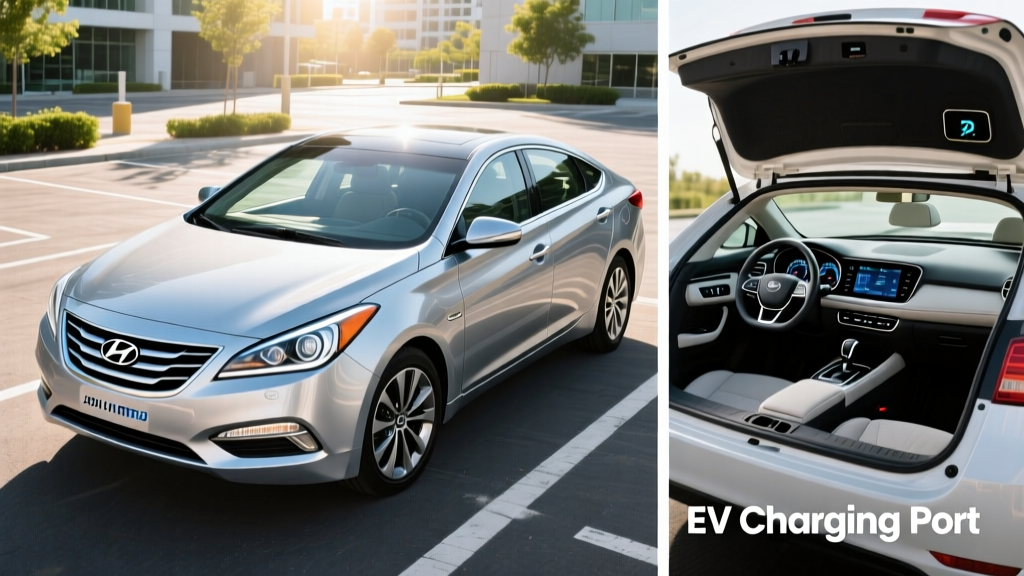
The 2014 Hyundai Sonata Hybrid was one of the most fuel-efficient midsize sedans of its era, combining a 2.4-liter four-cylinder engine with an electric motor for an EPA-rated 36 MPG combined. More than a decade later, it remains a popular target on the used market for buyers who want hybrid efficiency without plug-in complexity or EV range concerns. But with a 12-year-old hybrid battery and discontinued production, prospective buyers need hard data on longevity, replacement costs, and whether this generation still holds up against modern hybrid and EV alternatives.
This guide covers everything a used-car shopper needs to know about the 2014 Sonata Hybrid — from real-world fuel economy and powertrain specs to battery warranty status and total cost of ownership in 2026.
2014 Sonata Hybrid Powertrain and Key Specs
The 2014 Sonata Hybrid pairs a 2.4-liter Atkinson-cycle four-cylinder engine with a 35 kW (47 hp) electric motor integrated into the transmission housing. Unlike some competitors that use a continuously variable transmission (CVT), Hyundai opted for a conventional 6-speed automatic — a choice that gives the Sonata Hybrid a more natural driving feel at the expense of a fraction of an MPG.
| Specification | Value |
|---|---|
| Engine | 2.4L Atkinson-cycle I4 |
| Engine Output | 169 hp / 156 lb-ft torque |
| Electric Motor | 35 kW (47 hp) / 151 lb-ft torque |
| Combined System Output | 199 hp |
| Transmission | 6-speed automatic |
| Hybrid Battery | 1.4 kWh lithium-polymer (Li-Po) |
| Drivetrain | Front-wheel drive |
| 0–60 mph | ~7.8 seconds |
| Curb Weight | 3,496 lbs |
| Cargo Volume | 14.4 cu ft |
| Original MSRP (Base) | $26,000 |
| Used Price Range (2026) | $6,500–$11,000 |
The 2014 Sonata Hybrid is a conventional hybrid (HEV). It does not plug in. The 1.4 kWh battery charges through regenerative braking and the gasoline engine. Hyundai did not offer a plug-in hybrid (PHEV) variant of this generation Sonata — the Sonata Plug-in Hybrid debuted with the next generation in 2016. If you see references to "Sonata PHEV" with 27 miles of electric-only range, that refers to the 2016–2020 model, not this one.
Fuel Economy: EPA Ratings vs. Real-World MPG
The EPA rates the 2014 Sonata Hybrid at 36 MPG city / 40 MPG highway / 37 MPG combined for the base trim. The Limited trim, which adds more weight from features like leather seats and a panoramic sunroof, drops slightly to 35/39/36 MPG. These figures placed the Sonata Hybrid competitively against the Toyota Camry Hybrid (40/38/39 MPG) and Ford Fusion Hybrid (44/41/42 MPG) of the same year, though the Fusion and Camry edged it out on paper.
| Model | City MPG | Highway MPG | Combined MPG |
|---|---|---|---|
| 2014 Hyundai Sonata Hybrid | 36 | 40 | 37 |
| 2014 Toyota Camry Hybrid | 40 | 38 | 39 |
| 2014 Ford Fusion Hybrid | 44 | 41 | 42 |
| 2014 Honda Accord Hybrid | 50 | 45 | 47 |
Real-World MPG Expectations
Hybrids typically perform better than their EPA ratings in city driving because regenerative braking recaptures energy in stop-and-go traffic. On the highway, where the electric motor contributes less and aerodynamic drag dominates, real-world MPG often dips below the sticker.
Based on aggregated owner data from fueleconomy.gov user reports and long-term fleet testing:
- City driving (mixed stop-and-go): 34–38 MPG — close to or slightly above the EPA city estimate
- Highway driving (70+ mph sustained): 33–37 MPG — below the 40 MPG highway sticker
- Cold weather (below 32°F): Expect a 10–15% drop to roughly 28–33 MPG combined, as the engine runs more frequently for cabin heat and battery warm-up
- Overall owner average: ~35 MPG combined, roughly 2 MPG below the EPA combined rating
The 2014 model year was a mid-cycle refresh for the Sonata Hybrid, and Hyundai recalibrated the powertrain for better highway efficiency compared to the 2011–2013 models. Still, the 6-speed automatic — while smoother than a CVT — doesn't keep the engine in its most efficient RPM range as consistently as the e-CVT transmissions in the Camry and Accord hybrids.
Battery Health, Warranty Status, and Replacement Cost
The single biggest concern for any used hybrid buyer is the traction battery. The 2014 Sonata Hybrid uses a 1.4 kWh lithium-polymer (Li-Po) pack located behind the rear seat. This is a small battery by modern standards — its job is to buffer energy from regenerative braking and assist the gas engine during acceleration, not to drive the car on electric power alone for meaningful distances.
Hyundai originally covered the Sonata Hybrid's battery with a 10-year / 100,000-mile warranty (8 years / 100,000 miles in states that don't follow California emissions rules). For a 2014 model, this warranty expired in 2024 at the latest. Unless the previous owner purchased an extended warranty that specifically covers the hybrid battery, any replacement cost in 2026 falls entirely on the current owner.
Hybrid Battery Replacement Cost
If the battery fails or degrades significantly, here's what replacement looks like:
- New OEM battery (Hyundai dealer): $2,500–$3,500 including labor
- Remanufactured battery (independent hybrid shop): $1,500–$2,200 including labor
- Used/salvage battery: $800–$1,200 for the part, plus $200–$400 for installation
The good news: the Sonata Hybrid's Li-Po battery has proven reasonably durable. Unlike the nickel-metal-hydride (NiMH) packs in older Toyota hybrids that were prone to cell imbalance after 150,000+ miles, the lithium-polymer chemistry in the Sonata tends to degrade more gradually. Most reports of significant degradation occur above 140,000 miles, and many units exceed 180,000 miles without requiring replacement.
How to Check Battery Health Before Buying
Before purchasing a used 2014 Sonata Hybrid, take these steps:
- OBD-II scan: Use a hybrid-compatible scanner (or have a shop do it) to read the battery's State of Health (SoH) and check for stored fault codes. Look for cell voltage imbalance greater than 0.3V between modules.
- Dashboard indicators: If the hybrid system warning light is illuminated, walk away unless the seller provides documentation of a recent battery replacement.
- Charge/discharge behavior: During a test drive, watch the energy flow display. The battery should charge and discharge smoothly — erratic jumps in the charge indicator suggest degraded cells.
- Mileage context: Below 100,000 miles, battery risk is low. Between 100,000–150,000 miles, budget $1,500–$2,500 as a contingency. Above 150,000 miles, assume a replacement will be needed within 1–2 years unless documentation proves otherwise.
Reliability and Long-Term Ownership Costs
The 2014 Sonata Hybrid received average reliability ratings from major tracking services. The conventional 6-speed automatic transmission — while less efficient than a CVT — is actually a reliability advantage, as it avoids the complex planetary gearset that can fail in e-CVT designs. Common issues reported by owners include:
- Hybrid system cooling fan failure: The battery cooling fan (located behind the rear seat) can fail, causing the battery to overheat and trigger limp mode. Replacement cost: $300–$500.
- Brake actuator wear: The regenerative braking system's actuator can develop issues around 100,000–130,000 miles. Symptoms include a firm brake pedal or reduced regenerative braking. Replacement: $800–$1,200.
- Electric water pump: The hybrid system's dedicated electric coolant pump can fail, typically between 80,000–120,000 miles. Replacement: $400–$600.
On the positive side, the Sonata Hybrid's brake pads and rotors last significantly longer than those on gas-only vehicles — often 80,000–100,000 miles — because regenerative braking handles most of the deceleration load.
Estimated Annual Ownership Costs (2026)
| Category | Annual Cost | Notes |
|---|---|---|
| Fuel (12,000 mi/yr, $3.20/gal) | ~$1,070 | Based on 35 MPG real-world combined |
| Insurance | $1,100–$1,500 | Varies by state and driver profile |
| Maintenance | $400–$700 | Oil changes, tires, fluids — lower than gas-only models |
| Repair reserve | $500–$800 | Higher-mileage hybrids need a contingency fund |
| Total (excluding battery replacement) | $3,070–$4,070 |
Tax Credits and Incentives
Because the 2014 Sonata Hybrid is a conventional hybrid (HEV) — not a plug-in hybrid or battery electric vehicle — it does not qualify for the federal §30D Clean Vehicle Credit. That credit applies only to new plug-in vehicles meeting battery sourcing, MSRP, and buyer income requirements under current IRS rules.
When new, the 2014 Sonata Hybrid was also ineligible for the federal alternative fuel vehicle credit, as that program had different qualification thresholds. Some states offered modest hybrid incentives at the time of purchase, but these have long since expired for this model year.
For used buyers in 2026, the relevant federal credit is the Used Clean Vehicle Credit (§25E), which provides up to $4,000 or 30% of the sale price (whichever is less) for qualifying used plug-in EVs and fuel cell vehicles. However, conventional hybrids like the Sonata Hybrid do not qualify for §25E either. There is no federal tax credit available for purchasing a used HEV.
A handful of states may offer registration fee discounts or HOV lane access for hybrids, but these programs vary widely and are phasing out in many jurisdictions. Check your state's DMV or energy office for current details.
Who Should Buy the 2014 Sonata Hybrid?
- 37 MPG combined EPA — strong for a midsize sedan
- Smooth, conventional 6-speed automatic (no CVT drone)
- Spacious cabin and 14.4 cu ft trunk
- Affordable used pricing ($6,500–$11,000)
- Long brake life from regenerative braking
- Comfortable ride quality for daily commuting
- Original battery warranty has expired (10yr/100k ended by 2024)
- No electric-only driving capability
- Below-average reliability for a hybrid (cooling fan, brake actuator issues)
- No federal tax credit eligibility (new or used)
- MPG trails Camry, Accord, and Fusion hybrids of the same year
- Aging infotainment and safety tech by 2026 standards
Decision Framework: Hybrid vs. PHEV vs. Full EV
Choose the 2014 Sonata Hybrid (HEV) if:
- You have no access to home or workplace charging
- Your budget is under $12,000 and you want maximum fuel savings per dollar
- You drive 10,000–15,000 miles per year in mixed city/highway conditions
- You want zero behavior change — no plugging in, no range planning
Choose a used PHEV (e.g., 2017–2020 Sonata Plug-in Hybrid, Prius Prime) if:
- You can install a Level 2 home charger (240V outlet)
- Most of your daily driving is under 25–30 miles (within electric-only range)
- You want to drive mostly on electricity but need gas backup for road trips
Choose a used full EV (e.g., Chevrolet Bolt, Nissan Leaf, Tesla Model 3) if:
- You have reliable home charging and your daily commute is under 200 miles
- You want to eliminate gasoline costs entirely
- You value instant torque, quiet operation, and lower maintenance
- You can budget $12,000–$20,000 for a capable used EV
How the 2014 Sonata Hybrid Drives in 2026
The 199 combined horsepower is adequate for merging and passing, and the Sonata Hybrid feels more composed at highway speeds than many first-generation hybrids that prioritized efficiency over refinement. The electric motor's 151 lb-ft of torque is available from low RPM, giving the car a responsive feel around town even though the 0–60 mph time of roughly 7.8 seconds won't impress anyone.
The 6-speed automatic shifts smoothly and avoids the rubber-band sensation of CVTs, but it does hunt for gears more noticeably under hard acceleration. In normal driving, the transitions between electric-only mode (at low speeds), combined mode, and engine-only mode are seamless — you'll rarely notice the handoff unless you're watching the energy flow display.
Ride quality is comfortable and compliant, though the added weight of the hybrid system (about 200 lbs over the gas-only Sonata) is noticeable over sharp bumps. Steering is light and accurate but offers minimal feedback — typical for a comfort-oriented family sedan.
Frequently Asked Questions
How many MPG does the 2014 Sonata Hybrid actually get?
The EPA rates it at 36 city / 40 highway / 37 combined MPG. In real-world driving, owners typically see 33–38 MPG combined depending on driving style and climate. Highway driving at 70+ mph tends to yield 33–37 MPG, while city stop-and-go driving can reach 36–40 MPG thanks to regenerative braking.
Does the 2014 Sonata Hybrid need to be plugged in?
No. This is a conventional hybrid (HEV), not a plug-in hybrid. The battery charges automatically through regenerative braking and the gasoline engine. You fuel it like any other gas car — just less frequently.
How much does it cost to replace the hybrid battery?
A new OEM battery from a Hyundai dealer costs $2,500–$3,500 installed. Remanufactured batteries from independent hybrid specialists run $1,500–$2,200 installed. Used salvage batteries are available for $800–$1,200 plus installation. Given the car's $6,500–$11,000 used value, a battery replacement represents a significant percentage of the vehicle's worth.
Is the 2014 Sonata Hybrid reliable?
It's average for a hybrid of its era. The powertrain itself is durable, but ancillary hybrid components — the battery cooling fan, brake actuator, and electric water pump — are known failure points between 80,000 and 140,000 miles. The original 10-year/100,000-mile battery warranty has expired on all 2014 models. Budget $500–$800 annually for repairs on a higher-mileage example.
Does the 2014 Sonata Hybrid qualify for any tax credit?
No. As a conventional hybrid (HEV), it does not qualify for the federal §30D new vehicle credit or the §25E used clean vehicle credit. Both programs require plug-in capability. No current federal incentive applies to this vehicle. Check your state's energy office for any remaining local hybrid incentives, though most have expired.
How does it compare to a modern hybrid or EV?
A 2025 Toyota Camry Hybrid achieves 44–52 MPG combined — a significant leap over the Sonata's 37 MPG — and comes with a fresh 10-year battery warranty. A used Chevrolet Bolt EV (2017–2023) can be found for $12,000–$16,000 and offers 238–259 miles of electric range with far lower fuel costs. The 2014 Sonata Hybrid's advantage is its low entry price, but you're trading long-term efficiency and warranty coverage for that upfront savings.
Sources: EPA Fuel Economy — 2014 Hyundai Sonata Hybrid, IRS Clean Vehicle Credits, NHTSA — 2014 Hyundai Sonata Hybrid Safety Ratings