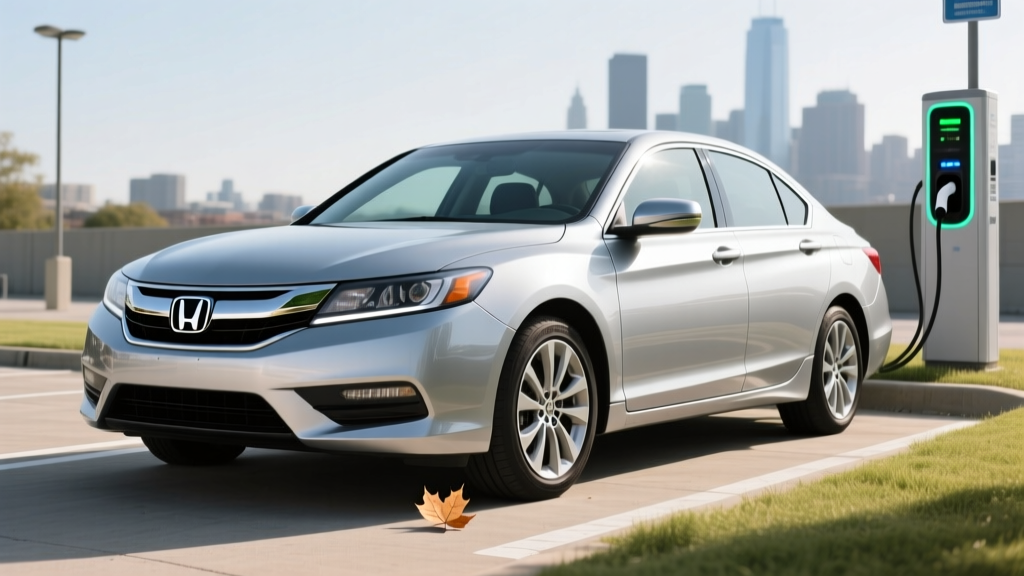
The 2014 Honda Accord Hybrid was Honda's return to the midsize hybrid sedan segment after a hiatus, and it arrived with one of the most efficient two-motor powertrains of its era. Over a decade later, it remains a common sight on the used market. For 2026 shoppers considering a budget-friendly hybrid, this generation raises practical questions: How does its real-world fuel economy hold up? What happens when the hybrid battery ages out? And how does it stack up against newer PHEVs and full EVs?
This guide breaks down everything a used-car buyer needs to know about the 2014 Accord Hybrid — from its EPA ratings and two-motor i-MMD powertrain to battery longevity, replacement costs, and whether it still earns a spot in your driveway.
2014 Honda Accord Hybrid: Key Specs at a Glance
| Spec | 2014 Honda Accord Hybrid |
|---|---|
| Powertrain Type | Conventional Hybrid (HEV) — no plug |
| Engine | 2.0L Atkinson-cycle 4-cylinder |
| Combined System Output | 196 hp |
| Electric Motors | Two (one drive motor, one generator/starter) |
| Transmission | Single-speed direct drive (no traditional CVT or gears) |
| EPA MPG (City / Hwy / Combined) | 50 / 45 / 47 |
| Fuel Tank | 15.8 gallons |
| Total Driving Range | ~742 miles (EPA combined) |
| Hybrid Battery | ~1.3 kWh lithium-ion (nominal) |
| 0-60 mph | ~7.1 seconds (Car and Driver tested) |
| Original MSRP (base) | $29,305 |
| 2026 Used Price Range (est.) | $8,000 – $14,500 depending on mileage/condition |
| Hybrid Battery Warranty (original) | 8 years / 100,000 miles (10 yr / 150,000 mi in CARB states) |
Fuel Economy: EPA Ratings vs. Real-World MPG
The 2014 Accord Hybrid's headline number was its 50 MPG city / 45 MPG highway / 47 MPG combined EPA rating — class-leading at launch and still competitive today. According to fueleconomy.gov, it outpaced the 2014 Toyota Camry Hybrid (41/38/40) and matched or beat most midsize hybrid sedans of the era.
| Driving Scenario | EPA Rating | Real-World Expectation |
|---|---|---|
| City | 50 MPG | 46–52 MPG (hybrids often exceed EPA in stop-and-go) |
| Highway (70+ mph) | 45 MPG | 38–43 MPG (aerodynamic drag, engine more engaged) |
| Combined | 47 MPG | 42–48 MPG (depends on driving mix) |
| Cold Weather (below 32°F) | — | 38–42 MPG combined (engine runs more for cabin heat) |
Honda's two-motor i-MMD system behaves differently from Toyota's power-split hybrid. Below roughly 45 mph, the Accord Hybrid operates primarily as a series hybrid — the gasoline engine spins a generator that feeds electricity to the drive motor, which turns the wheels. This makes it exceptionally efficient in city driving, where the electric motor handles most propulsion. At highway speeds, a lock-up clutch mechanically connects the engine to the wheels for direct drive, which is efficient but less so than the city cycle.
How the Two-Motor i-MMD Powertrain Works
Understanding the 2014 Accord Hybrid's powertrain is key to understanding why it drives and consumes fuel the way it does. Honda's Intelligent Multi-Mode Drive (i-MMD) system uses two electric motors and no conventional transmission:
- Drive Motor: 166 hp / 226 lb-ft of torque — this motor propels the car at low and moderate speeds.
- Generator Motor: 141 hp — coupled to the 2.0L Atkinson-cycle engine, it generates electricity to feed the drive motor or recharge the battery.
- 2.0L Atkinson-Cycle Engine: 141 hp / 122 lb-ft on its own — optimized for thermal efficiency rather than peak power.
- Combined Output: Honda rates the system at 196 hp, limited by the battery's discharge rate and power electronics.
The system operates in three modes without driver input:
- EV Drive: Battery powers the drive motor alone (short distances, low speeds).
- Hybrid Drive: Engine spins the generator, which powers the drive motor. Excess electricity charges the battery.
- Engine Drive: Lock-up clutch engages at highway speeds, connecting the engine directly to the wheels.
This architecture is closer to an extended-range EV (like the Chevy Volt's series mode) than a Toyota-style power-split system. The result is smooth, electric-like acceleration from a stop — with no gear shifts or CVT drone.
Hybrid Battery: Size, Lifespan, Warranty & Replacement Cost
The 2014 Accord Hybrid uses a ~1.3 kWh lithium-ion battery pack mounted behind the rear seats. This is a small pack by modern standards — for comparison, a 2026 Toyota RAV4 Prime PHEV carries an 18.1 kWh battery. The Accord Hybrid's pack is not designed for plug-in charging or meaningful electric-only range; it serves as a buffer to capture regenerative braking energy and assist the drive motor during acceleration.
Battery Degradation & Expected Lifespan
Honda's hybrid batteries in this generation have a strong longevity track record. The i-MMD system's power electronics keep the battery in a narrow state-of-charge window (roughly 40–80% SoC), which is the optimal range for lithium-ion longevity. Most owners report minimal noticeable degradation over 100,000–150,000 miles.
That said, a 2014 model in 2026 is 12 years old. Lithium-ion cells degrade with both cycle count and calendar age. Expect some capacity loss, which manifests as slightly more frequent engine engagement and marginally lower MPG — not a sudden failure.
Battery Replacement Cost
If the hybrid battery does fail outside warranty:
- New OEM replacement (Honda dealer): $2,000 – $3,500 including labor
- Refurbished/remanufactured pack: $1,200 – $2,000 from third-party hybrid specialists
- Individual cell replacement: $500 – $1,000 at independent hybrid repair shops (if only a few cells are degraded)
Given the used value of the vehicle ($8,000–$14,500), a full OEM battery replacement represents a significant percentage of the car's worth. Factor this into your purchase decision — ideally, request a hybrid battery health check before buying.
Reliability & Common Issues
The 2014 Accord Hybrid earned strong reliability marks overall. The i-MMD system proved durable, and the conventional Accord platform it's built on is one of Honda's most proven. That said, a few model-year-specific concerns are worth noting:
- Hybrid system software updates: Early 2014 models received ECU software updates to address rough engine engagement. Confirm any TSBs (Technical Service Bulletins) have been performed.
- 12V auxiliary battery: Like all hybrids, the Accord Hybrid has a conventional 12V battery for accessories. If it dies, the car won't start — even if the hybrid battery is full. Replace proactively every 4–5 years.
- Brake actuator: Some owners reported brake feel changes as the regenerative braking system ages. Not a safety failure, but a maintenance item at higher mileage.
- Air conditioning compressor: Electric A/C compressors in hybrids can be costly to replace ($1,000–$1,800). Check for cold A/C at purchase.
The Accord line consistently earns strong marks from IIHS for crash safety, and the 2014 Hybrid shares the same structure. NHTSA gave it a 5-star overall safety rating.
Tax Credits & Incentives: What Applies in 2026?
The 2014 Honda Accord Hybrid is a conventional hybrid (HEV), not a plug-in hybrid. This has direct implications for incentives:
- Federal §30D New EV Credit: Does NOT apply. This credit is for new battery-electric vehicles and plug-in hybrids only, with MSRP and income caps. The Accord Hybrid qualifies for neither — it's not a PHEV and was never sold new after the credit's current structure took effect.
- Federal Used EV Credit (§25E): Does NOT apply. This credit covers used BEVs and PHEVs only, not conventional hybrids.
- State incentives: A handful of states offered hybrid purchase incentives at the time of original sale, but virtually all have expired or shifted to BEV/PHEV-only programs. Check your state's current energy office website for any remaining hybrid rebates — they're rare in 2026.
Bottom line: You're buying this car for its fuel savings, not for tax credits. At 47 MPG combined versus a comparable gas Accord (~30 MPG combined), the fuel savings are the financial incentive.
HEV vs. PHEV vs. EV: Is the 2014 Accord Hybrid Right for You?
| Factor | 2014 Accord Hybrid (HEV) | Modern PHEV (e.g., 2026 RAV4 Prime) | Full EV (e.g., 2026 Tesla Model 3) |
|---|---|---|---|
| Plug-in Required? | No — self-charging | Yes — for electric miles | Yes — always |
| Electric-Only Range | ~1 mile (low speed) | 35–45 miles | 250–360 miles |
| Fuel Cost (per mile) | ~$0.07 (at $3.30/gal) | ~$0.04 (electric) / $0.09 (gas) | ~$0.04 (home charging) |
| Upfront Cost (2026) | $8,000–$14,500 (used) | $44,000–$50,000 (new) | $38,000–$52,000 (new) |
| Tax Credit Eligible? | No | Up to $7,500 (§30D, if eligible) | Up to $7,500 (§30D, if eligible) |
| Maintenance | Low (oil changes, standard) | Moderate (gas + electric systems) | Minimal (no engine) |
| Best For | No home charging, tight budget, high-mile commuting | Short electric commutes + road trips | Home charging access, lower operating cost |
- You don't have access to home or workplace charging (apartment, street parking)
- Your budget is under $15,000 and you want maximum fuel efficiency
- You drive 15,000+ miles per year and want to minimize fuel cost without plug-in infrastructure
- You want a proven, reliable midsize sedan with low ownership complexity
- You have Level 2 home charging and want electric-only daily driving
- You want to access the $7,500 federal tax credit (new vehicle purchase)
- You want to eliminate gasoline entirely (BEV) or reduce it dramatically (PHEV)
- You're willing to spend $35,000+ for newer safety tech, infotainment, and warranty coverage
Ownership Economics: What You'll Actually Spend
At 47 MPG combined and $3.30/gallon (2026 national average estimate), the 2014 Accord Hybrid costs roughly $0.07 per mile in fuel. Compare that to a 2014 gas Accord at ~30 MPG combined: roughly $0.11 per mile. Over 15,000 annual miles, that's a fuel savings of approximately $600 per year.
| Cost Category | 2014 Accord Hybrid (est.) | 2014 Accord Gas 2.4L (est.) |
|---|---|---|
| Purchase Price | $11,000 | $9,500 |
| Fuel (5 years, 15k mi/yr) | $5,250 | $8,250 |
| Insurance (5 years) | $6,500 | $6,000 |
| Maintenance (5 years) | $2,500 | $2,800 |
| Potential Battery Replacement | $1,500 (if needed) | $0 |
| 5-Year Total (est.) | $26,750 | $26,550 |
The hybrid's fuel savings largely offset its higher purchase price over five years. The breakeven point accelerates if gas prices rise or if you drive more than 15,000 miles annually. The wildcard is the hybrid battery — if it needs replacement during your ownership, it adds $1,500–$3,000. If it doesn't, the hybrid pulls ahead clearly.
Pros & Cons of the 2014 Honda Accord Hybrid in 2026
Pros
- Class-leading 47 MPG combined — still competitive with 2026 hybrids
- Smooth, electric-like driving feel from the two-motor i-MMD system
- Spacious midsize cabin with 15.8 cu-ft trunk (only slightly reduced vs. gas model)
- No plug-in required — works for apartment dwellers and street parkers
- Strong reliability record; proven Honda Accord platform
- Budget-friendly entry to hybrid ownership ($8k–$14.5k used)
Cons
- Original hybrid battery warranty has expired on all 2014 models
- Battery replacement cost ($2,000–$3,500) is significant relative to vehicle value
- No tax credits available (HEV, not PHEV or BEV)
- 2014 model lacks modern ADAS (no Honda Sensing suite — that arrived in 2016+)
- Infotainment is dated: small screen, no Apple CarPlay/Android Auto (added in 2016 refresh)
- Highway MPG drops noticeably at 75+ mph — this is a city-optimized hybrid
Frequently Asked Questions
How many MPG does the 2014 Honda Accord Hybrid get?
The EPA rates it at 50 MPG city, 45 MPG highway, and 47 MPG combined. Real-world owners typically see 43–48 MPG combined, with city driving often exceeding the EPA estimate and sustained highway driving at 75+ mph dropping to 38–43 MPG.
Does the 2014 Accord Hybrid need to be plugged in?
No. It is a conventional hybrid (HEV), not a plug-in hybrid. The battery charges through regenerative braking and the gasoline engine. There is no charging port and no electric-only driving range beyond very low-speed, short-distance creeping.
Is the 2014 Accord Hybrid reliable?
Yes, with caveats. The i-MMD hybrid system and Accord platform have strong reliability records. The main concern for a 2026 buyer is the 12-year-old hybrid battery, which is out of warranty. Budget $1,500–$3,000 as a contingency for potential battery replacement. Overall, Consumer Reports and owner surveys rate this generation above average for reliability.
What does it cost to replace the hybrid battery?
A new OEM battery from Honda runs $2,000–$3,500 installed. Refurbished packs from hybrid specialists cost $1,200–$2,000. Some independent shops can replace individual degraded cells for $500–$1,000. Not all 2014 models will need replacement — many batteries last 150,000+ miles — but at 12 years old, it's a realistic risk.
Does the 2014 Honda Accord Hybrid qualify for any tax credit?
No. As a conventional hybrid (HEV), it does not qualify for the federal §30D new vehicle credit, the §25E used EV credit, or most current state incentive programs. Its financial advantage comes entirely from fuel savings — roughly $600/year versus the gas Accord at 15,000 miles driven annually.
How does it compare to the Toyota Camry Hybrid of the same era?
The 2014 Accord Hybrid (47 MPG combined) beats the 2014 Camry Hybrid (40 MPG combined) by 7 MPG. The Accord also offers more horsepower (196 vs. 200 but with different power delivery characteristics) and a more engaging driving experience. The Camry Hybrid has a slight edge in trunk space and rear-seat comfort. Both are strong used hybrid choices.
Is the 2014 Accord Hybrid a PHEV?
No. Honda did offer a plug-in hybrid Accord in the 2014 model year — the Accord Plug-In Hybrid — but it was a separate, much rarer model sold only in California and Oregon. It had a 6.7 kWh battery, 13 miles of EPA electric-only range, and qualified for a federal tax credit at the time. The standard Accord Hybrid discussed in this guide is the conventional HEV version, which was sold nationwide and is far more common on the used market.
Should I buy this or a newer hybrid?
If your budget is under $15,000 and you lack home charging, the 2014 Accord Hybrid is one of the best-value used hybrids available. If you can spend $25,000+, a 2018–2022 Accord Hybrid (third-gen i-MMD, 48 MPG combined, Honda Sensing safety suite, CarPlay) is a meaningfully better car. If you have home charging and $35,000+, a new PHEV or BEV offers lower operating costs and current tax credit eligibility.