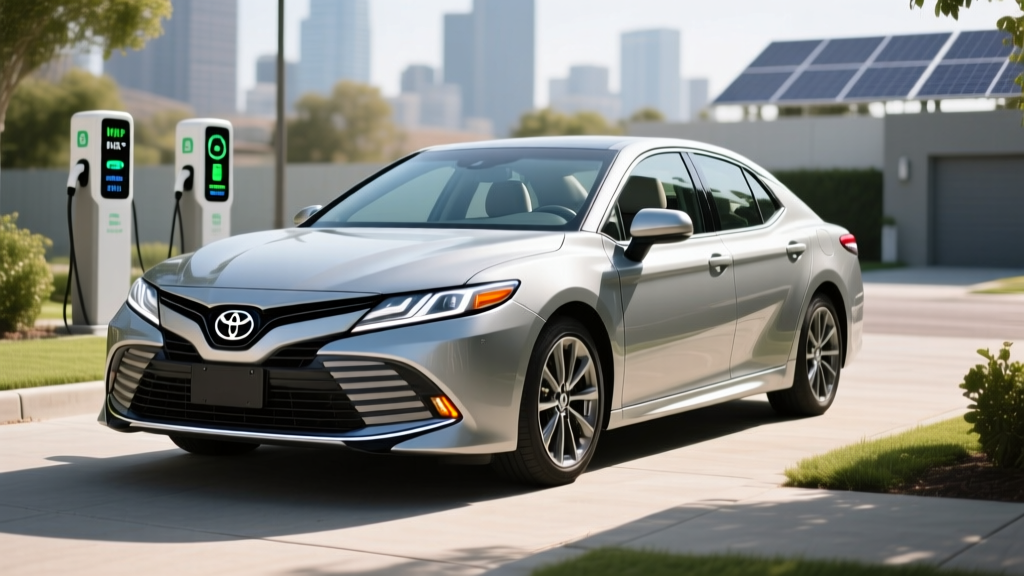
The 2018 Toyota Camry Hybrid LE sits at a crossroads that still matters in 2026: it is one of the most fuel-efficient midsize sedans ever sold without a plug, and on the used market it has depreciated into an affordable daily-driver sweet spot. If you are searching for a 2018 Toyota Camry Hybrid LE, you are likely weighing its 52 MPG combined EPA rating against newer hybrids, plug-in hybrids, and full battery-electric vehicles. This guide gives you the exact numbers — fuel economy, powertrain output, battery warranty, real-world efficiency, and ownership costs — so you can decide whether this sixth-year TNGA Camry is still a smart buy.
HEV vs PHEV vs EV: Where the Camry Hybrid Fits
Before examining the numbers, it is critical to understand what the 2018 Camry Hybrid LE actually is. It is a conventional hybrid electric vehicle (HEV), not a plug-in hybrid (PHEV) and not a battery-electric vehicle (BEV). Here is how those categories differ:
| Feature | HEV (Camry Hybrid) | PHEV (e.g., Prius Prime) | BEV (e.g., Tesla Model 3) |
|---|---|---|---|
| Plug-in charging | No — refuels via gas + regenerative braking | Yes — Level 1/2 AC | Yes — Level 1/2/DC fast |
| Electric-only range | ~1 mile at low speed | 25–45 miles typical | 250–400+ miles |
| Primary fuel | Gasoline | Gasoline + electricity | Electricity only |
| Federal tax credit (§30D) | Not eligible | Up to $7,500 (if sourcing/income rules met) | Up to $7,500 (if sourcing/income rules met) |
| Tailpipe emissions | Low (still burns gas) | Low when charged; gas when depleted | Zero at tailpipe |
The Camry Hybrid LE does not have a charge port. Its 1.6 kWh nickel-metal hydride (NiMH) traction battery is recharged exclusively by the gasoline engine and regenerative braking. You will never plug it in, and you will never experience range anxiety in the EV sense — it refuels at any gas station in five minutes.
EPA Fuel Economy and Real-World MPG
The LE trim is the efficiency champion of the 2018 Camry Hybrid lineup because it rides on 16-inch steel wheels with low-rolling-resistance tires and carries less weight than the SE or XLE trims.
| Metric | EPA Estimate | Real-World Expectation |
|---|---|---|
| City | 51 MPG | 50–55 MPG (hybrids excel in stop-and-go) |
| Highway | 53 MPG | 45–50 MPG (aero drag and sustained speed reduce regen benefit) |
| Combined | 52 MPG | 47–52 MPG depending on driving mix |
| Fuel tank | 13.2 gallons | ~570–660 miles per tank |
Hybrids often exceed their EPA city estimate because regenerative braking recovers energy that a gas car wastes as heat. In mixed suburban driving with moderate speeds, many owners report 50–54 MPG on the LE trim consistently. Highway-only road trips at 75+ mph will pull that number down to the mid-to-high 40s, which is still exceptional for a midsize sedan.
For comparison, the 2018 Camry gas 4-cylinder (LE) achieves 29/41/34 MPG city/highway/combined per fueleconomy.gov. The hybrid costs roughly $2,000–$3,000 more on the used market but saves approximately 40% on fuel, which typically pays back within 2–3 years at 12,000 miles annually.
Powertrain, Performance, and Battery Specs
| Specification | 2018 Camry Hybrid LE |
|---|---|
| Engine | 2.5L inline-4 (A25A-FXS) Atkinson cycle |
| Engine output | 176 HP / 163 lb-ft torque |
| Electric motor | Permanent-magnet AC synchronous, 118 HP / 149 lb-ft |
| Net system horsepower | 208 HP |
| Transmission | eCVT (planetary gearset, not a belt CVT) |
| Traction battery | 1.6 kWh NiMH (sealed, air-cooled) |
| 0–60 mph | ~7.8 seconds |
| Drivetrain | Front-wheel drive |
| Curb weight | ~3,472 lbs |
Toyota's Hybrid Synergy Drive uses a planetary gearset to blend engine and motor power seamlessly. There is no traditional transmission shifting — the eCVT provides smooth, linear acceleration. The 208 combined horsepower is competitive with the turbocharged 4-cylinders in rival midsize sedans, and the instant electric torque gives the Camry Hybrid strong off-the-line response in city traffic.
The 1.6 kWh NiMH battery is small by modern standards, but that is intentional. HEV batteries are sized for frequent shallow cycles (absorb regen, deploy assist) rather than deep discharge. This design contributes heavily to the battery's longevity.
Battery Warranty, Lifespan, and Replacement Cost
Battery longevity is the single most common concern among used hybrid buyers. Here is what you need to know about the 2018 Camry Hybrid LE's traction battery:
| Item | Detail |
|---|---|
| Original factory warranty | 8 years / 100,000 miles (10 yr / 150,000 mi in CARB states: CA, NY, MA, CT, ME, MD, NJ, OR, RI, VT, WA, CO, MN, NV, NM, and others adopting CARB rules) |
| Warranty coverage threshold | Battery capacity below ~60% of original, or failure |
| Current status (2026) | 8 years elapsed since 2018 — original federal warranty expired; CARB-state 10-year warranty may still apply if under 150,000 miles |
| Expected battery lifespan | 150,000–200,000+ miles with normal use |
| OEM replacement cost | $2,500–$4,000 (battery + labor at dealer) |
| Refurbished/reconditioned replacement | $1,000–$2,000 from independent hybrid specialists |
| Individual module replacement | $200–$500 per failed module (NiMH pack has 34 modules; rarely all fail) |
NiMH batteries in Toyota hybrids have a proven track record spanning over two decades. The Prius, which uses similar chemistry, routinely reaches 200,000+ miles on the original pack. The Camry Hybrid's battery is less stressed than a PHEV or BEV battery because it operates in a narrow state-of-charge window (roughly 40–80%), avoiding the deep cycles that accelerate degradation.
If you are buying a used 2018 Camry Hybrid LE in 2026, ask the seller for a hybrid battery health report. Many Toyota dealers can pull the battery's internal resistance and voltage-block data. You can also use an OBD2 scanner with an app like Dr. Prius or Hybrid Assistant to run a life expectancy test. A pack showing less than 5% variance across modules is in good health.
Pricing, Ownership Costs, and Tax Credit Eligibility
The 2018 Camry Hybrid LE originally carried an MSRP of approximately $28,690 (including destination). On the used market in 2026, expect to pay between $16,000 and $22,000 depending on mileage, condition, and region, according to Kelley Blue Book and Edmunds pricing data.
Tax credit status: The 2018 Camry Hybrid LE does not qualify for the federal §30D new clean vehicle credit, which applies only to plug-in vehicles (PHEVs and BEVs) with sufficient battery capacity and meeting battery-sourcing and critical-mineral requirements per IRS guidelines. It also does not qualify for the up-to-$4,000 used clean vehicle credit (§25E), which likewise requires a plug-in vehicle. No federal tax incentive applies to conventional HEVs.
Some states offer their own hybrid rebates or HOV lane access for HEVs, though most incentive programs have shifted toward PHEVs and BEVs. Check your state's energy office or DMV for current programs.
Estimated Annual Fuel Cost
At 12,000 miles per year, $3.50/gallon regular unleaded, and 52 MPG combined:
- Camry Hybrid LE: ~$808/year in fuel
- Camry gas LE (34 MPG combined): ~$1,235/year in fuel
- Annual savings vs gas model: ~$427/year
Over five years of ownership, that fuel savings totals roughly $2,100, which largely offsets the used-market price premium over the gas Camry.
Who Should Buy This Hybrid vs a PHEV or EV
Pros
- 52 MPG combined — no plug required, no range anxiety
- Proven NiMH battery with 200,000+ mile track record
- Strong reliability ratings (Consumer Reports, J.D. Power)
- Comfortable ride, spacious rear seat, large 15.1 cu-ft trunk
- Low annual fuel cost (~$808 at 12k mi/yr)
- No home charging infrastructure needed
- Toyota Safety Sense-P standard (AEB, lane departure, adaptive cruise)
Cons
- No electric-only driving range (HEV limitation)
- No federal or most state tax credits
- NiMH battery is older chemistry (heavier, less energy-dense than Li-ion)
- Infotainment lacks Apple CarPlay/Android Auto on 2018 model year
- Original battery warranty likely expired for most examples
- Not as quick as turbocharged rivals (7.8 sec 0–60)
Choose the 2018 Camry Hybrid LE if: You want maximum MPG without plugging in, you lack access to home or workplace charging, you drive 10,000–15,000 miles/year mostly in city/suburban conditions, and you prioritize reliability and low operating costs over tech features.
Choose a PHEV (e.g., Prius Prime, RAV4 Prime) instead if: You can install a Level 2 home charger, your daily commute is under 40 miles, and you want to drive most days on electricity while keeping gas for road trips.
Choose a full EV (e.g., Tesla Model 3, Hyundai Ioniq 6) instead if: You have reliable home charging, want zero tailpipe emissions, qualify for the §30D tax credit, and your typical trips fall within 250 miles or you are comfortable with DC fast charging on road trips.
Reliability, Safety, and Known Issues
The 2018 Camry Hybrid earned a 5-star overall safety rating from NHTSA and was an IIHS Top Safety Pick+ when equipped with optional LED headlights. Toyota Safety Sense-P is standard across all trims, including pre-collision braking with pedestrian detection, lane departure alert with steering assist, automatic high beams, and full-speed adaptive cruise control.
In terms of mechanical reliability, the 2018 model year is the first of the XV70 generation built on Toyota's TNGA-K platform. It has proven durable. Common minor complaints include:
- Infotainment system feels dated (no CarPlay/Android Auto — Toyota added these for the 2019 model year)
- Road noise at highway speeds (improved in later years with added sound deadening)
- Occasional 12V auxiliary battery drain if the car sits unused for weeks (common to all hybrids)
The hybrid system itself — inverter, motor-generators, planetary gearset — has very few failure points. Toyota's hybrid drivetrains are among the most reliable powertrains in the industry, which is why they are favored by taxi fleets worldwide.
Frequently Asked Questions
How many MPG does the 2018 Toyota Camry Hybrid LE get?
The EPA rates the 2018 Camry Hybrid LE at 51 MPG city, 53 MPG highway, and 52 MPG combined. In real-world driving, owners typically see 47–55 MPG depending on conditions. City and suburban driving yield the best results thanks to regenerative braking. Sustained highway driving above 70 MPH drops efficiency to the mid-40s.
Does the 2018 Camry Hybrid need to be plugged in?
No. The 2018 Camry Hybrid LE is a conventional HEV with no charge port. The 1.6 kWh NiMH battery is recharged by the gasoline engine and by capturing energy during braking and deceleration. You fuel it exclusively at a gas station, exactly like a conventional car.
How far can it go on electric only?
Effectively less than one mile at very low speeds (under 25 MPH). The HEV system uses the electric motor to assist the engine and to propel the car at crawling speeds, but the battery is too small for meaningful electric-only driving. If electric-only commuting is your goal, you need a PHEV or BEV.
Is the hybrid battery reliable and what does replacement cost?
Yes. Toyota's NiMH hybrid batteries routinely last 150,000–200,000+ miles. A new OEM replacement battery costs $2,500–$4,000 installed at a dealer. Refurbished packs from hybrid specialists run $1,000–$2,000. Individual module replacement (if only a few cells degrade) can cost $200–$500. The original 8-year/100,000-mile federal warranty has expired for most 2018 examples, but CARB-state 10-year/150,000-mile coverage may still apply.
Does the 2018 Camry Hybrid qualify for any tax credit?
No. The federal §30D clean vehicle credit and the §25E used clean vehicle credit both require plug-in vehicles (PHEVs or BEVs) with minimum battery capacity. The Camry Hybrid LE is a conventional HEV and does not qualify for any federal tax incentive. Check your state energy office for any local hybrid rebates, though most have shifted to plug-in vehicles.
How does the Camry Hybrid LE compare to the SE and XLE trims?
The LE trim achieves the best fuel economy (52 MPG combined) due to lighter 16-inch steel wheels and low-rolling-resistance tires. The SE and XLE trims use 18-inch alloy wheels and are rated at 44/47/46 MPG combined — still excellent, but 6 MPG lower. The XLE adds leather, a premium audio system, and more sound insulation. All trims share the same 208 HP hybrid powertrain.
Should I buy a used 2018 Camry Hybrid LE in 2026?
If the specific vehicle has a clean history, under 120,000 miles, and passes a hybrid battery health check, it remains one of the most cost-efficient used sedans available. The fuel savings over a gas Camry are meaningful, the drivetrain is proven, and the TNGA platform delivers solid ride quality and safety. Its main drawbacks are the dated infotainment and lack of tax credits. For buyers who cannot charge at home and want minimal operating costs, it is a strong choice.