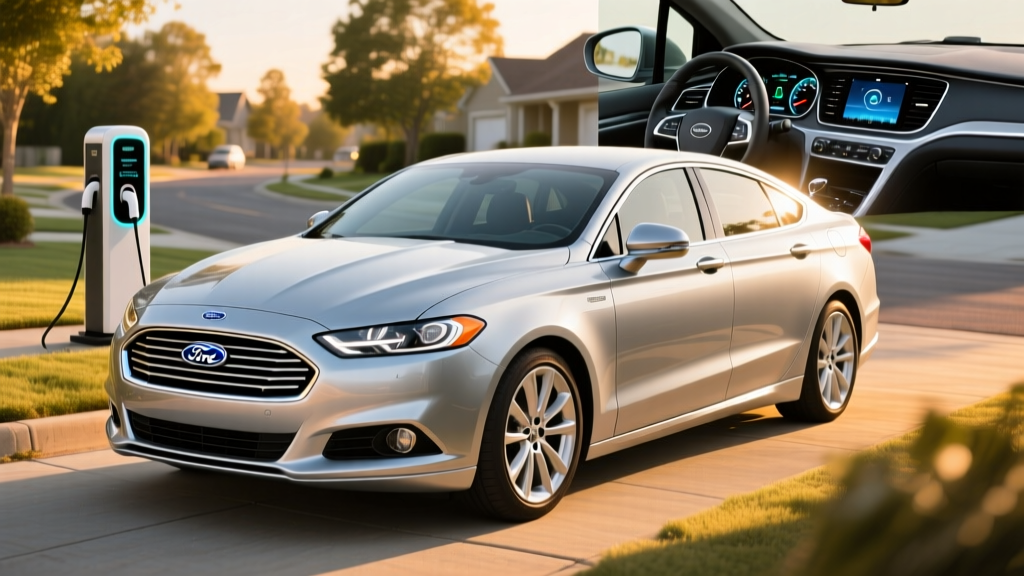
Why the 2014 Ford Fusion Hybrid SE Still Gets Attention in 2026
More than a decade after it rolled off the assembly line, the 2014 Ford Fusion Hybrid SE sedan remains a fixture on the used-car market — and for good reason. With EPA-rated fuel economy that still rivals many new hybrids, a spacious midsize cabin, and Ford's reputation for widely available service parts, this generation of Fusion Hybrid continues to attract budget-conscious commuters and rideshare drivers alike.
But buying a 12-year-old hybrid in 2026 comes with questions that don't apply to a new purchase: How has the battery held up? What does a replacement cost? And does the real-world MPG actually match the EPA sticker? This guide answers those questions with hard data, not marketing copy.
HEV vs. PHEV: What the 2014 Fusion Hybrid Actually Is
The 2014 Ford Fusion Hybrid SE is a conventional hybrid electric vehicle (HEV) — sometimes called a "self-charging" hybrid, though that term is marketing shorthand. Here is the critical distinction every buyer must understand:
Conventional Hybrid (HEV) — Fusion Hybrid
- No plug, no charging cord required
- Battery recharges via regenerative braking and the gasoline engine
- Electric motor assists the engine; very limited electric-only driving at low speeds
- No electric-only range to speak of (under 1 mile at parking-lot speeds)
- Fuel economy measured in MPG
Plug-In Hybrid (PHEV) — Fusion Energi (separate model)
- Requires plug-in charging (120V or 240V)
- Larger battery (7.6 kWh usable in the 2014 Energi)
- EPA-rated 19 miles of electric-only range
- Fuel economy measured in MPGe (electric mode) and MPG (gas mode)
- Eligible for federal tax credit when purchased new (no longer eligible used)
This article focuses on the standard Fusion Hybrid SE. If you're looking at a Fusion Energi (the PHEV variant), many of the reliability and battery-lifespan principles below still apply, but the range, charging, and tax-credit details differ significantly.
Fuel Economy: EPA Numbers and Real-World MPG
The 2014 Ford Fusion Hybrid SE carries EPA ratings that were competitive at launch and remain respectable today. Here is the official breakdown from fueleconomy.gov:
| Metric | EPA Rating |
|---|---|
| City MPG | 44 MPG |
| Highway MPG | 41 MPG |
| Combined MPG | 42 MPG |
| Fuel Tank Capacity | 13.5 gallons |
| EPA Total Range | ~567 miles |
| Annual Fuel Cost (EPA est.) | ~$1,250 (based on 15,000 mi/yr) |
Real-World MPG: What Owners Actually Report
Hybrids are unique in that they often exceed their EPA city rating in stop-and-go traffic because regenerative braking recovers energy that a gas car wastes as heat. However, highway driving at sustained speeds above 70 mph tends to yield lower numbers than the EPA highway estimate.
Based on aggregated owner reports from Fuelly and Edmunds long-term testing of this generation:
- City / suburban driving: 42–48 MPG (many owners match or beat the 44 MPG EPA city figure)
- Highway (70-75 mph): 35–39 MPG (aerodynamic drag and sustained engine load reduce hybrid advantage)
- Cold weather (below 30°F): 33–38 MPG combined (engine runs more to heat the cabin and keep the battery warm)
- Overall mixed-driving average: 39–43 MPG
For a 12-year-old vehicle, these numbers are still compelling. A 2026 Toyota Camry Hybrid LE, for comparison, is EPA-rated at 51/53/52 MPG — meaning the Fusion Hybrid gives up roughly 10 MPG to a modern equivalent but often costs $10,000–$15,000 less on the used market.
Powertrain Specs: Engine, Motor, and Combined Output
The 2014 Fusion Hybrid pairs a 2.0-liter Atkinson-cycle four-cylinder engine with an electric motor, connected through a planetary gearset that Ford calls an electronically controlled continuously variable transmission (eCVT). This is not a belt-driven CVT like those in some Nissan products — it's a power-split device similar in concept to Toyota's Hybrid Synergy Drive.
| Specification | Value |
|---|---|
| Gas Engine | 2.0L Atkinson-cycle I-4 |
| Engine Horsepower | 141 hp @ 6,000 rpm |
| Engine Torque | 129 lb-ft @ 4,000 rpm |
| Electric Motor Output | 118 hp (88 kW) |
| Combined Net System Horsepower | 188 hp |
| Transmission | eCVT (power-split planetary gearset) |
| Drivetrain | Front-wheel drive |
| 0–60 mph (tested) | ~7.6 seconds |
| Hybrid Battery (NiMH) | 1.4 kWh (gross), ~0.9 kWh usable |
| Curb Weight | ~3,615 lbs |
The 188 combined horsepower is adequate for highway merging and passing. The electric motor provides immediate torque from a stop, which makes the Fusion Hybrid feel quicker off the line than its 0–60 time suggests. The eCVT operates smoothly with none of the "rubber-band" drone associated with belt-type CVTs.
Battery Lifespan, Warranty, and Replacement Cost
This is the single biggest concern for anyone buying a used hybrid, and it deserves a thorough answer.
Original Battery Warranty
When new, the 2014 Fusion Hybrid's nickel-metal hydride (NiMH) traction battery was covered by Ford's hybrid battery warranty:
- 8 years / 100,000 miles in most states
- 10 years / 150,000 miles in California Air Resources Board (CARB) states (CA, CT, ME, MD, MA, NJ, NY, OR, RI, VT, WA)
As of 2026, the original factory warranty has expired for every 2014 Fusion Hybrid unless the vehicle has under 100,000 miles and a transferable extended warranty was purchased.
How Long Does the Battery Actually Last?
NiMH batteries in Ford and Toyota hybrids have a well-documented track record. The 2014 Fusion Hybrid uses a relatively small 1.4 kWh battery that is never fully charged or fully discharged — the hybrid system keeps the state of charge (SoC) between roughly 40% and 80%. This shallow cycling dramatically extends battery life compared to a full EV battery that regularly cycles from 10% to 90%.
Real-world data points:
- Taxi and rideshare fleets running Fusion Hybrids commonly report 180,000–250,000 miles before noticeable battery degradation
- Consumer Reports and iFixit surveys show NiMH hybrid battery failures are most common between 130,000 and 200,000 miles, though many last well beyond that
- A 2014 model with 100,000–140,000 miles today may still have a functional battery, but it is entering the window where capacity loss becomes measurable
Battery Replacement Cost in 2026
If the hybrid battery does fail, here is what you can expect to pay:
- New OEM Ford battery: $2,500–$3,800 (part only; labor adds $500–$900)
- Remanufactured battery (e.g., GreenTech, Dorman): $1,500–$2,200 installed
- Used/salvage battery: $600–$1,200 installed (risky — unknown remaining lifespan)
- Individual cell/module replacement: $300–$600 if only one or two modules have failed (a qualified hybrid technician can test individual modules)
Before purchasing any used 2014 Fusion Hybrid, request a hybrid battery health report. Many Ford dealers and independent hybrid shops can read the battery's state of health (SoH) via OBD-II. Look for SoH above 75%. Below 65%, plan for a replacement within 1–2 years.
SE Trim Features: What You Get
The SE was the mid-level trim for the 2014 Fusion Hybrid, sitting above the base S and below the Titanium. It came well-equipped for its era:
- Sync infotainment with 4.2-inch color LCD and voice commands
- Push-button start with intelligent access
- Dual-zone automatic climate control
- Power-adjustable driver's seat (6-way)
- 17-inch aluminum wheels
- Backup camera (standard on Hybrid SE)
- Ford MyKey (teen-driver speed/audio limiter)
- Bluetooth hands-free phone and audio streaming
Notable omissions by 2026 standards: no Apple CarPlay or Android Auto (Sync 3, which supports both, didn't arrive until the 2017 refresh), no adaptive cruise control on the SE trim, and no lane-keeping assist. If smartphone integration is a priority, factor in a $300–$500 aftermarket head-unit replacement.
Pricing in 2026: Used Market Value
The 2014 Ford Fusion Hybrid SE has depreciated significantly from its original MSRP of approximately $27,280 (before destination). As of early 2026, typical used-market pricing is:
- 80,000–100,000 miles, clean title: $8,500–$11,000
- 100,000–140,000 miles, clean title: $6,500–$9,000
- 140,000+ miles or rebuilt title: $4,000–$6,500
Prices vary by region, condition, and whether the hybrid battery has been recently replaced or tested. A documented battery replacement within the last 30,000 miles is worth a $1,500–$2,000 premium.
Tax Credit Eligibility
The 2014 Ford Fusion Hybrid SE does not qualify for any federal tax credit as a used purchase in 2026. Here is why:
- The federal §25E used-EV credit (up to $4,000) applies only to battery electric vehicles (BEVs) and plug-in hybrids (PHEVs) — not conventional hybrids (HEVs).
- The §30D new-vehicle credit does not apply to used purchases.
- The Fusion Hybrid SE has no plug and no meaningful electric-only range, so it has never been eligible for federal plug-in incentives.
- Some states offer modest used-hybrid rebates or HOV-lane access, but these vary by jurisdiction and often have income caps. Check your state's energy or DMV website for current programs.
Who Should Buy the 2014 Fusion Hybrid SE — and Who Shouldn't
Pros
- 42 MPG combined still competitive with many new hybrids
- Spacious midsize cabin with comfortable rear seat
- Smooth, quiet powertrain with adequate passing power
- Widely available parts and service network
- Strong safety ratings (IIHS Top Safety Pick for 2014)
- Low purchase price in 2026 used market
Cons
- Original battery warranty has expired — replacement is an ownership risk
- No Apple CarPlay/Android Auto without aftermarket upgrade
- Dated infotainment (Sync 2 / MyFord Touch has a poor reputation for responsiveness)
- No plug-in option means no electric-only commuting
- No federal tax credit eligibility
- Trunk space reduced by battery pack (12.2 cu ft vs. 16.0 cu ft in gas Fusion)
Decision Framework
Choose the 2014 Fusion Hybrid SE if:
- You want a sub-$10,000 commuter with 40+ MPG and no charging requirement
- You drive 12,000–20,000 miles per year, mostly city/suburban
- You don't have access to home or workplace EV charging
- You're comfortable budgeting $2,000–$3,500 for a potential battery replacement during ownership
Choose a PHEV (like a used Fusion Energi or Prius Prime) if:
- You have home Level 2 charging and a commute under 25 miles
- You want electric-only daily driving with gas backup for road trips
- You want to reduce gasoline consumption more aggressively than an HEV allows
Choose a full EV (BEV) if:
- You have reliable home charging (Level 2, 240V)
- Your daily driving is under 200 miles and you're comfortable with public DC fast charging for road trips
- You want zero tailpipe emissions and minimal drivetrain maintenance
- You can budget $18,000+ for a used BEV (e.g., 2020+ Chevy Bolt, Nissan Leaf, or Tesla Model 3)
Reliability Record and Common Issues
The 2014 Fusion Hybrid's powertrain — the 2.0L Atkinson-cycle engine and eCVT — has proven to be one of Ford's most reliable drivetrain combinations. Unlike the gasoline-only Fusion models with the 1.5L EcoBoost (known for coolant intrusion issues), the hybrid's naturally aspirated engine is relatively simple and under-stressed.
Common issues reported by owners and tracked by NHTSA include:
- 12V battery drain: Like many hybrids, the Fusion can drain its 12V accessory battery if left sitting for 2–3 weeks. This is not the traction battery — it's the standard lead-acid battery that powers electronics. A $180 AGM replacement resolves this.
- MyFord Touch / Sync 2 glitches: The infotainment system in this generation is slow and occasionally unresponsive. Ford issued software updates, but the hardware is inherently limited. An aftermarket head unit is the most effective fix.
- Brake actuator recall: Some 2013–2014 Fusion Hybrids were recalled for a brake system issue. Confirm recall status via NHTSA VIN lookup before purchasing.
- EVAP purge valve: A common minor emissions issue ($150–$250 repair) that can trigger a check-engine light.
Overall, Consumer Reports rates the 2014 Fusion Hybrid's reliability as average to above average for its class. The hybrid-specific components (eCVT, inverter, traction battery) have a lower failure rate than the conventional Fusion's turbocharged engines and 6-speed automatic transmissions.
Ownership Cost Snapshot: 5-Year Projection
Here is a realistic 5-year cost estimate for a 2014 Fusion Hybrid SE purchased at $8,500 with 110,000 miles, driven 15,000 miles per year:
| Category | Estimated 5-Year Cost | Notes |
|---|---|---|
| Purchase Price | $8,500 | Clean title, ~110k miles |
| Fuel (gasoline) | $6,250 | @ 42 MPG combined, $3.50/gal avg |
| Insurance | $5,500–$7,500 | Varies by state, age, driving record |
| Maintenance | $2,500–$3,500 | Oil, brakes, tires, filters over 75k miles |
| Hybrid Battery Reserve | $0–$3,000 | Budget for possible replacement |
| Depreciation | $3,500–$4,500 | Estimated resale: $4,000–$5,000 |
| Total (5 years) | $26,250–$33,250 | ~$5,250–$6,650/year all-in |
For comparison, a similarly priced gas-only 2014 Fusion 2.5L (rated at 22/34/26 MPG) would spend approximately $9,600 on fuel over the same period — roughly $3,350 more in gas alone. The hybrid's fuel savings offset much of the battery-replacement risk.
Frequently Asked Questions
How many MPG does the 2014 Ford Fusion Hybrid SE get?
The EPA rates it at 44 city / 41 highway / 42 combined MPG. Real-world mixed driving typically yields 39–43 MPG, with city-heavy routes sometimes exceeding 44 MPG and sustained highway driving at 75 mph dropping to 35–39 MPG.
Does the 2014 Fusion Hybrid need to be plugged in?
No. The Fusion Hybrid is a conventional HEV. It charges its own battery through regenerative braking and the gasoline engine. You never plug it in. If you want a plug-in Fusion, look for the Fusion Energi (PHEV), which is a separate model with 19 miles of electric-only range.
Is the 2014 Fusion Hybrid reliable?
Yes, with caveats. The hybrid powertrain (2.0L engine + eCVT) is among Ford's most reliable setups. The main risk is the aging NiMH traction battery, which is now outside its original warranty window. Budget $1,500–$3,500 for a potential battery replacement during ownership. The infotainment system (MyFord Touch) is a known weak point but does not affect drivability.
What does a hybrid battery replacement cost?
A new OEM battery runs $3,000–$4,700 installed. Remanufactured batteries cost $1,500–$2,200 installed. Individual module replacement (if only one or two cells fail) can cost as little as $300–$600. Always get a battery health report before purchase.
Does the 2014 Fusion Hybrid qualify for any tax credit?
No. As a conventional hybrid (HEV) with no plug, it has never qualified for federal plug-in vehicle tax credits. The used-EV credit (§25E, up to $4,000) applies only to BEVs and PHEVs. Some states may offer minor incentives for efficient vehicles, but these vary widely — check your state's energy office for current programs.
How does the Fusion Hybrid compare to a Prius of the same year?
The 2014 Toyota Prius is EPA-rated at 50 MPG combined — 8 MPG better than the Fusion Hybrid. However, the Fusion offers a significantly larger cabin, a quieter ride, a more conventional driving feel, and better highway stability. The Prius wins on pure efficiency; the Fusion Hybrid wins on comfort and space. Both have strong reliability records.
What should I check before buying a used 2014 Fusion Hybrid?
Request an OBD-II hybrid battery health report (state of health percentage). Verify all NHTSA recalls have been performed — particularly the brake system recall. Check the maintenance history for regular oil changes (every 7,500–10,000 miles with synthetic). Test the air conditioning (compressor is electric and costly to replace). And confirm the 12V battery is in good condition — a weak 12V battery causes a surprising number of "hybrid system" warning lights that are not actually traction battery failures.