Quick Verdict: A Pioneer PHEV That Still Commutes
The 2013 Toyota Prius Plug-In Hybrid was one of the first mass-market plug-in hybrids sold in the United States, bridging the gap between Toyota's legendary conventional hybrid and the all-electric future. With 11 miles of EPA-rated electric-only range, a 50 MPG combined rating once the battery depletes, and Toyota's proven Hybrid Synergy Drive powertrain, it remains a viable used-car option for budget-conscious commuters in 2026 — provided you understand its limitations.
This guide covers everything a prospective buyer or current owner needs: real-world MPG and EV range, battery health expectations, replacement costs, and how this early PHEV stacks up against modern hybrids and full EVs.
| Specification | 2013 Prius Plug-In Hybrid |
|---|---|
| EPA EV-Only Range | 11 miles |
| Total Combined Range (EV + Gas) | ~540 miles |
| EPA MPG (Charge-Sustaining) | 50 combined / 51 city / 49 highway |
| MPGe (EV Mode) | 95 MPGe |
| Battery Capacity | 4.4 kWh (lithium-ion) |
| Combined System Horsepower | 134 hp |
| Engine | 1.8L 4-cyl Atkinson-cycle (98 hp) |
| Electric Motor | 60 kW (80 hp) |
| Level 1 Charge Time (120V) | ~3 hours (0–100%) |
| Level 2 Charge Time (240V) | ~1.5 hours (0–100%) |
| DC Fast Charging | Not supported |
| 0–60 mph | ~9.8 seconds |
| Original MSRP | $32,000–$35,000 |
| Hybrid Battery Warranty (Original) | 8 years / 100,000 miles (10 yr / 150,000 mi in CARB states) |
HEV vs PHEV: What the Prius Plug-In Actually Is
The conventional Toyota Prius (HEV) cannot be plugged in. It generates all its electricity from the gasoline engine and regenerative braking, achieving up to 50 MPG without ever needing a charging cable.
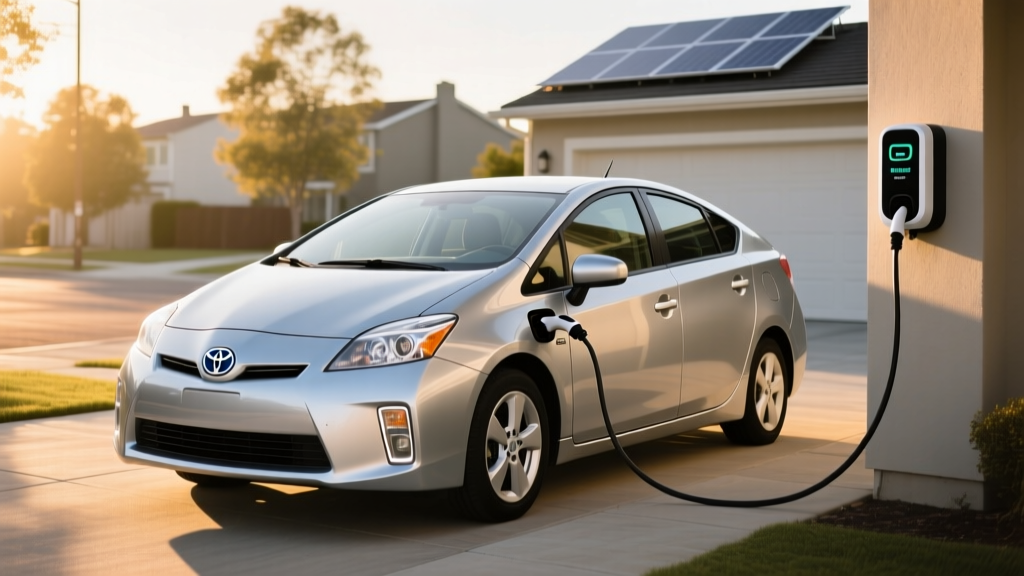
The 2013 Prius Plug-In Hybrid (PHEV) adds a larger 4.4 kWh lithium-ion battery pack and a charge port (J1772 connector). You can plug it into a standard 120V household outlet or a 240V Level 2 charger to gain up to 11 miles of pure electric driving before the gasoline engine engages. Once the EV range is depleted, it operates exactly like a standard Prius hybrid at 50 MPG.
This distinction matters for used buyers: if you cannot charge at home or work, the plug-in advantage disappears and you are effectively driving a slightly heavier standard Prius. The PHEV only delivers its efficiency premium when you actually plug it in regularly.
Fuel Economy: EPA Numbers and Real-World MPG
According to fueleconomy.gov, the 2013 Prius Plug-In Hybrid carries these official ratings:
| Mode | City | Highway | Combined |
|---|---|---|---|
| Charge-Sustaining (Hybrid) | 51 MPG | 49 MPG | 50 MPG |
| Charge-Depleting (EV) | 95 MPGe | ||
Real-World MPG vs EPA
Toyota hybrids frequently exceed their EPA city rating in stop-and-go traffic because regenerative braking recaptures energy that gasoline-only cars waste as heat. Many owners report 52–55 MPG in urban driving. Highway driving at 75+ mph typically drops efficiency to 43–46 MPG due to aerodynamic drag and the Atkinson-cycle engine's lower high-RPM output.
In EV mode, the real-world electric range varies significantly:
- Mild weather, city driving (30–40 mph): 12–14 miles achievable
- Highway at 65 mph: 8–9 miles before engine engagement
- Cold weather (below 40°F): 7–9 miles, as cabin heating draws from the battery and the engine may start for heat
The EV mode top speed is 62 mph. Exceed that or demand hard acceleration, and the 1.8L engine fires up regardless of battery charge.
Powertrain and Charging Specifications
The 2013 Prius Plug-In uses Toyota's third-generation Hybrid Synergy Drive with a combined system output of 134 horsepower. The 1.8-liter Atkinson-cycle four-cylinder produces 98 hp and 105 lb-ft of torque, supplemented by a 60 kW (80 hp) electric motor integrated into the transaxle. A second, smaller motor/generator handles engine starting and regenerative braking.
Charging Details
The charge port uses a standard J1772 connector (the universal Level 1/Level 2 standard used by all non-Tesla EVs of that era). Charging speeds:
- Level 1 (120V, 12A): ~1.4 kW — full charge in approximately 3 hours
- Level 2 (240V, 15A): ~3.3 kW onboard charger limit — full charge in approximately 1.5 hours
- DC Fast Charging: Not available. The 4.4 kWh battery is too small to justify DC fast hardware, and the vehicle lacks a CCS or CHAdeMO port.
With only 4.4 kWh total capacity (roughly 3.5 kWh usable to protect battery longevity), even a standard household outlet provides a meaningful overnight top-up. Most owners plug in at night using the included Level 1 cord and wake up to a full charge.
Battery Health, Warranty, and Replacement Costs
Original Hybrid Battery Warranty: 8 years / 100,000 miles nationwide. In California Air Resources Board (CARB) states (CA, CT, ME, MD, MA, NJ, NY, OR, RI, VT, WA), coverage extends to 10 years / 150,000 miles.
2026 Status: All 2013 models are now beyond the original 8-year warranty window. However, Toyota's lithium-ion packs have proven durable, with many exceeding 150,000 miles with less than 15% capacity loss when properly maintained.
Battery Degradation and Lifespan
The 4.4 kWh lithium-ion pack in the Prius Plug-In is conservatively managed — Toyota restricts the usable window to roughly 3.5 kWh to minimize stress. This means the battery rarely sees full 0% or 100% states of charge, which significantly extends cycle life.
Based on long-term owner data and industry analysis, expect:
- 100,000 miles: 10–15% capacity loss (EV range drops from 11 to ~9–10 miles)
- 150,000 miles: 15–25% capacity loss (EV range ~8–9 miles)
- 200,000+ miles: Some packs continue functioning with 25–35% loss, but EV range may be 7 miles or fewer
Importantly, even a heavily degraded pack does not disable the car. The Prius Plug-In simply operates as a standard hybrid with reduced or zero EV-only range, still delivering 48–50 MPG.
Battery Replacement Cost
If the high-voltage battery fails outright (a relatively rare occurrence compared to gradual degradation), replacement options in 2026 include:
- New OEM Toyota pack: $2,500–$3,500 (parts) + $500–$800 labor = $3,000–$4,300 total
- Refurbished/remanufactured pack: $1,200–$2,000 installed
- Individual module replacement: Independent hybrid specialists can replace only the failed modules within the pack for $600–$1,200, a cost-effective option for a single weak cell
According to NHTSA records, the 2013 Prius Plug-In has no major battery-related recalls. Toyota's hybrid battery track record across the Prius family remains among the best in the industry.
Pricing and Tax Credit Eligibility in 2026
The 2013 Prius Plug-In originally carried an MSRP of $32,000 (base) to $35,000 (Advanced trim with features like the Entune navigation system and heated seats). In 2026, used examples typically trade between $7,000 and $13,000 depending on mileage, condition, and battery health.
Federal Tax Credit Status
When new, the 2013 Prius Plug-In qualified for a $2,500 federal tax credit under the original §30D program (the credit scaled with battery capacity: $2,500 base + $417 per kWh above 4 kWh, capped at the vehicle's battery size). That credit is no longer available for new purchases of this discontinued model.
For used purchases in 2026, the IRS Used Clean Vehicle Credit (§25E) offers up to $4,000 or 30% of the sale price (whichever is less) if the following conditions are met:
- Sale price is $25,000 or less (nearly all used 2013 Prius Plug-Ins qualify)
- Buyer's adjusted gross income does not exceed $75,000 (single) / $112,500 (head of household) / $150,000 (joint)
- The vehicle is purchased from a licensed dealer (private-party sales do not qualify)
- The vehicle has a minimum 4 kWh battery capacity (the Prius Plug-In's 4.4 kWh pack meets this threshold)
At a typical $10,000 used price, the 30% calculation yields a $3,000 credit, effectively reducing net cost to around $7,000. Always consult a tax professional to confirm eligibility for your specific situation, as IRS rules are subject to change.
Who Should Choose the 2013 Prius Plug-In?
Pros
- Proven Toyota hybrid reliability with 200,000+ mile potential
- 50 MPG combined eliminates range anxiety entirely
- 11-mile EV range covers many short commutes emission-free
- Low used purchase price ($7,000–$13,000)
- Potential $3,000 used-EV tax credit under §25E
- No DC fast-charging dependency — Level 1 overnight charging is sufficient
- Low maintenance costs (no transmission fluid changes, long brake life from regen)
Cons
- Only 11 miles of EV range — far less than modern PHEVs (30–45 miles)
- 9.8-second 0–60 time makes highway merging sluggish
- Dated infotainment with no Apple CarPlay or Android Auto
- Tight rear-seat and cargo space vs modern crossovers
- No DC fast charging capability
- Original battery warranty has expired on all examples
- EV mode limited to 62 mph top speed
Decision Framework
Choose the 2013 Prius Plug-In if: You have a short commute (under 12 miles each way), can charge at home overnight, want a budget-friendly entry to plug-in driving, and value 50 MPG as a fallback for longer trips. It's ideal as a second car or an affordable daily driver for someone not ready to commit to a full EV.
Choose a modern PHEV (e.g., 2026 Toyota RAV4 Prime, Prius Prime) if: You need 35+ miles of EV range to cover your full daily driving on electricity alone, want modern safety tech (automatic emergency braking, lane-keeping), and have a budget above $35,000.
Choose a full EV (e.g., Chevrolet Bolt, Nissan Leaf) if: You want zero gasoline expenses, have reliable home charging, and your daily driving stays within 150–250 miles. A full EV eliminates oil changes and engine maintenance entirely.
Choose a conventional hybrid (standard Prius, Honda Accord Hybrid) if: You cannot charge at home or at work. A PHEV's electric range is wasted without regular plugging in, and a conventional HEV delivers nearly the same MPG without the charging requirement.
Frequently Asked Questions
How many MPG does the 2013 Toyota Prius Plug-In get?
The EPA rates it at 51 city / 49 highway / 50 combined MPG once the battery is depleted and it operates as a conventional hybrid. In EV mode, it achieves 95 MPGe. Real-world city driving often yields 52–55 MPG thanks to strong regenerative braking, while sustained highway driving above 70 mph may drop to 43–46 MPG.
How far can the 2013 Prius Plug-In go on electric only?
The EPA rates it at 11 miles of EV-only range. In mild weather with gentle city driving, some owners extract 12–14 miles. Highway driving or cold temperatures reduce this to 7–9 miles. The EV mode is limited to speeds up to 62 mph.
Is the 2013 Prius Plug-In reliable, and what does a battery replacement cost?
Toyota's Hybrid Synergy Drive is among the most proven powertrains ever produced. The high-voltage lithium-ion battery is conservatively managed and typically lasts 150,000+ miles with gradual degradation rather than sudden failure. If replacement is needed, a new OEM pack costs $3,000–$4,300 installed, while refurbished options run $1,200–$2,000. Independent shops can replace individual failed modules for $600–$1,200.
Does the 2013 Prius Plug-In qualify for any tax credit in 2026?
It is no longer eligible for the new-vehicle §30D credit. However, buyers purchasing from a licensed dealer may qualify for the Used Clean Vehicle Credit (§25E) — up to $4,000 or 30% of the sale price (whichever is less). At a typical $10,000 sale price, that equals a $3,000 credit, subject to buyer income limits ($75K single / $150K joint). Confirm eligibility with a tax professional and the IRS guidelines.
Hybrid vs PHEV vs EV — which should I choose?
If you can charge at home and your daily driving is under 15 miles, this PHEV lets you commute mostly on electricity while keeping a gas tank for longer trips. If you cannot charge at home, a conventional HEV (standard Prius) gives you 50 MPG without plugging in. If you want zero gas use and your routine stays under 200 miles daily, a full battery EV (BEV) eliminates engine maintenance entirely but requires reliable charging access.
Can I charge the 2013 Prius Plug-In at a public charging station?
Yes, at any Level 2 public station with a J1772 connector — the same standard used by all non-Tesla EVs. However, because the battery is only 4.4 kWh and the onboard charger maxes out at 3.3 kW, charging completes in about 1.5 hours regardless of the station's output. DC fast chargers (CCS, CHAdeMO, NACS) will not work with this vehicle.
What is the total driving range?
With a full battery and a full 11.9-gallon fuel tank, the combined range is approximately 540 miles (11 miles EV + ~530 miles from gasoline at 50 MPG). This eliminates range anxiety entirely — the car simply switches to hybrid mode when the battery depletes.