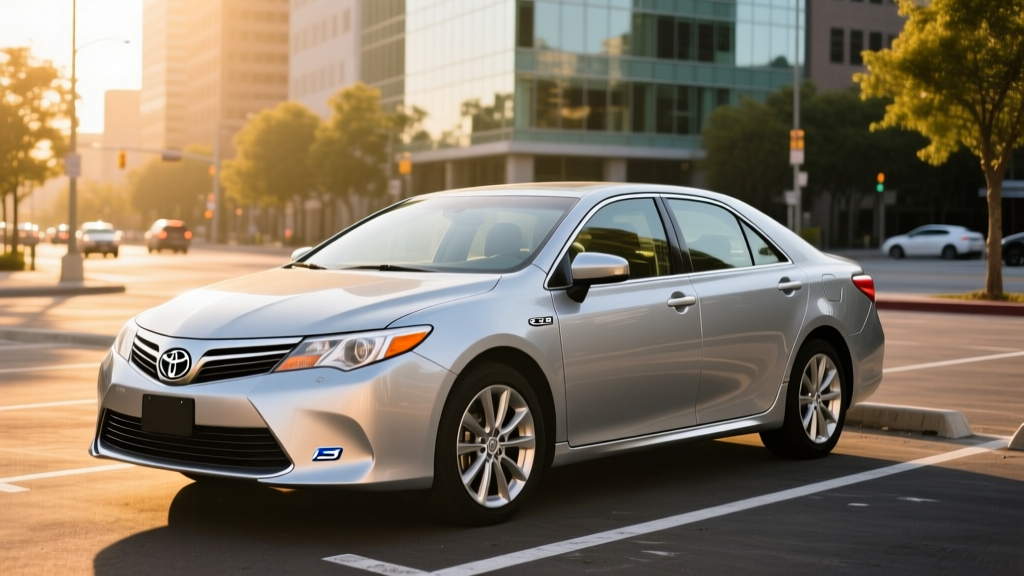
The 2013 Toyota Camry Hybrid occupies a specific niche in today's used-car market: a proven, mid-size hybrid sedan that delivers real-world fuel savings without the complexity of a plug. With over a decade of reliability data behind it and a replacement-hybrid-battery market that's now mature and affordable, it remains a compelling choice for budget-conscious drivers who want hybrid efficiency without EV charging infrastructure. Here's the complete ownership picture for 2026 buyers.
2013 Camry Hybrid Fuel Economy: EPA vs. Real World
The 2013 Camry Hybrid's efficiency numbers remain impressive even by modern standards. Toyota's Hybrid Synergy Drive pairs a 2.5-liter Atkinson-cycle four-cylinder engine with an electric motor and a nickel-metal hydride (NiMH) battery pack, delivering strong city efficiency where hybrids shine brightest.
| Metric | EPA Rating |
|---|---|
| City MPG | 40 MPG |
| Highway MPG | 38 MPG |
| Combined MPG | 41 MPG |
Source: EPA / fueleconomy.gov
In mixed driving, owners frequently report 38–43 MPG combined. City-heavy commutes often push past the 40 MPG city sticker because regenerative braking recaptures energy in stop-and-go traffic. Highway-only driving at 75+ MPH can drop efficiency to 34–36 MPG due to increased aerodynamic drag — hybrids lose their city advantage at sustained high speeds. In cold weather (below 30°F), expect a 5–10% efficiency dip as the engine runs more frequently to heat the cabin and warm the battery.
For context, the 2013 gasoline-only Camry LE with its 2.5L engine earns an EPA 28 MPG combined. The hybrid delivers roughly 46% better fuel economy — a gap that translates to approximately $500–$700 in annual fuel savings at 15,000 miles per year and $3.50/gallon gasoline (2026 national average).
HEV vs. PHEV: Where the 2013 Camry Hybrid Fits
A common point of confusion for first-time hybrid shoppers is the difference between a conventional hybrid (HEV) and a plug-in hybrid (PHEV). The 2013 Camry Hybrid is strictly an HEV — it cannot be plugged in and has no meaningful electric-only driving range.
| Feature | HEV (e.g., 2013 Camry Hybrid) | PHEV (e.g., Prius Prime) | BEV (e.g., Tesla Model 3) |
|---|---|---|---|
| Plug-in charging | No — self-charging via engine + regen | Yes — Level 1/2 AC charging | Yes — Level 1/2 AC + DC fast charging |
| Electric-only range | ~1 mile at very low speed | 25–44 miles (model-dependent) | 250–400+ miles |
| Total range | 600+ miles (gas tank) | 400–600+ miles (electric + gas) | 250–400+ miles (battery only) |
| Battery size | ~1.6 kWh (NiMH) | 8–18 kWh (lithium-ion) | 50–100+ kWh (lithium-ion) |
| Federal tax credit (new) | None | Up to $7,500 (§30D, if eligible) | Up to $7,500 (§30D, if eligible) |
| Home charging needed | No | Recommended for EV-range benefit | Essential |
The 2013 Camry Hybrid's small 1.6 kWh NiMH battery serves a specific role: it stores energy recaptured from braking and excess engine output, then deploys it to assist acceleration and enable brief engine-off coasting. You never plug it in — the car manages the battery's state of charge automatically. This is a key advantage for apartment dwellers, street parkers, or anyone without access to a charging outlet.
Powertrain Specs and Driving Character
| Specification | Detail |
|---|---|
| Engine | 2.5L Atkinson-cycle 4-cylinder (156 HP) |
| Electric motor | Permanent-magnet synchronous (105 kW / 141 HP) |
| Net system horsepower | 200 HP |
| Transmission | eCVT (planetary gearset, no traditional belts) |
| Drivetrain | Front-wheel drive |
| Battery type | Nickel-metal hydride (NiMH), ~1.6 kWh |
| 0–60 MPH | ~7.6 seconds |
| Curb weight | ~3,435 lbs |
| Fuel tank | 17.0 gallons |
| Total range (est.) | ~600–680 miles |
The eCVT in the Camry Hybrid is not a belt-and-pulley CVT like those found in some competitors. Toyota uses a planetary gearset that seamlessly blends engine and motor power with no fixed gear ratios and no belts to wear out. This design is a significant contributor to the model's long-term reliability — there are no traditional transmission clutches, bands, or torque converters to fail.
The 200 combined horsepower provides adequate acceleration for highway merging and passing. The electric motor's instant torque fills in the low-end gap before the four-cylinder reaches its power band, making the car feel responsive around town despite its weight.
Hybrid Battery Lifespan, Warranty, and Replacement Cost
For any used hybrid buyer, the traction battery is the single biggest financial question mark. Here's what the data shows for the 2013 Camry Hybrid's NiMH pack:
Toyota warranted the 2013 Camry Hybrid's battery for 8 years / 100,000 miles (10 years / 150,000 miles in California and states that follow CARB emissions standards). As of 2026, all original factory battery warranties have expired unless the vehicle was sold with a certified-pre-owned (CPO) extension.
Real-world battery longevity: Toyota's NiMH hybrid batteries have proven remarkably durable. Fleet data and owner surveys consistently show these packs lasting 150,000–200,000+ miles before significant capacity loss. Unlike the lithium-ion packs in modern EVs, NiMH chemistry degrades more gradually and tolerates the shallow charge/discharge cycles that Toyota's hybrid system employs (the system keeps the battery between roughly 40–80% state of charge to maximize lifespan).
Battery replacement cost in 2026:
- Remanufactured battery: $1,500–$2,500 installed at an independent hybrid specialist
- New OEM Toyota battery: $3,000–$4,000 installed at a dealership
- Individual module replacement: $300–$800 if only one or two of the battery's 34 modules have failed (a viable option offered by many hybrid repair shops)
The availability of remanufactured packs and module-level repair has driven replacement costs down significantly compared to a decade ago. A failed hybrid battery is no longer a car-ending event — it's a repair comparable in cost to a timing-belt service on a conventional vehicle.
Reliability Track Record and Common Issues
The 2013 Camry Hybrid benefits from Toyota's conservative engineering approach. The hybrid system adds complexity (inverter, electric motor, battery) but eliminates other failure-prone components (no traditional automatic transmission, no alternator, no starter motor, no accessory belt). Net reliability has proven excellent.
Known issues to inspect on a used 2013 Camry Hybrid:
- Brake actuator assembly: Some 2012–2014 Camry Hybrids experienced premature wear in the regenerative braking actuator. Check for any ABS warning lights, unusual brake pedal feel, or recall service history. Toyota issued extended warranty coverage on some model years for this component.
- 12V auxiliary battery: Like all hybrids, the Camry has a standard 12V battery that powers electronics. It's located in the trunk and typically lasts 4–6 years. A dead 12V battery will prevent the car from starting even if the hybrid battery is fully charged.
- Inverter coolant pump: Verify that the inverter coolant reservoir shows fluid movement when the car is in READY mode. A failed pump can overheat the inverter — a costly repair ($2,000+).
- Standard Camry items: Water pump, suspension bushings, and interior wear are consistent with any 10+ year-old sedan.
The NHTSA lists several recalls for the 2013 Camry — confirm all have been addressed before purchase. The IIHS gave the 2013 Camry its Top Safety Pick+ designation, reflecting strong crash-test performance.
Pricing and Tax Credit Eligibility in 2026
As a used vehicle, the 2013 Camry Hybrid is not eligible for the federal §30D new clean vehicle credit. However, it may qualify for the Used Clean Vehicle Credit under IRS §25E:
- Credit amount: Up to $4,000 (30% of the sale price, capped at $4,000)
- Vehicle price cap: Sale price must be $25,000 or less (easily met — used 2013 Camry Hybrids typically sell for $8,000–$14,000 depending on mileage and condition)
- Buyer income cap: Adjusted gross income ≤ $75,000 (single), $112,500 (head of household), or $150,000 (joint filers)
- Vehicle requirements: Must be at least 2 model years old, purchased from a licensed dealer, and the battery must have at least a portion of its original capacity
- Frequency limit: One used-EV/hybrid credit per buyer every 3 years
- Point-of-sale transfer: Available — the credit can be applied as a down-payment reduction at the dealer
Source: IRS.gov — Used Clean Vehicle Credit
Current used-market pricing (2026):
| Mileage Range | Typical Price |
|---|---|
| 80,000–110,000 miles | $11,000–$14,000 |
| 110,000–150,000 miles | $8,500–$11,500 |
| 150,000–200,000 miles | $6,500–$9,000 |
At a $10,000 purchase price from a dealer, a qualifying buyer could claim up to $3,000 (30% of $10,000) via the §25E credit, bringing effective cost to ~$7,000. This makes the 2013 Camry Hybrid one of the most cost-efficient ways to access hybrid fuel savings in 2026.
Who Should Buy the 2013 Camry Hybrid?
- You drive 12,000+ miles per year, mostly in city or suburban conditions where hybrid efficiency peaks
- You lack access to home or workplace charging (apartment, street parking, no garage outlet)
- You want a proven, low-risk vehicle with abundant parts availability and any mechanic can service the non-hybrid components
- Your budget is under $15,000 and you want to minimize fuel costs without taking on EV range or charging concerns
- You value a full-size trunk (the hybrid battery sits behind the rear seats but trunk space remains competitive at ~13.1 cu ft)
- You have reliable Level 2 home charging and want electric-only commuting (consider a used Prius Prime or a new PHEV eligible for the §30D credit)
- Your commute is primarily highway at 75+ MPH — the hybrid advantage diminishes, and a diesel or efficient turbocharged gas car may close the MPG gap
- You want the latest safety tech (automatic emergency braking, lane-keeping assist) — these weren't standard on the 2013 Camry
- You're buying new and want to maximize federal tax incentives — the §30D credit applies only to new PHEVs and BEVs meeting battery-sourcing requirements
- 41 MPG EPA combined; frequently exceeded in real-world city driving
- Proven NiMH battery with 150K–200K+ mile lifespan
- No plug-in charging required — zero infrastructure dependency
- eCVT planetary gearset has no belts or clutches to fail
- Affordable battery replacement ($1,500–$2,500 remanufactured)
- Potential $4,000 used-vehicle tax credit (§25E)
- Strong IIHS safety ratings
- No electric-only driving capability
- Original factory battery warranty has expired on all examples
- Pre-dates standard automatic emergency braking and modern ADAS
- Highway MPG (38) is less impressive than city (40)
- NiMH battery is heavier and less energy-dense than modern lithium-ion
- Trunk space reduced vs. gas Camry due to battery placement
Frequently Asked Questions
How many MPG does the 2013 Toyota Camry Hybrid get?
The EPA rates the 2013 Camry Hybrid at 40 MPG city, 38 MPG highway, and 41 MPG combined. Real-world owners typically report 38–43 MPG combined, with city-heavy driving often exceeding the EPA city figure thanks to regenerative braking. Highway-only driving above 70 MPH may yield 34–36 MPG.
Does the 2013 Camry Hybrid need to be plugged in?
No. The 2013 Camry Hybrid is a conventional hybrid (HEV), not a plug-in hybrid (PHEV). It charges its battery entirely through regenerative braking and the gasoline engine. You fuel it like any other car — just with fewer stops at the pump.
How far can the 2013 Camry Hybrid drive on electric power alone?
Effectively zero meaningful distance. The hybrid system can move the car at very low speeds (under 25 MPH) for roughly a mile on battery power alone under ideal conditions, but this is not a practical electric-driving mode. The battery's role is to assist the engine and recapture braking energy, not to provide EV range. If electric-only commuting is your goal, you need a PHEV or BEV.
How long does the hybrid battery last, and what does replacement cost?
Toyota's NiMH hybrid batteries typically last 150,000–200,000+ miles before significant degradation. Many original 2013 Camry Hybrid batteries are still in service in 2026. If replacement is needed, a remanufactured battery costs $1,500–$2,500 installed, while a new OEM pack runs $3,000–$4,000. Module-level repair (replacing only the failed cells) can cost as little as $300–$800.
Is the 2013 Camry Hybrid reliable?
Yes. The 2013 Camry Hybrid is widely regarded as one of the most reliable vehicles in its class. The eCVT transmission uses a durable planetary gearset with no belts or clutches. Key items to inspect on a used example include the brake actuator assembly, inverter coolant pump operation, and 12V auxiliary battery condition. Verify all NHTSA recalls have been performed.
Does the 2013 Camry Hybrid qualify for any tax credit?
As a used vehicle, it is not eligible for the §30D new clean vehicle credit. However, it may qualify for the IRS §25E Used Clean Vehicle Credit: up to $4,000 (30% of sale price) if purchased from a dealer for $25,000 or less, and if the buyer's income falls under IRS caps ($75K single / $150K joint). Confirm eligibility with a tax professional and review current IRS guidance before purchase.
Hybrid vs. PHEV vs. EV — which should I choose?
Choose an HEV (like the 2013 Camry Hybrid) if you lack home charging access and want fuel savings with zero behavioral change. Choose a PHEV if you have Level 2 home charging and want 25–44 miles of electric-only commuting with a gas engine for longer trips. Choose a BEV (full EV) if you have reliable home charging, want to eliminate gasoline entirely, and your daily driving falls within the vehicle's range. Each option has a different infrastructure requirement — match the vehicle to your charging reality, not the other way around.