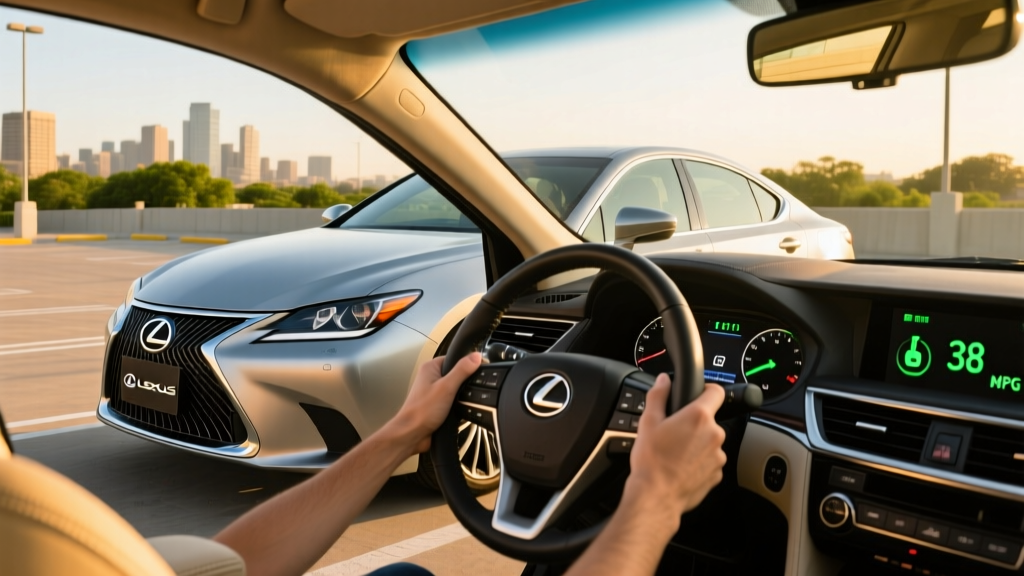
The 2013 Lexus ES 300h arrived as Lexus's first hybrid midsize luxury sedan, pairing a 2.5-liter four-cylinder engine with an electric motor to deliver premium comfort without the fuel bill of its V6 sibling. More than a decade later, it remains one of the most reliable used hybrids on the market — and its fuel economy still holds up against newer competitors. If you're researching the 2013 Lexus ES 300h hybrid fuel economy MPG figures before buying, this guide covers every number that matters: EPA ratings, real-world results, battery longevity, and total ownership cost in 2026.
EPA Fuel Economy Ratings: City, Highway, and Combined MPG
The 2013 Lexus ES 300h carries a single powertrain configuration — no trim-level variations affect fuel economy. Here are the official EPA figures as published on fueleconomy.gov:
| Metric | Value |
|---|---|
| City MPG | 40 MPG |
| Highway MPG | 39 MPG |
| Combined MPG | 40 MPG |
| Fuel Tank Capacity | 17.2 gallons |
| Total Range (Full Tank) | ~688 miles |
| Annual Fuel Cost (EPA est.) | ~$1,650 (15k mi/yr at $3.30/gal) |
For context, the gas-only 2013 Lexus ES 350 with its 3.5L V6 rates at just 24 MPG combined. That's a 40% fuel-economy advantage for the hybrid — a difference that compounds into real dollars every month.
Real-World MPG: What Owners Actually Report
EPA stickers are a starting point, not a guarantee. The 2013 ES 300h's hybrid system behaves differently than most vehicles in real-world conditions — and in ways that often favor the owner.
The ES 300h uses Toyota's Hybrid Synergy Drive (shared with the Camry Hybrid platform), which prioritizes electric-motor operation at low speeds. This means urban commuters with frequent stops extract the most value. On sustained highway runs, the 2.5L Atkinson-cycle engine does most of the work, and aerodynamic drag at higher speeds erodes efficiency.
Owner-reported data from Fuelly and Edmunds forums clusters around 38–42 MPG for mixed driving, which aligns closely with the EPA combined figure. This is a hybrid that delivers on its sticker promise — unlike some turbocharged gas cars that fall short of EPA estimates in real-world use.
Powertrain Specs: Engine, Motor, and Combined Output
| Component | Specification |
|---|---|
| Engine | 2.5L 4-cyl Atkinson-cycle (2AR-FXE) |
| Engine Power | 156 hp @ 5,700 rpm |
| Electric Motor Power | 105 kW (141 hp) |
| Net System Horsepower | 200 hp |
| Transmission | eCVT (planetary gearset) |
| Drivetrain | Front-wheel drive |
| 0–60 mph | ~8.1 seconds |
| Hybrid Battery | 1.6 kWh NiMH (sealed) |
Note that the 1.6 kWh nickel-metal hydride (NiMH) battery is small by modern standards — this is a conventional hybrid (HEV), not a plug-in. It cannot be plugged in, has no electric-only driving mode of meaningful distance, and recharges entirely through regenerative braking and engine power. This is a critical distinction from plug-in hybrids (PHEVs) and battery-electric vehicles (BEVs).
HEV vs PHEV vs EV: Where Does the ES 300h Fit?
If you're cross-shopping electrified vehicles, understanding the three main categories prevents costly mismatches:
Conventional Hybrid (HEV)
Example: 2013 Lexus ES 300h
- No plug — refuels with gas only
- Small battery (~1–2 kWh)
- Electric motor assists at low speed
- 35–50 MPG typical
- No federal tax credit
Plug-In Hybrid (PHEV)
Example: 2026 Toyota RAV4 Prime
- Plugs in for 25–45 mi electric range
- Larger battery (~18 kWh)
- Gas engine kicks in after battery depletes
- 94+ MPGe on electric, 38 MPG on gas
- May qualify for §30D credit (if eligible)
Battery Electric (BEV)
Example: 2026 Hyundai Ioniq 6
- No gas engine — electric only
- Large battery (54–100+ kWh)
- 250–360 mi EPA range
- Requires home or public charging access
- Up to $7,500 §30D credit if eligible
The 2013 ES 300h is squarely an HEV. There is no plug, no electric-only range to speak of (the car can creep at very low speeds on battery for roughly one mile under ideal conditions, but this isn't a practical driving mode), and no eligibility for any current federal EV tax credit. It's a gas car that happens to be exceptionally efficient.
Hybrid Battery Longevity, Warranty, and Replacement Cost
The number-one concern for used-hybrid buyers is battery failure. Here's what the data shows for the 2013 ES 300h's NiMH pack:
NiMH chemistry degrades more gracefully than early lithium-ion packs. Rather than sudden failure, the battery gradually loses capacity, which manifests as slightly reduced MPG (the engine runs more often to compensate). Many owners report 180,000+ miles on the original battery with only a 2–3 MPG decline.
If you're buying a used 2013 ES 300h, ask for the hybrid battery health check from a Lexus dealer — they can read the State of Health (SoH) via the OBD-II system. A pack above 70% capacity is generally considered healthy for daily use.
2026 Used Pricing and Tax Credit Eligibility
The 2013 Lexus ES 300h originally started at approximately $38,850 MSRP. In the 2026 used market, expect to pay:
| Condition / Mileage | Price Range |
|---|---|
| Excellent (under 80k mi) | $16,000 – $19,500 |
| Good (80k–130k mi) | $12,500 – $16,000 |
| Fair (130k–180k mi) | $9,000 – $12,500 |
Tax credit status: The 2013 ES 300h does not qualify for the federal §30D new clean vehicle credit — it's a conventional hybrid, not a plug-in, and it's a used vehicle. It also does not qualify for the Used Clean Vehicle Credit (which applies only to used BEVs and PHEVs priced under $25,000 from a dealer). There is no federal tax incentive of any kind for purchasing this vehicle in 2026. Some states may offer minimal used-hybrid incentives, but these are rare and vary by jurisdiction — check your state's energy office for specifics.
Who Should Buy the 2013 ES 300h — And Who Shouldn't
✓ Choose This Hybrid If…
- You want luxury-car comfort with 40 MPG
- You lack home charging access (apartment, street parking)
- Your commute is city-heavy with stop-and-go traffic
- You want proven Toyota/Lexus hybrid reliability
- You need 688+ miles of range between fill-ups
- Budget is under $20,000 for a reliable luxury sedan
✗ Look Elsewhere If…
- You want electric-only driving (consider a PHEV or BEV)
- You want federal tax credits (only plug-ins qualify)
- You prioritize sporty handling (ES is comfort-tuned)
- You need AWD (ES 300h is FWD only)
- You want the latest infotainment and ADAS tech
- You drive mostly highway at 80+ mph (MPG drops to ~34)
The 2013 ES 300h occupies a specific niche: it's the best choice for buyers who want a near-silent, fuel-sipping luxury sedan without changing their refueling habits. If you have a garage and want to eliminate gas entirely, a used BEV like the Chevrolet Bolt or a PHEV like the Toyota Prius Prime will deliver greater fuel savings — but at higher upfront cost and with charging infrastructure requirements.
Frequently Asked Questions
How many MPG does the 2013 Lexus ES 300h hybrid get?
The EPA rates it at 40 MPG city, 39 MPG highway, and 40 MPG combined. Real-world city driving often yields 41–44 MPG, while sustained highway driving at 75+ mph typically returns 34–37 MPG.
Can the 2013 ES 300h drive on electric power only?
Only in very limited circumstances — roughly one mile at speeds below 25 mph under light load. This is not a usable electric-only mode. The car is a conventional hybrid (HEV) and cannot be plugged in. If electric-only commuting matters to you, look at a PHEV like the Toyota Prius Prime (25 mi electric) or a full BEV.
Is the 2013 Lexus ES 300h hybrid reliable?
Yes. The ES 300h shares its hybrid powertrain with the Toyota Camry Hybrid, one of the most proven hybrid systems ever built. Lexus consistently ranks at or near the top of J.D. Power and Consumer Reports reliability surveys. The main risk factor on a 2013 model is hybrid battery age — budget $1,500–$4,500 for potential replacement if the pack hasn't been serviced.
What does a replacement hybrid battery cost?
A new OEM Lexus hybrid battery costs approximately $3,500–$4,500 installed at a dealership. Refurbished or reconditioned NiMH packs from independent hybrid specialists run $1,200–$2,200 installed. Some shops offer individual cell replacement for $800–$1,500 if only specific modules have failed.
Does the 2013 ES 300h qualify for any tax credit in 2026?
No. The federal §30D credit applies only to new plug-in vehicles (PHEVs and BEVs) meeting battery sourcing and MSRP requirements. The Used Clean Vehicle Credit applies only to used plug-in vehicles under $25,000. As a conventional hybrid, the ES 300h has never qualified for any federal EV incentive. Check IRS clean vehicle credit guidelines for current rules.
How does the ES 300h compare to the gas ES 350 in fuel costs?
At 15,000 miles per year and $3.30/gallon, the ES 300h costs roughly $1,240 annually in fuel. The ES 350 (24 MPG combined) costs roughly $2,060. That's an $820/year savings with the hybrid — or about $4,100 over five years — which more than offsets the ES 300h's slightly higher used-market price.
Does the hybrid battery affect cargo space?
Minimally. The NiMH pack is mounted behind the rear seats, reducing trunk volume from 15.4 cu ft (ES 350) to 12.1 cu ft (ES 300h). The rear seats do not fold flat due to the battery placement, which limits hauling long items.