Quick Verdict: A Sport Hybrid Ahead of Its Time
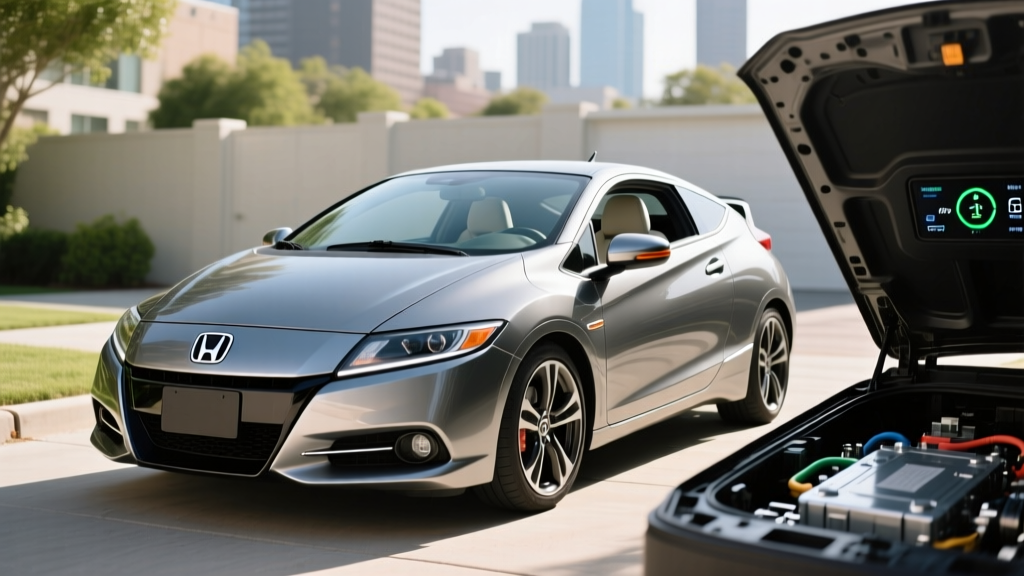
The 2013 Honda CR-Z hybrid occupies a unique space in the used-car market: it's the only two-seat sport hybrid Honda ever sold in the United States, and it remains one of the lightest, most engaging hybrid vehicles from the early 2010s. With an EPA-rated 36 MPG combined and a curb weight under 2,800 pounds, the CR-Z delivers a driving experience that modern crossovers can't match — even if its total system output of 130 horsepower won't win any drag races.
For 2026 used-car shoppers, the CR-Z represents an affordable entry into hybrid ownership. Clean examples typically trade between $8,000 and $14,000 depending on mileage and condition. But before you buy, you need to understand the Integrated Motor Assist (IMA) system, the battery's expected lifespan, and what replacement actually costs. This guide covers everything.
2013 CR-Z Hybrid: Core Specifications
| Specification | Value |
|---|---|
| Powertrain | 1.5L i-VTEC 4-cylinder + IMA electric motor |
| Gas Engine Output | 110 hp @ 6,000 rpm / 107 lb-ft torque |
| Electric Motor Output | 14 hp (10 kW) / 58 lb-ft torque |
| Combined System Output | 130 hp / 140 lb-ft (CVT) or 140 lb-ft (6MT) |
| Transmission | 6-speed manual or CVT |
| Battery Type | Nickel-Metal Hydride (NiMH), 0.6 kWh nominal |
| Curb Weight | 2,765 lbs (6MT) / 2,776 lbs (CVT) |
| Drivetrain | Front-wheel drive |
| 0–60 mph | ~9.7 seconds (estimated) |
| EPA Fuel Economy (6MT) | 31 city / 38 highway / 34 combined MPG |
| EPA Fuel Economy (CVT) | 35 city / 39 highway / 37 combined MPG |
| Fuel Tank | 10.6 gallons |
| Total Range (CVT) | ~392 miles |
| Original MSRP (2013) | $19,995–$23,010 (LX to EX with Navi) |
| Used Price Range (2026) | $8,000–$14,000 |
Fuel Economy: EPA Ratings vs. Real-World MPG
The 2013 Honda CR-Z was offered with two transmissions, and the fuel economy figures differ meaningfully between them. Here's the EPA breakdown from fueleconomy.gov:
| Transmission | City MPG | Highway MPG | Combined MPG |
|---|---|---|---|
| 6-Speed Manual | 31 | 38 | 34 |
| CVT (Continuously Variable) | 35 | 39 | 37 |
The CVT-equipped CR-Z achieves better city MPG because Honda's IMA system can keep the engine operating more efficiently in stop-and-go conditions. The manual transmission sacrifices some city efficiency for driver engagement — a trade-off enthusiasts willingly accept.
Real-World Fuel Economy
Owner-reported data on Fuelly and similar tracking platforms consistently shows that the CR-Z meets or exceeds its EPA estimates in mixed driving. Many CVT owners report 38–42 MPG in suburban commuting, where regenerative braking recaptures energy effectively. Highway-only driving at 75+ mph typically yields 35–37 MPG — slightly below the EPA highway sticker, which is common for small, lightweight vehicles that lose aerodynamic efficiency at higher speeds.
In cold weather (below 30°F), expect a 5–10% drop in fuel economy. The IMA battery operates less efficiently at low temperatures, and the gasoline engine runs richer during warm-up. This is far less dramatic than the 20–30% range loss a full EV experiences in winter, but it's worth noting for buyers in northern climates.
Understanding the IMA Hybrid System: HEV, Not PHEV
The 2013 CR-Z is a conventional hybrid electric vehicle (HEV), not a plug-in hybrid (PHEV). This is a critical distinction for used-car shoppers who may be unfamiliar with Honda's older hybrid architecture.
HEV vs. PHEV: What's the Difference?
| Feature | HEV (CR-Z) | PHEV (e.g., Toyota RAV4 Prime) |
|---|---|---|
| Plug-in charging | No — never plug in | Yes — Level 1 or Level 2 |
| Electric-only range | None (motor assists engine only) | 25–42 miles typical |
| Battery size | 0.6 kWh (NiMH) | 13–18 kWh (lithium-ion) |
| Regenerative braking | Yes | Yes |
| Gasoline required | Yes — always | Yes — after EV range depletes |
| Federal tax credit (new) | None | Up to $7,500 (§30D, if eligible) |
Honda's Integrated Motor Assist (IMA) system uses a thin electric motor sandwiched between the gasoline engine and the transmission. This motor provides torque assist during acceleration, enables regenerative braking, and allows the engine to shut off at stops. However, the IMA motor cannot propel the CR-Z on electric power alone — unlike modern PHEVs or full EVs. The 14-hp electric motor is purely supplemental.
The 0.6 kWh NiMH battery pack is recharged exclusively through regenerative braking and engine-driven generation. You never plug the CR-Z in. You fuel it with regular unleaded gasoline (87 octane) and drive.
IMA Battery Lifespan, Reliability, and Replacement Cost
The IMA battery is the single biggest concern for any used CR-Z buyer. Here's what you need to know about longevity, failure modes, and costs.
Expected Battery Lifespan
The NiMH battery pack in the CR-Z has proven more durable than the first-generation IMA batteries in the 2000–2006 Honda Insight and Civic Hybrid. Based on owner reports and independent hybrid shop data, most CR-Z IMA batteries reach 120,000–160,000 miles before showing significant capacity degradation or triggering an IMA warning light.
Unlike lithium-ion batteries in modern EVs, NiMH cells degrade more predictably and tend to fail gradually rather than catastrophically. You'll typically notice reduced regenerative braking capability and slightly lower fuel economy before the system throws a code.
Replacement Cost
If the IMA battery does fail, here are your options:
- Refurbished/remanufactured IMA battery: $1,000–$1,800 installed at an independent hybrid specialist. Several companies offer refurbished NiMH packs with 1–3 year warranties.
- New OEM Honda IMA battery: $2,000–$2,800 for the part alone, plus $300–$500 labor at a dealership. Availability may be limited as Honda discontinues parts for older models.
- Individual cell replacement: Some hybrid repair shops can replace only the failed cells within the pack for $500–$900, though this requires specialized expertise and may not be a long-term fix if other cells are also degrading.
For context, a full EV battery replacement (e.g., a Nissan Leaf or early Chevy Bolt) typically runs $6,000–$15,000+. The CR-Z's small NiMH pack is far cheaper to replace — one of the financial advantages of a mild hybrid system.
Overall Reliability
Beyond the IMA battery, the 2013 CR-Z is mechanically straightforward. The 1.5L i-VTEC engine (L15B family) is well-proven and shares architecture with the Honda Fit. The 6-speed manual transmission is robust. The CVT is generally reliable but should have its fluid changed every 30,000–60,000 miles — a maintenance item many owners neglect.
Common non-hybrid issues include:
- A/C compressor clutch wear (moderate repair cost, ~$600–$900)
- 12V auxiliary battery drain if the car sits for extended periods
- Brake actuator noise (regenerative braking system — usually normal, but worth checking if accompanied by warning lights)
Driving Experience and the 3-Mode System
The CR-Z's party trick is Honda's 3-Mode Drive System, which lets you select between Sport, Normal, and Econ driving modes via dashboard buttons. Each mode adjusts throttle response, electric motor assist levels, steering weight, and (on CVT models) transmission behavior.
- Sport Mode: Sharpens throttle response, maximizes IMA motor assist, and increases steering effort. This is where the CR-Z feels most alive, though fuel economy drops to roughly 30–32 MPG.
- Normal Mode: Balances performance and efficiency. The default for most daily driving.
- Econ Mode: Softens throttle response, reduces A/C compressor load, and prioritizes fuel savings. Expect 40+ MPG in gentle suburban driving in this mode.
Manual transmission models also feature a Sport+ button on the steering wheel that temporarily boosts IMA assist for overtaking or spirited driving — a clever feature that Honda unfortunately never carried forward to other models.
Tax Credits and Incentives in 2026
Because the 2013 Honda CR-Z is a conventional hybrid (HEV) and not a plug-in vehicle, it does not qualify for the federal §30D clean vehicle tax credit. The IRS §30D credit applies only to plug-in electric vehicles (BEVs and PHEVs) meeting specific battery capacity, critical mineral sourcing, MSRP, and buyer income requirements. See the current rules at irs.gov.
There is also no federal used-EV credit (§25E) available for the CR-Z, as that credit similarly applies only to plug-in vehicles.
Some states historically offered rebates for conventional hybrids, but most of these programs have ended or shifted exclusively to PHEVs and BEVs. Check your state's current incentive database — but set expectations low for a 2013 HEV purchase.
Who Should Buy the 2013 CR-Z Hybrid?
Choose the 2013 CR-Z If:
- You want an affordable, fun-to-drive hybrid under $15,000
- You prioritize fuel economy without ever wanting to plug in
- You value a lightweight, manual-transmission option (rare in hybrids)
- Your daily commute is under 40 miles with some stop-and-go traffic
- You want Honda reliability with low maintenance costs
Look Elsewhere If:
- You need more than two seats or meaningful cargo space (7.8 cu ft trunk)
- You want electric-only driving capability (consider a PHEV like the Toyota Prius Prime)
- You need all-wheel drive or ground clearance for snow/rough roads
- You want modern driver-assistance features (the CR-Z has no ADAS beyond ABS and stability control)
- You want a vehicle eligible for federal EV tax credits
Pros
- 37 MPG combined (CVT) — excellent for a sport-oriented car
- Engaging driving dynamics; available 6-speed manual
- Lightweight (under 2,800 lbs) — rare for any hybrid
- Low IMA battery replacement cost ($1,000–$2,800)
- Distinctive styling; nothing else looks like it
- Affordable used pricing ($8K–$14K)
Cons
- Only two seats — impractical for most buyers
- Modest 130 hp total output; slow by modern standards
- No electric-only driving mode
- Minimal cargo space (7.8 cu ft)
- No modern ADAS or infotainment
- IMA battery aging on all surviving examples
- No federal tax credit eligibility
CR-Z vs. Modern Alternatives: What Else to Consider
If the CR-Z's limitations give you pause, here's how it compares to other options in the used and new hybrid market:
| Vehicle | Type | EPA Combined MPG / MPGe | Used/New Price | Seats |
|---|---|---|---|---|
| 2013 Honda CR-Z | HEV | 37 MPG (CVT) | $8K–$14K (used) | 2 |
| 2024–2026 Toyota Prius | HEV | 57 MPG (LE FWD) | $28K–$35K (new) | 5 |
| 2024–2026 Toyota Prius Prime | PHEV | 44 mi EV + 52 MPG | $33K–$40K (new) | 5 |
| 2016–2022 Toyota Prius | HEV | 52–56 MPG | $14K–$24K (used) | 5 |
| 2012–2015 Toyota Prius c | HEV | 50 MPG | $8K–$14K (used) | 5 |
The modern Prius delivers dramatically better fuel economy and practicality, but at roughly double the price. The Prius c is the closest used-market competitor in price, offering 50 MPG and four doors — but none of the CR-Z's driving engagement.
Frequently Asked Questions
How many MPG does the 2013 Honda CR-Z hybrid get?
The EPA rates the 2013 CR-Z at 35 city / 39 highway / 37 combined MPG with the CVT, and 31 city / 38 highway / 34 combined MPG with the 6-speed manual. Real-world owner data shows CVT models commonly achieve 38–42 MPG in suburban driving and 35–37 MPG on the highway.
Is the 2013 CR-Z a plug-in hybrid?
No. The CR-Z is a conventional hybrid (HEV). You never plug it in. The small 0.6 kWh NiMH battery charges solely through regenerative braking and the gasoline engine. It cannot drive on electric power alone.
How much does it cost to replace the CR-Z hybrid battery?
A refurbished IMA battery costs $1,000–$1,800 installed at a hybrid specialist. A new OEM Honda battery runs $2,000–$2,800 plus labor. Individual cell replacement is possible for $500–$900 at specialized shops. Most IMA batteries last 120,000–160,000 miles.
Does the 2013 CR-Z qualify for any tax credit?
No. The federal §30D clean vehicle credit and §25E used-EV credit apply only to plug-in vehicles (BEVs and PHEVs). The CR-Z, as a conventional hybrid, is not eligible for any federal tax credit. State hybrid incentives have largely ended as well.
Is the 2013 CR-Z reliable?
Yes, with the caveat that the IMA battery will eventually need replacement if it hasn't been addressed already. The 1.5L engine, manual transmission, and CVT are all proven Honda components. The CR-Z's simplicity — lightweight, minimal electronics — works in its favor for long-term reliability.
Should I buy a CR-Z hybrid or a full EV?
Choose the CR-Z if you lack home charging access, drive long distances where charging infrastructure is sparse, or want a low-cost entry into hybrid efficiency. Choose a full EV if you can charge at home, want zero tailpipe emissions, and are willing to pay more upfront for dramatically lower per-mile energy costs (roughly $0.04/mile for an EV vs. $0.10/mile for the CR-Z at 2026 fuel and electricity prices).