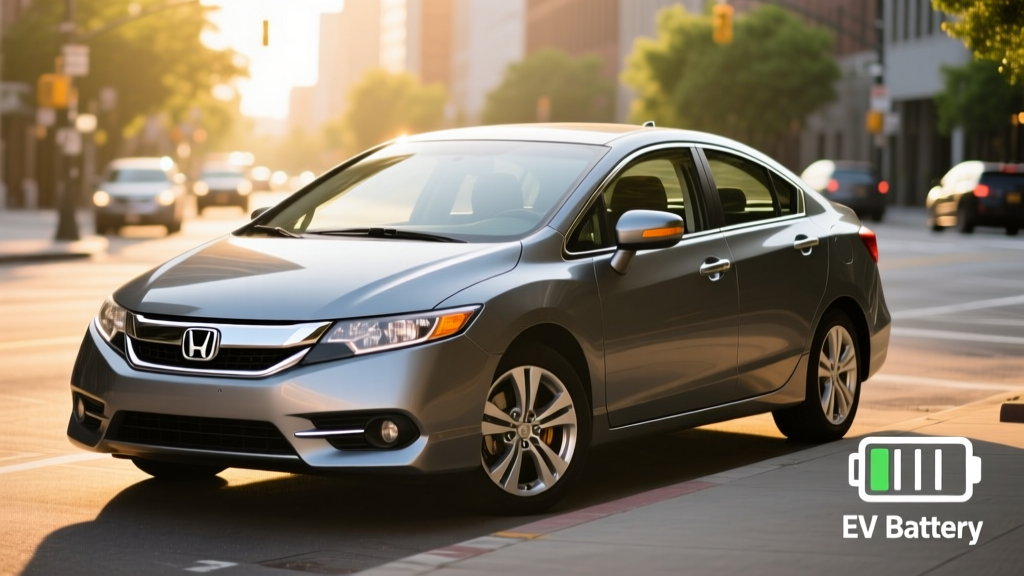
The 2013 Honda Civic Hybrid sedan occupies a specific niche in the used-hybrid market: a compact, fuel-sipping commuter that doesn't require a plug, doesn't demand a lifestyle change, and — if the IMA battery holds up — delivers fuel economy that still competes with newer hybrids. As of 2026, well-maintained examples typically trade between $6,500 and $11,000 depending on mileage and condition, making this one of the most affordable entry points into hybrid ownership.
But the 2013 Civic Hybrid's Integrated Motor Assist (IMA) system is fundamentally different from the hybrid systems Toyota and Hyundai use today. Understanding those differences — along with the battery degradation realities of a 13-year-old hybrid — is essential before you hand over cash.
HEV vs PHEV: Where the 2013 Civic Hybrid Fits
Let's establish a critical distinction upfront, because buyers new to electrified vehicles sometimes conflate the two:
Conventional Hybrid (HEV)
The 2013 Civic Hybrid is a conventional hybrid. It has a small battery (0.5 kWh) that charges exclusively through regenerative braking and the gasoline engine. You never plug it in. The electric motor assists the gas engine during acceleration and enables brief, low-speed electric-only driving, but the car always relies primarily on its 1.5-liter four-cylinder engine.
Plug-In Hybrid (PHEV)
A PHEV — like the current Honda Clarity Plug-In Hybrid (discontinued) or the Toyota RAV4 Prime — carries a much larger battery (13–18+ kWh), can be plugged into a wall outlet or charger, and delivers 25–42 miles of true electric-only driving before the gas engine takes over. The 2013 Civic Hybrid cannot do this. Honda did not offer a Civic PHEV in 2013.
If you're shopping for a Civic that plugs in, you won't find one from this generation. The Civic lineup didn't get a plug-in variant until much later, and even then only in limited markets. For 2013, the hybrid is strictly a self-charging HEV.
Fuel Economy: EPA Numbers vs. Real-World MPG
The 2013 Honda Civic Hybrid sedan carries the following EPA fuel economy ratings:
| Driving Cycle | EPA Rating |
|---|---|
| City | 44 MPG |
| Highway | 47 MPG |
| Combined | 45 MPG |
Source: fueleconomy.gov
Real-World MPG Reality Check
The 2013 Civic Hybrid's EPA highway rating (47 MPG) is unusually high for its era — higher than its city rating, which is atypical for hybrids. Honda's IMA system in this generation uses a relatively small electric motor (20 hp) that provides modest assist, meaning highway cruising efficiency depends heavily on the 1.5L engine's lean-burn capability and aerodynamics.
What to expect in practice:
- City driving (stop-and-go): 38–43 MPG. The IMA system's regen braking recovers energy, but the small battery and weak motor limit electric-only assist compared to Toyota's Hybrid Synergy Drive.
- Highway cruising (65–70 mph): 42–48 MPG. Lean-burn mode helps, but sustained high speeds and headwinds pull numbers down.
- Combined real-world: Most owners report 40–44 MPG in mixed driving, per Fuelly owner logs.
- Cold weather penalty: Expect a 5–10% drop in winter months (36–40 MPG) as the engine runs more frequently to maintain cabin heat and battery temperature.
Compared to the 2026 Toyota Prius (57 MPG combined EPA), the 2013 Civic Hybrid trails by roughly 12 MPG. But compared to a conventional 2013 Civic EX (33 MPG combined), the hybrid saves approximately 1.8 gallons per 100 miles — roughly $450–$600 annually at 15,000 miles/year and $3.50/gallon fuel.
Powertrain and Performance Specifications
| Specification | 2013 Civic Hybrid Sedan |
|---|---|
| Engine | 1.5L i-VTEC inline-4 |
| Engine Output | 90 hp @ 5,500 rpm / 97 lb-ft torque |
| Electric Motor (IMA) | 20 hp / 58 lb-ft torque |
| Combined System Output | 110 hp @ 5,500 rpm / 125 lb-ft torque |
| Transmission | Continuously Variable (CVT) |
| Drivetrain | Front-Wheel Drive |
| Hybrid Battery | 0.5 kWh Nickel-Metal Hydride (NiMH) |
| 0–60 mph | ~10.5 seconds |
| Curb Weight | ~2,853 lbs |
| Fuel Tank Capacity | 13.2 gallons |
| Total Driving Range | ~594 miles (at 45 MPG combined) |
The IMA system in the 2013 Civic is Honda's third-generation parallel hybrid architecture. Unlike Toyota's series-parallel system (which can drive the car on electric power alone at higher speeds), Honda's IMA is a mild hybrid assist: the electric motor is sandwiched between the engine and transmission and cannot propel the car independently except at very low speeds under light load. Think of it more as an electric turbocharger than a true dual-powertrain hybrid.
Performance is adequate for commuting but unremarkable. The 110 combined horsepower and CVT's drone under hard acceleration mean this is a car optimized for efficiency, not passing maneuvers. Merging onto fast-moving freeways requires planning.
Hybrid Battery Lifespan, Warranty, and Replacement Costs
Original Battery Warranty
Honda originally warranted the 2013 Civic Hybrid's IMA battery for 8 years / 80,000 miles (10 years / 150,000 miles in California and states adopting CARB emissions standards). As of 2026, the factory warranty has expired for every 2013 Civic Hybrid on the road.
This is the single most important section for anyone considering a used 2013 Civic Hybrid. The NiMH IMA battery in this generation has a documented history of premature degradation.
Degradation Reality
Honda's IMA batteries in the 2006–2015 Civic Hybrid generation were subject to a class-action lawsuit and extended warranty coverage due to widespread failures. Common symptoms of a degraded IMA battery include:
- IMA system warning light on the dashboard
- Reduced fuel economy (dropping to 30–35 MPG as the system disables regen and electric assist)
- Recalibration events (the battery gauge drops to zero and slowly recharges — a sign of cell imbalance)
- Failure to pass emissions in states requiring OBD-II readiness monitors
Replacement Options and Costs (2026)
| Option | Estimated Cost | Notes |
|---|---|---|
| OEM Honda replacement (dealer) | $2,500–$3,500 | New NiMH pack; rarely cost-effective on a car worth $8K |
| Aftermarket refurbished NiMH | $1,200–$2,000 | Reconditioned cells from shops like Bumble Bee Batteries or Hybrid Automotive; 1–3 year warranty typical |
| Grid charger + manual balancing | $300–$500 | Extends life of marginally degraded pack; requires technical comfort |
| IMA bypass / disable | $100–$300 | Disables hybrid system entirely; car runs as gas-only at ~33 MPG; may trigger check-engine light |
Our recommendation: If the IMA battery has already been replaced with a quality refurbished unit (and you have documentation), that's a positive. If it's the original battery at 120,000+ miles, budget $1,500–$2,000 for a refurb replacement or negotiate the purchase price down accordingly.
Pricing, Tax Credits, and Ownership Costs in 2026
Used Market Pricing
As of early 2026, the 2013 Honda Civic Hybrid sedan trades in the following ranges based on condition and mileage:
- High-mileage (130K+ mi), fair condition: $5,500–$7,000
- Average (80K–120K mi), good condition: $7,500–$9,500
- Low-mileage (under 80K mi), excellent: $9,500–$11,500
Tax Credit Eligibility
The 2013 Civic Hybrid does not qualify for the federal §30D new clean vehicle credit — that credit applies only to new vehicles. For used electrified vehicles, the IRS offers the Previously Owned Clean Vehicle Credit (up to $4,000 or 30% of sale price, whichever is less), but eligibility requires:
- Sale price of $25,000 or less
- Buyer income below $75,000 (single) / $150,000 (joint)
- Vehicle model year at least two years older than the calendar year (2013 qualifies in 2026)
- Purchase from a licensed dealer (private-party sales excluded)
- The vehicle must be a qualified plug-in electric or fuel cell vehicle — and here's the problem: conventional hybrids like the Civic Hybrid do not qualify. The used-vehicle credit requires plug-in capability.
Source: IRS.gov — Used Clean Vehicle Credit
Bottom line: No federal tax credit is available for the 2013 Civic Hybrid. Some states may offer minimal registration or HOV-lane perks for older hybrids, but check your local DMV — most state incentive programs have shifted to PHEVs and BEVs.
Annual Ownership Cost Estimate
| Cost Category | Annual Estimate |
|---|---|
| Fuel (15K mi/yr, 42 MPG real-world, $3.50/gal) | ~$1,250 |
| Insurance (national avg, older compact) | ~$900–$1,200 |
| Maintenance (oil, tires, brakes — hybrid regen extends brake life) | ~$500–$800 |
| IMA battery reserve (amortized over 5 years) | ~$300–$400 |
| Total estimated annual cost | ~$2,950–$3,650 |
Who Should Buy the 2013 Civic Hybrid — And Who Shouldn't
Choose the 2013 Civic Hybrid If:
- You want a sub-$10,000 commuter with 40+ MPG real-world fuel economy
- You have no access to plug-in charging (apartment, street parking) — no plug needed
- You drive 10,000–18,000 miles/year in mixed city/highway conditions
- You value Honda's interior ergonomics and straightforward controls
- You're mechanically inclined or have a trusted hybrid-savvy mechanic
Look Elsewhere If:
- You want true electric-only driving range — consider a used PHEV like the Chevrolet Volt or Toyota Prius Prime
- You want modern safety tech (blind-spot monitoring, automatic emergency braking) — the 2013 Civic lacks these
- You're not comfortable budgeting for a potential $1,500–$2,500 IMA battery replacement
- You want the lowest possible fuel cost — a used BEV like a 2018+ Nissan Leaf or Chevy Bolt will cost $0.03–$0.05/mile on electricity vs. $0.08–$0.10/mile on gas in this Civic
- You want strong highway passing power — 110 hp combined is modest
Hybrid vs PHEV vs EV — Which Fits You?
| Factor | 2013 Civic Hybrid (HEV) | Used PHEV (e.g., 2017 Prius Prime) | Used BEV (e.g., 2019 Chevy Bolt) |
|---|---|---|---|
| Plug-in required? | No | Yes (for EV range) | Yes |
| Electric-only range | ~1 mile (low speed only) | 25 miles | 238 miles |
| Fuel/energy cost per mile | ~$0.08–$0.10 | ~$0.04–$0.08 | ~$0.03–$0.05 |
| Maintenance complexity | Moderate (IMA system) | Higher (dual powertrain) | Lower (no engine) |
| Used price range (2026) | $6K–$11K | $14K–$20K | $12K–$18K |
| Best for | No-plug commuters | Home-chargers with short commutes | Home-chargers wanting max savings |
Reliability and Known Issues
The 2013 Civic Hybrid's non-hybrid components — suspension, brakes, electronics, interior — follow the Civic's generally strong reliability reputation. The 1.5L engine is durable when maintained. Specific issues to watch for:
- IMA battery degradation (detailed above — the dominant concern)
- CVT shudder — some owners report hesitation or vibration at low speeds; often resolved with a CVT fluid flush using Honda HMMF fluid
- 12V battery drain — the auxiliary 12V battery can drain if the car sits for extended periods; the IMA system relies on the 12V to boot up
- Brake actuator — the regenerative braking system's actuator can fail at high mileage ($800–$1,200 replacement); listen for unusual grinding or a firm pedal
- Navigation/infotainment — the 2013-era Honda nav system is slow by modern standards; many owners upgrade to an aftermarket head unit with Apple CarPlay/Android Auto
Source: NHTSA — 2013 Honda Civic Hybrid (for recall and complaint history)
Pros and Cons at a Glance
Pros
- 40–44 MPG real-world without plugging in
- Low purchase price in 2026 ($6K–$11K)
- Honda reliability in non-hybrid components
- Regen braking extends brake pad life (60K–80K+ miles common)
- Comfortable ride quality for a compact
- Good visibility and intuitive controls
Cons
- IMA battery replacement likely needed ($1,200–$3,500)
- No federal tax credit eligibility
- Modest 110 hp — slow acceleration
- No modern ADAS features (no AEB, no lane-keep)
- Outdated infotainment system
- IMA system less effective than Toyota Hybrid Synergy Drive
Frequently Asked Questions
How many MPG does the 2013 Honda Civic Hybrid get?
The EPA rates it at 44 city / 47 highway / 45 combined. In real-world mixed driving, expect 40–44 MPG, with cold weather reducing that to 36–40 MPG. The IMA system is most effective in stop-and-go city traffic where regenerative braking recovers energy.
Does the 2013 Civic Hybrid need to be plugged in?
No. The 2013 Civic Hybrid is a conventional hybrid (HEV), not a plug-in hybrid. Its small 0.5 kWh NiMH battery charges entirely through regenerative braking and the gasoline engine. You fuel it like any other car.
Is the 2013 Civic Hybrid reliable?
The mechanical components (engine, suspension, brakes) are reliable with proper maintenance. The primary risk is the IMA hybrid battery, which has a documented history of premature degradation in this generation. Budget $1,200–$2,000 for a refurbished replacement if the original battery hasn't been replaced. Check NHTSA complaint records for the specific VIN before purchasing.
How much does it cost to replace the hybrid battery?
An OEM Honda dealer replacement runs $2,500–$3,500. Aftermarket refurbished NiMH packs cost $1,200–$2,000 and are the more practical choice for a vehicle in this price range. Grid charging and manual cell balancing can extend a marginally degraded battery for $300–$500.
Does the 2013 Civic Hybrid qualify for any tax credit?
No. The federal §30D credit applies only to new plug-in vehicles. The used clean vehicle credit (up to $4,000) requires plug-in capability, which a conventional hybrid lacks. No federal tax incentive is available for this vehicle in 2026.
Should I buy a 2013 Civic Hybrid or a used Prius?
The Toyota Prius (third generation, 2010–2015) offers superior fuel economy (50 MPG combined EPA), a more robust hybrid system (Toyota's Hybrid Synergy Drive has a stronger track record for battery longevity), and more cargo versatility as a liftback. The Civic Hybrid's advantage is a lower purchase price and a more conventional trunk design. If you can stretch to $9K–$13K, a same-era Prius is generally the stronger hybrid buy.
What's the difference between the Civic Hybrid and the Civic Natural Gas or Civic GX?
The Civic Natural Gas (also offered in 2013) is a completely different vehicle running on compressed natural gas — not a hybrid. It has no electric motor or hybrid battery. Don't confuse the two in listings.