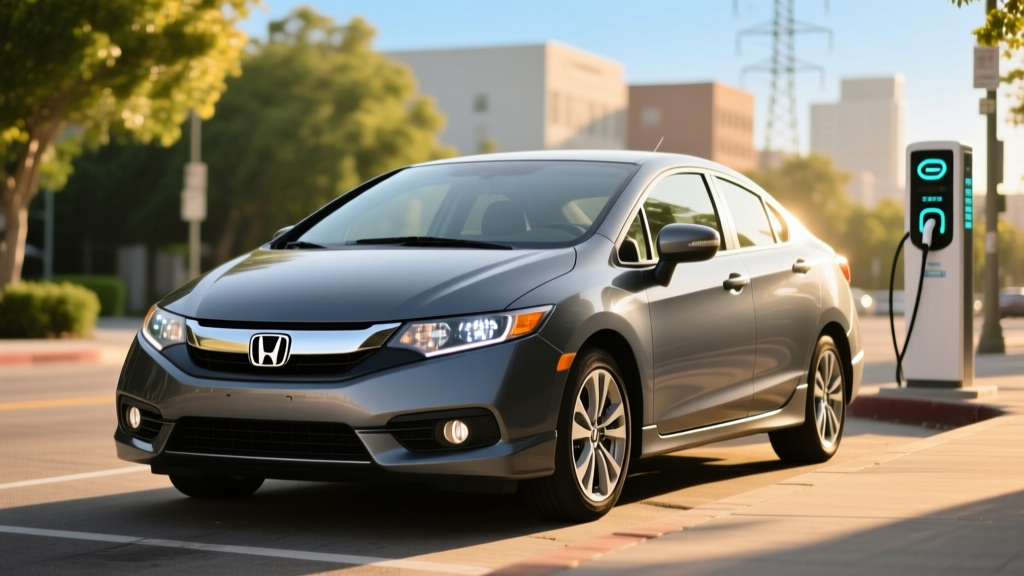
The 2013 Honda Civic Hybrid occupies a specific niche in the used-car market: a compact sedan that sips fuel without requiring you to plug in, change your driving habits, or learn new technology. More than a decade after it rolled off the assembly line, buyers still search for this model because it represents a low-risk entry into hybrid ownership — if the battery checks out.
This guide covers everything a used-car shopper in 2026 needs to know about the 2013 Civic Hybrid: real-world MPG versus EPA estimates, the Integrated Motor Assist (IMA) system's reliability track record, battery replacement costs, and how it stacks up against modern hybrids and plug-in hybrids on the market today.
2013 Honda Civic Hybrid: EPA MPG and Real-World Fuel Economy
The 2013 Civic Hybrid is a conventional hybrid electric vehicle (HEV). It does not plug in. It charges its small battery through regenerative braking and the gasoline engine. Here is the official EPA fuel economy breakdown:
| Metric | Value |
|---|---|
| City MPG | 44 |
| Highway MPG | 44 |
| Combined MPG | 44 |
| Fuel Tank Capacity | 13.2 gallons |
| Total Driving Range (EPA est.) | ~581 miles |
Source: fueleconomy.gov
Real-World MPG: What Owners Actually See
The 44 MPG combined figure is one of the more honest EPA estimates from that era, but real-world results depend heavily on driving conditions:
- City driving (stop-and-go): 42–48 MPG. The IMA system recovers energy during frequent braking, and the engine shuts off at stops. Many owners report exceeding the EPA city number in dense urban traffic.
- Highway cruising (65–75 mph): 38–43 MPG. At sustained high speeds, the electric motor contributes less and aerodynamic drag dominates. Expect a few MPG below the sticker.
- Cold weather (below 35°F): 35–40 MPG. The engine runs longer to warm the cabin and the battery operates less efficiently in cold temperatures.
- Mixed commuting: 40–45 MPG is the typical owner-reported range on forums and fuel-tracking apps.
The key takeaway: if your commute is primarily urban with frequent stops, the 2013 Civic Hybrid will likely meet or exceed its EPA rating. Highway-heavy drivers should budget for 38–42 MPG.
Understanding the IMA Powertrain: How It Works
The 2013 Civic Hybrid uses Honda's Integrated Motor Assist (IMA) system — a mild hybrid architecture fundamentally different from the series-parallel systems in Toyota's Hybrid Synergy Drive or modern Honda two-motor hybrids.
| Component | Specification |
|---|---|
| Gasoline Engine | 1.5L inline-4, i-VTEC |
| Engine Horsepower | 90 hp @ 5,500 rpm |
| Electric Motor | 20 hp (15 kW) IMA motor |
| Combined System Output | 110 hp @ 5,500 rpm |
| Combined Torque | 127 lb-ft @ 1,000–3,500 rpm |
| Transmission | CVT (continuously variable) |
| Battery Type | Nickel-Metal Hydride (NiMH) |
| Battery Voltage | 158V nominal |
| Drivetrain | Front-wheel drive |
| 0–60 mph (estimated) | ~10.5 seconds |
The IMA motor is sandwiched between the engine and transmission. It assists during acceleration and acts as a generator during braking. Unlike Toyota's system, the IMA motor cannot propel the car on electric power alone at meaningful speeds — Honda's system allows brief, low-speed electric-only creeping under very light loads, but this is not a practical "EV mode." The gasoline engine is always the primary motivator.
This architecture is simpler and lighter than a full series-parallel hybrid, but it sacrifices some efficiency potential. The 44 MPG combined result was competitive in 2013 but has since been eclipsed by the Toyota Prius (52–57 MPG combined in current generations) and Honda's own modern two-motor hybrid system found in the Accord Hybrid and CR-V Hybrid.
HEV vs. PHEV vs. EV: Which Powertrain Fits You?
The 2013 Civic Hybrid is a conventional HEV. Here is how the three electrified categories compare for a used-car buyer today:
| Factor | HEV (like 2013 Civic Hybrid) | PHEV (e.g., used Prius Prime) | BEV (e.g., used Chevy Bolt) |
|---|---|---|---|
| Plug in to charge? | No | Yes (for electric range) | Yes (always) |
| Electric-only range | N/A (motor assists only) | 20–44 miles typical | 150–300+ miles |
| Fuel/energy cost per mile | ~$0.09–$0.11 (gas) | ~$0.04 (electric) / $0.09 (gas) | ~$0.03–$0.05 (electric) |
| Home charging needed? | No | Recommended (Level 1 or 2) | Essential (Level 2) |
| Tailpipe emissions | Low (efficient gas engine) | Zero (EV mode) / Low (gas mode) | Zero |
| Used price range (2026) | $6,000–$11,000 | $12,000–$22,000 | $10,000–$20,000 |
| Maintenance complexity | Low (standard hybrid) | Moderate (two systems) | Low (fewer moving parts) |
Choose the 2013 Civic Hybrid (HEV) if: You want fuel savings without changing any habits. No plug, no app, no charging station hunting. You drive a mix of city and highway and want a simple, proven car in the $7,000–$10,000 range.
Choose a used PHEV if: You have home charging access and a short commute (under 30 miles round-trip). You'll run mostly on electricity daily but want a gas engine for road trips.
Choose a used BEV if: You have reliable home Level 2 charging, your daily driving is under 200 miles, and you want the lowest per-mile energy cost and zero tailpipe emissions.
IMA Battery Lifespan, Warranty, and Replacement Cost
The single biggest concern for any used hybrid buyer is the traction battery. The 2013 Civic Hybrid uses a nickel-metal hydride (NiMH) pack — older chemistry than the lithium-ion batteries in modern EVs and PHEVs, but with a well-documented longevity profile.
Original Honda IMA Battery Warranty
- Coverage: 8 years / 80,000 miles (10 years / 150,000 miles in CARB states including CA, CT, MA, ME, NJ, NY, OR, RI, VT, WA)
- What triggers replacement: Battery capacity loss causing IMA system warning light, reduced fuel economy, or failure to hold charge
- Status in 2026: Original warranty has expired on all 2013 models unless an extended warranty was purchased
How Long Do IMA Batteries Actually Last?
Based on owner reports, mechanic data, and hybrid specialist forums, the 2013 Civic Hybrid's IMA battery typically lasts between 100,000 and 150,000 miles before showing significant degradation or triggering the IMA warning light. Some units fail earlier (80,000–100,000 miles), particularly in hot climates where thermal stress accelerates cell degradation. Others reach 170,000+ miles with gradual capacity loss rather than sudden failure.
NiMH batteries degrade differently than lithium-ion: they tend to lose capacity gradually rather than failing catastrophically. You may notice declining fuel economy (dropping from 44 to 38–40 MPG combined) before any warning light appears.
Battery Replacement Costs in 2026
| Option | Cost Range | Warranty | Notes |
|---|---|---|---|
| New OEM Honda battery (dealer) | $2,500–$3,500 | 3 years / 36,000 mi | Best reliability; parts availability declining for 2013 model |
| Remanufactured battery (specialist) | $1,200–$2,000 | 1–3 years typical | Good balance of cost and reliability; several reputable vendors |
| Used/salvage battery | $400–$800 | 30–90 days | Highest risk; unknown remaining life |
| Individual cell replacement (DIY/specialist) | $300–$600 | None to 1 year | Requires technical skill; addresses specific bad cells |
For a car worth $7,000–$10,000, a $2,500+ dealer battery replacement represents 25–35% of the vehicle's value. This is the central economic calculation for any used Civic Hybrid purchase: budget for the battery or buy one with recent replacement documentation.
Reliability, Common Issues, and What to Watch For
The 2013 Civic Hybrid earned average-to-above-average reliability marks from major evaluators. The non-hybrid components (engine block, transmission, suspension, electronics) follow the Civic's well-established durability pattern. The hybrid-specific items are where scrutiny matters:
- IMA battery degradation: The #1 issue. Watch for the IMA warning light, declining MPG, or the battery gauge showing fewer bars than expected.
- IMA motor: Generally reliable, but failures have been reported above 120,000 miles. Replacement is costly ($1,500–$2,500).
- CVT transmission: Honda's CVT from this era is durable with regular fluid changes (every 30,000–60,000 miles). Neglected fluid can lead to shuddering or premature wear.
- 12V auxiliary battery: Like any car, the standard 12V battery needs replacement every 3–5 years. A dead 12V battery can prevent the IMA system from starting.
- Engine mounts: The 1.5L engine can wear through motor mounts around 100,000–130,000 miles, causing vibration at idle.
NHTSA safety recall data for the 2013 Civic Hybrid shows a small number of recalls. Always run the VIN through NHTSA's recall lookup before purchasing to confirm all campaigns have been addressed.
Does the 2013 Civic Hybrid Qualify for Any Tax Credit?
No. The 2013 Honda Civic Hybrid does not qualify for the federal §30D clean vehicle tax credit. That credit applies only to new plug-in electric vehicles (BEVs and PHEVs) meeting specific battery capacity, MSRP, income, and critical-mineral sourcing requirements as defined by the IRS.
Conventional hybrids (HEVs) like the Civic Hybrid have never been eligible for the §30D credit. Some states offered hybrid purchase incentives in 2013, but those programs have long expired.
The only potential tax benefit when buying a used 2013 Civic Hybrid in 2026: if you itemize deductions and use the car for business, you can deduct mileage at the IRS standard rate. There is no purchase incentive available.
Pricing and Value in the 2026 Used Market
As of early 2026, the 2013 Honda Civic Hybrid trades in the following ranges depending on mileage, condition, and battery health:
| Condition | Mileage Range | Price Range |
|---|---|---|
| Excellent (new battery, low miles) | 60,000–90,000 mi | $9,000–$11,500 |
| Good (original battery, well-maintained) | 90,000–130,000 mi | $7,000–$9,000 |
| Fair (high miles, battery may need service) | 130,000–170,000 mi | $5,000–$7,000 |
| Project/as-is (IMA light on) | 150,000+ mi | $3,000–$5,000 |
A pre-purchase inspection by a hybrid-experienced mechanic ($100–$200) is strongly recommended. Ask specifically for an IMA battery health check — many shops can read the battery's state of health (SoH) through the OBD-II port and give you a percentage of remaining capacity.
2013 Civic Hybrid vs. Modern Alternatives
How does a 2013 Civic Hybrid compare to what you can buy today? Here is a quick comparison with current and recent alternatives in similar price ranges:
| Vehicle | EPA Combined MPG | Powertrain | Approx. Used/New Price |
|---|---|---|---|
| 2013 Honda Civic Hybrid | 44 MPG | HEV (IMA) | $7,000–$11,000 (used) |
| 2024–2026 Toyota Prius LE | 57 MPG | HEV (series-parallel) | $28,000–$30,000 (new) |
| 2024–2026 Honda Civic Hybrid | 49 MPG | HEV (two-motor) | $29,000–$32,000 (new) |
| 2020–2023 Toyota Corolla Hybrid | 52 MPG | HEV (series-parallel) | $17,000–$22,000 (used) |
| 2020–2023 Hyundai Ioniq Hybrid | 55–59 MPG | HEV (series-parallel) | $15,000–$20,000 (used) |
Modern hybrids deliver 10–15 MPG more than the 2013 Civic Hybrid thanks to advanced two-motor architectures and improved aerodynamics. The trade-off is price: a current-generation hybrid costs two to three times as much. If your budget is under $12,000 and you want hybrid efficiency without plugging in, the 2013 Civic Hybrid remains a rational choice — provided you account for potential battery replacement.
Pros and Cons
Pros
- 44 MPG combined EPA — still competitive for a non-plug-in vehicle
- No charging infrastructure needed — fill up at any gas station
- Honda Civic platform: abundant parts, independent mechanic familiarity
- Low insurance costs relative to EVs and PHEVs
- Spacious trunk (10.7 cu ft) compared to some hatchback hybrids
- Simple IMA system — fewer hybrid-specific components to fail than complex series-parallel systems
Cons
- IMA battery nearing or past end-of-life on most examples; $1,200–$3,500 replacement
- Modest 110 hp combined — slow acceleration, especially on highway merges
- Outdated infotainment: no Apple CarPlay, Android Auto, or modern safety tech
- No electric-only driving mode — always burning gasoline
- CVT drone under hard acceleration
- No federal or state purchase incentives available
Frequently Asked Questions
How many MPG does the 2013 Honda Civic Hybrid get?
The EPA rates the 2013 Civic Hybrid at 44 MPG city, 44 MPG highway, and 44 MPG combined. In real-world driving, owners typically see 40–48 MPG depending on conditions — city driving often exceeds the EPA estimate while highway cruising may fall 2–6 MPG short.
Is the 2013 Civic Hybrid a plug-in hybrid?
No. The 2013 Civic Hybrid is a conventional hybrid (HEV). It charges its battery through regenerative braking and the gasoline engine. You never plug it in. Honda did not offer a plug-in Civic until later model years in other markets.
How long does the IMA battery last?
Most IMA batteries in the 2013 Civic Hybrid last between 100,000 and 150,000 miles. Hot climates and aggressive driving can shorten lifespan. By 2026, most original batteries are at or past their expected service life. Budget for a replacement ($1,200–$3,500) or seek an example with a documented recent battery swap.
What does it cost to replace the hybrid battery?
A new OEM battery from a Honda dealer runs $2,500–$3,500 installed. Remanufactured batteries from hybrid specialists cost $1,200–$2,000. Used/salvage units are $400–$800 but carry high risk. Individual cell repair is possible for $300–$600 at a specialist shop.
Does the 2013 Civic Hybrid qualify for any tax credit?
No. The federal §30D clean vehicle credit applies only to new plug-in vehicles (BEVs and PHEVs). Conventional hybrids like the Civic Hybrid are not eligible. No current state incentives cover used HEV purchases either.
Is the 2013 Civic Hybrid reliable overall?
The non-hybrid components are typical Civic-reliable. The hybrid-specific risk centers on the IMA battery and, less commonly, the IMA motor. With a healthy or recently replaced battery and regular CVT fluid changes, these cars routinely reach 200,000+ miles. A pre-purchase hybrid diagnostic is essential.
How does it compare to a used Toyota Prius of the same year?
The 2013 Toyota Prius achieves 50 MPG combined (EPA) versus the Civic Hybrid's 44 MPG. The Prius uses a more advanced series-parallel hybrid system that can drive on electric power alone at low speeds. However, the Prius typically commands $1,000–$3,000 more on the used market. Both have strong reliability records, though Prius battery replacements are similarly priced.
Should I buy a 2013 Civic Hybrid or a newer used hybrid?
If your budget is strictly under $12,000, the 2013 Civic Hybrid is a solid choice with the battery caveat. If you can stretch to $17,000–$22,000, a 2020–2023 Toyota Corolla Hybrid or Hyundai Ioniq Hybrid delivers 52–59 MPG with a battery that likely has 80,000+ miles of remaining life and modern safety features like automatic emergency braking.