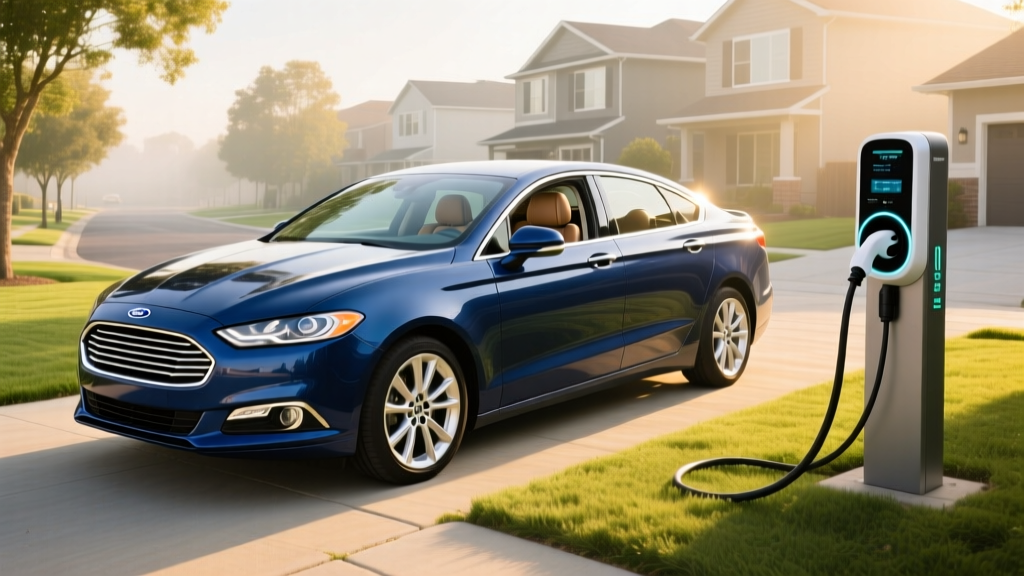
Quick Verdict: The 2013 C-Max Hybrid SEL in 2026
The 2013 Ford C-Max Hybrid SEL is a compact hybrid wagon that originally targeted 47 MPG combined — a number that drew attention (and controversy) when the EPA revised it downward after launch. For used-car buyers in 2026, it remains a practical, spacious hybrid with real-world fuel economy that typically lands between 39–44 MPG depending on driving habits. With cargo versatility rivaling a small crossover and no plug-in requirement, it's a solid budget hybrid — but aging battery packs and discontinued production mean buyers need to go in with eyes open about battery health and replacement costs.
| Specification | Value |
|---|---|
| Powertrain | 2.0L Atkinson-cycle I4 + electric motor (series-parallel hybrid) |
| Combined Horsepower | 188 hp (net system) |
| Transmission | Electronically controlled CVT (eCVT) |
| EPA MPG (City / Hwy / Combined) | 44 / 41 / 43 (revised 2014 label) |
| Original EPA MPG (pre-revision) | 47 / 47 / 47 |
| Battery Type | Lithium-ion, ~1.4 kWh (nominal, HEV) |
| Fuel Tank | 13.5 gallons |
| Total Range (est.) | ~580 miles |
| 0–60 mph | ~8.1 seconds |
| Drivetrain | Front-wheel drive |
| Cargo Volume (behind rear seats) | 24.5 cu ft |
| Cargo Volume (seats folded) | 52.6 cu ft |
| Original MSRP (SEL trim) | $29,200 (2013) |
| Typical Used Price (2026) | $6,500–$10,500 |
HEV vs. PHEV: Where the C-Max Hybrid Fits
Ford sold two versions of the C-Max for the 2013 model year, and confusing them is a common buyer mistake:
| Feature | C-Max Hybrid (HEV) | C-Max Energi (PHEV) |
|---|---|---|
| Plugs in? | No — self-charging via engine + regen | Yes — Level 1 (120V) or Level 2 (240V) |
| Battery Size | ~1.4 kWh (Li-ion) | 7.6 kWh (Li-ion) |
| Electric-Only Range | N/A (EV mode at low speed only, ~1 mi) | 21 miles (EPA) |
| EPA Combined MPG / MPGe | 43 MPG (revised) | 100 MPGe (EV mode) / 43 MPG (hybrid mode) |
| Total Range | ~580 miles | ~620 miles (EV + gas) |
| DC Fast Charging | No | No (Level 2 max) |
| Level 2 Charge Time (0–100%) | N/A | ~2.5 hours |
| Federal Tax Credit (original) | None | Expired; was eligible pre-2019 |
This article focuses on the C-Max Hybrid (HEV). If you need plug-in electric range for a short commute and have home charging access, the C-Max Energi is the PHEV variant — but its 21-mile electric range is modest by 2026 standards, where newer PHEVs like the Toyota RAV4 Prime offer 42+ miles.
How Many MPG Does the 2013 C-Max Hybrid SEL Actually Get?
This question has a complicated history. When the 2013 C-Max Hybrid launched, Ford advertised 47 MPG city, highway, and combined — a number derived from the Fusion Hybrid's EPA certification. Consumer reports and owners quickly found that real-world driving, especially highway cruising, fell well short. Ford issued a software update and the EPA revised the label in 2014 to 44 city / 41 highway / 43 combined.
| Driving Scenario | EPA Estimate (Revised) | Real-World Expectation |
|---|---|---|
| City (stop-and-go, regen-heavy) | 44 MPG | 42–48 MPG |
| Highway (70+ mph, sustained) | 41 MPG | 36–41 MPG |
| Combined (mixed driving) | 43 MPG | 39–44 MPG |
| Cold Weather (below 32°F) | N/A | 34–38 MPG |
Why real-world MPG varies: Hybrids like the C-Max benefit enormously from regenerative braking in city traffic, which recaptures kinetic energy and lets the engine shut off at stops. On the highway, the gasoline engine runs continuously and the hybrid advantage shrinks. Cold weather further reduces MPG because the engine must run more often to heat the cabin and keep the battery at optimal temperature. Data from fueleconomy.gov confirms the revised 43 MPG combined rating, though owner-reported averages cluster around 40–42 MPG.
Powertrain and Driving Impressions
The C-Max Hybrid pairs a 2.0-liter Atkinson-cycle inline-four (producing 141 hp on its own) with a 118-hp electric motor integrated into the eCVT transmission housing. Combined system output is 188 horsepower — competitive with the Toyota Prius V (134 hp) and noticeably more powerful. The electric motor provides strong low-end torque, making the C-Max feel quicker off the line than its 0–60 time of ~8.1 seconds suggests.
The eCVT is a planetary-gear power-split device (Ford's version of Toyota's HSD architecture, licensed under patent agreements). It's smooth and avoids the rubber-band effect of belt-driven CVTs. The SEL trim adds features like the SYNC infotainment system, leather-trimmed seats, and a power-adjustable driver's seat — amenities that made it Ford's premium hybrid hatchback offering in 2013.
Battery Health, Warranty, and Replacement Cost
For any used hybrid, the traction battery is the single biggest financial risk. The 2013 C-Max Hybrid uses a ~1.4 kWh lithium-ion battery pack (manufactured by Sanyo/Panasonic). Because this is a conventional HEV, the battery operates in a narrow state-of-charge window (roughly 40–60% SoC) managed by the vehicle's computer — this shallow cycling significantly extends cell life compared to a full EV or PHEV that regularly depletes to low SoC.
Battery Warranty Coverage
- Federal emissions warranty: 8 years / 80,000 miles (covers hybrid battery as an emissions-related component)
- CARB-state warranty: 10 years / 150,000 miles in California and states that adopted CARB standards (e.g., NY, MA, NJ, CT, OR, WA, MD, RI, VT, ME)
- Capacity threshold: Ford did not publish a specific degradation percentage trigger, but warranty covers failure or significant capacity loss that triggers diagnostic trouble codes
Is the battery reliable? By 2026, most 2013 C-Max Hybrids are 13 years old. The lithium-ion packs have generally held up well — owner forums and repair databases show that wholesale battery failures are uncommon, though some high-mileage examples (150,000+ miles) have seen individual cell degradation. Unlike the Toyota Prius, which has a massive aftermarket for refurbished batteries, the C-Max Hybrid's parts ecosystem is smaller.
Battery replacement cost:
- OEM new battery (Ford dealer): $3,000–$4,000 installed
- Refurbished/remanufactured battery: $1,500–$2,500 installed (limited availability vs. Prius)
- Individual cell/module repair: $800–$1,500 at a hybrid specialist shop
Before purchasing any used 2013 C-Max Hybrid, request a hybrid battery health report from a Ford dealer or hybrid specialist. An OBD-II scan tool with hybrid-specific software (e.g., FORScan) can read individual cell voltages and internal resistance — a healthy pack should show cell voltage variance under 0.2V.
Does the 2013 C-Max Hybrid Qualify for a Tax Credit?
No. The 2013 C-Max Hybrid (HEV) never qualified for the federal §30D plug-in vehicle tax credit because it is a conventional hybrid — it does not plug in and its battery capacity is far below the 4 kWh minimum threshold. The C-Max Energi (PHEV) was eligible for a credit when new, but that credit has long since expired for both the buyer and the vehicle.
For 2026 used-car buyers, the IRS used clean vehicle credit (§25E) offers up to $4,000 or 30% of the sale price (whichever is less) — but only for vehicles with a plug: BEVs and PHEVs with at least 7 kWh of battery capacity. The C-Max Hybrid (1.4 kWh, no plug) does not qualify. The C-Max Energi (7.6 kWh, plug-in) may qualify if purchased from a dealer for under $25,000 and the buyer meets income caps ($75,000 single / $150,000 joint). Always verify current rules at IRS.gov and consult a tax professional.
Hybrid vs. PHEV vs. Full EV — Which Fits You?
Choose the C-Max Hybrid (HEV) if:
- You want better fuel economy without changing your routine — no plugs, no charging apps, no range planning
- You drive a mix of city and highway and want 40+ MPG without thinking about it
- Your budget is under $10,000 for a hybrid with wagon-like cargo space
- You live in an apartment or lack home charging access
Choose a PHEV instead if:
- You have home charging (Level 2) and a commute under 30 miles — a modern PHEV (e.g., 2026 Toyota Prius Prime, 44 mi EV range) can cover daily driving on electricity alone
- You want to reduce gasoline consumption by 70–90% on typical daily trips
- You want eligibility for the used-EV tax credit (§25E, up to $4,000)
Choose a full EV (BEV) instead if:
- You have reliable home or workplace Level 2 charging
- Your daily driving is under 200 miles and you take road trips only a few times per year
- You want zero tailpipe emissions, minimal maintenance (no oil changes, no engine), and the lowest per-mile fuel cost
- You qualify for the full §30D new-vehicle credit (up to $7,500) or the §25E used credit
Pros and Cons of the 2013 C-Max Hybrid SEL
Pros
- Strong real-world city MPG (42–48 with regenerative braking)
- 188 hp — more powerful than most 2013-era hybrids
- Spacious cargo area (24.5 cu ft / 52.6 cu ft folded)
- No plug-in required — works with existing gas-station infrastructure
- Comfortable ride, quiet cabin for a compact hybrid
- SEL trim well-equipped: leather, SYNC, power driver seat
- Affordable used pricing ($6,500–$10,500 in 2026)
Cons
- Highway MPG disappointing (36–41 real-world) vs. original 47 MPG marketing
- Discontinued in 2018 — smaller parts and service ecosystem vs. Prius
- Aging battery: 13-year-old pack may need service or replacement ($1,500–$4,000)
- No federal or state tax credit available (HEV, not PHEV/BEV)
- eCVT drone under hard acceleration
- SYNC infotainment system dated by 2026 standards
- No DC fast charging (N/A for HEV, but Energi PHEV also lacks it)
Frequently Asked Questions
How many MPG does the 2013 C-Max Hybrid SEL get?
The revised EPA rating is 44 city / 41 highway / 43 combined. Real-world owners typically see 39–44 MPG combined, with city driving yielding the best results (42–48 MPG) thanks to regenerative braking. Highway driving at 70+ mph drops to 36–41 MPG. Cold weather can reduce combined MPG to 34–38.
How far can the C-Max Hybrid go on electric only?
The C-Max Hybrid (HEV) cannot drive on electric power alone for meaningful distances. It can operate in EV mode at very low speeds (under ~25 mph) for roughly half a mile on a fully charged battery, but the gasoline engine kicks in frequently. This is fundamentally different from the C-Max Energi (PHEV), which offers 21 miles of electric-only range. If electric-only commuting matters, look at the Energi or a modern PHEV.
Is the 2013 C-Max Hybrid reliable?
Overall reliability is average to slightly above average for a 2013 vehicle. The powertrain (2.0L engine + eCVT) is proven and shared with the Fusion Hybrid. The main risk is the aging lithium-ion battery pack. Unlike the Toyota Prius — which has a vast refurbished-battery market — the C-Max Hybrid's battery replacement options are more limited and expensive. Pre-purchase inspection with a hybrid-specific OBD-II scan is strongly recommended. NHTSA shows no major systemic recalls specific to the hybrid system.
What does it cost to replace the hybrid battery?
A new OEM battery from a Ford dealer runs $3,000–$4,000 installed. Refurbished or remanufactured packs cost $1,500–$2,500 but are harder to source than Prius batteries. Individual cell/module replacement at a hybrid specialist can run $800–$1,500. Given the vehicle's current used value ($6,500–$10,500), a full OEM replacement may not be economically justified — factor this into your purchase negotiation.
Does the 2013 C-Max Hybrid qualify for any tax credit?
No. As a conventional hybrid (HEV) with no plug and a 1.4 kWh battery, it does not qualify for the federal §30D new-vehicle credit or the §25E used-vehicle credit. Those credits require plug-in capability and minimum battery thresholds. Some states historically offered hybrid incentives, but most have expired or shifted to PHEV/BEV-only programs.
Should I buy the C-Max Hybrid or the C-Max Energi?
If you have home Level 2 charging and a commute under 20 miles, the Energi's 21-mile electric range can eliminate most gasoline use on weekdays. However, the Energi is heavier (reducing hybrid-mode MPG slightly), has less cargo space (battery intrudes into the cargo floor), and its 7.6 kWh battery is more expensive to replace ($4,000–$6,000). If you lack charging access or prioritize cargo space, the standard Hybrid is the better choice.
How does the C-Max Hybrid compare to a 2013 Toyota Prius V?
The Prius V offers more cargo space (34.3 cu ft behind rear seats vs. 24.5), better-established reliability, and a massive aftermarket battery ecosystem. However, it makes only 134 hp (vs. 188 hp for the C-Max) and feels noticeably slower. The Prius V's EPA rating of 44/40/42 MPG is nearly identical to the revised C-Max. If power and driving feel matter, the C-Max wins; if cargo volume and long-term parts availability matter, the Prius V is the safer bet.