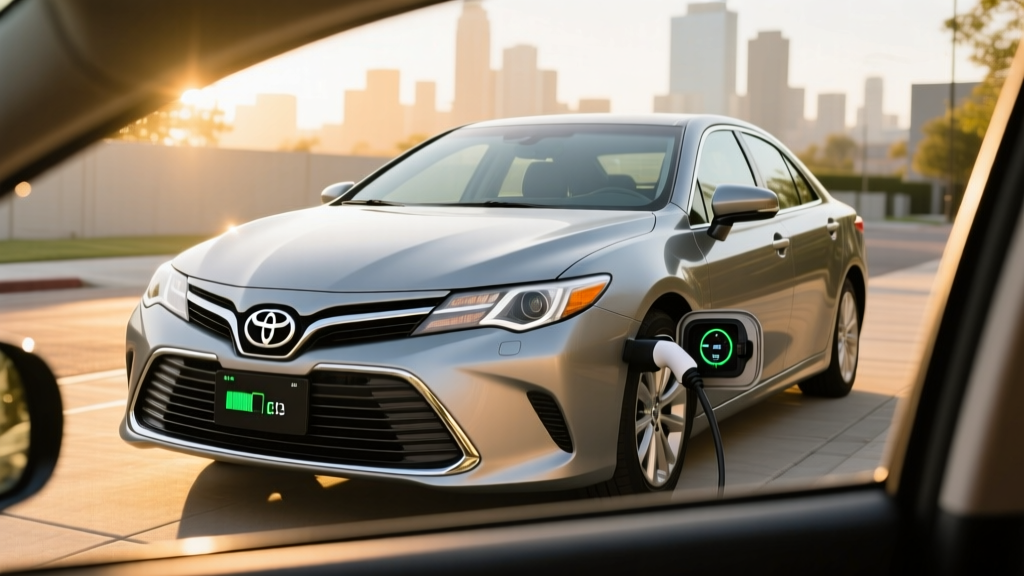
The 2013 Toyota Camry Hybrid remains one of the most practical used hybrid sedans on the market more than a decade after its debut. Built on Toyota's proven Hybrid Synergy Drive system, it delivers consistent fuel economy, low running costs, and the kind of reliability that has made the Camry nameplate a staple for budget-conscious drivers. For buyers in 2026 considering a used hybrid over a new EV or gas car, this midsize sedan still makes a compelling case — if you know what to look for.
This guide breaks down everything a used-car buyer needs to know: real-world MPG, battery longevity, replacement costs, and how the 2013 Camry Hybrid stacks up against modern plug-in hybrids and full EVs.
2013 Camry Hybrid Fuel Economy: EPA vs. Real-World MPG
The EPA rates the 2013 Camry Hybrid (LE trim) at 43 MPG city / 39 MPG highway / 41 MPG combined. The sportier XLE trim, which adds weight and larger wheels, drops slightly to 40 city / 38 highway / 40 combined. These figures come from fueleconomy.gov and remain the official benchmark.
| Trim | City MPG | Highway MPG | Combined MPG |
|---|---|---|---|
| LE | 43 | 39 | 41 |
| XLE | 40 | 38 | 40 |
Real-World MPG: Why Hybrids Often Beat the Sticker in the City
Conventional hybrids like the 2013 Camry Hybrid frequently exceed their EPA city estimates in real-world driving. The reason is straightforward physics: regenerative braking recaptures kinetic energy during stop-and-go traffic, and the electric motor handles low-speed propulsion where gasoline engines are least efficient. Many owners report 44-47 MPG in city commuting, particularly in warm weather with moderate acceleration.
Highway driving tells a different story. At sustained speeds above 65 mph, the gasoline engine does most of the work, and aerodynamic drag dominates. Expect 36-39 MPG on the highway, especially in colder months when the engine runs more frequently to maintain cabin heat and battery temperature.
Powertrain Specs: Engine, Motor, and Combined Output
The 2013 Camry Hybrid pairs a 2.5-liter inline-4 Atkinson-cycle gasoline engine with a permanent-magnet electric motor through Toyota's eCVT (electronically controlled continuously variable transmission). This is a conventional hybrid (HEV) — it does not plug in and charges its battery exclusively through regenerative braking and engine-driven generation.
| Specification | Value |
|---|---|
| Gasoline Engine | 2.5L 4-cyl Atkinson cycle |
| Engine Horsepower | 156 hp @ 5,700 rpm |
| Electric Motor Output | 105 kW (141 hp) |
| Net Combined System HP | 200 hp |
| Transmission | eCVT |
| 0-60 mph | ~7.6 seconds |
| Drivetrain | Front-wheel drive |
| Battery Type | NiMH (Nickel-Metal Hydride) |
| Battery Capacity | 1.6 kWh (gross) |
The 200 combined horsepower gives the Camry Hybrid adequate passing power and confident highway merging. The eCVT eliminates shift shock entirely, though some drivers note the characteristic "rubber-band" feel during hard acceleration where engine RPM holds steady while vehicle speed climbs. This is normal eCVT behavior, not a fault.
HEV vs. PHEV vs. EV: Which Powertrain Fits Your Driving?
The 2013 Camry Hybrid is a conventional hybrid electric vehicle (HEV). Understanding how it differs from plug-in hybrids and full battery-electric vehicles is essential before buying.
| Feature | HEV (e.g., 2013 Camry Hybrid) | PHEV (e.g., RAV4 Prime) | BEV (e.g., Tesla Model 3) |
|---|---|---|---|
| Plugs In? | No | Yes | Yes |
| Electric-Only Range | ~1 mile at low speed | 25-42 miles | 250-350+ miles |
| Battery Size | 1-2 kWh | 13-20 kWh | 50-100 kWh |
| Gas Engine? | Yes (primary) | Yes (backup) | No |
| Home Charging Needed? | No | Recommended | Essential |
| Federal Tax Credit (New) | None | Up to $7,500 (§30D) | Up to $7,500 (§30D) |
| Tailpipe Emissions | Low | Low (zero in EV mode) | Zero |
Who Should Choose the 2013 Camry Hybrid?
The 2013 Camry Hybrid is ideal for drivers who:
- Want maximum MPG without changing their fueling habits (no plug, no app, no charging station hunting)
- Live in apartments or homes without dedicated parking where Level 2 charging installation isn't feasible
- Drive 15,000+ miles per year and want to minimize fuel costs
- Want a proven, low-risk used car with widely available parts and service
- Need a reliable daily commuter with strong resale value retention
Consider a PHEV or full EV instead if you have home charging access, a shorter commute (under 30 miles), and want to eliminate or drastically reduce gasoline consumption.
Battery Longevity, Warranty, and Replacement Cost
Hybrid battery lifespan is the single most common concern for used hybrid buyers — and it's the area where the 2013 Camry Hybrid has the strongest track record.
How Long Do 2013 Camry Hybrid Batteries Actually Last?
The NiMH battery pack in the 2013 Camry Hybrid has proven remarkably durable. Toyota's hybrid battery management system is conservative — it never allows the battery to fully charge or fully discharge, keeping the state of charge (SoC) within a narrow window (roughly 40-80%) that minimizes cell stress. This "shallow cycling" strategy is why Camry Hybrid batteries routinely last 150,000 to 200,000+ miles before significant degradation.
Based on owner reports and repair databases, here's what to expect:
- Under 100,000 miles: Battery failure is rare. Most issues are covered under extended warranty if purchased.
- 100,000-150,000 miles: Some capacity loss is normal but usually unnoticeable in daily driving. MPG may drop by 1-2 MPG.
- 150,000-200,000 miles: Higher risk of individual cell failure. Many batteries still function adequately.
- 200,000+ miles: Battery replacement becomes increasingly likely, though many original packs survive past this point.
Battery Replacement Cost in 2026
If the hybrid battery in a 2013 Camry Hybrid does fail, replacement options have become more accessible and affordable:
| Option | Cost Range | Warranty | Notes |
|---|---|---|---|
| New OEM (Toyota dealer) | $3,500 - $4,500 | 3 yr / 36,000 mi | Most expensive but guaranteed fit and function |
| Remanufactured (e.g., Green Bean Battery) | $1,500 - $2,200 | Limited lifetime | Replaced weak cells, tested and balanced |
| Used/Salvage yard | $500 - $1,000 | 30-90 days | Cheapest option but unknown remaining life |
| Individual cell replacement (DIY/specialist) | $300 - $800 | Varies | Replaces only failed cells; requires expertise |
The remanufactured route has become the most popular choice for 2013 Camry Hybrid owners in 2026. Companies like Green Bean Battery and hybrid specialists offer reconditioned packs with warranties that rival OEM coverage at roughly half the cost.
Reliability and Common Issues Beyond the Battery
The 2013 Camry Hybrid scores well across major reliability indices. According to NHTSA data, it carries few recurring complaints relative to its sales volume. Here's what to watch for in a used example:
- Inverter coolant pump: Some units fail between 80,000-120,000 miles. Replacement runs $400-$700. Check for coolant leaks near the inverter (passenger-side engine bay).
- Brake actuator assembly: The regenerative braking system's actuator can develop issues past 120,000 miles. Symptoms include a firm brake pedal or warning lights. Dealer replacement is $1,200-$1,800.
- 12V auxiliary battery: Like all vehicles, the 12V battery (located in the trunk) needs replacement every 4-6 years. A dead 12V battery will prevent the hybrid system from starting, even if the traction battery is fully charged.
- eCVT transmission: Toyota's planetary-gear eCVT is one of the most reliable transmissions ever built. It has no belts, no clutches, and no traditional friction surfaces to wear. Failures before 200,000 miles are extremely rare.
Used Pricing and Tax Credit Eligibility
As of early 2026, the 2013 Camry Hybrid trades on the used market in the following ranges, depending on mileage, condition, and trim:
| Trim | Mileage Range | Price Range |
|---|---|---|
| LE | 80,000 - 120,000 | $9,500 - $12,500 |
| LE | 120,000 - 160,000 | $7,000 - $9,500 |
| XLE | 80,000 - 120,000 | $10,500 - $13,500 |
| XLE | 120,000 - 160,000 | $8,000 - $10,500 |
Does the 2013 Camry Hybrid Qualify for Any Tax Credit?
No federal tax credit applies to the 2013 Camry Hybrid. There are two reasons:
- Conventional hybrids (HEVs) have never qualified for the federal §30D plug-in vehicle tax credit. The credit, as defined by the IRS, applies only to plug-in electric vehicles (PHEVs and BEVs) that meet battery capacity, sourcing, MSRP, and buyer income requirements.
- The used-EV tax credit (§25E) also excludes conventional hybrids. This credit, worth up to $4,000 or 30% of the sale price (whichever is less), applies only to used plug-in vehicles with a battery capacity of at least 7 kWh.
Some states historically offered hybrid purchase incentives, but most have expired or shifted focus to plug-in vehicles. Check your state's energy office or department of environmental quality for any active programs, but do not count on incentive money for a conventional hybrid purchase in 2026.
Pros and Cons: The Honest Assessment
Pros
- 41 MPG combined EPA; often exceeds this in city driving
- No plug-in charging required — fuel and go
- Proven 200 hp powertrain with strong passing power
- Exceptional eCVT reliability (no belts or clutches)
- Hybrid batteries commonly last 150K-200K+ miles
- Widely available, affordable replacement batteries
- Low insurance costs relative to EVs
- Strong Toyota dealer service network nationwide
Cons
- No electric-only driving beyond very low speeds (~1 mi)
- No federal or state tax credit eligibility
- NiMH battery (older chemistry vs. modern lithium-ion)
- Dated infotainment (no Apple CarPlay/Android Auto)
- eCVT drone under hard acceleration
- Brake actuator replacement is costly if it fails
- Original factory warranty has expired on all examples
- Not as efficient as newer hybrid designs (e.g., 2025 Camry at 51 MPG)
Buying Checklist: What to Inspect Before You Buy
If you're evaluating a specific 2013 Camry Hybrid, use this checklist to avoid costly surprises:
- Check the hybrid battery health: Ask a Toyota dealer or hybrid specialist to run a battery health diagnostic. This reads individual cell voltages and internal resistance — the best indicator of remaining battery life.
- Verify maintenance records: Look for regular oil changes (every 5,000-10,000 miles with synthetic), inverter coolant flushes, and brake fluid exchanges.
- Test the regenerative braking: During a test drive, the transition from regenerative to friction braking should be smooth. Grinding, pulsing, or a firm pedal may indicate actuator issues.
- Scan for diagnostic trouble codes: Even if the check engine light is off, stored codes can reveal past hybrid system faults. Any OBD-II scanner or auto parts store can do this for free.
- Inspect the 12V battery: Located in the trunk, this battery should be less than 4 years old. A weak 12V battery can cause a cascade of warning lights and hybrid system errors.
- Confirm the trim level: The LE gets 41 MPG combined; the XLE gets 40. The difference is small but matters if fuel economy is your top priority.
Frequently Asked Questions
How many MPG does the 2013 Camry Hybrid get?
The EPA rates the 2013 Camry Hybrid LE at 43 city / 39 highway / 41 combined MPG. The XLE trim is rated at 40/38/40 MPG. In real-world city driving, many owners report 44-47 MPG thanks to regenerative braking. Highway driving typically yields 36-39 MPG.
Does the 2013 Camry Hybrid need to be plugged in?
No. The 2013 Camry Hybrid is a conventional hybrid (HEV). It charges its 1.6 kWh NiMH battery through regenerative braking and the gasoline engine. There is no plug, no charge port, and no need for any charging infrastructure.
How long does the 2013 Camry Hybrid battery last?
The NiMH hybrid battery typically lasts between 150,000 and 200,000+ miles. Toyota's conservative battery management system, which keeps the state of charge between roughly 40-80%, significantly extends cell life. Some original batteries have exceeded 250,000 miles, though this is not guaranteed.
How much does it cost to replace the hybrid battery?
A new OEM battery from a Toyota dealer costs $3,500-$4,500. Remanufactured batteries from reputable suppliers run $1,500-$2,200 and typically include a limited lifetime warranty. Used/salvage batteries cost $500-$1,000 but carry unknown remaining life.
Is the 2013 Camry Hybrid reliable?
Yes. The 2013 Camry Hybrid has an excellent reliability record. The eCVT transmission is among the most durable ever produced, and the hybrid system has been refined over multiple generations. The most common failure points are the inverter coolant pump (mid-life) and brake actuator assembly (high mileage), both of which are well-documented and serviceable.
Does the 2013 Camry Hybrid qualify for a tax credit?
No. Conventional hybrids (HEVs) do not qualify for the federal §30D new clean vehicle credit or the §25E used clean vehicle credit. These credits are reserved for plug-in vehicles (PHEVs and BEVs) that meet specific battery capacity, sourcing, and pricing requirements. No federal tax incentive is available for the 2013 Camry Hybrid.
Hybrid vs. PHEV vs. EV — should I buy a 2013 Camry Hybrid or something else?
Choose the 2013 Camry Hybrid if you want maximum MPG without plug-in charging, have no home charging access, or want the lowest-risk used purchase. Choose a PHEV (like a used Prius Prime or RAV4 Prime) if you have home charging and a short commute you want to cover on electricity. Choose a full EV if you have reliable home charging, want zero tailpipe emissions, and can handle a higher upfront cost for lower running expenses.