The Grand Highlander Hybrid: Three-Row Efficiency Done Right
Toyota's Grand Highlander Hybrid occupies a rare niche: a genuinely spacious three-row SUV that returns over 35 MPG combined without ever needing to be plugged in. For 2026, it remains one of the most practical family haulers on the market, pairing Toyota's proven hybrid synergy drive system with a cabin that finally offers usable third-row dimensions and class-leading cargo volume behind the rear seats.
This guide focuses on what buyers actually need to know — the Toyota Grand Highlander Hybrid interior dimensions, real-world fuel economy, powertrain options, and whether the conventional hybrid (HEV) or the more powerful Hybrid MAX variant makes more sense for your family. We'll also cover the battery warranty, reliability data, and tax credit eligibility so you can make an informed purchase decision.
HEV vs. PHEV: Where the Grand Highlander Fits
The 2026 Toyota Grand Highlander Hybrid is a conventional hybrid (HEV), not a plug-in hybrid (PHEV). This means:
- No plug required. The battery recharges through regenerative braking and the gasoline engine. You never need to find a charger.
- No electric-only range. Unlike a PHEV (e.g., the Toyota RAV4 Prime with 42 miles of EV range), the Grand Highlander Hybrid uses its electric motors to assist the gas engine continuously, not to drive on electricity alone for meaningful distances.
- No federal EV tax credit. The §30D credit applies only to plug-in vehicles with sufficient battery capacity. HEVs like this one do not qualify for the up-to-$7,500 federal credit, though some state programs offer small hybrid rebates.
If you want plug-in capability from Toyota in a three-row SUV, the closest option is the Toyota Sienna (minivan, HEV only) or stepping outside Toyota to something like the Kia Sorento PHEV (32 miles electric-only). The Grand Highlander remains HEV-only for 2026.
Interior Dimensions, Seating, and Cargo Volume
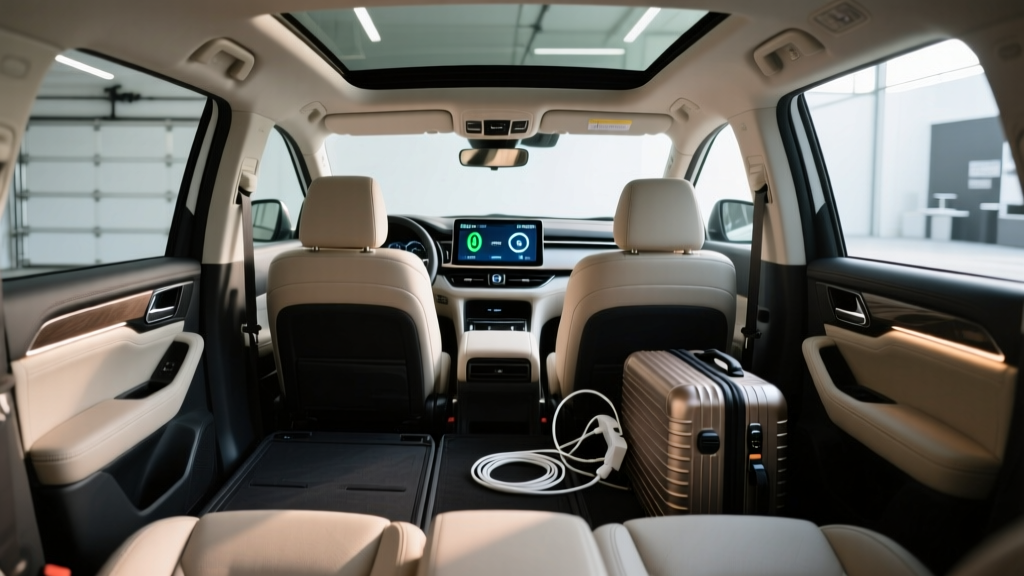
The "Grand" in Grand Highlander isn't marketing fluff — it adds roughly 6.5 inches of overall length compared to the standard Highlander, and that space goes directly to the third row and cargo area. Here's how the interior stacks up:
| Dimension | Grand Highlander Hybrid | Standard Highlander Hybrid |
|---|---|---|
| Front-row headroom | 41.5 in | 40.1 in |
| Second-row legroom | 42.0 in | 39.4 in |
| Third-row legroom | 33.5 in | 27.7 in |
| Third-row headroom | 37.2 in | 35.9 in |
| Cargo behind 3rd row | 20.6 cu ft | 16.1 cu ft |
| Cargo behind 2nd row | 57.9 cu ft | 48.4 cu ft |
| Max cargo (all rows folded) | 97.5 cu ft | 84.3 cu ft |
The third row is the headline story. Adults up to about 6'0" can sit comfortably for trips under an hour — a meaningful improvement over the standard Highlander's cramped rearmost seats. Second-row captain's chairs (available on XLE and standard on Limited/Platinum) offer excellent thigh support and a wide center pass-through.
Materials vary by trim: SofTex synthetic leather on XLE, genuine leather on Limited and Platinum. The Platinum adds quilted leather seats, a panoramic sunroof, and a 12.3-inch digital instrument cluster. All trims share Toyota's 12.3-inch touchscreen infotainment system with wireless Apple CarPlay and Android Auto.
Powertrain Options: Standard Hybrid vs. Hybrid MAX
Toyota offers two distinct hybrid powertrains in the Grand Highlander, and the choice significantly affects both performance and fuel economy:
| Spec | Standard Hybrid (HEV) | Hybrid MAX |
|---|---|---|
| Engine | 2.5L inline-4 + 2 electric motors | 2.4L turbo inline-4 + electric motor |
| Combined horsepower | 245 hp | 362 hp |
| Combined torque | 173 lb-ft (engine) + electric assist | 400 lb-ft |
| Drivetrain | FWD or AWD (electronic rear motor) | AWD standard |
| 0-60 mph | ~7.8 sec | ~5.6 sec |
| Towing capacity | 3,500 lb | 5,000 lb |
| Transmission | eCVT | 6-speed automatic |
The standard hybrid uses Toyota's familiar planetary-gear eCVT, which delivers seamless, drone-free acceleration in normal driving. The Hybrid MAX swaps the eCVT for a traditional 6-speed automatic and pairs a turbocharged engine with a more powerful electric motor integrated between the engine and transmission. The result is a dramatically more responsive SUV that feels closer to a V6 in character while still delivering strong efficiency.
Fuel Economy: EPA Ratings and Real-World MPG
Fuel economy is where the Grand Highlander Hybrid separates itself from every non-hybrid three-row SUV in its class. Here are the official EPA figures from fueleconomy.gov:
| Powertrain / Drivetrain | City MPG | Highway MPG | Combined MPG |
|---|---|---|---|
| Standard Hybrid FWD | 37 | 34 | 36 |
| Standard Hybrid AWD | 36 | 32 | 34 |
| Hybrid MAX AWD | 27 | 28 | 27 |
Real-World MPG: What to Actually Expect
Toyota hybrids tend to meet or slightly exceed their EPA city ratings in real-world driving because regenerative braking recaptures energy in stop-and-go traffic. On the standard Hybrid FWD, owners commonly report 36–38 MPG in mixed suburban driving. Highway-only trips at 75+ mph typically yield 31–33 MPG — slightly below the EPA highway figure, which is normal for a boxy three-row SUV.
The Hybrid MAX, with its turbocharged engine and performance-oriented tuning, delivers closer to 25–27 MPG in real-world mixed driving. If maximum fuel savings are the priority, the standard hybrid is the clear choice. If you need 5,000-lb towing and quicker acceleration, the MAX sacrifices about 9 MPG combined for those capabilities.
Battery, Warranty, and Long-Term Reliability
Hybrid battery longevity remains a top concern for first-time hybrid buyers. Here's what Toyota provides:
| Component | Warranty Coverage |
|---|---|
| Hybrid battery | 10 years / 150,000 miles (whichever comes first) |
| Hybrid system components (inverters, motors, control modules) | 8 years / 100,000 miles |
| Powertrain (engine, transmission) | 5 years / 60,000 miles |
| Basic bumper-to-bumper | 3 years / 36,000 miles |
Toyota has been building hybrid powertrains since the 1997 Prius, and the company's nickel-metal hydride (NiMH) and lithium-ion hybrid batteries have an exceptional track record. The standard Grand Highlander Hybrid uses a 1.87 kWh NiMH battery pack (small by EV standards — remember, this is an HEV that never plugs in). The Hybrid MAX uses a 1.8 kWh lithium-ion pack. These are not the large traction batteries found in EVs; they're designed for frequent shallow charge/discharge cycles rather than deep cycling.
Battery replacement cost: If the hybrid battery does fail outside warranty, replacement runs approximately $2,500–$4,000 including labor at a Toyota dealer, or $1,500–$2,500 through independent hybrid specialists using refurbished cells. In practice, failures before 200,000 miles are rare based on data from Toyota's high-mileage hybrid fleet.
Toyota's 10-year/150,000-mile hybrid battery warranty (extended from 8 years/100,000 miles for 2020+ models) is among the best in the industry and should cover the vast majority of owners for the life of their ownership.
Pricing, Trims, and Tax Credit Eligibility
The 2026 Grand Highlander Hybrid is offered in five trims, starting with the LE and topping out at the Hybrid MAX Platinum:
| Trim | Powertrain | MSRP (est.) |
|---|---|---|
| LE | Standard Hybrid (FWD/AWD) | $45,120 / $46,720 |
| XLE | Standard Hybrid (FWD/AWD) | $48,675 / $50,275 |
| Limited | Standard Hybrid (FWD/AWD) | $53,070 / $54,670 |
| Hybrid MAX Limited | Hybrid MAX AWD | $57,560 |
| Hybrid MAX Platinum | Hybrid MAX AWD | $60,875 |
Federal Tax Credit: Does It Qualify?
No. The Grand Highlander Hybrid is a conventional HEV and does not qualify for the IRS §30D Clean Vehicle Credit, which requires a plug-in electric vehicle with a battery capacity of at least 7 kWh. The Grand Highlander's ~1.8 kWh battery and lack of a charge port disqualify it entirely.
However, the Grand Highlander Hybrid may qualify for:
- State hybrid rebates — some states (e.g., Colorado, California's CVRP for lower-income buyers) offer smaller incentives for high-MPG hybrids. Check your state's energy office.
- Employer or utility incentives — some utility companies offer rebates for purchasing vehicles exceeding 30 MPG combined.
If the federal tax credit is a priority, you'd need to look at plug-in alternatives like the Toyota RAV4 Prime (PHEV, though two-row) or fully electric three-row options like the Kia EV9.
Grand Highlander Hybrid vs. Full EV vs. Gas: Which Fits You?
Choose the Grand Highlander Hybrid (HEV) if:
- You want three-row seating with 35+ MPG and zero behavior change — just fill up with gas as usual.
- You don't have reliable access to home or workplace charging, making a PHEV or EV impractical.
- You regularly carry passengers in the third row and need 20+ cu ft of cargo behind it.
- You want Toyota's long-proven hybrid reliability with a 10-year battery warranty.
Choose a PHEV (e.g., Kia Sorento PHEV) if:
- You can charge at home and want 30+ miles of electric-only commuting with a gas backup for road trips.
- You want partial EV tax credit eligibility and lower daily fuel costs.
- Third-row space is a secondary concern (the Sorento's third row is tighter).
Choose a Full EV (e.g., Kia EV9, Tesla Model X) if:
- You have Level 2 home charging and want zero tailpipe emissions with the lowest per-mile fuel cost.
- You drive under 300 miles daily and can plan around DC fast charging for road trips.
- You want the $7,500 federal tax credit (subject to income, MSRP, and sourcing rules).
Pros
- 36 MPG combined (FWD) — best-in-class for three-row SUVs
- Adult-usable third row with 33.5" legroom
- 20.6 cu ft cargo behind third row
- 10-year/150,000-mile hybrid battery warranty
- No plug-in charging required
- Hybrid MAX offers 362 hp and 5,000-lb towing
- Toyota Safety Sense 3.0 standard on all trims
Cons
- No federal tax credit eligibility (HEV, not PHEV/EV)
- Hybrid MAX drops to 27 MPG combined
- No plug-in hybrid variant available
- Starting price above $45K; well-equipped models push $60K+
- eCVT drone under heavy acceleration (standard hybrid)
- No DC fast charging capability (not applicable to HEVs)
Frequently Asked Questions
How many MPG does the Toyota Grand Highlander Hybrid get?
The standard Hybrid FWD achieves 37 city / 34 highway / 36 combined MPG per the EPA. The AWD version drops slightly to 36/32/34. The Hybrid MAX AWD is rated at 27/28/27 MPG. In real-world mixed driving, owners of the standard Hybrid typically report 35–38 MPG.
Is the Grand Highlander Hybrid a plug-in?
No. It is a conventional hybrid (HEV) that charges its small battery through regenerative braking and the gasoline engine. You never plug it in. Toyota does not currently offer a PHEV version of the Grand Highlander.
How far can it go on electric only?
As an HEV, the Grand Highlander Hybrid cannot drive on electric power alone for any meaningful distance. The electric motors assist the gas engine continuously at low speeds and during acceleration, but the vehicle always requires gasoline to operate. If electric-only driving matters to you, look at a PHEV like the Kia Sorento PHEV (32 miles EV range) or a full EV.
Is the Grand Highlander Hybrid reliable, and what does battery replacement cost?
Toyota's hybrid systems have decades of proven reliability, with many Prius and Highlander Hybrid examples exceeding 250,000 miles on the original battery. The hybrid battery is warranted for 10 years/150,000 miles. Out-of-warranty replacement costs approximately $2,500–$4,000 at a dealer. The Grand Highlander earned an IIHS Top Safety Pick+ designation, and NHTSA ratings are available on their site.
Does the Grand Highlander Hybrid qualify for any tax credit?
It does not qualify for the federal §30D Clean Vehicle Credit, which requires plug-in capability and a battery of at least 7 kWh. Some state programs and utility companies offer smaller rebates for high-efficiency hybrids — check your local programs. The IRS rules are clear: HEVs are excluded from the federal credit.
What's the difference between the standard Hybrid and Hybrid MAX?
The standard Hybrid pairs a 2.5L naturally aspirated engine with two electric motors for 245 hp and up to 36 MPG combined. The Hybrid MAX uses a 2.4L turbocharged engine with a more powerful electric motor for 362 hp, 5,000-lb towing, and a 6-speed automatic — but fuel economy drops to 27 MPG combined. Choose the standard hybrid for efficiency; choose MAX for performance and towing.
How much cargo space does the Grand Highlander Hybrid have?
Behind the third row: 20.6 cu ft. Behind the second row: 57.9 cu ft. With both rear rows folded: 97.5 cu ft. These figures are identical across Hybrid and Hybrid MAX trims — the battery pack is compact enough to avoid any cargo floor intrusion.