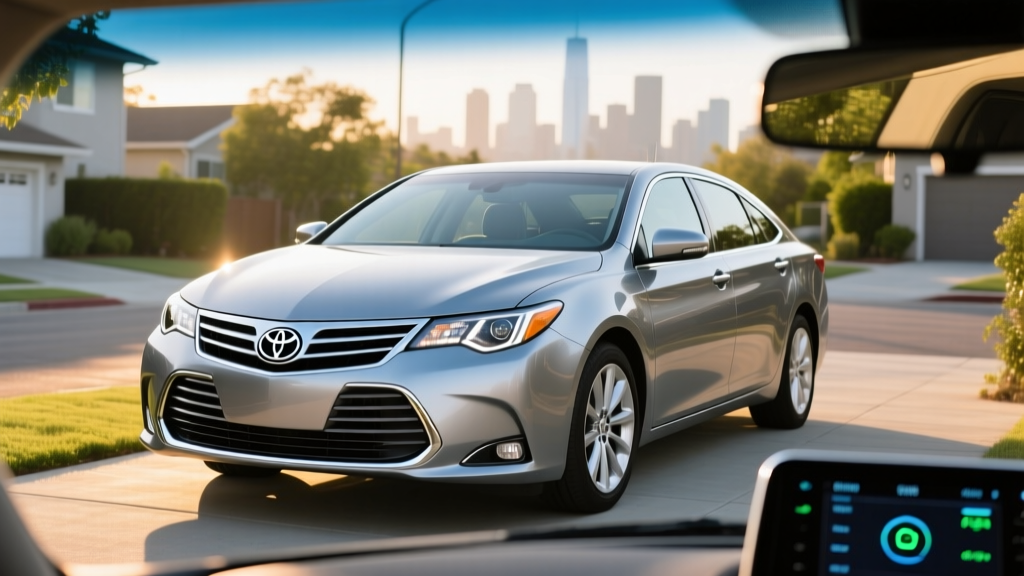
The 2013 Toyota Avalon Hybrid occupies an unusual space in the used-car market. It's a full-size, near-luxury sedan that returns 40 MPG combined, costs a fraction of its original MSRP on the used market, and carries Toyota's hybrid reliability reputation. For buyers in 2026 who want maximum fuel efficiency without plugging in, this third-generation Avalon Hybrid remains a compelling — and pragmatic — choice.
But buying a 13-year-old hybrid comes with one big question: what shape is the high-voltage battery in? Below, we break down the 2013 Avalon Hybrid's fuel economy, powertrain specs, real-world ownership costs, battery longevity, and how it stacks up against modern hybrids, PHEVs, and full EVs.
2013 Avalon Hybrid Fuel Economy: EPA vs. Real-World MPG
The EPA rates the 2013 Avalon Hybrid at 40 MPG city, 39 MPG highway, and 40 MPG combined. These numbers were class-leading for a full-size sedan when the car launched and remain impressive by 2026 standards.
| Driving Cycle | EPA MPG |
|---|---|
| City | 40 MPG |
| Highway | 39 MPG |
| Combined | 40 MPG |
Source: fueleconomy.gov
Real-World MPG: What Owners Actually See
Toyota's Hybrid Synergy Drive system excels in stop-and-go traffic, where the electric motor handles low-speed propulsion and regenerative braking recaptures energy. In real-world driving, many owners report 38–43 MPG combined, with city driving sometimes exceeding the EPA estimate by 2–3 MPG. Highway-only trips at 75+ MPH can dip to 35–37 MPG, as the gasoline engine does more of the work at sustained high speeds.
Cold-weather impact is modest compared to a full EV. Expect a 5–10% MPG reduction in freezing temperatures, primarily from the engine running more frequently to generate cabin heat. There's no large battery to thermally manage, so the penalty is far smaller than the 20–30% range loss a BEV experiences in winter.
Powertrain and Performance Specs
The 2013 Avalon Hybrid pairs a 2.5-liter Atkinson-cycle inline-4 engine with a permanent-magnet electric motor, connected through Toyota's eCVT (planetary gearset, not a belt-driven CVT). The result is smooth, linear acceleration and seamless engine-motor handoffs.
| Specification | Value |
|---|---|
| Engine | 2.5L Atkinson-cycle I4 |
| Engine Power | 156 HP @ 5,700 RPM |
| Electric Motor Power | 105 kW (141 HP) |
| Net Combined System Power | 200 HP |
| Transmission | eCVT (planetary gearset) |
| 0–60 MPH | ~8.0 seconds |
| Drivetrain | Front-wheel drive |
| Hybrid Battery | 1.6 kWh (NiMH), sealed |
The 1.6 kWh nickel-metal hydride (NiMH) battery is small by modern standards — it's not designed for electric-only driving at meaningful speeds. Instead, it acts as an energy buffer, storing recaptured braking energy and supplementing the gas engine during acceleration. This is the defining characteristic of a conventional hybrid (HEV): you never plug it in.
HEV vs. PHEV vs. EV: Which Is Right for You?
The 2013 Avalon Hybrid is a conventional hybrid (HEV). It cannot be plugged in and has no meaningful electric-only range (roughly 1 mile at very low speeds). Here's how HEVs compare to PHEVs and full battery-electric vehicles (BEVs):
| Feature | HEV (e.g., Avalon Hybrid) | PHEV (e.g., RAV4 Prime) | BEV (e.g., Tesla Model 3) |
|---|---|---|---|
| Plug-in Charging | No | Yes | Yes |
| Electric-Only Range | ~0 miles | 25–42 miles | 250–360 miles |
| Gasoline Engine | Yes (primary) | Yes (backup) | No |
| Fuel/Charging Needed | Gas only | Gas + electricity | Electricity only |
| Home Charging Setup | None required | 120V or 240V outlet | 240V Level 2 recommended |
| Federal Tax Credit (New) | None | Up to $7,500 (§30D) | Up to $7,500 (§30D) |
| Maintenance | Low (no plug, simple system) | Moderate (two powertrains) | Lowest (no engine/oil) |
- Choose an HEV (like the Avalon Hybrid) if: You lack home charging access, want zero lifestyle change from a gas car, drive long highway miles, and want the lowest purchase price.
- Choose a PHEV if: You can charge at home, your daily commute is under 40 miles, and you want electric daily driving with gas-engine flexibility for road trips.
- Choose a BEV if: You have reliable home charging, want the lowest per-mile fuel cost, and your typical trips fall within 200–250 miles (or you're willing to plan DC fast-charging stops).
Battery Longevity, Warranty, and Replacement Cost
For any used hybrid buyer, the high-voltage battery is the single biggest financial risk. Here's what you need to know about the 2013 Avalon Hybrid's NiMH pack.
Toyota covered the 2013 Avalon Hybrid battery for 8 years / 100,000 miles (10 years / 150,000 miles in California and states adopting CARB emissions standards). As of 2026, the original warranty has expired on all examples unless the vehicle has unusually low mileage and is registered in a CARB state.
How Long Does the Avalon Hybrid Battery Actually Last?
Toyota's NiMH hybrid batteries have a strong longevity record. Based on fleet data, owner reports, and independent analysis, most Toyota NiMH packs last 150,000–200,000 miles before significant degradation. Some exceed 250,000 miles with gradual capacity loss rather than sudden failure.
The key advantage of the NiMH chemistry in this application: it's managed conservatively. Toyota's system never fully charges or fully depletes the pack (a tight state-of-charge window of roughly 40–80%), which dramatically reduces stress and extends cycle life.
Battery Replacement Cost in 2026
If the battery does fail, replacement options include:
- New OEM Toyota battery: $2,500–$3,500 (parts) + $500–$800 (labor) = roughly $3,000–$4,300 installed.
- Refurbished/remanufactured battery: $1,200–$2,000 installed. Several companies offer reconditioned NiMH packs with 1–3 year warranties.
- Individual cell replacement: $800–$1,500 if only a few cells have failed (requires a shop with hybrid battery diagnostics).
At current used-car values (see pricing below), a full OEM battery replacement may not be economically justified. A refurbished pack is usually the smarter call for a 2013 model.
Used Pricing and Tax Credit Eligibility
The 2013 Avalon Hybrid originally started at approximately $36,280 MSRP (XLE Premium trim) and reached over $42,000 for the Limited. In the 2026 used market, expect to pay:
| Condition / Mileage | Approximate Price |
|---|---|
| Excellent, under 80K miles | $11,000–$14,000 |
| Good, 80K–130K miles | $8,000–$11,000 |
| Fair, 130K+ miles | $5,500–$8,000 |
Does the 2013 Avalon Hybrid Qualify for Any Tax Credit?
No. The federal §30D tax credit applies only to new plug-in vehicles (PHEVs and BEVs) that meet current battery-sourcing, critical-mineral, MSRP cap, and buyer income requirements as outlined by the IRS. Conventional hybrids (HEVs) have never qualified for the §30D credit.
The now-expired Used Clean Vehicle Credit (§25E) also required the vehicle to be a plug-in EV or fuel-cell vehicle. The Avalon Hybrid, as a non-plug-in HEV, does not qualify for any federal purchase incentive. Some states may offer minimal used-car rebates or emissions-based incentives — check your state's energy office for current programs.
Reliability and Ownership Costs
The 2013 Avalon Hybrid benefits from Toyota's mature Hybrid Synergy Drive, which was in its third generation by 2013 and had been refined across millions of Prius, Camry Hybrid, and Highlander Hybrid units. The powertrain is one of the most proven hybrid systems ever produced.
Key reliability notes for prospective buyers:
- eCVT transmission: The planetary gearset has no belts, clutches, or torque converter to wear out. Failures are extremely rare.
- Brakes: Regenerative braking reduces pad wear significantly. Many owners report 80,000+ miles on original brake pads.
- Engine: The 2AR-FXE 2.5L Atkinson-cycle engine is under-stressed and reliable. Timing chain (not belt) eliminates a common maintenance item.
- Inverter/cooling: The hybrid inverter coolant pump should be inspected; Toyota issued a service campaign for some model years. Verify recall/service campaign completion via the NHTSA recall lookup.
- 12V battery: Like all hybrids, the Avalon has a conventional 12V auxiliary battery. If it dies, the car cannot start — even with a full hybrid battery. Replace proactively every 4–5 years.
Annual Ownership Cost Estimate
Assuming 15,000 miles/year, $3.20/gallon regular fuel, and 40 MPG combined:
- Annual fuel cost: ~$1,200 (375 gallons × $3.20)
- Comparable gas-only Avalon (25 MPG combined): ~$1,920/year (600 gallons)
- Annual fuel savings vs. gas-only: ~$720/year
Insurance, maintenance, and registration will add $1,800–$2,500/year depending on your state and driving record. Total annual operating cost is typically $3,000–$3,700, making the Avalon Hybrid one of the most affordable full-size sedans to operate.
Pros and Cons of the 2013 Avalon Hybrid in 2026
- 40 MPG combined — exceptional for a full-size sedan
- Spacious cabin, comfortable ride, large trunk (14.4 cu ft)
- Proven Toyota hybrid reliability
- No plug-in charging needed — zero lifestyle change
- Low used-car entry price ($8K–$14K)
- Regenerative braking extends brake pad life
- Original hybrid battery warranty expired
- NiMH battery less energy-dense than modern Li-ion
- No electric-only driving capability
- Dated infotainment (no Apple CarPlay/Android Auto)
- No federal tax credit eligibility
- Safety tech limited (no automatic emergency braking standard)
Who Should Buy the 2013 Avalon Hybrid?
The 2013 Avalon Hybrid is ideal for:
- High-mileage commuters who drive 15,000+ miles/year and want to minimize fuel costs without charging infrastructure.
- Apartment dwellers or renters who cannot install a Level 2 charger and don't want to rely on public charging networks.
- Budget-conscious buyers who want a reliable, efficient sedan under $15,000 with low operating costs.
- Rideshare drivers (Uber/Lyft) where fuel economy directly impacts earnings and cabin space matters for passenger comfort.
Look elsewhere if you want EV-mode driving for short commutes (consider a used PHEV like the Toyota Prius Prime), need modern ADAS features like automatic emergency braking, or want the lowest possible per-mile energy cost that only a full BEV provides with home solar.
Frequently Asked Questions
How many MPG does the 2013 Avalon Hybrid get?
The EPA rates it at 40 MPG city, 39 MPG highway, and 40 MPG combined. Real-world driving typically yields 38–43 MPG combined, with city driving often exceeding the EPA estimate thanks to Toyota's regenerative braking system.
Does the 2013 Avalon Hybrid need to be plugged in?
No. This is a conventional hybrid (HEV), not a plug-in hybrid (PHEV). The battery charges exclusively through regenerative braking and the gasoline engine. There is no charging port and no electric-only driving range to speak of.
How much does it cost to replace the hybrid battery?
A new OEM Toyota replacement battery costs roughly $3,000–$4,300 installed. Refurbished/remanufactured packs are available for $1,200–$2,000 installed. Most Toyota NiMH hybrid batteries last 150,000–200,000 miles before needing replacement.
Is the 2013 Avalon Hybrid reliable?
Yes. Toyota's third-generation Hybrid Synergy Drive is among the most proven hybrid systems in production. The eCVT planetary gearset is virtually bulletproof, the Atkinson-cycle engine is under-stressed, and regenerative braking extends brake life. The main risk on a 13-year-old example is hybrid battery age — have it tested before purchase.
Does the 2013 Avalon Hybrid qualify for any tax credit?
No. Federal tax credits under IRS §30D and §25E apply only to plug-in vehicles (PHEVs and BEVs). As a conventional hybrid, the Avalon Hybrid has never qualified for federal purchase incentives. Check your state's energy office for any local programs.
How does the 2013 Avalon Hybrid compare to a modern hybrid?
Modern hybrids like the 2026 Toyota Camry Hybrid (up to 51 MPG combined) and Toyota Crown (41 MPG combined) offer better efficiency, updated safety tech, and fresh battery warranties. However, they also cost $28,000–$42,000 new. The 2013 Avalon Hybrid delivers 80% of the efficiency for 30–40% of the price, making it a strong value proposition if the battery checks out.