The 2012 Toyota Highlander Hybrid at a Glance
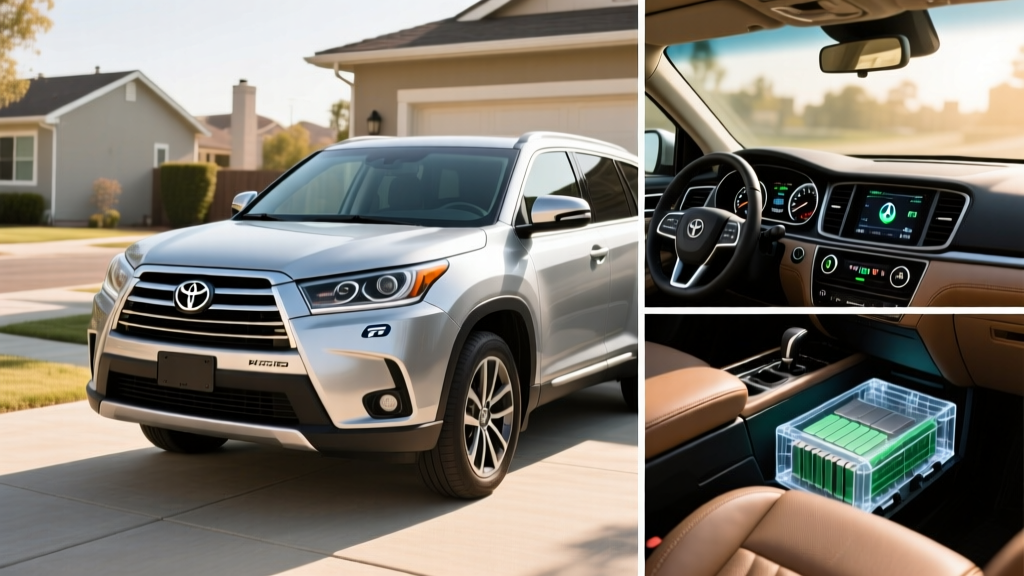
When shoppers search for a "2012 Toyota hybrid SUV," they're almost always looking at one vehicle: the 2012 Toyota Highlander Hybrid. Toyota didn't offer a RAV4 Hybrid until 2016, and the smaller C-HR Hybrid never came to the US market in that era. So if you're evaluating a 2012 Toyota hybrid SUV as a used purchase in 2026, the Highlander Hybrid is your candidate — and it's worth understanding exactly what you're getting.
The 2012 Highlander Hybrid is a conventional hybrid electric vehicle (HEV), not a plug-in hybrid. It generates all its electricity from its gasoline engine and regenerative braking. You never plug it in. This is an important distinction, because it fundamentally changes how you use and think about the vehicle compared to a PHEV or full battery-electric SUV.
HEV vs. PHEV: What's the Difference?
HEV (Conventional Hybrid): Small battery (~1.9 kWh in the Highlander Hybrid), charged by the engine and regen braking. No plug. Improves MPG by assisting the gas engine and enabling low-speed electric-only driving for short bursts.
PHEV (Plug-In Hybrid): Larger battery (typically 13–20+ kWh), charges via a plug (Level 1 or Level 2). Offers 25–45 miles of electric-only range before the gas engine kicks in. Examples: Toyota RAV4 Prime, Toyota Prius Prime.
BEV (Battery Electric Vehicle): No gas engine. Large battery (60–100+ kWh). Must be plugged in to recharge. Examples: Tesla Model Y, Hyundai Ioniq 5.
Fuel Economy: How Many MPG Does the 2012 Highlander Hybrid Get?
The EPA rated the 2012 Toyota Highlander Hybrid at 28 MPG combined, with 28 MPG city and 28 MPG highway. For a three-row, all-wheel-drive SUV weighing over 4,500 pounds, that was genuinely impressive in 2012 — and it remains competitive among used midsize SUVs today.
| Metric | EPA Rating | Real-World Expectation |
|---|---|---|
| City MPG | 28 MPG | 27–30 MPG (hybrids often match or beat EPA in city) |
| Highway MPG | 28 MPG | 25–27 MPG (hybrid advantage diminishes at sustained high speed) |
| Combined MPG | 28 MPG | 26–29 MPG depending on driving mix |
| Fuel Tank | 17.2 gallons | ~450–480 miles per tank |
Real-world note: Toyota's Hybrid Synergy Drive system excels in stop-and-go city driving, where the electric motor handles low-speed propulsion and regenerative braking recaptures energy. On the highway, the 3.5-liter V6 does more of the work, and fuel economy tends to drop slightly below the EPA sticker. In mixed suburban driving, owners commonly report 26–29 MPG — right around the EPA estimate. Source: fueleconomy.gov.
For comparison, the gas-only 2012 Highlander V6 AWD was rated at 18 city / 24 highway / 20 combined. The hybrid's 40% improvement in city MPG is substantial and translates to roughly $400–$600 in annual fuel savings at 15,000 miles per year and $3.50/gallon.
Powertrain and Performance Specs
| Specification | 2012 Highlander Hybrid |
|---|---|
| Powertrain Type | HEV (conventional hybrid, no plug) |
| Engine | 3.5L V6 Atkinson-cycle |
| Combined Net Horsepower | 280 hp |
| Electric Motors | Front motor (167 hp) + Rear motor (68 hp) |
| Hybrid Battery | ~1.9 kWh NiMH (nickel-metal hydride) |
| Drivetrain | AWD (eAWD — electric rear axle, no mechanical driveshaft) |
| Transmission | eCVT (electronically controlled continuously variable) |
| 0–60 mph | ~7.8 seconds |
| Towing Capacity | 3,500 lbs |
| Cargo Volume (behind 3rd row / max) | 10.3 / 95.4 cu ft |
The 280 combined horsepower figure made the 2012 Highlander Hybrid one of the more powerful midsize hybrid SUVs of its era. The eAWD system is notable: instead of a traditional mechanical driveshaft connecting the front and rear axles, a dedicated rear electric motor provides all-wheel-drive traction when needed. This means the rear wheels are electrically driven, improving packaging efficiency and allowing instant torque to the rear axle.
The 1.9 kWh NiMH battery is tiny by modern standards — a 2026 RAV4 Prime PHEV uses an 18.1 kWh lithium-ion pack. But in a conventional HEV, the battery doesn't need to store much energy. It buffers power between the engine and motors, enabling electric assist during acceleration and capturing energy during braking.
Battery Lifespan, Reliability, and Replacement Cost
Hybrid Battery Warranty & Expected Life
Original warranty: Toyota covered the hybrid battery for 8 years / 100,000 miles (10 years / 150,000 miles in CARB states including California, New York, Massachusetts, and others).
Real-world lifespan: Toyota's NiMH hybrid batteries have proven remarkably durable. Many Highlander Hybrids have exceeded 150,000–200,000 miles on the original pack. The NiMH chemistry is less energy-dense than modern lithium-ion but is highly tolerant of the shallow charge/discharge cycles used in HEV operation.
Replacement cost (2026): A refurbished NiMH hybrid battery pack for the 2012 Highlander Hybrid runs approximately $2,000–$3,500 installed at an independent hybrid specialist. A new OEM Toyota pack lists closer to $4,000–$5,500 at a dealership. Individual cell module replacement (reconditioning) can cost as little as $500–$1,200 if only a few modules have degraded.
The 2012 Highlander Hybrid benefits from Toyota's deep experience with the Hybrid Synergy Drive platform, which had already been refined across multiple generations of the Prius and Camry Hybrid by 2012. The result is one of the most reliable hybrid powertrains on the used market.
According to long-term ownership data and reliability surveys, the hybrid system itself is rarely a failure point. The more common maintenance items for a 2012 Highlander Hybrid at 120,000+ miles are conventional: suspension components, brakes (though regen braking extends pad life significantly), the water pump, and the inverter coolant system. The hybrid battery cooling fan filter should be cleaned periodically — a clogged filter can cause the battery to overheat and degrade prematurely.
Key reliability signal: The 2012 Highlander earned strong marks from IIHS and benefits from Toyota's reputation for long-term durability. Hybrid taxi fleets using the same powertrain architecture have logged 300,000+ miles with minimal hybrid system issues.
Pricing in 2026: What Does a Used 2012 Highlander Hybrid Cost?
As of early 2026, a used 2012 Toyota Highlander Hybrid typically sells for $9,000–$16,000 depending on mileage, condition, trim level (Base or Limited), and region. Lower-mileage examples under 100,000 miles command the premium end of that range, while high-mileage units (150,000+) cluster around $9,000–$12,000.
Tax credit eligibility: The federal §30D new clean vehicle credit does not apply to a 2012 model — it was never eligible under current rules, and the credit applies only to new vehicle purchases. However, the Used Clean Vehicle Credit (§25E) may apply if you purchase from a licensed dealer for $25,000 or less. The used-EV credit provides 30% of the sale price, up to $4,000, but there's a catch: the vehicle must be a qualified plug-in electric vehicle or fuel cell vehicle. Since the 2012 Highlander Hybrid is a conventional HEV with no plug, it does not qualify for the §25E used credit either.
This is a common point of confusion. Federal tax credits for electrified vehicles — both new (§30D) and used (§25E) — require the vehicle to have a plug (PHEV or BEV) or be a fuel cell vehicle. Conventional hybrids like the Highlander Hybrid, RAV4 Hybrid, and Camry Hybrid are not eligible for any federal purchase credit. Check current IRS rules for details, as legislation can change.
Who Should Choose This 2012 Toyota Hybrid SUV?
✓ Pros
- Proven, bulletproof Toyota hybrid powertrain with 280 hp
- 28 MPG combined — 40% better than the gas V6 Highlander
- Standard eAWD with no mechanical complexity
- Three-row seating for up to 7 passengers
- 3,500-lb towing capacity
- No plug required — fuel it like any gas car
- Strong resale value and parts availability
- NiMH battery has proven to last 150K–200K+ miles
✗ Cons
- No electric-only driving range (it's an HEV, not a PHEV)
- Dated interior technology by 2026 standards (no Apple CarPlay, basic infotainment)
- NiMH battery chemistry is older tech (heavier, less energy-dense)
- Ride and handling feel dated vs. modern crossovers
- No federal tax credit eligibility (no plug)
- Third-row space is tight for adults
- Safety tech lacks modern ADAS features (no automatic emergency braking, no lane-keeping assist)
Choose the 2012 Highlander Hybrid If:
- You want a budget-friendly three-row SUV with excellent fuel economy and no charging hassle
- You drive primarily in city/suburban traffic where the hybrid system shines
- You value mechanical reliability and low cost of ownership over cutting-edge tech
- You don't have access to home or workplace charging (making a PHEV or BEV impractical)
Consider a PHEV Instead If:
- You have a short commute (under 40 miles) and can charge at home — a RAV4 Prime or Prius Prime would let you drive mostly on electricity
- You want to qualify for federal tax credits (up to $7,500 new, $4,000 used — for eligible plug-in models)
- You want modern ADAS safety features and infotainment
Consider a Full EV Instead If:
- You have reliable home Level 2 charging and want zero tailpipe emissions
- Your daily driving is under 250 miles and you want minimal maintenance
- You're ready to move past gasoline entirely and take advantage of lower per-mile energy costs
2012 Highlander Hybrid vs. Alternatives: Quick Comparison
| Vehicle | Type | Combined MPG / MPGe | Electric Range | Used Price (2026) |
|---|---|---|---|---|
| 2012 Toyota Highlander Hybrid | HEV | 28 MPG | N/A | $9K–$16K |
| 2016+ Toyota RAV4 Hybrid | HEV | 32–34 MPG | N/A | $14K–$22K |
| 2021+ Toyota RAV4 Prime | PHEV | 38 MPG + 94 MPGe | 42 miles EV | $30K–$40K |
| 2012 Lexus RX 450h | HEV | 30 MPG | N/A | $11K–$18K |
| 2022+ Hyundai Tucson PHEV | PHEV | 35 MPG + 80 MPGe | 33 miles EV | $26K–$34K |
If three-row capacity is non-negotiable and your budget is under $16,000, the 2012 Highlander Hybrid has virtually no direct competition in the hybrid space. The Lexus RX 450h shares the same powertrain but only seats five. The Honda Pilot from that era didn't offer a hybrid variant.
Frequently Asked Questions
How many MPG does the 2012 Toyota Highlander Hybrid get?
The EPA rates it at 28 MPG combined (28 city / 28 highway). Real-world driving typically yields 26–29 MPG depending on conditions. City driving often matches or slightly exceeds the EPA figure thanks to regenerative braking and electric assist at low speeds. Highway-only driving may drop to 25–27 MPG.
Does the 2012 Highlander Hybrid need to be plugged in?
No. This is a conventional hybrid (HEV), not a plug-in hybrid. The battery charges through the gasoline engine and regenerative braking. You fuel it exactly like any other gas vehicle — at a gas station. There is no plug, no charging cable, and no electric-only driving range to worry about.
How far can the 2012 Highlander Hybrid drive on electric only?
Essentially zero miles in any practical sense. The NiMH battery is very small (~1.9 kWh), and the system uses electric power only for low-speed assist (typically under 25 mph for very short distances, like creeping through a parking lot). It cannot sustain electric-only driving at road speeds. If you want meaningful electric-only range, you need a PHEV like the RAV4 Prime (42 miles EV) or a full BEV.
Is the 2012 Highlander Hybrid reliable? What about the battery?
Yes, it's one of the most reliable hybrid SUVs from its era. Toyota's Hybrid Synergy Drive had been thoroughly proven by 2012 across millions of Prius, Camry Hybrid, and Highlander Hybrid vehicles. The NiMH hybrid battery typically lasts 150,000–200,000+ miles. If replacement is needed, expect $2,000–$3,500 for a refurbished pack or $4,000–$5,500 for a new OEM unit. The original warranty was 8 years/100,000 miles (10/150,000 in CARB states), so any 2012 model is now out of factory hybrid battery warranty.
Does the 2012 Highlander Hybrid qualify for any tax credit?
No. Federal tax credits for electrified vehicles — both the new vehicle credit (§30D) and the used vehicle credit (§25E) — require the vehicle to be a plug-in electric vehicle (PHEV or BEV) or fuel cell vehicle. Since the Highlander Hybrid is a conventional HEV with no plug, it does not qualify for federal purchase incentives. Some states may offer separate incentives for hybrids, but these are uncommon and vary by jurisdiction. Always check current IRS guidance and your state's energy office for the latest rules.
What should I check before buying a used 2012 Highlander Hybrid?
Focus on these items during a pre-purchase inspection:
- Hybrid battery health: Ask a Toyota dealer or hybrid specialist to run a battery health check. Look for voltage delta between modules — a large spread indicates aging cells.
- Hybrid battery cooling fan: Located behind the rear seat area. Ensure the filter is clean and the fan operates. A clogged filter accelerates battery degradation.
- Inverter coolant: Check for proper fluid level and condition. The inverter cooling system should be flushed per Toyota's maintenance schedule.
- Brake actuator: The electro-hydraulic brake system is unique to Toyota hybrids. Listen for unusual pump cycling when pressing the brake pedal at startup.
- General maintenance records: Regular oil changes, transmission fluid service, and coolant flushes matter even on a hybrid.
Hybrid vs. PHEV vs. EV — which should I buy?
The right choice depends on your charging access and driving patterns:
- HEV (like the 2012 Highlander Hybrid): Best for buyers who want better fuel economy with zero lifestyle change. No plug, no range anxiety, no charging infrastructure needed. Ideal if you lack home charging access.
- PHEV (like the RAV4 Prime): Best for buyers with home charging and a commute under the vehicle's EV range (typically 30–45 miles). You get daily electric driving with the gas engine as a backup for road trips. Eligible for federal tax credits.
- BEV (like the Tesla Model Y or Hyundai Ioniq 5): Best for buyers with reliable home charging who want the lowest operating costs, minimal maintenance, and zero tailpipe emissions. Requires planning for longer road trips around DC fast charging.
The 2012 Toyota Highlander Hybrid remains a smart used-SUV choice in 2026 for budget-conscious families who need three rows, all-wheel drive, and strong fuel economy without the complexity of plug-in charging. Its NiMH battery has aged gracefully across the fleet, Toyota parts support is ubiquitous, and 28 MPG from a 4,500-pound AWD SUV is still nothing to dismiss. Just understand what it is — a well-executed conventional hybrid, not an EV — and buy with realistic expectations about its 14-year-old technology and safety equipment.