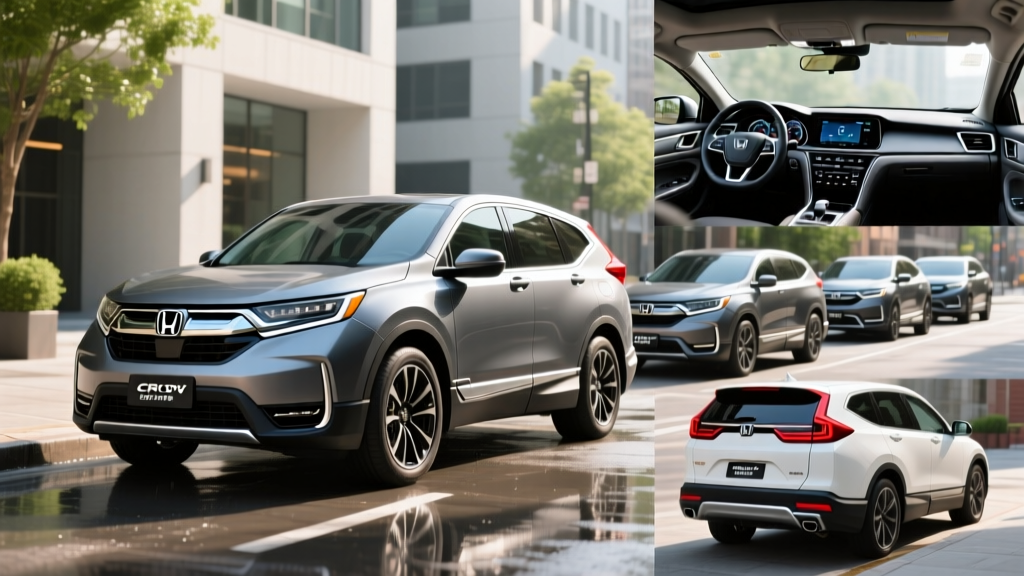
The Honda CR-V Hybrid has become one of the best-selling electrified SUVs in America, and for good reason: it delivers genuine fuel savings without the range anxiety or charging logistics of a full battery-electric vehicle. But Honda offers the CR-V Hybrid across multiple trims, and the differences in price, equipment, and real-world efficiency matter. This guide breaks down every 2026 Honda CR-V Hybrid trim with exact EPA MPG figures, powertrain specs, battery warranty details, and the ownership math you need before signing a purchase agreement.
HEV vs PHEV: What Honda Actually Offers
Before diving into trim levels, it's essential to clarify a common point of confusion. The 2026 Honda CR-V Hybrid sold in the United States is a conventional hybrid electric vehicle (HEV) — not a plug-in hybrid (PHEV). This means:
- No plug, no charging cable. The CR-V Hybrid charges its small battery exclusively through regenerative braking and the gasoline engine.
- No electric-only driving range to speak of. The hybrid system assists the engine and enables brief low-speed electric creep, but you cannot drive miles on battery alone like a PHEV or BEV.
- No federal EV tax credit eligibility. Because it cannot plug in, the CR-V HEV does not qualify for the IRS §30D clean vehicle credit (up to $7,500 for qualifying PHEVs and BEVs).
CR-V Hybrid (HEV) vs. Plug-in Alternatives
If you want plug-in electric range, Honda does not currently offer a CR-V PHEV in the U.S. market. Buyers wanting 30+ miles of electric-only driving should cross-shop the Toyota RAV4 Prime (PHEV, 42 miles electric, §30D eligible) or step into a full BEV like the Honda Prologue or Hyundai Ioniq 5. The CR-V Hybrid is strictly a self-charging HEV optimized for fuel economy, not electric-only commuting.
2026 Honda CR-V Hybrid Powertrain Specs
Every 2026 CR-V Hybrid trim shares the same two-motor hybrid system. Honda pairs a 2.0-liter Atkinson-cycle four-cylinder engine with two electric motors and an electronically controlled continuously variable transmission (e-CVT). There is no traditional geared transmission.
| Specification | 2026 CR-V Hybrid |
|---|---|
| Engine | 2.0L Atkinson-cycle I-4 |
| Combined System Output | 204 hp / 247 lb-ft torque |
| Electric Motors | Two-motor hybrid system |
| Transmission | e-CVT (direct drive) |
| Drivetrain (FWD trims) | Front-wheel drive |
| Drivetrain (AWD trims) | Real Time AWD™ (mechanical rear axle) |
| Hybrid Battery | ~1.06 kWh lithium-ion (self-charging) |
| 0-60 mph (est.) | ~7.6 seconds |
| Towing Capacity | 1,000 lbs |
The 204 combined horsepower puts the CR-V Hybrid ahead of many competitors in the compact hybrid SUV segment. The two-motor system allows the engine to operate primarily as a generator at low and moderate speeds, with the electric drive motor propelling the wheels — a setup that delivers smooth, responsive acceleration in city driving. At highway speeds, the engine can mechanically connect to the wheels for efficient cruising.
Fuel Economy: EPA MPG by Trim and Drivetrain
Fuel economy varies depending on whether you choose front-wheel drive (FWD) or all-wheel drive (AWD). Here are the official EPA figures as published on fueleconomy.gov:
| Drivetrain | City MPG | Highway MPG | Combined MPG |
|---|---|---|---|
| FWD Hybrid | 43 | 36 | 40 |
| AWD Hybrid | 40 | 34 | 37 |
Real-world MPG expectations: Honda's two-motor hybrid system excels in stop-and-go city driving, where the electric motors handle most of the propulsion and regenerative braking recaptures energy. Many owners report exceeding the EPA city estimate by 2-4 MPG in moderate-temperature urban driving. Highway efficiency is less impressive — sustained 75+ mph cruising reduces the hybrid advantage, and AWD models may return 31-33 MPG on long interstate trips. In cold weather (below 30°F), expect a 3-5 MPG drop across the board as the engine runs more frequently to provide cabin heat and maintain battery temperature.
⛽ Annual Fuel Cost Estimate
At 15,000 miles/year and $3.40/gallon regular unleaded, the FWD CR-V Hybrid (40 MPG combined) costs approximately $1,275/year in fuel. The AWD version (37 MPG) costs about $1,378/year. Compare that to a non-hybrid AWD compact SUV averaging 28 MPG combined, which would cost roughly $1,821/year — a difference of $440-$550 in annual savings with the hybrid.
2026 Honda CR-V Hybrid Trim Lineup and Pricing
Honda offers the CR-V Hybrid across several trims. Hybrid powertrain availability has expanded significantly — previously limited to the top Sport and Sport Touring trims, Honda now offers hybrid powertrains on additional trims. Here's the approximate 2026 MSRP lineup (destination charge included):
| Trim | Drivetrain | MSRP (approx.) | Key Features |
|---|---|---|---|
| Sport | FWD or AWD | ~$35,350 - $36,850 | Hybrid powertrain, 7" touchscreen, wireless Apple CarPlay/Android Auto, Honda Sensing suite, 18" wheels |
| Sport-L | FWD or AWD | ~$37,850 - $39,350 | Leather-trimmed seats, power tailgate, wireless phone charger, heated front seats, dual-zone climate |
| Sport Touring | AWD standard | ~$42,350 | 9" touchscreen, Bose 12-speaker audio, heated steering wheel, panoramic moonroof, hands-free tailgate, ventilated front seats, Wi-Fi hotspot |
Note: Pricing is approximate for the 2026 model year and subject to change. Always verify current MSRP on Honda's official site. Destination charges are typically included in Honda's published MSRP.
Which Trim Offers the Best Value?
The Sport AWD represents the efficiency sweet spot for most buyers — you get the hybrid powertrain, all-weather capability, and Honda's full safety suite at the lowest entry price. The Sport-L adds meaningful comfort upgrades (leather, heated seats, power tailgate) for roughly $2,500 more, which most buyers will find worthwhile in colder climates. The Sport Touring commands a ~$5,000 premium over the Sport AWD and is justified only if you value premium audio, the larger touchscreen, and luxury touches like ventilated seats and a panoramic roof.
Tax Credit Eligibility: What CR-V Hybrid Buyers Should Know
Because the Honda CR-V Hybrid is a conventional HEV — not a plug-in vehicle — it does not qualify for the federal §30D Clean Vehicle Credit. That credit, which offers up to $7,500 for new qualifying PHEVs and BEVs, requires a minimum battery capacity of 7 kWh and external charging capability, neither of which the CR-V Hybrid possesses.
💰 Other Savings to Consider
- State incentives: A handful of states offer rebates or HOV lane access for hybrids (not just PHEVs/BEVs), though these are increasingly rare. Check your state's energy office or DMV for current programs.
- Insurance discounts: Some insurers offer modest green-vehicle discounts for hybrids.
- Fuel savings: As calculated above, $440-$550/year in fuel savings vs. a comparable gas-only compact SUV adds up to $2,200-$2,750 over five years.
- Resale value: CR-V Hybrids have held strong residual values, often outperforming gas-only trims at trade-in time.
For the latest federal incentive rules, consult the IRS Clean Vehicle Credits page.
Battery Warranty, Reliability, and Replacement Cost
Hybrid battery longevity is consistently the top concern for first-time hybrid buyers. Here's what Honda provides:
🔋 Honda Hybrid Battery Warranty
- Standard coverage: 8 years / 100,000 miles (whichever comes first)
- CARB-state coverage: 10 years / 150,000 miles in states that follow California Air Resources Board emissions rules (CA, CO, CT, DE, ME, MD, MA, MN, NJ, NM, NY, OR, RI, VT, WA, and others adopting CARB standards)
- What's covered: Hybrid battery pack and hybrid system components (power control unit, electric motors) against defects and excessive capacity loss
- Capacity threshold: Honda warrants the battery against abnormal degradation; there is no published minimum capacity retention percentage like BEV warranties typically specify
Real-world reliability data: Honda's two-motor hybrid system has been in production since the early 2010s (first in the Accord Hybrid), and the CR-V Hybrid has been on sale in the U.S. since the 2020 model year. The hybrid battery is a small (~1.06 kWh) lithium-ion pack that operates within a narrow state-of-charge window — Honda's battery management system never fully charges or fully depletes it, which significantly extends cycle life. Failure rates for Honda hybrid batteries remain low based on long-term owner data and NHTSA complaint databases.
Replacement cost if out of warranty: A Honda CR-V Hybrid battery replacement typically costs between $2,000 and $4,000 including labor, depending on whether you use a new OEM unit, a refurbished unit, or an independent hybrid specialist. This is substantially less than a full BEV battery replacement ($8,000-$20,000+) because the CR-V's hybrid battery is small. Given the robust warranty coverage and the battery's conservative operating parameters, most owners will never face this expense.
For broader reliability ratings, the CR-V consistently earns strong marks from Consumer Reports and was named an IIHS Top Safety Pick when equipped with specific headlights.
CR-V Hybrid vs. Full EV vs. Gas: Which Fits Your Life?
Choose the CR-V Hybrid (HEV) if:
- You cannot install a home charger (apartment, street parking, no garage)
- You regularly drive 300+ miles in a day and don't want to plan charging stops
- You live in an area with sparse public charging infrastructure
- You want lower fuel costs without changing your refueling habits
- Your budget is $35,000-$42,000 and you want AWD capability
Choose a PHEV (e.g., Toyota RAV4 Prime) if:
- You can charge at home and your daily commute is under 40 miles
- You want electric-only daily driving but gas flexibility for road trips
- You want to pursue the $7,500 federal tax credit (§30D) to offset a higher purchase price
Choose a full EV (e.g., Hyundai Ioniq 5, Tesla Model Y) if:
- You have reliable home Level 2 charging
- Your daily driving is under 250 miles and you can plan road-trip charging
- You want the lowest per-mile energy cost (~$0.04-$0.06/mile on home electricity vs. ~$0.09/mile for the CR-V Hybrid)
- You want to eliminate oil changes, spark plugs, and transmission fluid entirely
Pros and Cons: 2026 Honda CR-V Hybrid
✓ Pros
- 40 MPG combined (FWD) — class-leading among non-plug-in compact SUVs
- 204 hp provides confident acceleration and merging
- No charging infrastructure needed — works with existing gas stations
- Generous cargo space (37.0 cu ft behind rear seats)
- Honda Sensing ADAS suite standard on all trims
- Strong resale value and proven hybrid reliability
- Excellent IIHS safety ratings
✗ Cons
- No plug-in option — cannot drive on electric-only power
- No federal tax credit eligibility
- AWD drops combined MPG to 37 (still good, but a noticeable penalty)
- e-CVT drone under hard acceleration (common to all CVT hybrids)
- Towing limited to 1,000 lbs (gas CR-V tows 1,500 lbs)
- Sport Touring AWD pushes past $42,000 — approaching luxury-compact pricing
- Road-trip highway MPG unremarkable (~31-33 real-world at 75 mph)
Frequently Asked Questions
How many MPG does the Honda CR-V Hybrid actually get?
The EPA rates the FWD CR-V Hybrid at 43 city / 36 highway / 40 combined MPG. The AWD version is rated at 40 city / 34 highway / 37 combined. In real-world driving, city MPG often exceeds the EPA estimate by 2-4 MPG thanks to regenerative braking, while sustained highway driving at 75+ mph typically returns 31-33 MPG for AWD models. Cold weather reduces efficiency by roughly 3-5 MPG.
Can I plug in the Honda CR-V Hybrid to charge?
No. The CR-V Hybrid is a conventional HEV, not a plug-in hybrid. It has no charging port and no external charging capability. The small hybrid battery charges itself through regenerative braking and the gasoline engine. If you want a plug-in Honda SUV, look at the Honda Prologue (full BEV) or wait for a potential future CR-V PHEV variant.
Does the Honda CR-V Hybrid qualify for any tax credit?
The CR-V Hybrid does not qualify for the federal §30D Clean Vehicle Credit because it is not a plug-in vehicle. Some states may offer minor hybrid incentives or HOV lane access, but these vary by jurisdiction and are increasingly targeted at PHEVs and BEVs. Check your state's energy office for current programs.
How long will the CR-V Hybrid battery last, and what does replacement cost?
Honda warranties the hybrid battery for 8 years/100,000 miles (10 years/150,000 miles in CARB states). Real-world data from Honda's hybrid lineup suggests these batteries routinely last 150,000+ miles with minimal degradation due to conservative state-of-charge management. Out-of-warranty replacement costs approximately $2,000-$4,000 — far less than a full EV battery replacement.
Is the CR-V Hybrid good for road trips?
Yes, with a caveat. The CR-V Hybrid has a 14.0-gallon fuel tank, giving the FWD model roughly 560 miles of total range and the AWD model roughly 518 miles at EPA combined figures. You'll stop less often than in most gas-only compact SUVs. However, highway fuel economy is the hybrid's weakest point — expect 31-33 MPG on the interstate in AWD models, which is only marginally better than some turbocharged gas competitors.
Should I get the FWD or AWD CR-V Hybrid?
If you live in a mild climate with minimal snow, FWD saves you ~$1,500 on purchase price and returns 3 more combined MPG. If you deal with snow, ice, or unpaved roads regularly, the AWD system's traction benefit is worth the MPG and cost trade-off. The Sport Touring trim comes exclusively with AWD.
How does the CR-V Hybrid compare to the Toyota RAV4 Hybrid?
The RAV4 Hybrid (AWD standard) is EPA-rated at 41 city / 38 highway / 39 combined — very close to the CR-V Hybrid AWD's 37 combined. The RAV4 Hybrid offers a PHEV variant (RAV4 Prime, 42 miles electric, §30D eligible) that the CR-V lineup lacks. The CR-V Hybrid counters with slightly more horsepower (204 vs. 219 hp for the RAV4, though Honda's feels more responsive in city driving), a more refined interior in upper trims, and a slightly roomier cargo area. Both are excellent choices; your decision may come down to whether you want a PHEV option (Toyota) or prefer Honda's driving dynamics and interior.
Bottom Line: The CR-V Hybrid Is a No-Compromise Efficiency Play
The 2026 Honda CR-V Hybrid occupies a specific and valuable position: it delivers meaningful fuel savings (40 MPG combined FWD) with zero lifestyle changes. No charging, no range planning, no tax-credit paperwork. You fill up at the same gas stations, drive the same routes, and spend $440-$550 less per year on fuel compared to a gas-only compact SUV.
The Sport AWD trim at ~$36,850 is the value pick for most buyers. The Sport-L adds worthwhile comfort features for cold-climate owners. The Sport Touring at ~$42,350 is well-equipped but pushes into pricing territory where PHEV and BEV alternatives start making financial sense — especially if you qualify for the $7,500 federal credit on a plug-in vehicle.
If you can charge at home and want to maximize both savings and electric driving, a PHEV or BEV will ultimately cost less per mile. But if charging isn't an option — or you simply don't want the complexity — the CR-V Hybrid remains one of the most efficient, practical, and reliable compact SUVs you can buy.