Quick Verdict: A Proven Hybrid Workhorse Entering Its Teen Years
The 2012 Toyota Camry Hybrid XLE represents a pivotal model year — it was the first Camry Hybrid built on Toyota's revamped XV50 platform, delivering a meaningful leap in fuel economy over its predecessor. With an EPA-rated 40 MPG combined, a 200-horsepower Hybrid Synergy Drive powertrain, and Toyota's reputation for hybrid longevity, this sedan remains a compelling used-car target in 2026 for buyers who want electrified efficiency without plug-in complexity.
But a 14-year-old hybrid raises specific questions: How has the nickel-metal hydride (NiMH) traction battery held up? What does replacement cost in 2026? And does this generation's XLE trim offer enough technology to justify its place in your driveway versus a newer hybrid or a full battery-electric vehicle (BEV)? This guide answers those questions with hard data.
Fuel Economy: EPA Numbers and Real-World MPG
The 2012 Camry Hybrid's fuel economy was a benchmark when new, and it still holds up against modern non-plug-in hybrids. Here's the official EPA breakdown, sourced from fueleconomy.gov:
| Metric | LE Trim | XLE Trim |
|---|---|---|
| City MPG | 43 | 40 |
| Highway MPG | 39 | 38 |
| Combined MPG | 41 | 40 |
| Annual Fuel Cost (est.) | ~$1,250 | ~$1,300 |
| Gallons per 100 miles | 2.4 | 2.5 |
Why does the XLE get slightly lower MPG? The XLE trim adds weight — leather upholstery, a power-adjustable passenger seat, upgraded audio, and additional sound insulation. That extra mass costs the XLE roughly 1-3 MPG versus the lighter LE trim across all driving cycles.
Real-World MPG: What Owners Actually Report
Toyota's hybrid system excels in stop-and-go city driving, where regenerative braking recaptures energy and the electric motor handles low-speed propulsion. Many owners report exceeding the EPA city figure in warm-weather urban commuting — 44-47 MPG is achievable on flat terrain at moderate speeds.
Highway driving tells a different story. At sustained 75-80 MPH, expect 34-37 MPG. The 2.5-liter Atkinson-cycle engine operates less efficiently at high constant loads, and aerodynamic drag dominates. In cold weather (below 30°F), the engine runs more frequently to maintain cabin heat and battery temperature, dropping combined economy to roughly 35-37 MPG until the system warms up.
Powertrain: Hybrid Synergy Drive Specifications
The 2012 Camry Hybrid uses Toyota's third-generation Hybrid Synergy Drive, pairing a 2.5-liter four-cylinder Atkinson-cycle gasoline engine with a permanent-magnet electric motor through an electronically controlled continuously variable transmission (eCVT).
| Specification | Value |
|---|---|
| Gas Engine | 2.5L 4-cyl Atkinson cycle (2AR-FXE) |
| Gas Engine Power | 156 HP @ 5,700 RPM |
| Gas Engine Torque | 156 lb-ft @ 4,500 RPM |
| Electric Motor Power | 105 kW (141 HP) |
| Net Combined System Output | 200 HP |
| Transmission | eCVT (planetary gearset) |
| 0-60 MPH | ~7.6 seconds |
| Drivetrain | Front-wheel drive |
| Traction Battery | NiMH, ~1.6 kWh (gross) |
| Emissions Certification | SULEV / AT-PZEV (varies by state) |
The eCVT is not a belt-and-pulley CVT like those found in some competitors. Toyota's system uses a planetary gearset that seamlessly blends engine and motor power with no fixed gear ratios. This design has proven extraordinarily reliable — there are no belts to slip, no clutches to wear, and no conventional transmission fluid to change on a short interval.
Acceleration is adequate for merging and passing. The 200 HP combined output puts the Camry Hybrid XLE in the same ballpark as many four-cylinder gasoline midsize sedans of its era, with the added benefit of instant electric torque at low speeds. The EV mode button allows electric-only driving at very low speeds (under ~25 MPH) for short distances — roughly 1 mile or less — but this is not a meaningful electric-only range. It's designed for creeping through parking lots or residential streets, not commuting.
HEV vs. PHEV vs. EV: Where Does the 2012 Camry Hybrid Fit?
If you're cross-shopping a used 2012 Camry Hybrid, you're likely also considering newer hybrids, plug-in hybrids, and possibly a used BEV. Here's a decision framework:
| Factor | HEV (This Camry) | PHEV (e.g., RAV4 Prime) | BEV (e.g., Model 3, Ioniq 5) |
|---|---|---|---|
| Plugs In? | No | Yes | Yes |
| Electric-Only Range | ~1 mile (low speed) | 25-42 miles | 250-350+ miles |
| Fuel/Energy Cost | ~$0.10/mile (gas) | ~$0.04/mile (elec) + gas | ~$0.04/mile (elec) |
| Home Charging Needed? | No | Recommended | Essential |
| Tailpipe Emissions | Low (SULEV) | Low to zero (EV mode) | Zero |
| Maintenance Burden | Engine + hybrid system | Engine + hybrid + larger battery | Minimal (no engine) |
| Best For | No charger access; want simplicity | Short commutes + road trips | Home charging + daily driving |
Choose the 2012 Camry Hybrid XLE if: You lack access to home or workplace charging, you want a proven low-maintenance sedan with strong fuel economy, and your budget is in the $7,000-$11,000 used-car range (typical 2026 market pricing depending on mileage and condition).
Look at a PHEV instead if: You can install a Level 2 charger at home, your daily commute is under 40 miles round-trip, and you want to drive mostly on electricity while keeping a gas engine for road trips.
Consider a full EV if: You have reliable home charging, your daily driving is under 250 miles, and you want to eliminate gasoline costs and engine maintenance entirely.
Battery Health, Warranty, and Replacement Costs in 2026
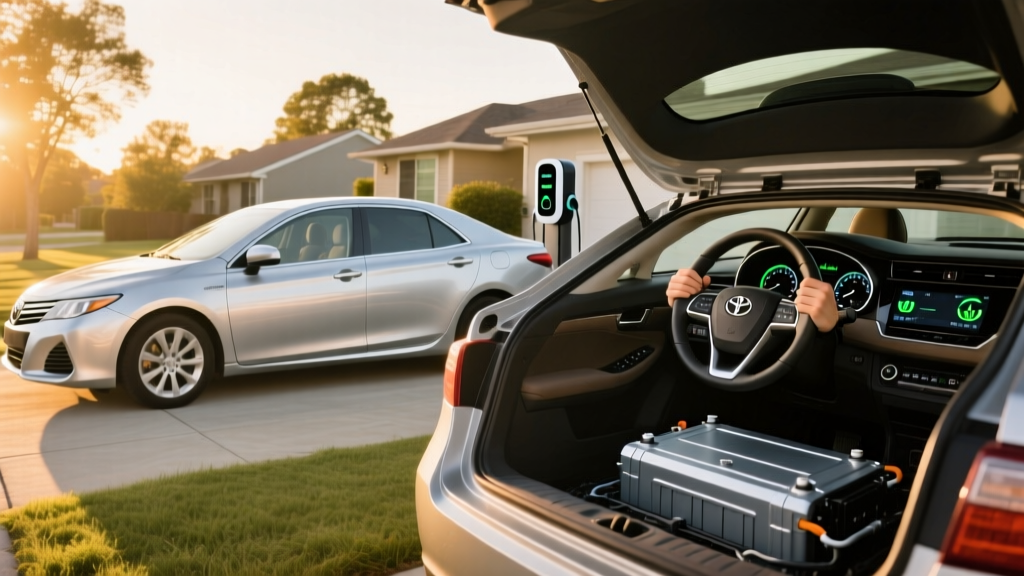
The single biggest concern for any used-hybrid buyer is traction battery longevity. The 2012 Camry Hybrid uses a nickel-metal hydride (NiMH) battery pack — a chemistry Toyota has deployed since the original Prius in 1997. NiMH is less energy-dense than modern lithium-ion but has a well-documented degradation profile.
• Original Warranty: 8 years / 100,000 miles (10 years / 150,000 miles in CARB states including CA, NY, MA, and others)
• Warranty Status in 2026: Expired for all 2012 models — even in CARB states, the 10-year/150k coverage ended by 2022.
• Expected Battery Lifespan: Data from fleet operators and owner surveys suggests 150,000-200,000 miles before significant capacity loss, with many units lasting 200,000+ miles with gradual degradation rather than sudden failure.
• Replacement Cost (2026): A new OEM Toyota NiMH pack costs approximately $2,500-$3,500 installed at a dealership. Refurbished/reconditioned packs from third-party suppliers range from $1,200-$2,000 installed. Individual module replacement (only failed cells) can cost $500-$1,000 at a hybrid specialist shop.
How to assess battery health before buying:
- Check the dashboard: Watch the battery state-of-charge display during a test drive. The bars should cycle normally — if the battery jumps rapidly from full to near-empty under light load, cells may be imbalanced.
- Use an OBD-II scanner with hybrid data: Apps like Dr. Prius or Hybrid Assistant can read individual battery module voltages. Healthy modules should be within 0.2V of each other under load.
- Review maintenance records: A battery that's been kept in moderate temperatures and not routinely deep-cycled (run to near-empty) will have degraded less.
- Look for the "battery replacement" sticker: If a previous owner replaced the pack, there should be documentation and possibly a warranty from the installer.
XLE Trim: What You Get for the Money
The XLE was the top-tier trim for the 2012 Camry Hybrid, and it came well-equipped for its era. Standard features include:
- Leather-trimmed heated front seats
- 8-way power driver seat with lumbar
- 4-way power passenger seat
- Smart Key with push-button start
- Auto-dimming rearview mirror with compass and HomeLink
- Dual-zone automatic climate control
- 6.1-inch touchscreen with Entune audio (Bluetooth, USB)
- Backup camera
- 17-inch alloy wheels with low-rolling-resistance tires
- LED taillights
What it lacks by 2026 standards: No Apple CarPlay or Android Auto (the Entune system is dated), no adaptive cruise control, no lane-keeping assist, no blind-spot monitoring, and no automatic emergency braking. Toyota Safety Sense — the brand's suite of ADAS features — didn't arrive on the Camry until the 2018 model year. If active safety technology is a priority, this is the most significant gap in the 2012 Camry Hybrid XLE's profile.
Tax Credits and Incentives: The Used-Hybrid Reality
The 2012 Camry Hybrid is not eligible for the federal §30D new clean vehicle tax credit — that credit applies only to new plug-in vehicles (BEVs and PHEVs) meeting battery sourcing, MSRP, and buyer income requirements as defined by the IRS.
It is also not eligible for the federal used EV credit (up to $4,000 under IRC §25E), because that credit applies only to plug-in vehicles — BEVs and PHEVs — not conventional HEVs.
Some states and municipalities offer incentives for purchasing used hybrid vehicles, but these are increasingly rare and typically targeted at PHEVs or BEVs. Check your state's environmental or energy agency for current programs. There is no federal incentive for buying a conventional hybrid in 2026.
Ownership Costs and Reliability Track Record
The 2012 Camry Hybrid's long-term ownership profile is one of its strongest selling points. According to data aggregated by sources like Consumer Reports and owner forums, this generation has above-average reliability for its age class.
| Category | Estimated Cost |
|---|---|
| Fuel (15,000 mi/yr @ 38 MPG, $3.40/gal) | ~$1,340 |
| Insurance (national avg., varies by profile) | ~$1,100-$1,500 |
| Maintenance (oil, filters, brakes, tires) | ~$400-$700 |
| Expected Repairs (age-related) | ~$300-$800 |
| Total Annual Estimate | ~$3,140-$4,340 |
Maintenance advantages of the hybrid system: Regenerative braking significantly reduces wear on the friction brake pads and rotors — many owners report original brake pads lasting 80,000-100,000 miles. The eCVT has no transmission fluid to change at short intervals. The engine runs less than in a conventional car, reducing oil degradation.
Known issues to watch for: The water pump (electric, specific to the hybrid) can fail around 120,000-150,000 miles ($400-$600 replacement). The brake actuator assembly has been the subject of owner complaints and a technical service bulletin — if the brake pedal feels unusually firm or the ABS warning light illuminates, this component may need attention ($1,200-$1,800 at a dealer). The 12V auxiliary battery (a standard AGM unit, separate from the hybrid traction battery) should be replaced every 4-5 years.
Pros and Cons: The Honest Assessment
- 40 MPG combined EPA — still competitive in 2026
- Proven NiMH battery with 200k+ mile track record
- No plug-in charging required — zero infrastructure dependency
- Low brake wear from regenerative braking
- Spacious cabin and 15.4 cu-ft trunk
- XLE trim adds leather, heated seats, backup camera
- Strong parts availability and dealer service network
- Low used-car entry price ($7k-$11k typical)
- No modern ADAS (no AEB, no lane-keep, no blind-spot)
- Dated infotainment — no CarPlay/Android Auto
- NiMH battery will eventually need replacement ($1,200-$3,500)
- Original factory warranty fully expired
- Highway MPG drops to 34-37 at 75+ MPH
- No federal or state tax incentives available
- XLE MPG slightly lower than LE due to added weight
- EV mode limited to ~1 mile at very low speed
Frequently Asked Questions
How many MPG does the 2012 Toyota Camry XLE Hybrid get?
The EPA rates the 2012 Camry Hybrid XLE at 40 MPG city, 38 MPG highway, and 40 MPG combined. In real-world driving, expect 38-42 MPG combined depending on conditions. City driving in warm weather can exceed 43 MPG, while sustained highway driving at 75+ MPH typically yields 34-37 MPG. Cold weather reduces economy by 3-5 MPG due to increased engine operation for cabin heat.
Is the 2012 Camry Hybrid reliable, and what does battery replacement cost?
Yes — this generation has a strong reliability record. The NiMH traction battery typically lasts 150,000-200,000+ miles. A new OEM replacement costs $2,500-$3,500 installed; refurbished packs run $1,200-$2,000. The hybrid powertrain and eCVT are among the most durable components in the vehicle. Key items to monitor include the electric water pump and brake actuator assembly.
Does the 2012 Camry Hybrid qualify for any tax credit?
No. The federal §30D new vehicle credit and the §25E used vehicle credit both require plug-in capability (BEV or PHEV). Conventional hybrids like the Camry Hybrid are not eligible for any current federal tax incentive. Check your state environmental agency for any local programs, though these are rare for HEVs.
How far can it go on electric only?
The 2012 Camry Hybrid is a conventional HEV, not a plug-in hybrid. Its EV mode provides roughly 1 mile of electric-only driving at speeds under 25 MPH — useful for parking lots and quiet residential streets, but not a commuting solution. If electric-only range matters, you need a PHEV (like the Toyota Prius Prime, which offers 44 miles electric-only) or a full BEV.
Hybrid vs. PHEV vs. EV — which should I choose?
Choose this HEV if you lack home charging access and want maximum simplicity with no plug-in requirements. Choose a PHEV if you can charge at home, have a short commute (under 40 miles), and want to drive on electricity most days while keeping gas for longer trips. Choose a full BEV if you have reliable home charging, drive under 250 miles daily, and want zero tailpipe emissions with minimal maintenance. The 2012 Camry Hybrid XLE excels as a no-fuss, budget-friendly efficiency sedan for buyers who just want to fill up less often.
What should I check before buying a used 2012 Camry Hybrid?
Prioritize a pre-purchase inspection at a Toyota dealer or hybrid specialist. Have them read the traction battery module voltages via OBD-II to check for cell imbalance. Verify the brake actuator is functioning properly (no warning lights, firm but normal pedal feel). Check for electric water pump operation. Review service records for regular oil changes and any prior hybrid system work. Test-drive in EV mode and monitor the battery state-of-charge display for abnormal cycling.