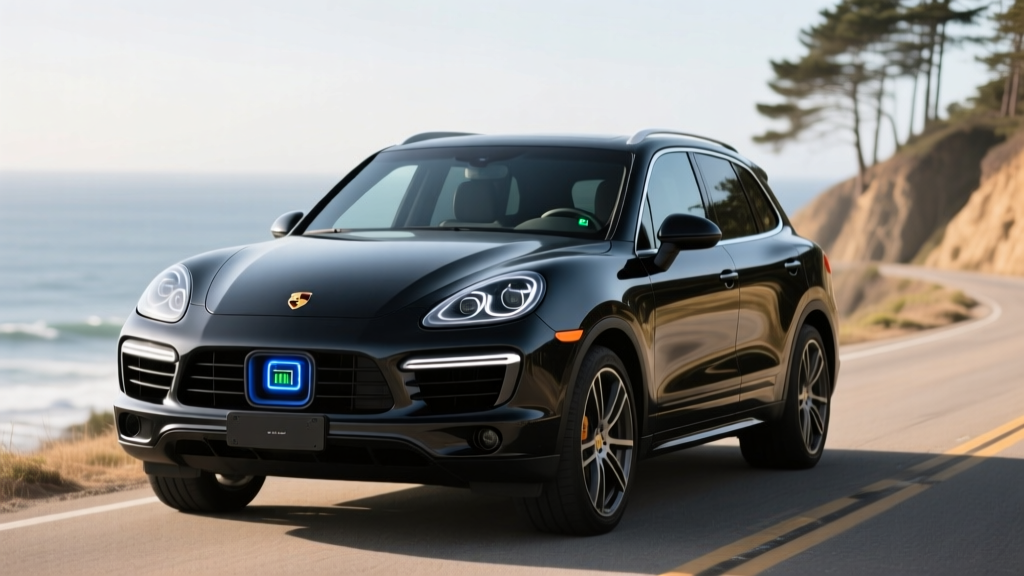
The 2012 Porsche Cayenne S Hybrid occupies a curious space in the used-luxury-SUV market. It was Porsche's first production hybrid, pairing a supercharged 3.0-liter V6 with an electric motor to deliver 380 combined horsepower while promising better fuel economy than its V8 siblings. More than a decade later, prospective buyers want to know: does the hybrid system hold up, what does it actually cost to maintain, and is it still a smart buy in 2026?
This guide breaks down the real-world fuel economy, hybrid battery longevity, replacement costs, and ownership economics so you can decide whether this early Porsche hybrid earns a spot in your garage — or whether a newer PHEV or full EV is the better play.
2012 Porsche Cayenne S Hybrid: Key Specifications
| Specification | Value |
|---|---|
| Powertrain | 3.0L Supercharged V6 + Electric Motor (Parallel Hybrid) |
| Combined Horsepower | 380 HP @ 5,500 RPM |
| Combined Torque | 428 lb-ft @ 1,000 RPM |
| Transmission | 8-speed Tiptronic automatic |
| 0–60 mph | 6.1 seconds |
| Hybrid Battery | 1.7 kWh NiMH (nickel-metal hydride) |
| Electric-Only Driving | Minimal — low-speed coasting/maneuvering only |
| EPA Fuel Economy (City/Hwy/Combined) | 20 / 24 / 21 MPG |
| Fuel Tank | 22.4 gallons |
| Total Range | ~470 miles |
| Drivetrain | All-wheel drive (AWD) |
| Curb Weight | 4,857 lbs |
| Original MSRP (2012) | $67,700 |
| Typical Used Price (2026) | $12,000 – $20,000 |
Fuel Economy: EPA Ratings vs. Real-World MPG
The EPA rates the 2012 Cayenne S Hybrid at 20 MPG city, 24 MPG highway, and 21 MPG combined. For context, the non-hybrid Cayenne S with its 4.8L V8 was rated at just 16 MPG combined that same year — a meaningful gap at the pump.
| Model | City | Highway | Combined |
|---|---|---|---|
| Cayenne S Hybrid (3.0L V6 + Motor) | 20 | 24 | 21 |
| Cayenne S (4.8L V8) | 14 | 20 | 16 |
| Cayenne (3.6L V6 Base) | 15 | 22 | 18 |
Source: fueleconomy.gov — 2012 Porsche Cayenne S Hybrid
Owner-reported data on Fuelly and enthusiast forums clusters around 19–22 MPG combined in mixed driving. The hybrid system's regenerative braking and engine-off coasting deliver their best gains in stop-and-go city traffic, where some drivers report 22–23 MPG. Sustained highway driving at 75+ MPH typically yields 23–25 MPG thanks to the tall 8th gear and engine-disconnect coasting function. Cold weather and short trips will drop city figures to 17–18 MPG.
How the Hybrid System Works: HEV, Not PHEV
This is critical for buyers to understand: the 2012 Cayenne S Hybrid is a conventional hybrid (HEV), not a plug-in hybrid (PHEV). You cannot plug it in. There is no electric-only range to speak of. The 1.7 kWh nickel-metal hydride (NiMH) battery charges exclusively through regenerative braking and engine power.
| Feature | 2012 Cayenne S Hybrid (HEV) | Modern PHEV Example (e.g., Cayenne E-Hybrid) |
|---|---|---|
| Plug-in Charging | No — charges via regen & engine only | Yes — Level 2 AC plug-in |
| Battery Size | 1.7 kWh (NiMH) | 25.9 kWh (Li-ion, 2024+ models) |
| Electric-Only Range | Negligible (coasting/creeping only) | ~30–35 miles EPA |
| DC Fast Charging | No | No (AC Level 2 only on most PHEVs) |
| Gas Engine | 3.0L Supercharged V6 | 3.0L Turbo V6 (newer generations) |
| Federal Tax Credit (§30D) | Never eligible | Eligible on newer models (subject to IRS rules) |
The electric motor in the 2012 Cayenne S Hybrid serves three roles: it provides torque-fill during acceleration (helping hit that 428 lb-ft peak at just 1,000 RPM), it enables engine-off coasting at highway speeds to save fuel, and it assists with stop-start functionality. Think of it as a performance-and-efficiency assist system, not an electric driving mode.
Hybrid Battery Longevity and Replacement Cost
The NiMH battery pack in the Cayenne S Hybrid is one of the top concerns for used buyers — and rightly so, given the vehicle's age. Here's what the data shows:
Battery Lifespan Data: NiMH packs in parallel-hybrid applications (similar to those in the Toyota Prius and Lexus RX 400h of the same era) typically last 150,000–200,000 miles before significant degradation. However, the Cayenne's pack operates under higher thermal and load stress due to the vehicle's weight and performance tuning. Owner reports suggest failures commonly occur between 100,000 and 150,000 miles.
Battery replacement cost: A new OEM hybrid battery from Porsche runs $4,000–$6,000 including parts and labor at a dealership. Independent hybrid specialists may offer refurbished or reconditioned NiMH packs for $2,000–$3,500. Individual cell replacement is possible at some specialists for $800–$1,500 if only a few cells have failed.
Warning signs of battery degradation: reduced fuel economy (dropping below 18 MPG combined), the hybrid system warning light on the dash, reduced regenerative braking feel, or the engine refusing to shut off at stops. A pre-purchase scan with a Porsche-compatible OBD tool (such as PIWIS or a capable aftermarket scanner) can read the hybrid battery's State of Health (SoH) and individual cell voltages.
Performance and Driving Character
The hybrid system was never just about efficiency — it was also about torque. The supercharged V6 produces 333 HP on its own, and the electric motor adds 47 HP, for a combined 380 HP and 428 lb-ft. That peak torque arriving at 1,000 RPM gives the Cayenne S Hybrid a muscular, effortless feel in daily driving that the naturally aspirated V8 Cayenne S couldn't match at low speeds.
The 0–60 MPH time of 6.1 seconds remains respectable for a nearly 5,000-pound luxury SUV. The 8-speed Tiptronic shifts smoothly, and the electric motor fills in the torque gaps between gears. Porsche also equipped the hybrid with a "sailing" or coasting mode: lift off the throttle at highway speed and the engine decouples, allowing the SUV to coast with zero engine braking drag — a trick that saves meaningful fuel on rolling highways.
Handling is typical Cayenne: communicative steering, firm-but-compliant air suspension (optional), and competent all-wheel drive. The hybrid adds roughly 175 lbs over the V6 base model, noticeable only in back-to-back canyon driving that no one really does in a luxury SUV.
Reliability and Common Issues
Beyond the hybrid battery, the 2012 Cayenne S Hybrid shares most of its mechanical components with the rest of the 958-generation Cayenne lineup. Key reliability considerations:
- Transfer case (T-case): The 958 generation is known for transfer-case failures, typically between 80,000–120,000 miles. Symptoms include clunking from the driveline, binding in tight turns, or a drivetrain warning light. Replacement runs $2,500–$4,000.
- Coolant system: Plastic coolant pipes and fittings in the engine valley are prone to cracking with age and heat cycles. Budget $800–$1,500 for preventive replacement of coolant crossover pipes.
- Air suspension: If equipped, air springs and compressors commonly need replacement after 100,000 miles. Aftermarket options (Arnott, etc.) reduce cost to $400–$800 per corner.
- Supercharger isolator: The Eaton supercharger's isolator coupling can wear, producing a rattling noise at idle. Replacement is $500–$900.
- Hybrid system inverter: Rare but documented failures. Replacement is $2,000–$3,500.
Overall, the 2012 Cayenne S Hybrid is moderately reliable for a German luxury SUV of its era — better than the twin-turbo Cayenne Turbo of the same year, but not in the same league as a Lexus RX 450h. A thorough pre-purchase inspection (PPI) at a Porsche specialist is non-negotiable at this price point.
Tax Credits and Used Purchase Economics
The 2012 Cayenne S Hybrid does not qualify for the federal §30D new-vehicle tax credit — it never did, as it's a conventional HEV, not a plug-in. The IRS restricts §30D credits to battery electric vehicles (BEVs) and plug-in hybrids (PHEVs) that meet battery-sourcing, critical-mineral, MSRP, and buyer-income requirements.
- ✗ Not a plug-in vehicle (HEV, not PHEV or BEV)
- ✗ Battery capacity below the 7 kWh minimum threshold
- ✗ No longer sold new (used-vehicle credit under §25E requires a PHEV/BEV sold for under $25,000 through a licensed dealer)
- ✗ Even the §25E used-EV credit does not apply to conventional hybrids
For current §30D and §25E rules, consult IRS.gov clean vehicle credits.
Used pricing in 2026: Expect to pay $12,000–$20,000 depending on mileage, condition, and service history. Low-mileage examples under 80K miles command the top of that range. Factor in $1,500–$3,000 annually for maintenance and potential hybrid system repairs.
Insurance: Annual premiums typically run $1,800–$2,800 depending on your state, driving record, and coverage level. The hybrid designation doesn't significantly affect insurance cost compared to the V6 or V8 Cayenne models.
Who Should Buy the 2012 Cayenne S Hybrid?
- You want a luxury performance SUV with better fuel economy than a V8 Cayenne
- You have access to an independent Porsche specialist for maintenance
- You drive 10,000–15,000 miles/year and value the 3–5 MPG improvement over the V8
- You understand you're buying a 14-year-old German luxury SUV and budget accordingly
- You prefer a conventional hybrid with no plug-in hassle or range planning
- You want meaningful electric-only driving (30+ miles) for commuting
- You want federal tax credits (look at newer PHEVs or BEVs)
- You want minimal maintenance costs (consider a Lexus RX 450h or a newer EV)
- You drive mostly short trips where a BEV would cost pennies per mile
- You lack a trusted European-car mechanic nearby
| Category | Estimated Cost |
|---|---|
| Purchase Price (avg.) | $16,000 |
| Fuel (12K mi/yr @ 21 MPG, $3.50/gal) | $10,000 |
| Insurance (avg.) | $11,500 |
| Maintenance & Repairs | $7,500 – $12,000 |
| Hybrid Battery Reserve | $3,000 – $5,000 |
| Total (5 Years) | $48,000 – $54,500 |
| Cost Per Mile | $0.80 – $0.91 |
Frequently Asked Questions
How many MPG does the 2012 Porsche Cayenne S Hybrid get?
The EPA rates it at 20 city / 24 highway / 21 combined MPG. Real-world owner data typically shows 19–22 MPG combined, with highway driving sometimes reaching 24–25 MPG thanks to the engine-disconnect coasting feature.
Is the 2012 Cayenne S Hybrid a plug-in hybrid?
No. It is a conventional hybrid (HEV). It cannot be plugged in and has no meaningful electric-only driving range. The battery charges solely through regenerative braking and the gasoline engine. If you want a plug-in Porsche SUV, look at the Cayenne E-Hybrid (introduced for the 2019 model year in the U.S.).
How far can it go on electric power alone?
Effectively zero miles in any practical sense. The electric motor assists during acceleration and enables engine-off coasting at highway speeds, but it cannot propel the vehicle independently for any meaningful distance. This is fundamentally different from a PHEV with 30+ miles of electric range.
Is the hybrid battery reliable, and what does replacement cost?
The NiMH battery typically lasts 100,000–150,000 miles before significant degradation. A new OEM replacement runs $4,000–$6,000 at a dealer, or $2,000–$3,500 for a refurbished pack from an independent hybrid specialist. Given the vehicle's age, budget for this as a potential expense.
Does the 2012 Cayenne S Hybrid qualify for any tax credit?
No. It never qualified for the federal §30D new-vehicle credit because it's a conventional hybrid, not a plug-in. It also does not qualify for the §25E used clean-vehicle credit, which applies only to used BEVs and PHEVs sold under $25,000. Check IRS.gov for current credit rules.
Hybrid vs. PHEV vs. full EV — which is right for me?
A conventional hybrid (HEV) like this Cayenne makes sense if you want better fuel economy with zero behavior change — no plugging in, no range planning. A PHEV is ideal if you have home charging and a short commute (under 30 miles) but also want gas-engine range for road trips. A full EV (BEV) offers the lowest per-mile fuel cost and least maintenance, but requires reliable charging access and a higher upfront budget. For 2026 buyers, a used Cayenne E-Hybrid PHEV (2019+, ~$35,000–$50,000) offers 30+ miles of electric commuting with the Cayenne's luxury and performance.
How does it compare to a Lexus RX 450h of the same era?
The 2012 Lexus RX 450h delivers 30 MPG combined — nearly 50% better — with legendary Toyota hybrid reliability and lower maintenance costs. However, it gives up 150+ horsepower, the Porsche badge, and the Cayenne's sportier driving dynamics. If efficiency and reliability are priorities, the Lexus wins. If performance and prestige matter, the Porsche justifies its higher running costs.
Pros
- 380 HP and 428 lb-ft of torque — muscular low-end pull
- 3–5 MPG improvement over the V8 Cayenne S
- Smooth 8-speed automatic with engine-disconnect coasting
- Competent AWD and optional air suspension
- Significant depreciation already absorbed (used pricing)
Cons
- Hybrid battery nearing end of life; $2K–$6K replacement
- No plug-in capability; no electric-only range
- No federal tax credit eligibility
- Transfer-case and coolant-pipe issues common to 958 generation
- Higher maintenance costs than Japanese hybrid SUVs