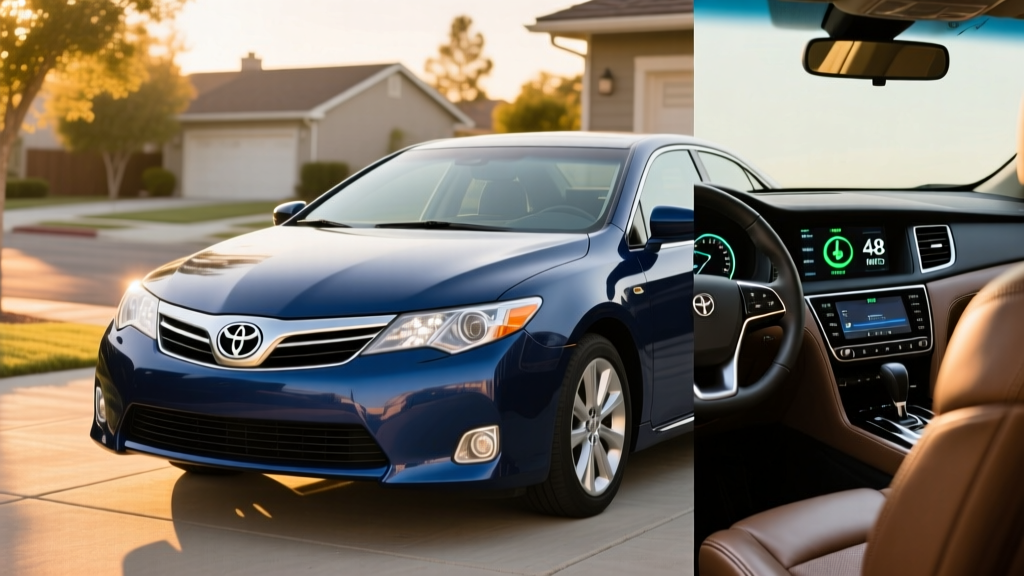
Quick Verdict: The 2011 Camry Hybrid in 2026
The 2011 Toyota Camry Hybrid is a conventional hybrid electric vehicle (HEV) — not a plug-in. It requires no charging infrastructure, runs on gasoline alone, and uses regenerative braking paired with a small battery to boost fuel economy. For used-car shoppers evaluating budget-friendly hybrids in 2026, this model remains a practical commuter with proven reliability. But at 15 years old, the critical question isn't its original EPA rating — it's whether the hybrid battery is still healthy and what replacement will cost.
The 2011 Camry Hybrid is a conventional hybrid (HEV). It cannot plug in. Its 1.4 kWh nickel-metal hydride (NiMH) battery charges exclusively through regenerative braking and the gasoline engine. A plug-in hybrid (PHEV), by contrast, has a larger battery (typically 10–25 kWh), can charge from a wall outlet or public charger, and offers 20–50 miles of electric-only driving before the gas engine engages. If you want electric-only commuting, you need a PHEV or a full BEV — not this car.
Fuel Economy: EPA Ratings vs. Real-World MPG
The 2011 Camry Hybrid's efficiency was competitive when new and remains respectable today. Here's the official EPA breakdown, sourced from fueleconomy.gov:
| Metric | MPG |
|---|---|
| City | 31 |
| Highway | 35 |
| Combined | 33 |
| Fuel tank capacity | 17.2 gal |
| Total range | ~567 miles |
Real-World MPG: What to Actually Expect
Hybrids like the Camry tend to meet or exceed their EPA city rating in stop-and-go traffic, where regenerative braking recaptures energy most effectively. On the highway, the electric motor contributes less, so real-world highway MPG often falls slightly below the 35 EPA figure.
- City driving (stop-and-go): 30–34 MPG — regen braking shines here
- Highway cruising (65–75 mph): 32–36 MPG — aerodynamic drag dominates
- Cold weather penalty: Expect a 5–10% drop in winter. The engine runs more frequently to heat the cabin, reducing electric-motor assist time
- Aged battery penalty: A degraded NiMH battery on a 2011 model may reduce city MPG by 2–4 MPG if it can no longer hold a meaningful charge
Powertrain Specs: Engine, Motor, and Combined Output
The 2011 Camry Hybrid uses Toyota's Hybrid Synergy Drive system — the same proven architecture found in the Prius of that era, but scaled for a midsize sedan.
| Component | Specification |
|---|---|
| Gasoline engine | 2.4L inline-4 (2AZ-FXE, Atkinson cycle) |
| Engine horsepower | 147 hp @ 6,000 rpm |
| Electric motor | Permanent-magnet AC synchronous |
| Motor output | 40 hp (30 kW) |
| Net combined horsepower | 187 hp |
| Transmission | eCVT (planetary gearset, no fixed gears) |
| Hybrid battery | 1.4 kWh NiMH (244.8V nominal) |
| 0–60 mph | ~8.4 seconds |
| Drivetrain | Front-wheel drive |
Don't confuse the 1.4 kWh battery with a PHEV or EV battery. This is a buffer battery — it stores recaptured braking energy for short electric-motor assists (typically under 1 mile at low speeds). It is not designed for electric-only commuting.
Hybrid Battery Lifespan, Warranty, and Replacement Cost
This is the single most important section for anyone considering a 15-year-old hybrid. The NiMH battery pack in the 2011 Camry Hybrid was warranted by Toyota for 8 years / 100,000 miles (10 years / 150,000 miles in California and states that follow CARB emissions standards). That factory warranty has long since expired on every 2011 model.
- Original warranty: 8 yr / 100,000 mi (10 yr / 150,000 mi in CARB states)
- Typical NiMH lifespan: 10–15 years or 150,000–200,000 miles before significant degradation
- New OEM replacement battery: ~$2,500–$3,500 (parts + labor at a Toyota dealer)
- Refurbished/remanufactured battery: ~$1,200–$2,000 installed
- Individual cell/module replacement: ~$400–$800 if only one or two modules have failed (requires a specialist)
How to Check Battery Health Before Buying
Before purchasing a 2011 Camry Hybrid, take these steps:
- Read the battery state-of-charge on the dash display. If it fluctuates wildly or never rises above two bars, the pack may have weak modules.
- Check for the red triangle warning light (hybrid system fault). This often indicates a battery module imbalance.
- Use an OBD-II scanner with hybrid-capable software (e.g., Techstream or a compatible app like Dr. Prius) to read individual module voltages. A healthy pack shows all modules within 0.2V of each other.
- Request a hybrid battery health report from a Toyota dealer — they can run a diagnostic for ~$100–$150.
Pricing in 2026: Used Market Value
The 2011 Camry Hybrid originally carried an MSRP of approximately $26,950. In the 2026 used market, examples typically trade between $5,000 and $9,500 depending on mileage, condition, and whether the hybrid battery has been replaced.
- High-mileage (150k+ mi), original battery: $5,000–$6,500 — budget for imminent battery replacement
- Moderate mileage (100k–140k mi), original battery: $6,500–$8,000
- Lower mileage (under 100k mi) or new aftermarket battery: $8,000–$9,500
Does the 2011 Camry Hybrid Qualify for Any Tax Credit?
No. The federal §30D tax credit for new qualified plug-in electric vehicles does not apply to the 2011 Camry Hybrid for two reasons: (1) it is a conventional HEV, not a plug-in vehicle, and the §30D credit requires plug-in capability with a minimum 4 kWh battery; (2) it is a used vehicle, and the used-EV credit (§25E, up to $4,000) also requires a plug-in vehicle with at least 4 kWh of battery capacity. No federal tax credit is available for this car. Always verify current incentive rules at irs.gov.
Reliability Record and Long-Term Ownership Costs
Toyota's Hybrid Synergy Drive is one of the most thoroughly validated hybrid powertrains ever produced. The eCVT transmission uses a planetary gearset with no clutch packs, bands, or traditional friction components — there are fewer moving parts than in a conventional automatic. The 2AZ-FXE engine, while known for occasional oil consumption issues in non-hybrid applications, tends to last well in hybrid duty because it operates under lighter thermal and mechanical loads.
According to NHTSA records, the 2011 Camry Hybrid has no widespread hybrid-system recalls. Common non-hybrid complaints include:
- Dashboard cracking (cosmetic, widespread on 2007–2011 Camry models)
- Power steering hose leaks (on some 4-cylinder models)
- Brake actuator wear (regenerative braking reduces pad wear, but the hydraulic actuator can develop issues past 120,000 miles)
Estimated Annual Ownership Costs (2026)
| Expense | Estimated Cost |
|---|---|
| Fuel (33 MPG, $3.20/gal avg) | ~$1,164/year |
| Insurance (national avg, older sedan) | ~$1,000–$1,400/year |
| Maintenance (oil, filters, brakes) | ~$400–$600/year |
| Hybrid battery reserve (amortized) | ~$300–$500/year |
| Total estimated annual cost | ~$2,864–$3,664/year |
2011 Camry Hybrid vs. Modern Alternatives: HEV, PHEV, or EV?
If you're cross-shopping the 2011 Camry Hybrid against newer options, here's how the powertrain types compare:
| Factor | HEV (e.g., 2011 Camry Hybrid) | PHEV (e.g., 2026 Prius Prime) | BEV (e.g., 2026 Tesla Model 3) |
|---|---|---|---|
| Plug-in required? | No | Yes (optional but beneficial) | Yes (mandatory) |
| Electric-only range | ~0.5 mi at low speed | 35–44 mi | 270–360 mi |
| Combined MPG / MPGe | 33 MPG | 52 MPG + 127 MPGe | 132 MPGe |
| Home charging needed? | No | Recommended (120V works) | Yes (240V ideal) |
| Federal tax credit | None | Up to $7,500 (new, §30D) | Up to $7,500 (new, §30D) |
| Upfront cost (2026) | $5,000–$9,500 (used) | ~$33,000+ (new) | ~$38,000+ (new) |
| Best for | Budget commuters, no charger access | Short-commute EV + road-trip flexibility | Home-charging owners, max savings |
Who Should Buy the 2011 Camry Hybrid?
- You need a sub-$10,000 commuter with strong fuel economy and no plug-in requirement
- You lack access to home or workplace charging (apartment, street parking)
- You want Toyota reliability with low maintenance costs
- Your commute is city-heavy, where hybrid MPG advantages are greatest
- You're willing to budget $1,500–$3,000 for a potential hybrid battery replacement
- You want electric-only driving — consider a used PHEV (Chevy Volt, Prius Prime) or a used BEV
- You drive primarily highway miles — the fuel economy advantage over a gas Camry narrows significantly
- The hybrid battery shows signs of degradation and the seller won't negotiate on replacement cost
- You want modern safety tech (AEB, lane-keeping, blind-spot monitoring) — these weren't available on the 2011 model
Pros and Cons at a Glance
- 33 MPG combined still competitive for a used sedan
- No plug-in charging required — fuel and go
- Toyota Hybrid Synergy Drive has exceptional longevity record
- eCVT is mechanically simpler than conventional automatics
- Low purchase price in 2026 used market
- Strong parts availability and independent mechanic support
- Hybrid battery is past its warranted lifespan — replacement likely needed
- No federal or state tax credits available
- Minimal electric-only capability (not a PHEV)
- Outdated safety tech — no AEB, lane-keeping, or adaptive cruise
- Dated infotainment — no Apple CarPlay, Android Auto, or Bluetooth audio streaming
- NiMH battery is less energy-dense than modern lithium-ion packs
Frequently Asked Questions
How many MPG does the 2011 Toyota Camry Hybrid get?
The EPA rates it at 31 city / 35 highway / 33 combined MPG. In real-world city driving, many owners report 30–34 MPG. Highway fuel economy typically runs 32–36 MPG. Cold weather and a degraded battery can reduce these figures by 5–15%.
Can I plug in the 2011 Camry Hybrid to charge?
No. The 2011 Camry Hybrid is a conventional hybrid (HEV), not a plug-in hybrid (PHEV). It has no charging port. The 1.4 kWh NiMH battery charges only through regenerative braking and the gasoline engine. Toyota did not introduce a Camry plug-in hybrid until later model years in select markets.
How long does the hybrid battery last, and what does replacement cost?
Toyota's NiMH hybrid batteries typically last 10–15 years or 150,000–200,000 miles. On a 2011 model, many original batteries have already been replaced or are nearing end-of-life. A new OEM replacement costs approximately $2,500–$3,500 installed at a dealer. Refurbished packs run $1,200–$2,000 installed, and individual module replacement (if only a few cells have failed) can cost $400–$800 at a hybrid specialist.
Is the 2011 Camry Hybrid reliable?
Yes, with one major caveat. The Hybrid Synergy Drive powertrain (engine, eCVT, motor) is among the most reliable in Toyota's lineup. The eCVT has no clutch packs or bands to wear out. The primary reliability risk on a 2011 model is the hybrid battery, which is past its factory warranty. Non-hybrid concerns include dashboard cracking and occasional brake actuator issues. Check IIHS safety ratings for crash-test performance.
Does the 2011 Camry Hybrid qualify for any tax credit?
No. The federal §30D clean vehicle credit requires a plug-in vehicle with a battery capacity of at least 4 kWh. The 2011 Camry Hybrid's 1.4 kWh NiMH battery and lack of a plug-in port make it ineligible. The used-EV credit (§25E) also requires plug-in capability. Some states offer inspection or registration fee discounts for hybrids, but no meaningful purchase incentive applies. Confirm current rules at irs.gov.
Hybrid vs. PHEV vs. EV — which should I choose?
If you can't charge at home and need the lowest upfront cost, the 2011 Camry Hybrid (HEV) works well. If you have access to a standard 120V outlet and a short commute, a used PHEV like the Chevy Volt (2016–2019) gives you 40+ miles of electric driving plus gas-engine range for road trips. If you can install a Level 2 home charger and want the lowest per-mile fuel cost, a used BEV (Nissan Leaf, Chevy Bolt, Tesla Model 3) eliminates gasoline entirely. The right choice depends entirely on your charging access, commute distance, and budget.