Quick Verdict: A Proven Hybrid Hatchback With Caveats
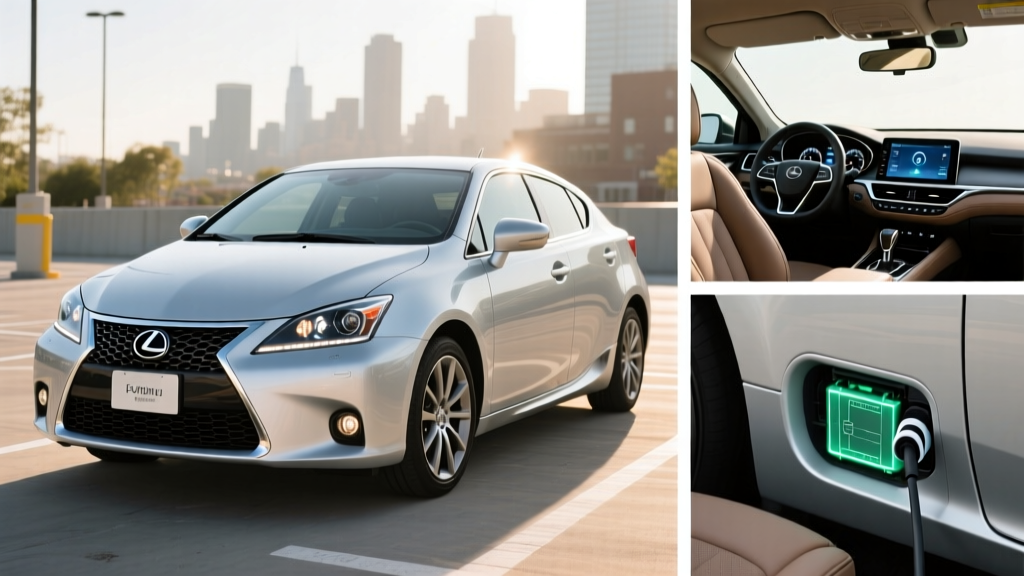
The 2011 Lexus CT 200h was Lexus's entry into the premium compact hybrid segment, pairing a 1.8-liter Atkinson-cycle four-cylinder with Toyota's Hybrid Synergy Drive. It is a conventional hybrid electric vehicle (HEV), not a plug-in hybrid (PHEV) — meaning it charges its own battery through regenerative braking and the gasoline engine. No plug, no outlet, no charging cable required.
In 2026, the CT 200h remains a compelling used-car proposition for buyers who want luxury-badge efficiency without the range anxiety of a full EV or the charging infrastructure demands of a PHEV. With an EPA-rated 42 MPG combined and a track record of exceptional powertrain reliability shared with the Toyota Prius, the CT 200h delivers predictable ownership costs. The trade-offs are clear: modest 134 combined horsepower, a firm ride, and a cabin that feels dated against modern competitors.
| Specification | 2011 Lexus CT 200h |
|---|---|
| Powertrain Type | Conventional Hybrid (HEV) |
| Engine | 1.8L Atkinson-cycle I4 |
| Combined Horsepower | 134 hp |
| Electric Motor | 60 kW (80 hp) AC synchronous |
| Hybrid Battery | 1.3 kWh NiMH (nickel-metal hydride) |
| EPA MPG (City / Hwy / Combined) | 43 / 40 / 42 |
| 0–60 mph | 9.8 seconds |
| Fuel Tank | 11.9 gallons |
| Total Range | ~499 miles |
| Drivetrain | FWD (eCVT) |
| Original MSRP (2011) | $29,120 (base) |
| Used Price Range (2026) | $7,500–$13,000 |
Fuel Economy: EPA Ratings and Real-World MPG
The EPA rates the 2011 Lexus CT 200h at 43 MPG city, 40 MPG highway, and 42 MPG combined, according to fueleconomy.gov. These figures made it one of the most efficient luxury-branded vehicles available at launch.
| Driving Condition | EPA Rating | Real-World Expectation |
|---|---|---|
| City | 43 MPG | 44–48 MPG (hybrids excel in stop-and-go) |
| Highway | 40 MPG | 37–40 MPG (aerodynamic drag, less regen benefit) |
| Combined | 42 MPG | 40–45 MPG (varies with driving mix) |
| Cold Weather (below 32°F) | — | 35–38 MPG (engine runs more for cabin heat) |
Like most Toyota/Lexus hybrids, the CT 200h frequently exceeds its EPA city rating in real-world urban driving. The hybrid system's ability to shut off the engine at stops, recapture energy through regenerative braking, and run on electric-only power at low speeds gives it a natural advantage in traffic. Highway driving tells a different story — the Atkinson-cycle engine's efficiency advantage narrows at sustained high speeds, and the car's 3,130-pound curb weight works against it.
Owners on fuel-tracking platforms consistently report lifetime averages between 40 and 45 MPG combined. Expect a meaningful drop in winter months, particularly in cold climates where the gasoline engine must run continuously to provide cabin heat — the CT 200h uses a traditional coolant-based heater, not the heat pump found in modern EVs.
HEV vs. PHEV vs. EV: Where Does the CT 200h Fit?
Understanding the distinction between electrified powertrains is essential before buying any hybrid or EV. The CT 200h is a conventional hybrid (HEV), and that carries specific implications for ownership.
| Feature | HEV (CT 200h) | PHEV (e.g., Prius Prime) | BEV (e.g., Model 3) |
|---|---|---|---|
| Plugs In? | No | Yes | Yes |
| Electric-Only Range | ~1 mile at low speed | 25–44 miles | 250–400 miles |
| Battery Size | 1.3 kWh | 13.6–18.1 kWh | 50–100 kWh |
| Gas Engine? | Yes (always available) | Yes (always available) | No |
| Home Charging Needed? | No | Recommended (120V or 240V) | Yes (240V strongly recommended) |
| Tailpipe Emissions | Low | Low to zero (when on battery) | Zero |
| Federal Tax Credit (2026) | None | Up to $7,500 (§30D) | Up to $7,500 (§30D) |
The CT 200h's 1.3 kWh nickel-metal hydride battery is small by modern standards — it exists only to buffer energy between the engine and motor, enabling brief electric-only assists at low speeds (roughly 1 mile at under 25 mph in ideal conditions). You cannot plug it in, and you should not expect meaningful electric-only driving.
If your daily commute is under 30 miles and you have access to home charging, a modern PHEV like the current Toyota Prius Prime (44 miles electric-only) or a full EV will deliver dramatically lower fuel costs. But if you lack charging access — apartment living, street parking, no garage — the CT 200h's self-charging hybrid system eliminates that barrier entirely. You fuel it like any gasoline car and simply enjoy better mileage.
Powertrain and Battery: What's Under the Hood
The CT 200h shares its powertrain architecture with the third-generation Toyota Prius (2010–2015), which is significant because that platform has accumulated billions of real-world miles and is among the most thoroughly validated hybrid systems ever produced.
The 1.8-liter 2ZR-FXE engine produces 98 horsepower on its own, while the 60 kW (80 hp) electric motor supplements it through a planetary gearset that functions as an electronically controlled continuously variable transmission (eCVT). Combined system output is 134 horsepower. This is not a performance-oriented powertrain — the 9.8-second 0–60 mph time reflects its efficiency-first tuning.
The hybrid battery is a 1.3 kWh nickel-metal hydride (NiMH) pack, mounted beneath the rear cargo area. NiMH chemistry was the industry standard for Toyota/Lexus hybrids of this era and is known for its durability and thermal stability, even if it offers lower energy density than modern lithium-ion cells.
Hybrid Battery Warranty and Lifespan
When new, the 2011 CT 200h carried Lexus's hybrid battery warranty of 8 years / 100,000 miles (extended to 10 years / 150,000 miles in California Air Resources Board states: CA, CT, MA, ME, NJ, NM, NY, OR, RI, VT, WA). By 2026, all original factory warranties have expired.
Real-world data from Prius and CT 200h fleets indicates NiMH hybrid batteries typically last 150,000–200,000 miles before significant capacity loss, with many exceeding 200,000 miles with gradual degradation rather than sudden failure. Replacement cost for a refurbished NiMH pack from an independent hybrid specialist runs $1,500–$2,500 installed. A new OEM battery from Lexus runs approximately $3,000–$4,000 installed.
Reliability, Common Issues, and Long-Term Ownership
The CT 200h benefits from one of the strongest reliability reputations in the luxury compact segment. The Prius-derived powertrain is remarkably durable, with the eCVT planetary gearset proving far more robust than belt-driven CVTs from other manufacturers. There are no traditional transmission clutches or bands to wear out.
Known issues to watch for on a 2011–2013 model year CT 200h:
- Hybrid battery degradation: At 13–15 years old, original NiMH packs are near or past their expected service life. Budget $1,500–$4,000 for potential replacement if the battery has not already been serviced.
- 12V auxiliary battery: Like all hybrids, the CT 200h has a separate 12V battery that powers electronics. These typically last 4–6 years and cost $200–$350 to replace.
- Brake actuator assembly: Some owners report brake actuator failures between 100,000–150,000 miles. Replacement runs $1,200–$1,800 at a dealership. Listen for unusual brake pedal feel or warning lights.
- Water pump (electric): The engine's electric water pump can fail around 100,000 miles. Replacement is approximately $400–$700.
- Dash/cabin rattles: Early CT 200h models are known for interior trim rattles, particularly around the dashboard and rear hatch. Cosmetic but annoying.
According to NHTSA records, the 2011 CT 200h has a relatively low number of recalls and complaints for its production volume, which reinforces the platform's overall reliability. The vehicle was never a high-volume seller in the U.S., so parts availability for body panels and trim can be tighter than for a Prius, but mechanical parts remain widely available through Toyota/Lexus channels and aftermarket suppliers.
Pricing, Tax Credits, and Total Cost of Ownership
As a used vehicle, the 2011 Lexus CT 200h does not qualify for any federal tax credit. The IRS §30D Clean Vehicle Credit applies only to new vehicles (and the separate used-EV credit under §25E applies only to eligible used EVs and PHEVs purchased from a dealer for $25,000 or less — the CT 200h is a conventional HEV and does not qualify for either).
Here's what the ownership economics look like in 2026:
| Cost Factor | 2011 CT 200h | 2025 Toyota Prius (HEV) | 2025 Tesla Model 3 (BEV) |
|---|---|---|---|
| Purchase Price | $7,500–$13,000 | $28,350–$35,000 | $38,990–$52,990 |
| Federal Tax Credit | None | None (HEV) | Up to $7,500 (§30D) |
| Annual Fuel Cost (12,000 mi/yr) | ~$960 (at $3.35/gal, 42 MPG) | ~$700 (at $3.35/gal, 57 MPG) | ~$480 (at $0.16/kWh, 25 kWh/100mi) |
| Annual Insurance (est.) | $1,100–$1,400 | $1,300–$1,700 | $1,600–$2,200 |
| Maintenance (annual avg.) | $500–$800 | $400–$600 | $300–$500 |
| 5-Year Fuel Total | ~$4,800 | ~$3,500 | ~$2,400 |
The CT 200h's economic advantage is its low entry price. A well-maintained example at $10,000 represents a fraction of the cost of any new hybrid or EV. Over five years of ownership, even accounting for potentially higher maintenance as the car ages, the total cost can remain competitive with financing a new vehicle — provided the hybrid battery remains healthy or has been recently replaced.
Pros and Cons: The Honest Assessment
Pros
- 42 MPG combined EPA — frequently exceeds 44 MPG in city driving
- Prius-derived powertrain with proven 200,000+ mile durability
- No charging infrastructure needed — fuel at any gas station
- Low used-car entry price ($7,500–$13,000)
- Lexus build quality, sound insulation, and dealership experience
- Low emissions without lifestyle change
Cons
- Only 134 hp — sluggish acceleration (9.8s 0–60)
- Firm, sometimes harsh ride quality on rough roads
- Dated infotainment with no Apple CarPlay or Android Auto
- Hybrid battery likely near end of life if original (budget for replacement)
- Small cargo area (14.3 cu ft) compared to modern hatchbacks
- No federal or state tax credit eligibility
Who Should Buy the 2011 CT 200h — and Who Shouldn't
Choose the 2011 Lexus CT 200h if:
- You want an efficient daily driver without needing home charging access
- Your budget is under $15,000 and you want luxury-badge build quality
- Your commute is primarily city and suburban driving where hybrid efficiency shines
- You want minimal ownership complexity — no charging apps, no plug, no range planning
- You're comfortable budgeting $1,500–$4,000 for a potential hybrid battery replacement
Look elsewhere if:
- You want brisk acceleration or engaging driving dynamics (consider a used BMW 330e PHEV or a newer Prius)
- You have home charging access and a commute under 30 miles — a PHEV or EV will save more on fuel
- You need modern infotainment, driver-assistance features, or advanced safety tech
- You regularly drive long highway distances where the efficiency advantage narrows
Frequently Asked Questions
How many MPG does the 2011 Lexus CT 200h get?
The EPA rates it at 43 MPG city, 40 MPG highway, and 42 MPG combined. Real-world owners typically see 40–45 MPG combined, with city driving often exceeding the EPA rating thanks to the hybrid system's regenerative braking and engine shut-off at stops. Cold weather can drop combined MPG to the mid-30s.
Is the 2011 CT 200h a plug-in hybrid?
No. The CT 200h is a conventional hybrid (HEV). It cannot be plugged in and has no meaningful electric-only range. The small 1.3 kWh NiMH battery charges itself through regenerative braking and the gasoline engine. If you want plug-in capability with electric-only driving, look at a PHEV like the Toyota Prius Prime or a full battery-electric vehicle.
How much does it cost to replace the hybrid battery?
A refurbished NiMH hybrid battery from an independent specialist costs approximately $1,500–$2,500 installed. A brand-new OEM battery from a Lexus dealer runs $3,000–$4,000 installed. Many hybrid specialists also offer individual cell module replacement for $800–$1,500 if only a few cells have degraded. Given the vehicle's age, verify battery health before purchase — a pre-purchase inspection at a hybrid specialist is strongly recommended.
Is the 2011 Lexus CT 200h reliable?
Yes. The CT 200h shares its powertrain with the third-generation Toyota Prius, one of the most reliable hybrid platforms ever built. The eCVT transmission, electric motor, and engine have proven capable of 200,000+ miles with basic maintenance. The main reliability concern at this age is hybrid battery degradation due to calendar aging, not a design flaw. Brake actuator and electric water pump failures are the most common non-routine repairs.
Does the 2011 Lexus CT 200h qualify for any tax credits?
No. The CT 200h is a conventional hybrid (HEV) and does not qualify for the federal §30D Clean Vehicle Credit, which applies to new EVs and PHEVs only. The used clean vehicle credit (§25E) also requires the vehicle to be a plug-in electric or fuel-cell vehicle. Some states previously offered hybrid incentives, but most have expired or shifted focus to plug-in vehicles. Check your state's current programs at afdc.energy.gov.
How does the CT 200h compare to a Prius?
Mechanically, they share the same 1.8L hybrid powertrain, but the CT 200h uses a more rigid chassis, additional sound insulation, and Lexus-tuned suspension for a quieter, more premium ride. The trade-off is slightly lower fuel economy (42 vs. 50 MPG combined for the 2011 Prius), less cargo space, and a higher original MSRP. If efficiency is your top priority, the Prius wins. If cabin refinement and badge prestige matter, the CT 200h holds its own.