Quick Verdict: A Pioneering Hybrid That Aged Gracefully
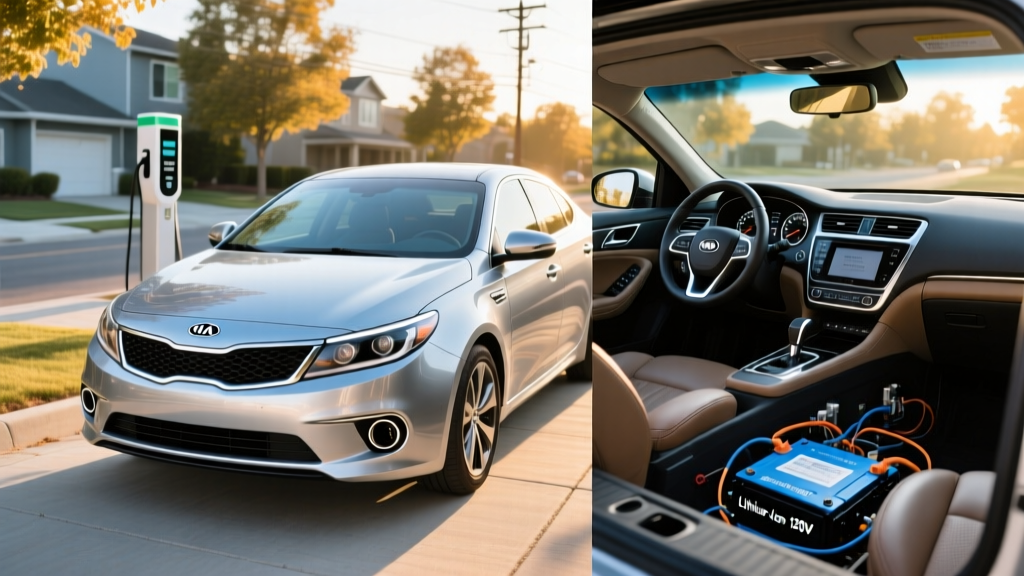
The 2011 Kia Optima Hybrid was Kia's first entry into the hybrid sedan market, competing against the Toyota Camry Hybrid and Hyundai Sonata Hybrid (its platform sibling). As a conventional hybrid electric vehicle (HEV), it requires no plug-in charging — the gasoline engine and regenerative braking handle all battery replenishment. Over a decade later, this first-generation Optima Hybrid remains a relevant used-car option for budget-conscious drivers seeking strong city fuel economy without the complexity or cost of a plug-in hybrid or full battery-electric vehicle.
With an EPA-rated 37 MPG combined, a proven 2.4-liter four-cylinder powertrain, and Kia's industry-leading hybrid battery warranty, the 2011 Optima Hybrid still delivers meaningful fuel savings. But buyers evaluating this model in the used market need to understand what they're getting — and what age-related battery degradation means for long-term ownership costs.
HEV vs. PHEV: What the 2011 Optima Hybrid Actually Is
Before diving into specs, it's essential to clarify what this vehicle is and isn't. The 2011 Kia Optima Hybrid is a conventional hybrid (HEV). It cannot be plugged in. There is no electric-only driving range to speak of beyond very low-speed maneuvering. The small battery pack assists the gasoline engine and captures energy during braking, but the 2.4L engine remains the primary propulsion source at all times.
HEV vs. PHEV vs. BEV — Where Does This Car Fit?
| Feature | HEV (2011 Optima Hybrid) | PHEV (e.g., Toyota Prius Prime) | BEV (e.g., Tesla Model 3) |
|---|---|---|---|
| Plugs in? | No | Yes | Yes |
| Electric-only range | ~0.5 mi at low speed | 25–44 mi typical | 250–360 mi typical |
| Fuel source | Gasoline only | Gasoline + grid electricity | Grid electricity only |
| Home charging needed? | No | Recommended (120V or 240V) | Required (240V ideal) |
| Tailpipe emissions | Reduced vs. gas-only | Zero in EV mode | Zero |
| Federal tax credit (new) | None | Up to $7,500 (§30D) | Up to $7,500 (§30D) |
The 2011 Optima Hybrid is strictly an HEV. Kia did not offer a plug-in variant of this generation. If you want electric-only commuting, you'll need to look at a PHEV or BEV instead.
Fuel Economy: EPA Ratings and Real-World MPG
The headline number for the 2011 Kia Optima Hybrid is its EPA fuel economy rating. According to fueleconomy.gov, the official figures are:
| Driving Condition | EPA MPG |
|---|---|
| City | 35 MPG |
| Highway | 40 MPG |
| Combined | 37 MPG |
Real-World MPG: What Owners Actually Report
Hybrid fuel economy is notoriously sensitive to driving style and conditions. Unlike conventional gas cars, hybrids tend to exceed their EPA city rating in stop-and-go traffic because regenerative braking recovers energy that would otherwise be lost as heat. Conversely, sustained highway driving at 75+ MPH reduces the hybrid system's advantage, as the electric motor contributes less at high speeds and aerodynamic drag dominates.
Owner-reported data from Fuelly and Edmunds forums clusters around 33–38 MPG combined in mixed driving. Drivers who do predominantly city commuting with gentle acceleration routinely report 38–41 MPG. Those with heavy highway commutes at higher speeds often see 30–34 MPG. Cold weather (below 40°F) typically reduces fuel economy by 3–5 MPG due to increased engine warm-up time and reduced battery efficiency.
Real-World Fuel Economy Expectation: EPA combined is 37 MPG. Plan for 33–38 MPG in typical mixed driving. City-heavy routes can push 39–41 MPG; highway-heavy commutes at 70+ MPH may drop to 30–34 MPG. With a 17.2-gallon fuel tank, expect a real-world range of approximately 520–650 miles per tank.
Powertrain Specs: Engine, Motor, and Combined Output
The 2011 Optima Hybrid pairs a 2.4-liter Atkinson-cycle four-cylinder gasoline engine with a 30 kW (40 hp) permanent-magnet electric motor, connected through a 6-speed automatic transmission — a notable differentiator from the CVT transmissions used in most competitors at the time (including the Toyota Camry Hybrid). This gives the Optima Hybrid a more natural driving feel, with distinct gear shifts rather than the rubber-band effect common to CVTs.
| Specification | Value |
|---|---|
| Gasoline engine | 2.4L Atkinson-cycle 4-cylinder |
| Engine horsepower | 169 hp @ 6,000 RPM |
| Engine torque | 156 lb-ft @ 4,250 RPM |
| Electric motor output | 30 kW (40 hp) / 151 lb-ft |
| Combined system output | 206 hp / 195 lb-ft |
| Transmission | 6-speed automatic |
| Drivetrain | Front-wheel drive |
| Hybrid battery | 1.4 kWh lithium-polymer (Li-Po) |
| 0–60 MPH | ~8.5 seconds (est.) |
| Curb weight | ~3,496 lbs |
The 1.4 kWh lithium-polymer battery pack is small by modern standards — for comparison, a 2026 Toyota Prius PHEV carries an 11.4 kWh pack. But in an HEV, battery capacity isn't about range; it's about providing short bursts of electric assist and capturing regenerative braking energy. The Li-Po chemistry was relatively advanced for 2011 and offered better energy density than the nickel-metal hydride (NiMH) packs used in the Toyota Camry Hybrid of the same era.
Battery Lifespan, Warranty, and Replacement Cost
The number-one concern for any used hybrid buyer is the traction battery. The 2011 Optima Hybrid's lithium-polymer pack was a first for Kia, and its long-term durability was unproven at launch. Now, with over a decade of real-world data, we can assess how these batteries have held up.
Original Hybrid Battery Warranty
Kia backed the 2011 Optima Hybrid's battery with one of the best warranties in the industry:
- 10 years / 100,000 miles — hybrid battery and hybrid-system components
- 5 years / 60,000 miles — basic bumper-to-bumper warranty
- 10 years / 100,000 miles — powertrain warranty
Critical note for used buyers: Kia's 10-year/100,000-mile warranty applies only to the original owner. For second and subsequent owners, coverage drops to 5 years / 60,000 miles from the vehicle's original in-service date. A 2011 model's original warranty has fully expired as of 2021 (or at 100,000 miles, whichever came first). Any battery failure today is an out-of-pocket expense.
Battery Degradation and Failure Rates
The 1.4 kWh Li-Po pack in the 2011 Optima Hybrid has shown moderate degradation over time. Unlike full EVs where degradation directly reduces driving range, hybrid battery degradation manifests as reduced electric-assist capability, slightly lower fuel economy, and more frequent engine engagement. Most owner reports suggest a 2–4 MPG drop from original fuel economy after 100,000+ miles, consistent with normal hybrid battery aging.
Complete battery failures are uncommon but not unheard of. The most frequent failure mode is individual cell imbalance, where one or more cells in the pack degrade faster than others, triggering a check-engine light and reducing hybrid system functionality. When this occurs, the car remains drivable on gasoline power alone, but fuel economy drops significantly.
Battery Replacement Cost
If the hybrid battery in a 2011 Optima Hybrid needs replacement, here's what to expect:
- New OEM battery (Kia dealer): $2,500–$3,500 (parts + labor)
- Remanufactured battery (independent hybrid specialist): $1,500–$2,500
- Individual cell/module replacement: $500–$1,200 (if only specific cells are bad)
Given that a well-maintained 2011 Optima Hybrid trades for $4,000–$7,000 in the used market (as of early 2026), a full OEM battery replacement represents a significant percentage of the vehicle's value. Budget for a remanufactured pack or cell-level repair if the battery shows signs of weakness during a pre-purchase inspection.
Driving Experience and Practical Considerations
The 2011 Optima Hybrid drives more like a conventional sedan than many of its hybrid contemporaries. The 6-speed automatic avoids the drone associated with CVTs, and the transition between electric and gasoline power is reasonably smooth — though not as seamless as Toyota's Hybrid Synergy Drive system. Under hard acceleration, you'll feel a brief hesitation as the system coordinates engine and motor output, a characteristic common to early parallel-hybrid designs.
Interior space is a strong point. The Optima Hybrid's trunk offers 10.8 cubic feet of cargo volume — slightly less than the gas-only Optima's 15.4 cu ft due to the hybrid battery occupying space behind the rear seats. Rear seat legroom remains generous at 38.8 inches, making this a practical family sedan.
Standard equipment on the sole EX trim included Bluetooth, dual-zone automatic climate control, 16-inch alloy wheels, and a touchscreen infotainment system with navigation available as an option. By 2026 standards, the tech feels dated — no Apple CarPlay, no Android Auto, no advanced driver-assistance features beyond basic stability control and anti-lock brakes.
Tax Credits, Pricing, and Ownership Economics
When new, the 2011 Kia Optima Hybrid carried an MSRP of approximately $26,500 (before destination charges). It did not qualify for the federal §30D tax credit, which has always been restricted to plug-in vehicles (PHEVs and BEVs) with battery packs of at least 4 kWh. The Optima Hybrid's 1.4 kWh pack fell well below this threshold.
Used Market Pricing (2026)
As of early 2026, a 2011 Kia Optima Hybrid in good condition with 80,000–120,000 miles typically sells for $4,000–$7,000 depending on condition, mileage, and regional demand. Low-mileage examples under 60,000 miles command a premium and can reach $8,000–$9,000.
No Federal Tax Credit for Used HEVs
Under current IRS rules, the used clean vehicle credit (§25E) provides up to $4,000 for qualifying used EVs and PHEVs — but conventional hybrids like the Optima Hybrid do not qualify. Only vehicles capable of being plugged in and meeting battery-capacity thresholds are eligible. This is a key distinction for buyers comparing a used HEV against a used PHEV like the Chevrolet Volt or Toyota Prius Prime, which may still qualify for the used-vehicle credit.
Cost to Fuel: Hybrid vs. Gas-Only
At a national average of $3.20/gallon for regular unleaded (early 2026 estimate) and 12,000 miles driven annually:
- 2011 Optima Hybrid (37 MPG combined): ~324 gallons/year = ~$1,037/year
- 2011 Optima gas-only 2.4L (26 MPG combined): ~462 gallons/year = ~$1,478/year
- Annual fuel savings with hybrid: ~$441/year
Over five years of ownership, that's roughly $2,200 in fuel savings — a meaningful offset against the hybrid's higher used-car premium over the gas-only variant.
Who Should Buy the 2011 Kia Optima Hybrid?
Choose This Hybrid If:
- You want better fuel economy without changing your driving or charging habits
- Your commute is city-heavy with frequent stop-and-go traffic
- You have no access to home or workplace charging (no plug needed)
- Your budget is under $7,000 and you want a midsize sedan
- You value a conventional driving feel (6-speed auto, not CVT)
Look at a PHEV or BEV Instead If:
- You have home charging access and want electric-only commuting
- Your daily commute is under 30 miles round-trip (a PHEV covers this on electricity)
- You want to qualify for federal or state clean-vehicle tax credits
- You want modern driver-assistance features (ADAS) and infotainment
- You want to eliminate gasoline entirely (BEV)
Pros and Cons at a Glance
Pros
- Strong 37 MPG combined EPA rating
- 6-speed automatic feels natural vs. CVT competitors
- Spacious rear seat and comfortable ride
- Low entry price on the used market ($4K–$7K)
- No plug-in charging required
- Proven 2.4L engine with wide parts availability
Cons
- Original hybrid battery warranty has expired
- Battery replacement cost ($1,500–$3,500) is high relative to vehicle value
- Reduced trunk space (10.8 cu ft) vs. gas-only Optima
- Dated interior tech — no CarPlay, Android Auto, or ADAS
- No federal tax credit eligibility (new or used)
- Hybrid system less refined than Toyota's Synergy Drive
Frequently Asked Questions
How many MPG does the 2011 Kia Optima Hybrid get?
The EPA rates it at 35 MPG city, 40 MPG highway, and 37 MPG combined. Real-world results typically range from 33–38 MPG combined, with city-heavy driving yielding the best results (up to 41 MPG) and sustained highway driving at higher speeds reducing economy to around 30–34 MPG.
Can I plug in the 2011 Optima Hybrid to charge it?
No. This is a conventional hybrid (HEV), not a plug-in hybrid. It has no charging port. The battery is recharged entirely by the gasoline engine and regenerative braking during normal driving. You fuel it exactly like a gas-only car.
How long does the hybrid battery last?
Kia's lithium-polymer hybrid batteries from this era typically last 120,000–180,000 miles before significant degradation occurs. Some units have exceeded 200,000 miles with gradual capacity loss. The original 10-year/100,000-mile warranty has expired for all 2011 models, so any battery issues are the owner's responsibility.
What does it cost to replace the hybrid battery?
A new OEM battery from a Kia dealer runs $2,500–$3,500 installed. Remanufactured batteries from hybrid specialists cost $1,500–$2,500. In some cases, individual cell or module replacement can be done for $500–$1,200 if only specific cells have failed.
Does the 2011 Kia Optima Hybrid qualify for any tax credit?
No. Federal clean-vehicle tax credits (§30D for new, §25E for used) require the vehicle to be a plug-in electric vehicle (PHEV or BEV) with a battery capacity of at least 4 kWh (new) or 7 kWh (used). The Optima Hybrid's 1.4 kWh battery does not qualify. Some states offered their own hybrid incentives at the time of purchase, but these have long since expired.
Is the 2011 Optima Hybrid reliable?
The 2.4L Theta II engine and 6-speed automatic transmission are generally reliable with proper maintenance. The hybrid system adds complexity but has proven reasonably durable. The most common complaints involve the hybrid battery (degradation after 100K+ miles), occasional issues with the hybrid system's electric water pump, and standard wear items. A pre-purchase inspection by a technician familiar with hybrid systems is strongly recommended.
How does it compare to the Toyota Camry Hybrid of the same year?
The 2011 Camry Hybrid rated 31 MPG combined (lower than the Optima's 37 MPG) and used a CVT, but Toyota's Hybrid Synergy Drive system is widely regarded as more refined and reliable long-term. The Camry Hybrid also benefits from Toyota's extensive hybrid parts and service network. The Optima Hybrid offers better fuel economy on paper and a more conventional driving feel, but the Camry Hybrid has a stronger track record for hybrid-system longevity.