The 2011 Hyundai Sonata Hybrid arrived as Hyundai's first foray into the hybrid sedan market, slotting a 2.4-liter four-cylinder engine and electric motor into the sixth-generation Sonata platform. More than a decade later, it remains a fixture on the used-car market for buyers seeking proven hybrid fuel economy without the complexity of plug-in charging. This guide covers everything a 2026 used-car shopper needs to know: real-world MPG, powertrain specs, battery longevity, replacement costs, and how this early HEV stacks up against modern hybrids, PHEVs, and full EVs.
2011 Hyundai Sonata Hybrid: Key Specifications
| Specification | Value |
|---|---|
| Powertrain Type | Conventional Hybrid (HEV) — no plug-in |
| Engine | 2.4L inline-4 (Theta II) + 30 kW electric motor |
| Combined Horsepower | 206 HP (net system output) |
| Transmission | 6-speed automatic |
| EPA MPG (City / Hwy / Combined) | 35 / 40 / 37 MPG |
| Hybrid Battery | 1.4 kWh lithium-polymer (air-cooled) |
| Fuel Tank | 18.5 gallons |
| Total Driving Range | ~684 miles (EPA combined) |
| 0–60 MPH | ~8.5 seconds (est.) |
| Drivetrain | Front-wheel drive |
| Original MSRP (2011) | $25,795 |
| Typical Used Price (2026) | $4,500–$8,000 depending on mileage/condition |
Fuel Economy: EPA Ratings vs. Real-World MPG
The EPA rates the 2011 Sonata Hybrid at 35 MPG city, 40 MPG highway, and 37 MPG combined, according to fueleconomy.gov. These numbers were competitive at launch and remain respectable for a midsize hybrid sedan.
| Driving Condition | EPA Rating | Real-World Expectation |
|---|---|---|
| City | 35 MPG | 33–38 MPG (regenerative braking excels in stop-and-go) |
| Highway | 40 MPG | 36–41 MPG (aerodynamic efficiency at steady speed) |
| Combined | 37 MPG | 34–38 MPG depending on driving style and climate |
As with most conventional hybrids, city driving tends to yield results at or slightly above the EPA estimate because regenerative braking recaptures energy during frequent stops. Highway driving at 75+ MPH or in mountainous terrain will push figures toward the low end. Owners in extreme cold (below 20°F) should expect a 5–10% reduction due to increased engine idling for cabin heat and reduced battery efficiency — though this penalty is far smaller than what a full EV experiences in winter.
With an 18.5-gallon fuel tank, the Sonata Hybrid delivers approximately 684 miles of total range at the EPA combined figure. In practice, expect 620–700 miles between fill-ups depending on conditions.
How the HEV Powertrain Works (No Plug Required)
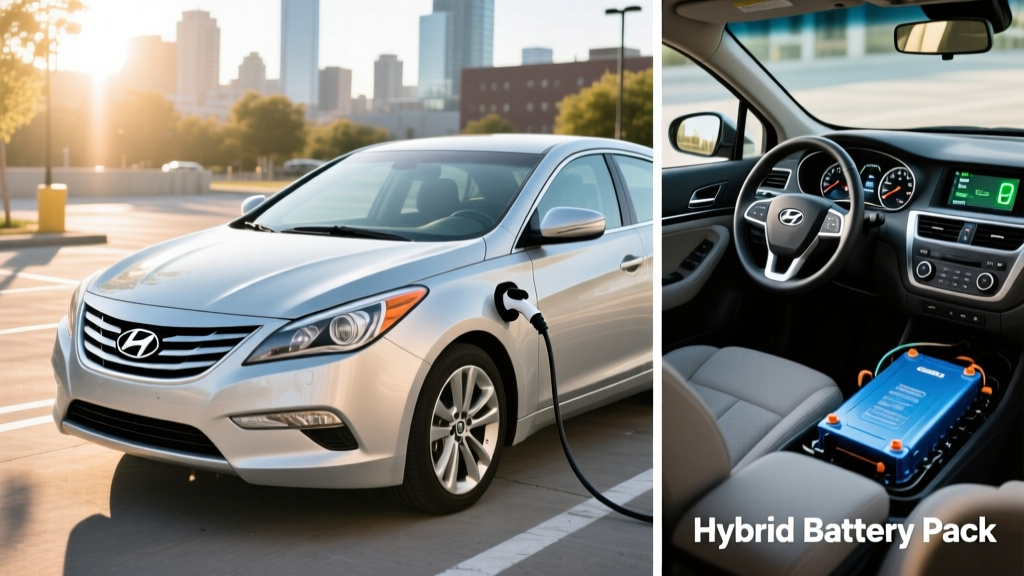
The 2011 Sonata Hybrid uses Hyundai's first-generation parallel hybrid system. A 2.4-liter Theta II gasoline engine producing 169 HP is paired with a 30 kW (40 HP) electric motor integrated into the transmission housing. Combined net system output is 206 HP. The system uses a 1.4 kWh lithium-polymer battery pack located behind the rear seats, which reduces trunk capacity to 14.0 cubic feet (down from 16.4 cu ft in the gas-only Sonata).
Critically, this is a conventional hybrid (HEV), not a plug-in hybrid. The battery charges exclusively through regenerative braking and engine-driven generation. There is no charging port, no plug, and no electric-only driving mode beyond brief low-speed assists. If you need plug-in capability, you would need to look at a PHEV like the later Hyundai Sonata Plug-in Hybrid (introduced for the 2016 model year) or a modern equivalent.
HEV vs. PHEV: What's the Difference?
| Feature | HEV (This Sonata Hybrid) | PHEV (e.g., newer Sonata PHEV) |
|---|---|---|
| Plug-in Charging | No — self-charging via regen/engine | Yes — plug in for electric-only range |
| Electric-Only Range | N/A (motor assists only) | Typically 20–40 miles |
| Battery Size | 1.4 kWh | 13–18 kWh typical |
| Federal Tax Credit (New) | None | Up to $7,500 (§30D, subject to rules) |
| Best For | Drivers without home charging access | Drivers with home charging and short commutes |
Reliability, Battery Lifespan, and Replacement Cost
The 2011 Sonata Hybrid's lithium-polymer battery was a departure from the nickel-metal hydride (NiMH) packs used in the Toyota Prius of that era. Lithium-polymer offered better energy density but was less battle-tested at the time. Now, with many examples surpassing 150,000 miles, the data is clearer.
Hybrid Battery Warranty (Original)
Hyundai originally warranted the hybrid battery for 8 years / 100,000 miles (10 years / 150,000 miles in CARB states including California, New York, Massachusetts, and others). For a 2011 model, this factory coverage has expired as of 2019–2021 depending on the state.
Real-world battery longevity: Most owner reports and repair databases indicate the 1.4 kWh lithium-polymer pack holds up well, with gradual capacity loss rather than sudden failure. Expect 150,000–200,000+ miles before significant degradation impacts fuel economy. Unlike a full EV battery, the small HEV pack cycles frequently but within a narrow state-of-charge window, which reduces stress on the cells.
Battery replacement cost (2026 estimates):
- Dealer OEM replacement: $2,500–$3,800 (battery + labor)
- Aftermarket/remanufactured pack: $1,200–$2,200
- Individual cell module repair: $500–$1,000 at a hybrid specialist shop
The Theta II engine in this generation has a known history of bearing wear and potential seizure in high-mileage examples. Hyundai issued extended warranties and recalls for certain Theta II engines. Before purchasing any used 2011 Sonata Hybrid, verify whether the engine recall/service campaign was performed by checking the VIN at NHTSA.gov. This is arguably a bigger reliability concern than the hybrid battery itself.
Hybrid vs. PHEV vs. Full EV: Which Fits Your Needs?
If you're cross-shopping the 2011 Sonata Hybrid against modern electrified options, here's a practical decision framework based on your situation:
Choose the 2011 Sonata Hybrid (HEV) If:
- You lack access to home or workplace charging
- Your budget is under $8,000
- You want simple, proven hybrid tech with no plug-in routine
- You drive 15,000+ miles/year and want 37 MPG without behavioral changes
- You live in an apartment or street-park and can't install a charger
Look at a PHEV or Full EV Instead If:
- You have home Level 2 charging and a commute under 30 miles (PHEV covers it on electric)
- You want the federal §30D tax credit (up to $7,500 for qualifying new EVs/PHEVs — see IRS.gov)
- You prioritize lower running costs: EVs cost roughly $0.04–$0.06/mile on home electricity vs. $0.12–$0.15/mile for a 37 MPG hybrid at $3.50/gal
- You want modern ADAS features (automatic emergency braking, lane-keep assist) unavailable on the 2011 Sonata
- You need a battery warranty with remaining coverage
Tax Credits and Incentives for Used Hybrid Buyers
The 2011 Hyundai Sonata Hybrid does not qualify for the federal §30D Clean Vehicle Credit, which applies only to new qualifying EVs and PHEVs with sufficient battery capacity. Conventional hybrids (HEVs) have never been eligible for the §30D credit regardless of model year.
For used electrified vehicles, the §25E Used Clean Vehicle Credit offers up to $4,000 (30% of sale price, capped) for qualifying used EVs and PHEVs purchased from a dealer — but again, this applies only to plug-in vehicles with at least 7 kWh of battery capacity. The Sonata Hybrid's 1.4 kWh pack does not meet this threshold.
In short: buying a used 2011 Sonata Hybrid means no federal tax incentive. The value proposition rests entirely on its low purchase price and strong fuel economy. Some states or utilities may offer rebates for any fuel-efficient vehicle — check your local programs — but there is no broad federal or state hybrid-specific credit for this model in 2026.
Driving Impressions and Ownership Practicalities
The 2011 Sonata Hybrid drives much like its gas-only sibling, which is both its strength and limitation. The 6-speed automatic transmission (unusual for a hybrid — most competitors used CVTs) delivers familiar shift feel and avoids the "rubber band" drone associated with Toyota's hybrid system. However, the transitions between electric and gasoline power are not as seamless as in newer hybrids. You may notice a slight shudder during engine start-stop events, and the regenerative braking feel is somewhat abrupt compared to modern systems.
Cabin noise is average for the era. The hybrid-specific low-rolling-resistance tires help efficiency but don't provide much grip in wet conditions — plan for quality all-season replacements. Interior materials and technology are dated by 2026 standards: a basic infotainment screen, no Apple CarPlay/Android Auto, and cloth seats on the base trim. The Limited trim adds leather, a premium audio system, and a sunroof.
Maintenance costs are modest. The hybrid system requires no routine service beyond what a gas car needs. The electric motor has no wearable components. Expect standard hybrid maintenance: oil changes every 5,000–7,500 miles, brake pads lasting 60,000–80,000+ miles (thanks to regenerative braking reducing friction-brake use), and cabin air filter replacements.
Pros and Cons Summary
Pros
- 37 MPG combined remains strong for a midsize sedan
- No plug-in charging required — works for apartment dwellers
- 6-speed automatic avoids CVT drone
- 206 HP provides adequate acceleration
- Low used-car pricing ($4,500–$8,000)
- Regenerative braking extends brake pad life significantly
Cons
- Theta II engine has known reliability concerns — verify recall status
- Trunk space reduced to 14.0 cu ft by battery placement
- No electric-only driving capability
- Dated infotainment and no modern ADAS features
- Hybrid system transitions are less refined than modern competitors
- No federal tax credit eligibility (new or used)
- Factory hybrid battery warranty has expired
Frequently Asked Questions
How many MPG does the 2011 Hyundai Sonata Hybrid get?
The EPA rates it at 35 MPG city, 40 MPG highway, and 37 MPG combined. Real-world driving typically yields 34–38 MPG combined, with city driving often matching or slightly exceeding the EPA estimate thanks to regenerative braking.
Does the 2011 Sonata Hybrid need to be plugged in?
No. This is a conventional hybrid (HEV). The 1.4 kWh battery charges itself through regenerative braking and the gasoline engine. There is no charging port and no plug-in capability.
How far can it drive on electric power alone?
The 2011 Sonata Hybrid does not have an electric-only driving mode. The electric motor assists the gasoline engine during acceleration and can propel the car at very low speeds for brief moments, but it cannot sustain electric-only driving like a PHEV or EV.
Is the hybrid battery reliable, and what does replacement cost?
The 1.4 kWh lithium-polymer battery is generally reliable to 150,000–200,000+ miles with gradual degradation. A dealer OEM replacement costs $2,500–$3,800; aftermarket or remanufactured options run $1,200–$2,200. The original 8-year/100,000-mile warranty has expired on all 2011 models.
Is the 2011 Sonata Hybrid more reliable than a regular gas Sonata?
The hybrid system itself adds minimal failure risk, but both models share the Theta II 2.4L engine, which has documented bearing-wear issues. Verify that any engine recall or extended-warranty service campaign was completed before purchase. Check your VIN at NHTSA.gov.
Does the 2011 Sonata Hybrid qualify for any tax credit?
No. As a conventional hybrid, it never qualified for the federal §30D credit and does not meet the battery-capacity threshold for the §25E used-vehicle credit. There are no current federal incentives for purchasing this model.
Should I buy a 2011 Sonata Hybrid or a used Toyota Prius from the same era?
The 2011 Prius (third generation) offers superior fuel economy at 50 MPG combined and a longer track record of hybrid reliability with its NiMH battery. The Sonata Hybrid provides more interior space, a more conventional driving feel with its 6-speed automatic, and slightly more power. If maximum fuel savings is the priority, the Prius wins. If you want a midsize sedan with hybrid efficiency, the Sonata Hybrid is a reasonable choice — just verify the engine recall status.
What should I check before buying a used 2011 Sonata Hybrid?
Prioritize these inspections: (1) Verify the Theta II engine recall/service campaign was performed via NHTSA.gov. (2) Check hybrid battery health — a dealer or hybrid specialist can read the battery's state of health (SoH). (3) Review maintenance records for regular oil changes. (4) Test for smooth engine start-stop transitions during a test drive. (5) Confirm the hybrid system warranty was not previously invoked, which could indicate a prior battery replacement.