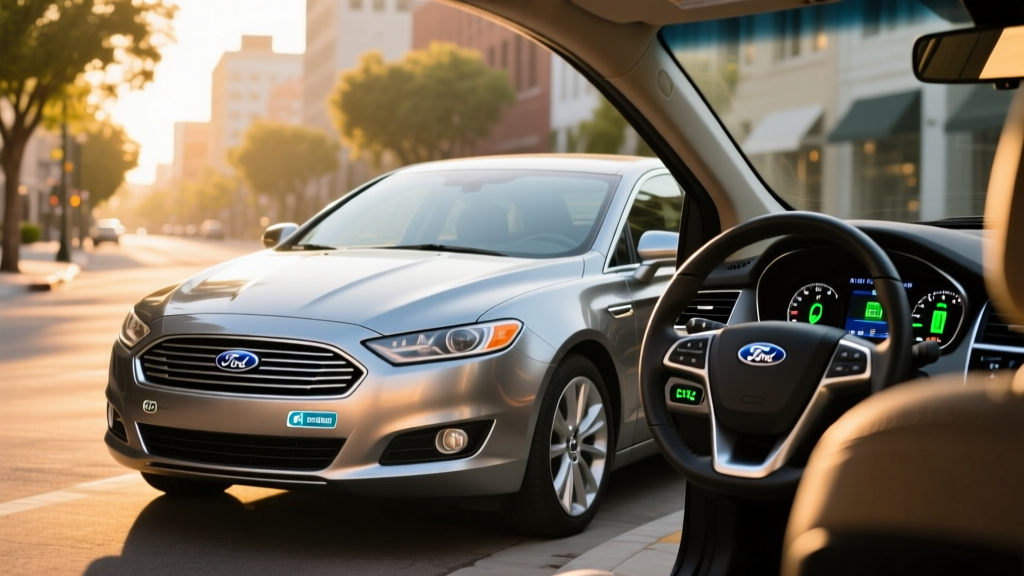
The 2011 Ford Fusion Hybrid was one of the first mainstream midsize sedans to challenge the Toyota Camry Hybrid on fuel economy alone. More than a decade later, it remains a fixture on the used-car market for budget-conscious commuters who want hybrid efficiency without plug-in complexity. This guide covers exactly what you need to know before buying one in 2026: real-world MPG, the nickel-metal hydride battery's longevity, replacement costs, and how it stacks up against modern hybrids and EVs.
HEV vs PHEV: What the 2011 Fusion Hybrid Actually Is
The 2011 Fusion Hybrid is a conventional hybrid electric vehicle (HEV). It cannot be plugged in. It generates all its electricity internally through regenerative braking and the gasoline engine. Ford did not introduce a plug-in variant until the 2013 Fusion Energi, which is a completely different powertrain.
Quick Reference: HEV vs PHEV
| Feature | 2011 Fusion Hybrid (HEV) | PHEV Example (e.g., 2017 Fusion Energi) |
|---|---|---|
| Plug-in charging | No — self-charging only | Yes — Level 1/Level 2 AC |
| Electric-only driving | Up to ~47 mph, very short distances (<1 mile) | Up to ~21 miles EPA electric-only |
| Battery size | 1.4 kWh (NiMH) | 7.6 kWh (Li-ion) |
| Federal tax credit (new) | None | Up to $4,007 (expired) |
| Driver behavior change needed | None — drive like a gas car | Plug in nightly to maximize value |
If you are shopping for a 2011 model, you are looking at an HEV. No charging cable, no electric-only commute, no plug. The trade-off is simplicity: you just fill up with gas and drive.
Fuel Economy: EPA Ratings vs Real-World MPG
The EPA rated the 2011 Ford Fusion Hybrid at 41 MPG city / 36 MPG highway / 39 MPG combined according to fueleconomy.gov. These numbers were competitive at launch and still hold up well against many 2026 non-hybrid midsize sedans.
| Driving Condition | EPA Rating | Real-World Expectation |
|---|---|---|
| City | 41 MPG | 38–44 MPG (hybrids excel in stop-and-go) |
| Highway | 36 MPG | 33–38 MPG (aerodynamic drag, less regen benefit) |
| Combined | 39 MPG | 35–41 MPG depending on driving mix |
Why City MPG Beats Highway MPG
This is the defining characteristic of conventional hybrids. In city driving, the electric motor handles low-speed acceleration — the most fuel-intensive phase — while regenerative braking recaptures energy at every stop. On the highway, the 2.5-liter Atkinson-cycle four-cylinder engine does most of the work with minimal electric assist, and the sedan's aerodynamic profile is unremarkable.
Real-World Variables That Shift MPG
Owners reporting on Fuelly and similar tracking platforms consistently log 35–42 MPG combined over multi-year averages. Factors that push numbers lower:
- Cold weather: Expect a 5–10% drop in winter months. The engine runs more frequently to provide cabin heat and maintain battery temperature.
- Aggressive acceleration: Hard throttle inputs engage the gas engine immediately, negating the electric motor's efficiency advantage.
- Tire pressure and age: Under-inflated tires or non-LRR (low rolling resistance) replacement tires can cost 2–3 MPG.
- Aging hybrid system: A degraded battery pack forces the engine to run more often, reducing electric-mode operation.
Powertrain and Performance Specs
| Specification | 2011 Ford Fusion Hybrid |
|---|---|
| Engine | 2.5L Atkinson-cycle inline-4 |
| Engine horsepower | 156 HP @ 6,000 RPM |
| Electric motor | Permanent-magnet AC synchronous |
| Combined system horsepower | 191 HP |
| Transmission | eCVT (planetary gearset, no traditional belts) |
| 0–60 MPH | ~8.2 seconds |
| Drivetrain | Front-wheel drive |
| Hybrid battery | 1.4 kWh NiMH (nickel-metal hydride) |
| Curb weight | ~3,720 lbs |
| Fuel tank | 16.5 gallons |
| Total driving range | ~640 miles (at combined EPA) |
The eCVT in this car is not a belt-and-cone CVT like those found in some Nissan or Subaru models. It uses a planetary gearset that seamlessly blends engine and motor power. This design, shared with Toyota's Hybrid Synergy Drive architecture (Ford licensed certain patents), is widely regarded as one of the most durable transmission types in existence — there are no belts to break, no clutch packs to wear, and no fixed gear ratios to hunt between.
Hybrid Battery: Longevity, Degradation, and Replacement Cost
Original Battery Warranty
8 years / 100,000 miles (10 years / 150,000 miles in California and states adopting CARB emissions standards). This warranty has expired for all 2011 models as of 2019 at the latest. Any battery failure is now an out-of-pocket expense.
NiMH Battery Durability
The 1.4 kWh nickel-metal hydride pack in the 2011 Fusion Hybrid is chemically conservative. NiMH cells degrade more slowly than early lithium-ion packs and tolerate heat well. Toyota's Prius, which used similar NiMH technology, routinely sees battery packs lasting 150,000–200,000 miles before meaningful degradation.
For a 2011 model in 2026, the battery is 15 years old. Mileage and storage conditions matter more than age alone, but you should assume some capacity loss. Signs of a degraded hybrid battery include:
- The engine running more frequently at stops or low speeds
- Noticeable drop in MPG (3–5+ MPG below historical averages)
- Rapid state-of-charge swings on the dashboard display
- A check-engine light with hybrid-related diagnostic trouble codes (P0A80, P0A7F, etc.)
Battery Replacement Costs
| Option | Cost Range (2026) | Notes |
|---|---|---|
| New OEM battery (Ford dealer) | $2,500–$3,800 installed | Full pack, original spec |
| Remanufactured battery | $1,200–$2,200 installed | Replaced weak cells, common choice for older vehicles |
| Used/salvage battery | $500–$1,000 + install | Risky — unknown remaining life |
| Individual cell/module repair | $400–$900 | Requires a hybrid-savvy technician; not all shops offer this |
Most owners of 15-year-old hybrids opt for a remanufactured pack or a module-level repair. Independent hybrid specialists in most metro areas now offer these services. The key question for a used buyer: has the battery already been replaced? A documented battery swap at 120,000 miles is a significant value-add on a 2011 model.
Reliability and Common Issues
The 2011 Fusion Hybrid benefits from a simpler powertrain than its gasoline-only siblings. There is no traditional automatic transmission to fail, no turbocharger, no direct-injection carbon buildup issue. The eCVT planetary gearset is essentially bulletproof in normal use.
Reported trouble spots from NHTSA complaints and owner forums include:
- Electric power steering (EPS): The 2010–2012 Fusion line had EPS torque sensor issues. Ford issued recalls for certain model years. Verify recall completion via NHTSA's VIN lookup.
- A/C compressor: The electric A/C compressor can fail at higher mileages. Replacement runs $800–$1,400.
- 12V auxiliary battery: Like all hybrids, the Fusion has a standard 12V battery that powers electronics. It is located in the trunk. A dead 12V battery will prevent the car from starting — even if the hybrid pack is fully charged.
- Brake actuator: The regenerative braking system uses an electrohydraulic brake actuator. Failures are uncommon but expensive ($1,200–$1,800) when they occur beyond 150,000 miles.
Overall, the 2011 Fusion Hybrid's reliability record is above average for its era. It lacks the legendary status of a contemporary Toyota Prius or Camry Hybrid, but it is not a problem-prone vehicle. A pre-purchase inspection by a technician with hybrid diagnostic capability is strongly recommended.
Tax Credits and Incentives in 2026
The 2011 Ford Fusion Hybrid does not qualify for any federal tax credit — neither when new nor under current IRS §30D rules. Conventional hybrids (HEVs) have never been eligible for the federal plug-in vehicle credit, which requires a minimum battery capacity and external charging capability.
Under the current IRS §30D clean vehicle credit, only plug-in electric vehicles (BEVs and PHEVs) with at least 7 kWh of battery capacity qualify, subject to MSRP caps, buyer income limits, and critical-mineral sourcing requirements. The 2011 Fusion Hybrid's 1.4 kWh NiMH pack falls far short.
Some states offered hybrid rebates when the car was new (e.g., California's now-defunct CVRP included hybrids in early years). Those programs have ended or transitioned to BEV/PHEV-only incentives. Check your state energy office for any residual programs, but do not expect meaningful incentive money for a used conventional hybrid purchase in 2026.
Who Should Buy the 2011 Fusion Hybrid vs a Modern EV or PHEV
Reasons to Buy
- Budget commuter: Clean examples sell for $4,000–$7,500 in 2026 — a fraction of any new hybrid or EV.
- No charging access: If you live in an apartment or lack a dedicated parking spot with an outlet, an HEV eliminates the charging problem entirely.
- Proven MPG: 39 MPG combined real-world is still excellent. That's roughly $1,100–$1,400/year in fuel at 15,000 miles and $3.20/gallon.
- Simple ownership: No charging equipment to install, no range planning, no plug-in habits to build.
Reasons to Look Elsewhere
- Battery age risk: A 15-year-old NiMH pack is a $1,500–$3,500 liability if it hasn't been replaced.
- No electric-only driving: You will burn gas on every trip, including short errands where a PHEV or EV would use zero fuel.
- Dated technology: No Apple CarPlay/Android Auto, no modern ADAS suite (lane-keeping, adaptive cruise), no DC fast charging.
- Higher-mileage examples: Most surviving 2011 models have 120,000–180,000+ miles. Suspension, steering, and interior wear are factors.
The Decision Framework
Choose the 2011 Fusion Hybrid if: Your budget is under $8,000, you drive 10,000–20,000 miles/year mostly in city or mixed conditions, you cannot charge at home, and you want low fuel costs with zero behavioral change.
Choose a used PHEV (e.g., 2017–2019 Fusion Energi, Prius Prime) if: You have home charging access, your commute is under 25 miles, and you want some electric-only driving without full EV commitment. Budget: $12,000–$20,000.
Choose a used BEV (e.g., 2018–2021 Bolt EV, Leaf, Model 3) if: You have reliable home Level 2 charging, your daily driving is under 200 miles, and you want zero tailpipe emissions and minimal maintenance. Budget: $12,000–$25,000.
Choose a new hybrid (e.g., 2026 Camry Hybrid, Accord Hybrid) if: You want a warranty, modern safety tech, and 48–52 MPG combined with no charging hassle. Budget: $29,000–$38,000.
Frequently Asked Questions
How many MPG does the 2011 Ford Fusion Hybrid get?
The EPA rates it at 41 MPG city, 36 MPG highway, and 39 MPG combined. Real-world owners typically see 35–42 MPG combined depending on driving style, climate, and battery condition. City driving yields the best results because regenerative braking and electric-motor assist are maximized at low speeds.
Can the 2011 Fusion Hybrid drive on electric power only?
Only in very limited circumstances. The car can propel itself on electric power alone at speeds up to approximately 47 MPH, but only for very short distances — typically under one mile and only with a sufficiently charged battery and light throttle input. This is not a meaningful electric-only range for commuting. It functions as an efficiency assist, not an EV mode.
Is the 2011 Fusion Hybrid reliable?
Above average for its model year. The eCVT transmission and Atkinson-cycle engine are durable designs. The main reliability risk at this age is the hybrid battery pack, which is 15 years old and likely past its original warranty. Budget $1,500–$3,000 as a contingency for battery service if there is no documented replacement. Other wear items (suspension, A/C, 12V battery) are typical for any 15-year-old vehicle.
How much does it cost to replace the hybrid battery?
A remanufactured battery pack installed by an independent hybrid shop runs $1,200–$2,200 in 2026. A new OEM pack from a Ford dealer costs $2,500–$3,800 installed. Module-level repairs, where only the weak cells are replaced, can cost $400–$900 but require a specialist. Most used buyers find a remanufactured pack offers the best value for a vehicle in this price range.
Does the 2011 Ford Fusion Hybrid qualify for any tax credit?
No. Conventional hybrids have never qualified for the federal §30D plug-in vehicle tax credit, which requires external charging capability and a minimum battery capacity of 7 kWh. The Fusion Hybrid's 1.4 kWh pack does not meet this threshold. No current state incentives target used conventional hybrid purchases either.
What should I check before buying a used 2011 Fusion Hybrid?
Prioritize these items: (1) hybrid battery state of health — ask for a scan-tool readout of battery block voltages and internal resistance; (2) recall completion, especially for electric power steering — verify via NHTSA VIN lookup; (3) maintenance records showing regular oil changes and transmission fluid service; (4) brake actuator function — listen for unusual pump cycling when pressing the brake pedal at a stop; (5) 12V battery age — a weak 12V battery causes phantom electrical issues in hybrids.
How does the 2011 Fusion Hybrid compare to a Toyota Camry Hybrid of the same year?
The 2011 Camry Hybrid was rated at 31/35/33 MPG (city/highway/combined) — significantly lower than the Fusion Hybrid's 41/36/39. The Fusion's more advanced hybrid system gave it a clear efficiency edge. However, the Camry Hybrid benefits from Toyota's deeper hybrid reliability track record and wider parts availability. If MPG is the priority, the Fusion wins on paper. If long-term parts support and resale demand matter more, the Camry holds an advantage.