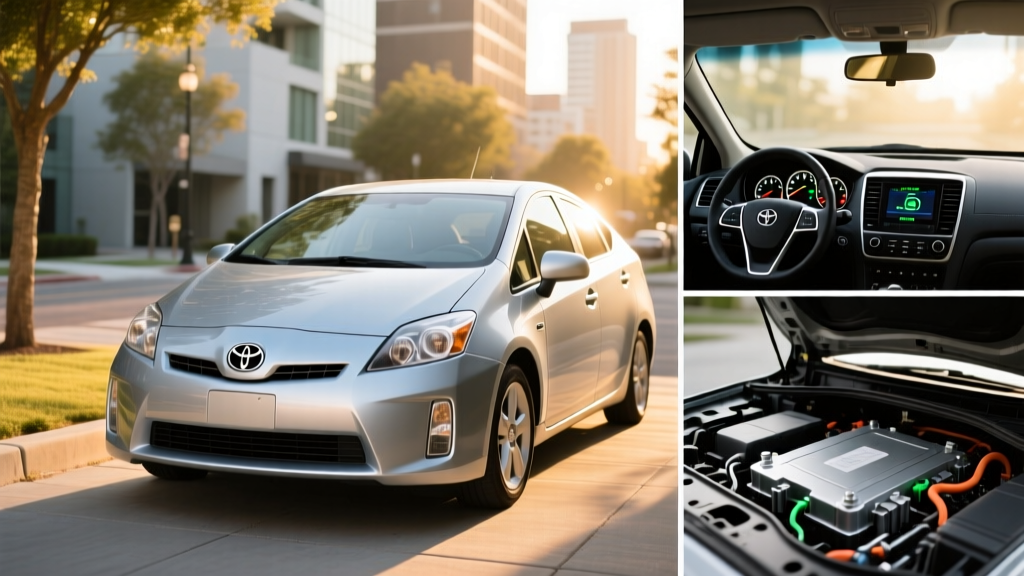
Quick Verdict: The 2010 Prius III Still Delivers at 50 MPG
If you're researching the 2010 Toyota Prius III hybrid as a used-car purchase, you're looking at one of the most fuel-efficient vehicles ever sold in the United States — and one of the most proven. The third-generation Prius (XW30 platform) introduced a larger 1.8-liter engine, improved aerodynamics, and a refined Hybrid Synergy Drive system that achieved an EPA-estimated 50 MPG combined. In 2026, well-maintained examples are still posting 45–52 MPG on the road, making this a compelling budget hybrid for commuters who aren't ready to go full EV.
The Prius III (sometimes written as Prius Three) sits mid-range in the 2010 lineup, adding features like a smart key system, upgraded audio, and an available navigation package over the base Prius I and II trims. Below, we break down every number that matters: fuel economy, powertrain specs, battery health, real-world ownership costs, and how it compares to modern PHEVs and BEVs.
2010 Toyota Prius III: Core Specifications
| Specification | Value |
|---|---|
| Powertrain Type | Series-parallel full hybrid (HEV) — no plug-in required |
| Gas Engine | 1.8L 4-cylinder Atkinson cycle, 98 hp |
| Electric Motor | 60 kW (80 hp) permanent magnet AC synchronous |
| Combined Net Horsepower | 134 hp |
| 0–60 mph | ~9.8 seconds |
| Hybrid Battery | 1.3 kWh nominal (NiMH), ~201.6V |
| Transmission | eCVT (planetary gearset, no fixed gears) |
| EPA Fuel Economy | 51 city / 48 highway / 50 combined MPG |
| Fuel Tank | 11.9 gallons |
| Total Driving Range | ~595 miles (EPA est.) |
| Cargo Volume | 21.6 cu ft (rear seats up) / 39.6 cu ft (folded) |
| Curb Weight | ~3,042 lbs |
| Original MSRP (2010) | $24,270 (Prius III before destination) |
| Used Price Range (2026) | $4,500–$8,500 depending on mileage and condition |
Fuel Economy: EPA Sticker vs. Real-World MPG
The EPA rated the 2010 Prius III at 51 MPG city, 48 MPG highway, and 50 MPG combined — numbers confirmed on fueleconomy.gov. These figures held up remarkably well in real-world use. According to aggregated driver data on Fuelly, owners of the 2010 Prius report a lifetime average of approximately 47.1 MPG, with many individual drivers consistently achieving 48–52 MPG in mixed driving.
- City driving: 49–54 MPG — regenerative braking and electric-only low-speed operation favor stop-and-go traffic
- Highway (65–70 mph): 44–48 MPG — aerodynamic drag and sustained engine use reduce efficiency vs. city
- Highway (75+ mph): 40–44 MPG — efficiency drops noticeably above 70 mph
- Cold weather (below 32°F): 38–44 MPG — engine runs more often for cabin heat; battery is less efficient
- Warm-weather combined: 48–52 MPG — peak efficiency in 60–85°F conditions
The Prius III's city MPG advantage over highway is a hallmark of Toyota's Hybrid Synergy Drive. At low speeds, the car operates on electric power alone for short distances, and the regenerative braking system recaptures energy that would otherwise be lost. On the highway, the 1.8L Atkinson-cycle engine runs continuously, and there's less opportunity for regeneration.
HEV vs. PHEV vs. EV: Where the 2010 Prius III Fits
The 2010 Prius III is a conventional hybrid electric vehicle (HEV). This is a critical distinction for shoppers cross-comparing with plug-in hybrids or full battery-electric vehicles. Here's how the three categories differ:
HEV (This Prius)
- No plug — charges via engine and regenerative braking
- Small battery (1.3 kWh)
- Electric-only: ~1 mile at very low speeds
- 50 MPG combined
- No range anxiety, no charging infrastructure needed
PHEV (e.g., Prius Prime)
- Plugs in for 25–44 miles electric-only
- Larger battery (8.8–13.6 kWh)
- Can DC fast charge (newer models)
- Gas engine kicks in after battery depletes
- May qualify for §30D tax credit (new purchases)
BEV (e.g., Model 3, Ioniq 5)
- 100% electric — no gas engine
- Large battery (50–100+ kWh)
- 250–350+ mile EPA range
- Requires home or public charging access
- Eligible for up to $7,500 federal credit (new)
The 2010 Prius III does not plug in. It has no electric-only range to speak of (the small NiMH battery provides brief low-speed assist, not sustained electric driving). If you want plug-in capability from a Prius, you'd need the Prius Plug-in Hybrid (2012–2015) or the Prius Prime (2017–present). Those PHEVs offer 11–44 miles of electric-only range depending on model year.
Hybrid Battery Health, Warranty, and Replacement Cost
Battery longevity is the single biggest concern for used Prius buyers — and it should be. The 2010 Prius III uses a nickel-metal hydride (NiMH) battery pack rated at 1.3 kWh nominal capacity, operating at approximately 201.6 volts. This is not the same chemistry as modern lithium-ion EV batteries; NiMH is less energy-dense but has proven remarkably durable over high mileage.
- Original warranty: 8 years / 100,000 miles (10 years / 150,000 miles in CARB states including CA, NY, MA, and others)
- Expected lifespan: 150,000–200,000+ miles with proper maintenance; many exceed 250,000 miles
- Common failure mileage: 120,000–180,000 miles in hot climates; 180,000–250,000+ in moderate climates
- Replacement cost (OEM new): $2,200–$3,500 installed at a Toyota dealer
- Replacement cost (refurbished/remanufactured): $1,000–$1,800 installed at an independent hybrid specialist
- Individual module replacement: $150–$400 if only 1–2 of the 28 modules are weak (diagnostic-dependent)
Heat is the primary enemy of the Prius NiMH battery. Cars that spent their lives in Arizona, Texas, or Southern California tend to see earlier battery degradation than those in cooler climates. The cabin air intake vent for the battery (located near the rear seat) must remain unobstructed — blocked airflow accelerates battery wear.
Before buying used: Have the hybrid battery tested with a Toyota Techstream diagnostic scan or a dedicated hybrid battery tester. Look for voltage delta between modules (a difference greater than 0.3V between the highest and lowest module indicates imbalance and impending failure). A healthy battery should show module voltages within 0.1–0.2V of each other under load.
Powertrain and Driving Experience
The 2010 Prius III pairs a 1.8-liter 2ZR-FXE Atkinson-cycle four-cylinder engine (98 hp, 105 lb-ft torque) with a 60 kW electric motor through Toyota's Hybrid Synergy Drive eCVT. Combined net output is 134 horsepower. The Atkinson cycle sacrifices low-RPM torque for superior thermal efficiency — the engine achieves roughly 38% thermal efficiency, which was class-leading in 2010.
The eCVT is not a traditional belt-and-pulley CVT. It uses a planetary gearset that seamlessly blends power from the engine and motor(s). There are no fixed gear ratios and no belt to wear out — this is why Prius transmissions are essentially bulletproof, with very few reported failures even past 200,000 miles.
Driving dynamics: The 2010 Prius III offers three driving modes — EV (electric-only at very low speed for under ~1 mile), Eco (reduces throttle response and A/C load for maximum efficiency), and Power (sharpens throttle response for merging). The 0–60 mph time of approximately 9.8 seconds is adequate for merging but not quick by modern standards. Handling is competent but comfort-oriented; the low-rolling-resistance tires prioritize efficiency over grip.
Reliability, Common Issues, and Ownership Costs
The third-generation Prius (2010–2015) is one of the most reliable vehicles Toyota has built. Data from owner surveys and repair databases show these common issues to watch for:
- Head gasket failure (EGR-related): The most significant known issue. Carbon buildup in the EGR (exhaust gas recirculation) system can cause localized overheating and head gasket failure, typically between 120,000–200,000 miles. Prevention: clean the EGR circuit and intake manifold every 80,000–100,000 miles (~$200–$400 service). Repair if failed: $2,500–$4,000.
- Brake actuator recall/wear: Some 2010 Prius models were subject to a brake actuator recall. Check NHTSA recall status via VIN at nhtsa.gov/recalls. Replacement cost if out of warranty: $1,200–$1,800.
- Oil consumption: Some 2010–2012 1.8L engines consume oil between changes. Check oil level every 3,000–5,000 miles. Toyota issued a technical service bulletin (not a recall) for excessive consumption.
- Inverter coolant pump: The hybrid inverter coolant pump can fail, typically around 100,000–150,000 miles. There was a recall for certain model years. Replacement: $300–$500.
- 12V auxiliary battery: Like all cars, the 12V battery (located in the rear cargo area) needs replacement every 4–6 years. Use an AGM-type battery specified for the Prius (~$180–$250).
Annual maintenance costs: Expect $400–$700 per year for routine maintenance (oil changes, brake fluid, coolant, cabin air filter, tire rotation). The regenerative braking system significantly extends brake pad life — many Prius owners report 80,000–100,000+ miles on original brake pads.
Tax Credit and Incentive Eligibility
As a 2010 conventional hybrid (HEV), the Prius III does not qualify for the federal §30D clean vehicle tax credit. That credit applies only to new plug-in electric vehicles (PHEVs and BEVs) meeting battery-sourcing, MSRP, and buyer-income requirements per IRS guidelines.
For the 2010 Prius III as a used purchase in 2026:
- Federal tax credit: Not eligible (HEV, and the used-EV credit under §25E applies only to plug-in vehicles under $25,000)
- State incentives: Some states offer registration fee reductions, HOV lane access, or emissions-test exemptions for hybrids — check your state's DMV or energy office
- HOV lane access: In most states, hybrid-only HOV lane stickers have expired or are limited to PHEVs/BEVs. California's Clean Air Vehicle decals for the 2010 Prius have long since expired
The financial case for the 2010 Prius III rests entirely on fuel savings, not tax incentives. At $3.40/gallon and 15,000 miles/year, the Prius III at 50 MPG costs approximately $1,020/year in fuel — compared to $1,889/year for a comparable 27 MPG compact gas car. That's roughly $869 in annual fuel savings, or $4,345 over five years.
2010 Prius III vs. Modern Alternatives: What Should You Buy?
Pros
- 50 MPG combined — still top-tier efficiency in 2026
- Extremely low annual fuel cost (~$1,020/yr)
- Proven reliability with 200,000+ mile potential
- No charging infrastructure needed
- Low purchase price ($4,500–$8,500 used)
- Massive aftermarket and repair knowledge base
- Strong parts availability
Cons
- No electric-only driving range
- No federal tax credit eligibility
- Hybrid battery replacement risk ($1,000–$3,500)
- EGR/head gasket concern at high mileage
- Dated infotainment and safety tech (no AEB, no backup camera standard)
- Modest 134 hp — slow by modern standards
- NiMH battery less efficient than modern Li-ion hybrids
Decision Framework: Is the 2010 Prius III Right for You?
Choose the 2010 Prius III if: You want maximum MPG on a tight budget ($5,000–$8,000), you drive 12,000+ miles per year (making fuel savings significant), you lack home charging access for a PHEV/EV, or you need a proven commuter that any mechanic can service.
Choose a modern PHEV (e.g., 2024–2026 Prius Prime) instead if: You can charge at home, you want 40+ miles of electric-only commuting, you want modern safety tech (AEB, lane-keeping, adaptive cruise), and you can spend $33,000+ (potentially $25,500+ after the $7,500 federal credit).
Choose a full BEV (e.g., Chevy Bolt, Tesla Model 3) instead if: You have reliable home or workplace charging, your daily driving is under 250 miles, you want zero tailpipe emissions and minimal maintenance, and you qualify for the federal tax credit.
Frequently Asked Questions
How many MPG does the 2010 Toyota Prius III hybrid get?
The EPA rates the 2010 Prius III at 51 MPG city, 48 MPG highway, and 50 MPG combined. Real-world data from owners shows an average of approximately 47 MPG, with typical results ranging from 44 MPG (cold weather, aggressive driving, high speeds) to 54 MPG (warm weather, city-heavy driving, conservative habits).
Does the 2010 Prius III need to be plugged in?
No. The 2010 Prius III is a conventional hybrid (HEV), not a plug-in hybrid. Its small 1.3 kWh NiMH battery charges entirely through the gas engine and regenerative braking. You fuel it like a normal car — there is no plug, no charging cable, and no electric-only commuting range.
How long does the hybrid battery last and what does replacement cost?
The 2010 Prius NiMH hybrid battery typically lasts 150,000–250,000 miles depending on climate and usage. Hot climates accelerate degradation. OEM replacement at a Toyota dealer costs $2,200–$3,500 installed. Refurbished/remanufactured batteries from independent hybrid specialists cost $1,000–$1,800 installed. In some cases, individual weak modules can be replaced for $150–$400.
Is the 2010 Prius III reliable at high mileage?
Yes, with proper maintenance. The powertrain (engine, eCVT, hybrid system) is exceptionally durable. The primary high-mileage concern is EGR system carbon buildup leading to head gasket failure — a preventive EGR cleaning every 80,000–100,000 miles mitigates this risk. The eCVT planetary gearset has no wear-prone belts and rarely fails. Many 2010 Prius examples exceed 250,000–300,000 miles with basic maintenance.
Does the 2010 Prius III qualify for any tax credit?
No. The 2010 Prius III is a conventional hybrid (HEV), not a plug-in vehicle. It does not qualify for the federal §30D new clean vehicle credit or the §25E used clean vehicle credit. Some states may offer minor benefits (emissions inspection exemptions, reduced registration fees) — check your state's current programs.
How does the 2010 Prius III compare to the current Prius?
The 2025–2026 Toyota Prius (fifth generation) produces 196 hp (a 46% increase), achieves 57 MPG combined (7 MPG better), and offers an available Prius Prime PHEV variant with up to 44 miles of electric-only range. However, a new Prius starts around $28,550–$37,000 depending on trim. The 2010 Prius III at $4,500–$8,500 used delivers roughly 88% of the fuel efficiency at 15–25% of the purchase price — a strong value proposition for budget-conscious commuters.