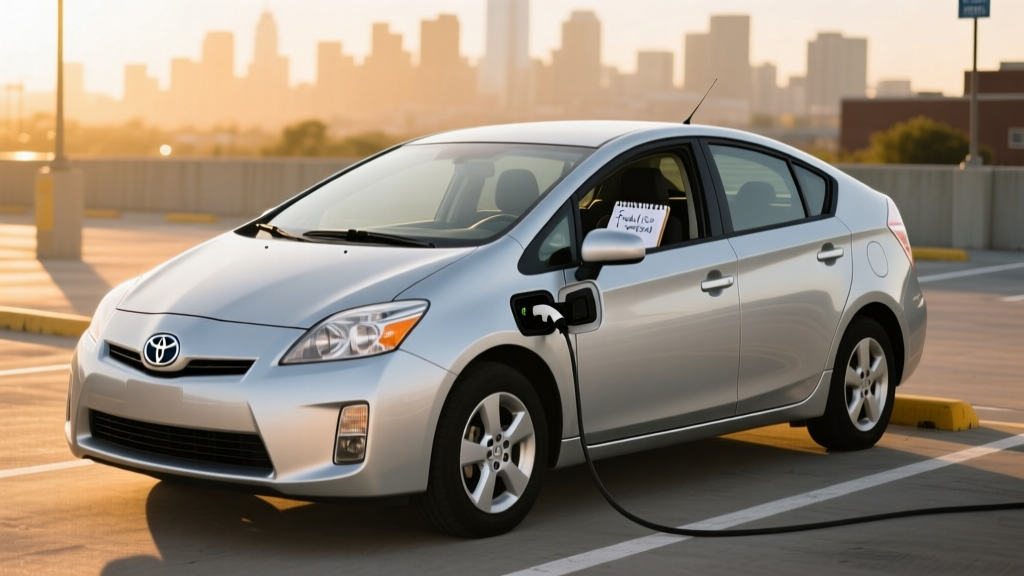
The 2010 Toyota Prius hybrid remains one of the most recognizable nameplates on the used car market in 2026. As a third-generation model, it introduced a larger 1.8-liter engine, improved aerodynamics, and the now-iconic hatchback silhouette that defined the hybrid segment for a decade. For budget-conscious shoppers eyeing a fuel-efficient daily driver under $8,000, the 2010 Prius still delivers compelling economics — but only if the hybrid battery is in good health.
This guide covers everything a used-car buyer needs to know: exact EPA fuel economy, real-world MPG expectations, battery lifespan and replacement costs, reliability data, and how this conventional hybrid (HEV) stacks up against modern PHEVs and full EVs in 2026.
2010 Toyota Prius Hybrid: Key Specifications
| Specification | 2010 Toyota Prius (Third Gen) |
|---|---|
| Powertrain Type | Conventional Hybrid (HEV) — no plug |
| Engine | 1.8L 4-cylinder Atkinson cycle (98 hp) |
| Electric Motor | Permanent magnet AC synchronous (80 hp / 60 kW) |
| Combined System Output | 134 hp |
| Hybrid Battery | 1.3 kWh Nickel-Metal Hydride (NiMH) |
| Transmission | eCVT (planetary gearset) |
| EPA City MPG | 51 MPG |
| EPA Highway MPG | 48 MPG |
| EPA Combined MPG | 50 MPG |
| 0-60 mph | ~9.8 seconds |
| Cargo Volume (rear seats up) | 21.6 cu ft |
| Cargo Volume (rear seats folded) | 39.6 cu ft |
| Original MSRP (base) | $22,800 |
| Typical 2026 Used Price | $4,500 – $8,000 |
Sources: EPA Fuel Economy — 2010 Toyota Prius, Toyota Motor Corporation archived specs.
Fuel Economy: EPA Sticker vs. Real-World MPG
The EPA rates the 2010 Prius at 51 city / 48 highway / 50 combined MPG. These were class-leading figures when the car launched, and they still hold up remarkably well against modern non-plug-in hybrids.
In practice, most 2010 Prius owners report 44–50 MPG combined in mixed driving. City-heavy routes often push above the EPA estimate — the regenerative braking system recovers more energy in stop-and-go traffic, where the electric motor handles low-speed propulsion. Highway-only driving at 70+ mph typically drops to 42–46 MPG due to aerodynamic drag overwhelming the hybrid system's efficiency advantage.
Cold weather (below 40°F) can reduce fuel economy by 10–15% as the engine runs longer to heat the cabin and bring the catalytic converter to operating temperature. Expect 38–44 MPG in winter conditions.
| Driving Scenario | Expected MPG |
|---|---|
| City (stop-and-go, under 40 mph) | 48–53 MPG |
| Highway (65–70 mph, steady cruise) | 42–46 MPG |
| Mixed combined (typical commute) | 44–50 MPG |
| Cold weather (below 40°F) | 38–44 MPG |
| Hot weather with A/C | 43–48 MPG |
HEV vs. PHEV: What the 2010 Prius Is (and Isn't)
The 2010 Prius is a conventional hybrid electric vehicle (HEV). It cannot be plugged in. The 1.3 kWh NiMH battery charges exclusively through regenerative braking and the gasoline engine. The electric motor assists during acceleration and can propel the car at low speeds (under ~25 mph) for very short distances — typically less than a mile on electric power alone.
| Feature | HEV (2010 Prius) | PHEV (e.g., 2026 Prius Prime) |
|---|---|---|
| Plugs in to charge? | No | Yes |
| Battery capacity | 1.3 kWh (NiMH) | 13.6 kWh (Li-ion) |
| Electric-only range | <1 mile at low speed | ~44 miles |
| Total range | ~500+ miles (gas tank) | ~44 electric + ~400 gas |
| Federal tax credit | No | Up to $3,750 (§30D) |
| Home charging needed? | No | Yes (Level 1 or 2) |
Toyota introduced the plug-in variant (originally called Prius Plug-In, now Prius Prime) in the 2012 model year. If you need meaningful electric-only driving range or want to charge at home and reduce gasoline consumption further, a newer PHEV is the right choice — but at a significantly higher purchase price.
Hybrid Battery Lifespan, Warranty, and Replacement Cost
This is the single biggest concern for any used 2010 Prius buyer. The NiMH hybrid battery is now 15–16 years old, and its health directly determines the car's fuel economy, drivability, and long-term viability.
Toyota originally warranted the hybrid battery for 8 years / 100,000 miles (extended to 10 years / 150,000 miles in California and states adopting CARB emissions standards). That factory coverage has expired for all 2010 models.
In practice, well-maintained 2010 Prius hybrid batteries have lasted 150,000–200,000+ miles. However, age-related degradation is now a factor regardless of mileage. Expect 10–20% capacity loss on an original battery, which translates to slightly reduced fuel economy and more frequent engine engagement.
| Battery Scenario | Estimated Cost (2026) |
|---|---|
| New OEM Toyota NiMH battery | $2,200 – $2,800 (parts) + $500–$800 labor |
| Refurbished / reconditioned battery | $1,000 – $1,600 installed |
| Aftermarket new battery (e.g., Green Bean) | $1,400 – $2,000 installed |
| Individual module replacement (1–2 bad cells) | $300 – $600 at a hybrid specialist |
Buyer tip: Before purchasing any 2010 Prius, have a hybrid-qualified mechanic perform a battery health check. A vehicle history report can reveal whether the battery was previously replaced under warranty. If the battery has been replaced within the last 3–5 years, that's a significant value-add worth $2,000+ in avoided near-term expense.
Reliability and Common Issues at 15+ Years
The 2010 Prius earned a strong reliability reputation, and the third-generation powertrain is considered one of Toyota's most durable. The eCVT transmission uses a planetary gearset with no traditional clutches or bands, making it virtually bulletproof with basic fluid maintenance.
Beyond the hybrid battery, these are the most common issues reported on high-mileage 2010 Prius examples:
- Head gasket failure (EGR-related): The most significant mechanical concern. Carbon buildup in the EGR (Exhaust Gas Recirculation) system can cause head gasket failure, typically between 120,000–180,000 miles. Prevention: EGR circuit cleaning every 60,000 miles. Repair cost: $1,800–$3,000.
- Brake actuator recall: Toyota issued a recall for the brake actuator assembly on 2010 models. Verify this recall was performed (free at any Toyota dealer).
- Inverter coolant pump: Can fail around 100,000–140,000 miles. Replacement: $400–$700. An overheating inverter will trigger warning lights and may disable hybrid drive.
- 12V auxiliary battery: A conventional lead-agency 12V battery located in the rear. Replacement every 4–5 years, ~$180–$250 for the correct AGM-type group size.
- Oil consumption: Some 2ZR-FXE 1.8L engines consume oil at higher mileage. Check oil level every 2,000 miles.
Powertrain and Driving Experience
The 2010 Prius pairs a 98-hp 1.8-liter Atkinson-cycle four-cylinder with an 80-hp (60 kW) electric motor for a combined system output of 134 hp. The Atkinson cycle sacrifices low-end torque for thermal efficiency — the engine stays in its most efficient RPM range while the electric motor fills in torque gaps during acceleration.
The eCVT (electronically controlled continuously variable transmission) is not a belt-driven CVT like those found in some competitors. It uses a planetary gearset that seamlessly blends engine and motor power with no shifting feel. Acceleration to 60 mph takes approximately 9.8 seconds — adequate for merging and city driving but noticeably slow by 2026 standards.
Three driving modes are available: EV (electric-only at very low speeds), Eco (reduces throttle response and A/C output for maximum efficiency), and Power (sharper throttle mapping for highway passing). In daily use, most drivers simply leave it in the default mode and let the hybrid system manage energy flow automatically.
Tax Credits, Pricing, and Ownership Economics
As a used conventional hybrid, the 2010 Prius does not qualify for any federal tax credit. The IRS §30D Clean Vehicle Credit applies only to new qualifying EVs and PHEVs with specific battery sourcing, MSRP caps, and buyer income limits. There is no federal incentive for purchasing a used HEV.
Some states offer minor registration fee reductions or HOV lane access for hybrids, but most of these programs have been restructured to favor zero-emission vehicles. Check your state's DMV for current provisions.
| Cost Factor | 2010 Toyota Prius (Used HEV) |
|---|---|
| Typical purchase price (2026) | $4,500 – $8,000 |
| Federal tax credit | $0 (not eligible) |
| Annual fuel cost (12,000 mi @ 47 MPG, $3.40/gal) | ~$868 |
| Annual fuel cost (comparable gas car @ 28 MPG) | ~$1,457 |
| Annual fuel savings vs. gas car | ~$589 |
| Insurance (avg. annual) | $900 – $1,300 |
| Estimated annual maintenance | $400 – $700 |
The fuel savings alone — nearly $600 per year versus a comparable 28-MPG gasoline compact — make the 2010 Prius a compelling budget option. Over five years of ownership, fuel savings can offset $3,000 of the purchase price.
Who Should Buy the 2010 Prius — And Who Shouldn't
- You need a reliable, ultra-efficient commuter on a tight budget (under $8,000).
- You drive primarily in city or suburban traffic where hybrid efficiency shines.
- You cannot install a home charger (apartment, street parking) — no plug required.
- You want proven reliability with widely available parts and hybrid-savvy mechanics.
- You value hatchback cargo versatility (21.6 cu ft with seats up).
- You want electric-only driving for daily commutes (consider a used or new Prius Prime, RAV4 Prime, or a BEV like the Chevy Bolt or Hyundai Ioniq 5).
- You want to qualify for federal or state EV tax credits.
- You drive more than 15,000 miles per year and want to significantly reduce gasoline costs with home solar charging.
- You want modern safety features (automatic emergency braking, lane-keeping assist) — the 2010 Prius predates these as standard equipment.
- You want a new-vehicle warranty and the latest infotainment (Apple CarPlay, Android Auto).
Frequently Asked Questions
How many MPG does the 2010 Toyota Prius hybrid get?
The EPA rates the 2010 Prius at 51 city / 48 highway / 50 combined MPG. Real-world combined driving typically yields 44–50 MPG, with city-heavy routes sometimes exceeding the EPA estimate and sustained highway driving dropping to 42–46 MPG. Cold weather can reduce economy by 10–15%.
Does the 2010 Prius need to be plugged in?
No. The 2010 Prius is a conventional hybrid (HEV), not a plug-in hybrid (PHEV). The battery charges through regenerative braking and the gasoline engine. You never plug it in — you simply fill the gas tank as you would with any other car.
How far can the 2010 Prius go on electric power alone?
Less than one mile, and only at very low speeds (under ~25 mph). The 1.3 kWh NiMH battery is far too small for meaningful electric-only driving. If you need substantial electric range, look at a PHEV like the Prius Prime (44 miles electric-only) or a full battery-electric vehicle.
Is the 2010 Prius reliable, and what does a battery replacement cost?
Yes, the 2010 Prius is widely regarded as one of the most reliable vehicles Toyota has produced. The main risk is the hybrid battery, which at 15+ years old may need replacement. A new OEM battery costs $2,700–$3,600 installed; refurbished options run $1,000–$1,600. The EGR-related head gasket issue is the most significant mechanical concern at high mileage. The original hybrid battery warranty (8yr/100k mi) has expired on all 2010 models.
Does the 2010 Prius qualify for any tax credit?
No. The 2010 Prius is a conventional hybrid (HEV) and does not qualify for the federal §30D Clean Vehicle Credit, which applies only to new qualifying EVs and PHEVs. The original hybrid tax credit that existed when the Prius was new expired for Toyota in 2010. Some states may offer minor benefits — check your local DMV.
What should I check before buying a used 2010 Prius?
Prioritize a hybrid battery health test (voltage delta across modules), verify the brake actuator recall was completed, inspect the EGR circuit for carbon buildup, check for oil consumption history, and confirm the inverter coolant pump is functioning. A pre-purchase inspection by a hybrid-qualified mechanic is strongly recommended and typically costs $100–$200.