Chevrolet's Two-Mode Hybrid system was one of the most ambitious powertrain gambles of the late 2000s, and the 2010 Silverado 1500 Hybrid sits squarely in the middle of that experiment. With the full-size truck segment now dominated by modern hybrids like the Ford F-150 PowerBoost and the Toyota Tundra i-FORCE MAX, the 2010 Silverado Hybrid has become a niche used-market curiosity. But for buyers hunting a capable work truck with a modest fuel-economy edge at a steep discount, it still warrants a serious look — provided you understand exactly what you're getting.
This guide covers the 2010 Silverado 1500 Hybrid's real-world efficiency, powertrain architecture, battery longevity, and what it costs to own one in 2026. If you're cross-shopping it against a conventional gas Silverado or a modern hybrid truck, we'll give you the numbers to decide.
What Is the 2010 Silverado 1500 Hybrid?
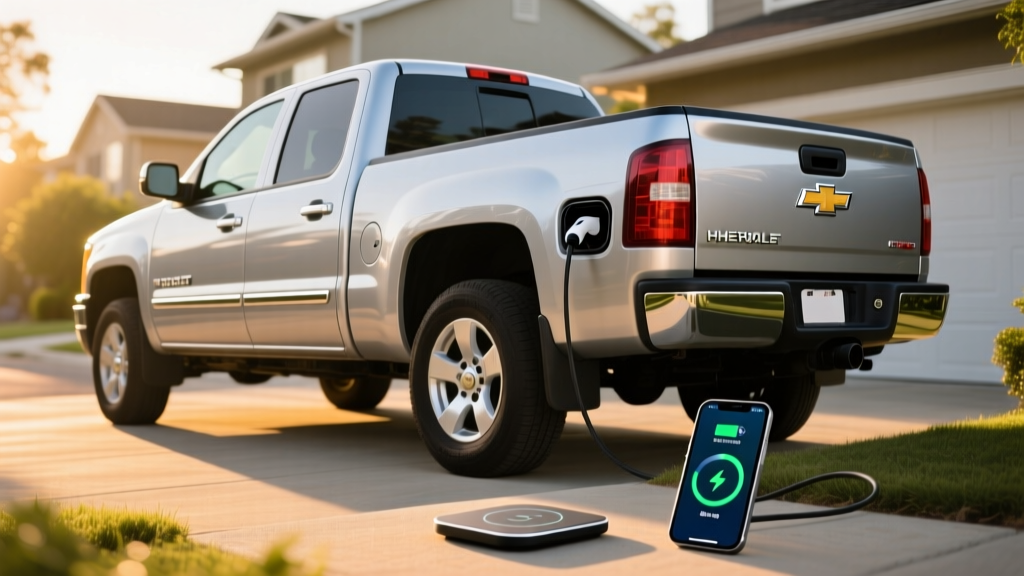
The 2010 Silverado 1500 Hybrid is a conventional hybrid (HEV), not a plug-in hybrid (PHEV). That distinction matters enormously. It uses GM's Two-Mode Hybrid system — a collaboration originally developed with BMW, Chrysler, and Daimler — which pairs a 6.0-liter Vortec V8 with two electric motors housed inside a specialized electronically variable transmission (EVT). The system recovers energy during braking and assists the gasoline engine during acceleration. You never plug it in; the 1.8 kWh nickel-metal hydride (NiMH) battery pack charges exclusively through regenerative braking and engine-driven generation.
HEV vs. PHEV — Quick Clarification
HEV (this truck): No plug. Battery recharges via regen and engine. Smaller battery (~1.8 kWh). Modest electric assist at low speeds. MPG improvement over gas-only model: roughly 20–25% in city driving.
PHEV (e.g., modern alternatives): Plugs into a wall or charger. Larger battery (typically 15–25 kWh). Can drive 20–40+ miles on electricity alone before the engine starts. Requires access to charging infrastructure to realize full benefit.
The 2010 Silverado 1500 Hybrid requires zero changes to your fueling routine — you fill it at a gas station like any other truck.
Fuel Economy: EPA MPG and Real-World Results
According to fueleconomy.gov, the 2010 Chevrolet Silverado 1500 Hybrid 2WD carries the following EPA ratings:
| Metric | 2WD Hybrid | 4WD Hybrid | 2WD Gas 5.3L V8 (for comparison) |
|---|---|---|---|
| City MPG | 21 | 20 | 15 |
| Highway MPG | 22 | 21 | 21 |
| Combined MPG | 21 | 20 | 17 |
The hybrid system delivers its biggest advantage in stop-and-go city driving, where regenerative braking and electric-motor assist do the most work. The 2WD hybrid's 21 city MPG represents a 40% improvement over the gas-only 5.3L V8's 15 city MPG — a genuinely significant gain for urban and suburban truck use. On the highway, the advantage nearly disappears because the 6.0L V8 is still doing most of the work at sustained speeds.
Real-world expectations: Owner reports and long-term tests from the era consistently showed 18–20 MPG combined for the 4WD model under mixed driving, with city-heavy commutes occasionally pushing into the low 20s. If your driving is predominantly highway at 70+ mph, expect figures closer to 18–19 MPG even in the 2WD model. Cold weather and heavy payloads will further reduce efficiency, as they do with any hybrid.
Powertrain Specs: The Two-Mode Hybrid System
| Specification | Detail |
|---|---|
| Engine | 6.0L Vortec V8 (VVT, Active Fuel Management) |
| Gasoline Engine Output | 332 hp @ 5,100 rpm / 367 lb-ft @ 4,100 rpm |
| Electric Motors | Two AC synchronous motors (60 kW each) inside EVT |
| Combined System Output | 379 hp |
| Transmission | 2-Mode EVT (electronically variable transmission) |
| Battery Pack | 1.8 kWh NiMH (nickel-metal hydride), 300V |
| Towing Capacity | Up to 6,100 lbs (2WD) / 5,900 lbs (4WD) |
| Payload Capacity | ~1,300–1,500 lbs depending on configuration |
| Drivetrain | RWD (2WD) or 4WD with Autotrac transfer case |
The Two-Mode system is clever engineering. In "Mode 1" (low-speed, city driving), the truck can launch and cruise up to roughly 30 mph on electric power alone for very short distances — typically a few hundred yards at a time. The V8 uses Active Fuel Management (AFM) to shut down four cylinders under light loads, effectively running as a 3.0L four-cylinder during highway cruising. In "Mode 2," the system optimizes power delivery for higher speeds, towing, and heavy acceleration.
The 379 combined horsepower figure was competitive for 2010, but towing capacity is notably lower than the conventional Silverado's 7,000–10,000+ lb ratings. If heavy towing is your primary need, this hybrid's trade-off leans the wrong direction.
Battery Longevity, Warranty, and Replacement Cost
Hybrid Battery Warranty & Lifespan
Original warranty: GM covered the hybrid battery and related components for 8 years / 100,000 miles (extended to 10 years / 150,000 miles in California Air Resources Board states).
As of 2026: All original factory hybrid-battery warranties have expired on 2010 model-year trucks. Any remaining coverage would come from an aftermarket extended warranty if one was purchased.
Real-world battery lifespan: NiMH packs in the Two-Mode system have shown mixed longevity. Many owners report the battery functioning adequately at 120,000–150,000 miles, but capacity degradation and cell failures become increasingly common beyond 150,000 miles. Unlike modern lithium-ion packs, NiMH chemistry is more susceptible to heat-related degradation and memory effects over time.
Battery replacement cost: A new OEM hybrid battery pack from GM (if still available through dealerships) was historically priced in the $3,000–$5,000 range for parts alone. Remanufactured packs from third-party suppliers typically cost $1,500–$3,000. Labor adds $500–$1,000 depending on the shop. Total replacement typically runs $2,000–$5,500 installed.
Some hybrid-specialty shops offer individual cell reconditioning or module replacement for $800–$1,500, which can extend the pack's life without a full swap. Before purchasing a used 2010 Silverado Hybrid, request a hybrid system diagnostic scan to check battery state of health (SoH) and look for any stored fault codes related to the EVT or battery management system.
Used Market Pricing in 2026
The 2010 Silverado 1500 Hybrid is exclusively a used-market vehicle. GM discontinued the Two-Mode Hybrid Silverado after the 2013 model year. As of early 2026, pricing on the used market typically falls in these ranges:
- $6,000–$9,000: Higher-mileage examples (150,000+ miles), often with cosmetic wear or known hybrid-system issues
- $9,000–$13,000: Moderate-mileage trucks (100,000–150,000 miles) in good condition with functioning hybrid systems
- $13,000–$17,000: Lower-mileage, well-maintained examples under 100,000 miles with clean vehicle history
For context, a brand-new 2026 Silverado 1500 with the available hybrid-adjacent powertrains (or a comparable Ford F-150 PowerBoost hybrid) starts above $50,000. The used 2010 Hybrid represents enormous upfront savings, but buyers must budget for the age-related maintenance that any 16-year-old truck requires — suspension components, brakes, transmission service, and potentially the hybrid battery.
Tax Credits and Incentives: What Applies Now
Federal tax credit: The 2010 Silverado 1500 Hybrid originally qualified for a federal tax credit under the Energy Policy Act, but GM's hybrid credit allocation was exhausted years ago, and that program has since been replaced. Under current IRS §30D rules, the §30D New Clean Vehicle Credit applies only to new vehicles meeting battery-sourcing, MSRP, and buyer-income requirements. A used 2010 Silverado Hybrid does not qualify for any federal new-vehicle tax credit.
The Used Clean Vehicle Credit (§25E) offers up to $4,000 (30% of sale price, capped at $4,000) for qualified used EVs and fuel-cell vehicles — but conventional hybrids (HEVs) are not eligible under §25E. Only plug-in hybrids (PHEVs) with at least 7 kWh of battery capacity and battery-electric vehicles (BEVs) qualify. The 2010 Silverado Hybrid's 1.8 kWh NiMH pack and non-plug-in architecture exclude it entirely.
State incentives: A small number of states offer modest rebates or HOV-lane access for hybrid vehicles, but most hybrid-specific state incentives have also shifted toward PHEVs and BEVs. Check your state's energy office or DMV for any remaining programs.
Hybrid vs. PHEV vs. Full EV: Which Truck Fits You?
Choose the 2010 Silverado Hybrid If:
- You want a V8 truck with slightly better city MPG without changing your fueling habits
- You're on a tight budget and need a full-size truck under $15,000
- You have no access to home or workplace charging
- Your driving is mostly city/suburban stop-and-go where the hybrid system delivers its best gains
- You don't need to tow more than ~6,000 lbs regularly
Consider a PHEV or Full EV Truck If:
- You have reliable Level 2 home charging and want meaningful electric-only driving
- You want current-year warranty coverage and modern safety technology
- You want to qualify for the §30D federal tax credit (up to $7,500 for eligible new PHEVs/EVs)
- You need higher towing capacity (modern hybrid trucks like the F-150 PowerBoost tow 11,000+ lbs)
- Lower long-term maintenance costs matter — a 2010 truck will need age-related repairs regardless of powertrain
For buyers who can charge at home and have a higher budget, the Ford F-150 PowerBoost (HEV, ~24 MPG combined, 11,000-lb towing) or the upcoming wave of electric trucks offer substantially more capability and efficiency. But at the 2010 Silverado Hybrid's used-market price point, there's no direct modern competitor — it's the cheapest way into a full-size hybrid truck.
Reliability and Common Issues
The 2010 Silverado 1500 Hybrid carries a mixed reliability reputation. The conventional Silverado platform from this generation (GMT900) is generally regarded as robust, with strong frame and suspension durability. However, the hybrid-specific components add complexity and potential failure points:
- NiMH battery degradation: The most common hybrid-specific concern. Expect reduced electric assist and slightly lower MPG as the pack ages. Complete failure triggers a check-engine light and the truck reverts to gas-only operation — it won't strand you, but you lose the hybrid benefit.
- EVT transmission: The Two-Mode EVT is a complex piece of engineering. While not prone to early failure, repairs are expensive ($3,000–$6,000) and require a specialist familiar with GM's hybrid system. Fewer shops can service these compared to a conventional 6-speed automatic.
- Active Fuel Management (AFM): The cylinder-deactivation system on the 6.0L V8 has a known history of lifter failures and excessive oil consumption in high-mileage engines. This is not unique to the hybrid but is worth monitoring.
- Electric power steering: Some owners report issues with the electrically assisted steering system, which was used to enable engine-off steering capability.
Before purchase, a pre-purchase inspection by a technician with GM hybrid experience is strongly recommended. Ask specifically for a hybrid battery health report and EVT diagnostic scan.
Frequently Asked Questions
How many MPG does the 2010 Silverado 1500 Hybrid get?
The EPA rates the 2WD model at 21 city / 22 highway / 21 combined MPG, and the 4WD at 20/21/20. Real-world mixed driving typically yields 18–20 MPG combined, with city-heavy routes occasionally reaching 21–22 MPG. Highway-only driving at high speeds may drop to 17–18 MPG.
Do I need to plug in the 2010 Silverado 1500 Hybrid?
No. This is a conventional hybrid (HEV), not a plug-in. The battery recharges through regenerative braking and the gasoline engine. You fuel it at a gas station exactly like a standard Silverado.
Is the 2010 Silverado Hybrid reliable, and what does a battery replacement cost?
The underlying GMT900 truck platform is solid, but the hybrid-specific components (NiMH battery, EVT transmission) add complexity. Battery replacement runs $2,000–$5,500 installed depending on whether you use a new OEM pack or a remanufactured unit. At 16 years old, budget for general truck maintenance on top of hybrid-system contingencies.
Does the 2010 Silverado 1500 Hybrid qualify for any tax credit?
No. Under current IRS rules, neither the §30D New Clean Vehicle Credit nor the §25E Used Clean Vehicle Credit applies to conventional hybrids. The §25E credit requires a PHEV with at least 7 kWh of battery capacity or a full BEV. The Silverado Hybrid's 1.8 kWh NiMH pack does not qualify.
How much can the 2010 Silverado Hybrid tow?
Maximum towing capacity is approximately 6,100 lbs for 2WD and 5,900 lbs for 4WD — significantly less than a conventionally equipped 2010 Silverado with the 5.3L V8 and a proper towing package (up to 10,700 lbs). If towing is a priority, the hybrid's efficiency advantage comes at a real capability cost.
Can the hybrid system be removed or bypassed if the battery fails?
Technically, the truck can operate in a degraded gas-only mode if the hybrid battery fails completely, but this is not a recommended long-term solution. The EVT transmission is integral to the drivetrain — you cannot simply swap in a conventional automatic. Proper repair or battery replacement is the only viable path.
The 2010 Silverado 1500 Hybrid occupies a specific niche: a budget-friendly, V8-powered full-size truck with a meaningful city-MPG advantage over its gas-only counterpart. It isn't the most efficient hybrid truck ever built, and it shows its age in technology and safety features. But if you need a capable work truck with lower city fuel costs, can't charge at home, and want to spend under $15,000, it remains a unique option on the used market. Just go in with eyes open about the battery, the EVT, and the towing trade-offs.