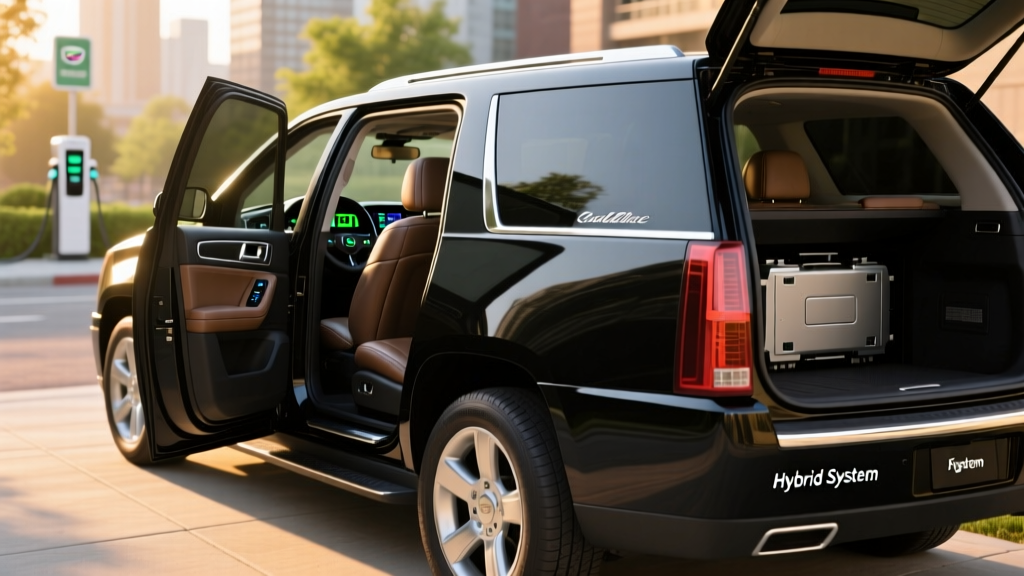
The 2010 Cadillac Escalade Hybrid was GM's ambitious attempt to make a 5,800-pound luxury SUV sip fuel like a midsize sedan. Built on the GMT900 platform and powered by GM's innovative 2-Mode hybrid system, it promised 21 MPG combined — nearly double the standard Escalade's thirst. But more than 15 years later, prospective used buyers need to weigh those fuel savings against aging battery packs, discontinued parts, and a new generation of electrified SUVs. Here's the data-driven breakdown you need before signing the check.
What Exactly Is the 2010 Escalade Hybrid?
The 2010 Escalade Hybrid is a conventional hybrid (HEV), not a plug-in hybrid (PHEV). This distinction matters enormously. Unlike a PHEV such as the Chrysler Pacifica Hybrid or Toyota RAV4 Prime, the Escalade Hybrid has no plug, no electric-only driving range, and no external charging capability. It recovers energy through regenerative braking and uses its gasoline engine to generate electricity on the fly — just like a Toyota Prius, only scaled up to a full-size luxury SUV.
HEV vs PHEV — Where the Escalade Hybrid Fits
| Feature | 2010 Escalade Hybrid (HEV) | Modern PHEV (e.g., Jeep Grand Cherokee 4xe) |
|---|---|---|
| Plug-in charging | No — never plugs in | Yes — Level 1/2 AC charging |
| Electric-only range | 0 miles (motor assists only) | 25–40 miles typical |
| Battery size | ~1.8 kWh (NiMH, small) | 14–20 kWh (Li-ion, large) |
| Federal tax credit | None (expired) | Up to $3,750–$7,500 if eligible |
| Fuel savings mechanism | Engine shut-off, regen, electric assist | Electric-only driving + hybrid mode |
GM's 2-Mode hybrid system, co-developed with BMW and Daimler (then Chrysler), was genuinely sophisticated for its era. It used two electric motors inside a specially designed transmission (the 2MT70) paired with a 6.0L Vortec V8 engine featuring Active Fuel Management (cylinder deactivation). The system could shut off the engine entirely at low speeds, run on electric motors alone up to about 25 mph under light load, and seamlessly blend gas and electric power during acceleration.
Fuel Economy: EPA Numbers and Real-World MPG
According to EPA data on fueleconomy.gov, the 2010 Cadillac Escalade Hybrid carries the following ratings:
| Metric | Escalade Hybrid (2WD) | Escalade Hybrid (4WD) | Standard Escalade (2010, 2WD) |
|---|---|---|---|
| City MPG | 21 | 20 | 14 |
| Highway MPG | 22 | 21 | 18 |
| Combined MPG | 21 | 20 | 15 |
| Annual Fuel Cost (est.) | ~$3,050 | ~$3,200 | ~$4,250 |
Real-world expectations: Hybrid SUVs typically match or slightly exceed their EPA city rating because stop-and-go driving maximizes regenerative braking and engine shut-off events. Owners on fuel-tracking platforms like Fuelly commonly report 19–22 MPG combined in mixed driving. However, highway-heavy commutes at 75+ mph tend to drop figures to 18–19 MPG, as the aerodynamic drag of a boxy SUV overwhelms the hybrid system's advantages. Towing — rated at 5,800 lbs for the hybrid versus 7,700 lbs for the standard model — will push fuel economy into the mid-teens.
The bottom line: compared to the standard 2010 Escalade's 15 MPG combined, the hybrid saves roughly 150–180 gallons of fuel per year (assuming 15,000 miles driven). At $3.40/gallon, that's approximately $510–$612 in annual savings — meaningful, but it takes years to recoup the hybrid's original price premium on the used market.
Powertrain and Performance Specs
| Specification | 2010 Escalade Hybrid |
|---|---|
| Engine | 6.0L Vortec V8 (VVT + Active Fuel Management) |
| Engine output | 332 hp @ 5,100 rpm / 367 lb-ft @ 4,100 rpm |
| Electric motors | Two AC motors inside 2MT70 transmission |
| Combined system horsepower | 379 hp (net) |
| Transmission | Electrically Variable Transmission (EVT), 2-Mode |
| Hybrid battery | ~1.8 kWh, Nickel-Metal Hydride (NiMH), 300V nominal |
| 0–60 mph | ~7.8 seconds |
| Curb weight | ~5,841 lbs (2WD) |
| Towing capacity | 5,800 lbs (2WD) / 5,600 lbs (4WD) |
| Drivetrain | RWD (2WD) or AWD (4WD) |
The 2-Mode system's brilliance was its ability to operate in two distinct modes: one optimized for low-speed, light-load driving (where one electric motor could propel the vehicle alone) and a second for highway speeds (where the system acted more like a traditional parallel hybrid). This dual-mode approach avoided the "rubber band" feeling of early single-mode hybrids like the first-gen Prius, delivering more linear acceleration.
That said, 379 net horsepower moving nearly 6,000 pounds means acceleration is adequate, not thrilling. The standard 6.2L V8 Escalade (403 hp) feels noticeably quicker, hitting 60 mph in about 6.5 seconds. If performance matters, the hybrid trades some urgency for efficiency.
Hybrid Battery Lifespan, Warranty, and Replacement Cost
⚠ Battery Age Alert for Used Buyers
The original hybrid battery warranty on the 2010 Escalade Hybrid was 8 years / 100,000 miles (covering defects and capacity loss below a threshold). As of 2026, every surviving example is well beyond that warranty window. Any battery failure is an out-of-pocket expense.
How long does the NiMH battery last? GM's 2-Mode NiMH packs have proven reasonably durable, with many units lasting 120,000–180,000 miles before significant degradation. Unlike the lithium-ion packs in modern EVs and PHEVs, NiMH chemistry degrades more gradually — you'll notice reduced fuel economy and less electric assist before a complete failure. That said, a 2010 model is now 16 years old, and calendar aging degrades NiMH cells regardless of mileage.
Replacement costs: A remanufactured hybrid battery pack for the 2010 Escalade Hybrid typically runs $2,500–$4,000 including installation at an independent hybrid specialist. GM dealerships historically quoted $5,000–$7,000+ for a new OEM pack, though new OEM availability has become limited as the platform ages. Third-party suppliers like GreenTech Automotive and Bumble Bee Batteries have offered compatible remanufactured units.
Signs of battery trouble: Watch for a noticeable drop in fuel economy (falling below 17 MPG combined), the "Check Hybrid System" warning, reduced regenerative braking feel, or the engine running continuously even at low speeds. A pre-purchase scan with an OBD-II hybrid-capable tool can reveal individual cell voltage imbalances before they become failures.
Pricing, Value, and Tax Credit Eligibility
When new, the 2010 Escalade Hybrid carried an MSRP of approximately $73,850 (2WD) to $76,550 (4WD) — a roughly $10,000 premium over the standard Escalade. That original price included a federal tax credit of up to $2,200 that was available at the time, though this credit has long since expired.
2026 used market pricing: Expect to find 2010 Escalade Hybrid examples in the $8,000–$16,000 range depending on mileage, condition, and battery health. Clean, low-mileage examples (under 90,000 miles) with documented battery health command the top of that range. High-mileage examples or those with unknown battery status often sell for $8,000–$11,000.
Federal Tax Credit Status
The 2010 Escalade Hybrid does not qualify for any current federal tax credit. The original IRS §30D hybrid credit that applied to this vehicle expired years ago, and GM's credit allocation was exhausted. Current IRS §30D rules apply only to new clean vehicles meeting battery sourcing, MSRP caps, and buyer income requirements. The used EV credit (§25E, up to $4,000) applies only to battery electric and fuel cell vehicles under $25,000 from a dealer — conventional hybrids are excluded. Check with a tax professional for your specific situation.
Reliability and Common Issues
The 2010 Escalade Hybrid's reliability record is a mixed bag, reflecting both the robustness of GM's truck platform and the complexity of a first-generation luxury hybrid system.
Known problem areas:
- 2-Mode transmission: The EVT is complex, and failures are costly ($3,000–$5,000 to rebuild or replace). Fortunately, widespread failures have been uncommon, but high-mileage examples are at increased risk.
- Active Fuel Management (AFM): The cylinder-deactivation system on the 6.0L V8 is known for lifter failures in GM's Vortec engines. Symptoms include ticking noises, misfires, and check-engine lights. Repair can exceed $2,000.
- Hybrid battery cooling: The NiMH pack has a dedicated cooling system. Blocked vents or failed cooling fans can accelerate battery degradation. Ensure the battery cooling duct (typically located behind the third-row seat area) is unobstructed.
- Standard Escalade issues: Power door lock actuators, dashboard cracking, HVAC blend door failures, and transmission cooler line leaks affect hybrid and non-hybrid models alike.
- Brake system: The regenerative braking system uses an electro-hydraulic unit that can be expensive to replace ($1,500–$2,500). Listen for unusual grinding or a hard pedal feel during test drives.
On the positive side, the 6.0L Vortec V8 (LFA/LC9 variant) is a proven, durable engine when maintained, and the hybrid system's regenerative braking actually extends the life of brake pads and rotors. Many owners report original brakes lasting 80,000+ miles.
2010 Escalade Hybrid vs Modern Alternatives
If you're cross-shopping the 2010 Escalade Hybrid, here's how it stacks up against both its era's competitors and modern electrified SUVs:
| Vehicle | Type | Combined MPG | Electric Range | 2026 Used Price (est.) |
|---|---|---|---|---|
| 2010 Cadillac Escalade Hybrid | HEV | 20–21 MPG | 0 mi | $8K–$16K |
| 2010 Lexus RX 450h | HEV | 30 MPG | 0 mi | $10K–$16K |
| 2024 Chrysler Pacifica Hybrid | PHEV | 82 MPGe / 30 MPG gas | 32 mi | $30K–$40K |
| 2025 Jeep Grand Cherokee 4xe | PHEV | 56 MPGe / 23 MPG gas | 26 mi | $38K–$50K |
| 2025 Cadillac Escalade IQ | BEV | ~89 MPGe (est.) | ~460 mi | $130K+ (new) |
The 2010 Escalade Hybrid's main advantage today is its combination of full-size SUV utility (8-passenger seating, genuine towing capability, commanding ride height) at a bargain price point. The Lexus RX 450h is far more efficient but much smaller. Modern PHEVs offer electric-only commuting but cost significantly more. The all-electric Escalade IQ delivers transformative efficiency and performance but at a tenfold price increase.
Decision Framework: Is the 2010 Escalade Hybrid Right for You?
Choose the 2010 Escalade Hybrid if:
- You need a full-size, 8-passenger SUV with towing capability on a tight budget
- Your driving is mostly city/suburban where the hybrid system maximizes MPG gains
- You have access to a trusted independent mechanic familiar with GM hybrid systems
- You're comfortable with potential $3,000–$5,000 hybrid repair risk and can self-insure
Look elsewhere if:
- You want electric-only commuting (consider a PHEV like the Pacifica Hybrid)
- You need a warranty-backed vehicle (all 2010 examples are sold as-is)
- You drive mostly highway miles — the hybrid advantage shrinks significantly at sustained speeds
- You want modern safety tech (blind-spot monitoring, automatic emergency braking) — the 2010 Escalade lacks these features
Pros and Cons at a Glance
✓ Pros
- ~40% better fuel economy than standard Escalade
- Genuine 8-passenger seating and cargo space
- Smooth, quiet electric assist at low speeds
- Regenerative braking extends pad/rotor life
- Low used-market entry price ($8K–$16K)
- Strong V8 power when needed (379 hp net)
✗ Cons
- All examples are out of factory warranty
- Hybrid battery replacement risk ($2,500–$4,000)
- Complex EVT transmission is costly to repair
- No electric-only driving capability
- Dated interior tech and safety features
- Reduced towing vs standard Escalade (5,800 vs 7,700 lbs)
- AFM lifter failure risk on 6.0L V8
Frequently Asked Questions
How many MPG does the 2010 Escalade Hybrid get in real driving?
The EPA rates it at 21 city / 22 highway / 21 combined (2WD). Real-world owners typically report 19–22 MPG in mixed driving, with city-heavy routes yielding the best results (up to 23 MPG in stop-and-go traffic) and sustained highway driving at 75+ mph dropping to 17–19 MPG. Towing drops it to the mid-teens.
Does the 2010 Escalade Hybrid need to be plugged in?
No. This is a conventional hybrid (HEV), not a plug-in hybrid. It charges its small NiMH battery entirely through regenerative braking and the gasoline engine. There is no plug, no charging port, and no electric-only driving range.
Is the hybrid battery still covered under warranty?
No. The original 8-year/100,000-mile hybrid battery warranty expired no later than 2018 for any 2010 model. All battery repairs or replacements are the owner's responsibility. Budget $2,500–$4,000 for a remanufactured replacement if needed.
Does the 2010 Escalade Hybrid qualify for any tax credit in 2026?
No. The original federal hybrid tax credit for this vehicle expired years ago. Current IRS §30D credits apply only to new qualifying clean vehicles. The used EV credit (§25E) does not cover conventional hybrids — only battery electric and fuel cell vehicles. Consult a tax professional for your specific situation.
Is the 2010 Escalade Hybrid reliable?
It's moderate. The 6.0L V8 engine and chassis are proven GM truck components, but the 2-Mode hybrid transmission, NiMH battery, and AFM cylinder deactivation system add complexity and potential repair costs. Pre-purchase inspection by a hybrid-qualified mechanic is strongly recommended. Check hybrid battery cell voltages via OBD-II scan before buying.
How does the Escalade Hybrid compare to a modern PHEV SUV?
A modern PHEV like the Jeep Grand Cherokee 4xe offers 26 miles of electric-only range, modern safety tech, and a factory warranty — but costs $38,000+ used. The Escalade Hybrid costs a fraction of that and offers more interior space, but lacks plug-in capability, modern features, and any remaining warranty protection.
What should I check before buying a used 2010 Escalade Hybrid?
Priority inspections: (1) hybrid battery health via OBD-II scan — check for cell voltage imbalance; (2) transmission operation — smooth mode transitions, no shuddering; (3) regenerative braking feel — should be progressive, not grabby; (4) AFM operation — listen for ticking or misfires indicating lifter wear; (5) battery cooling duct — must be clear and unobstructed. Also verify the hybrid system warning light illuminates at key-on and extinguishes at start.
The Verdict: A Budget Full-Size Hybrid With Caveats
The 2010 Cadillac Escalade Hybrid occupies a narrow niche in 2026: it's the cheapest way to get a full-size, three-row luxury SUV with meaningfully improved fuel economy. For buyers who need the space, can tolerate the repair risk, and drive in conditions where the hybrid system shines (city and suburban), it remains a rational used purchase. But go in with eyes open — the battery and transmission are aging, the warranty is long gone, and a $3,000–$5,000 repair fund should be part of your budget from day one.
If your budget allows $30,000+, a newer PHEV minivan or midsize SUV will deliver electric-only commuting, modern safety tech, and remaining warranty coverage. If you want a full-size electric SUV, the Cadillac Escalade IQ exists — at roughly ten times the price. The 2010 Escalade Hybrid is a bridge solution: yesterday's efficiency technology at today's bargain prices.